Finding your voice

One of the most important things a writer has to do is find their voice. That’s what’s going to make your work stand out among all the other writers out there.

I remember when I was a freshman in college, taking an English course, and submitted a story I had written for an assignment. “Hm,” the professor said, glaring at me over her glasses, “I see you’ve been reading a lot of Kurt Vonnegut lately.”

Hey, I was young, but her comments did hit me. I was copying someone else’s voice in my story—a very identifiable voice at that. I hadn’t yet found my own voice—my own unique way to tell a story.

So it goes.

That’s what really makes the best fiction enjoyable. It’s the person telling it that makes the difference; it’s why two people could witness the same event and one could relay it to you in a way that captures your attention and another puts you to sleep. It’s why two people could tell the same joke and one gets tremendous laughter and the other silence.

That only comes with practice with your own personality showing through, and I’m not sure if that is a skill that can be taught. But you need to keep that in the back of your mind as you write. If you’re trying to copy someone else’s style, you’ll fail and readers will realize it.

Your voice is a combination of your experience, your word choices, your way of looking at the world, your sense of humor or tragedy … it’s you. It’s what makes you unique, and that should come across in your writing.

So how do you find your own voice? One technique I’ve heard used is to literally try to copy someone else’s work. After a while, you get sick of it and you’ll find that your own voice will try to take over, and that’s a good thing. I’m not sure if that would work for everyone, but if that’s what it takes to break your real voice out, more power to you.

Honestly, I think the only real way to is to just write write write (as I’ve been saying all along on this blog) and eventually your natural voice will come out, as the words flow. Find a way to make your work read like you and only you.

I interviewed Nancy Springer a while ago, and she made a comment I think is very relevant. (In case you don’t recognize the name, she’s the author of many successful books, and her “Enola Holmes” series was made into films.) She said, “Students are usually anxious to ‘find their voice.’ I tell them that voice is just personality on paper. I tell them to let their personality flow out of their head, down their arms, and out through their fingers, onto the paper – or, I guess, the keypad? Anyway, some are able to do this, so they could become terrific writers, right? Nope. Sometimes students who have really and truly found their voice are just plain dull, because that’s the way they are, personally. But if a writer doesn’t find their voice, then how can readers relate? So, no, I don’t think everyone can become a good writer.”

I am not sure how to fix the problem of some people just being “dull”—but if you think that is your problem, shake it up. Do something unusual. Break your preconceived notions, have your characters do outrageous things, pretend you are possessed and write like you never would have before, and maybe the final result will surprise you and your inner voice will shine through.

My 2025 Philcon Schedule

It’s time for Philcon, Philadelphia’s oldest literary convention. It’s in New Jersey.  (Look, it was cheaper, okay?)

I’ve been a guest at Philcon for years, and it’s always great to go back there and see so many of my friends. This year’s event will be on the weekend of November 21-23.

If I’m not on a panel, you’ll probably find me at the Fantastic Books table in the Dealer’s Room.

Reading (Friday 7 pm): I plan on reading my short story “Horseman, Horseman, Horseman and Horseman, Attorneys at Law”. With Anna Kashina and Robert J. Sawyer.

Opening Ceremonies & Meet The Pros (Friday 8 pm): A great time to meet all the guests!

Meet the Editors (Saturday 11 am): Magazine and small press editors discuss what goes into creating their publications, from the economics of staying viable in the electronic age to getting appropriate submissions. With Neil Clarke, Ef Deal, Ty Drago, and Bjorn Hasseler. (I’m the moderator)

Ninja, Pirate, Monkey, Robot (Saturday 1 pm): Four panelists are assigned character archetypes and presented with questions about how they’d handle different situations in an hilarious competition of wit, humor, and knowledge. The audience decides who wins for the year based on the ingenuity – and humor- of their responses. Moderated by the most-winningest pair, D and Deli, formerly known as The Pax Twins!  With Tobias F Cabral, Melody Cryptid, Shara Donohue, Odele Pax, and Hildy Silverman.

How do I get Publishers to Notice Me? (Saturday 3 pm): How do you stand out when EVERYBODY is trying to stand out? How much does having a literary agent actually help with the process? What things should you absolutely NEVER do, unless your intent is to alienate yourself from the world of professional publishing? With Neil Clarke, Aaron Rosenberg, and Ian Randal Strock. (I’m the moderator)

Soft vs. Hard Magic Systems (Saturday 7 pm): Both systems have pros and cons, from the infinite possibilities of soft magic systems like in Lord of the Rings, to the repeatable and calculated success of the Mistborn series. Join our panelists as they break down how to decide what works best for your story. With Danielle Ackley-McPhail, Harry “Jack” Heckel, and Storm Humbert.

Assembling an Anthology (Sunday 11 am): Anthologies are typically organized around a theme that ties together stories written by different authors, and requires a different approach than writing a novel or putting together a collection of your own short fiction. What unique challenges do anthology editors face, and how do they conquer them? With Danielle Ackley-McPhail, Neil Clarke, Alex Shvartsman, and Ian Randal Strock. (I’m the moderator)

(From a previous Philcon!)

Using AI to write your story

Don’t. Dear whatever god(s) you believe in—just don’t.

Artificial intelligence can do some good things, but being creative isn’t one of them. If you use AI to write your story, you’re stealing other people’s creativity, and you’re not going to get a very good result.

And editors can tell. It’s not well-written. It’s full of cliches, has no original ideas, and there’s no poetry in the words.

Is that what you want? Predictability? No surprises in your work? Something so basic that even a computer could write it in your sleep? Publishing that would make you proud of your accomplishment?

AI can be useful for research, and, let’s face it, it’s not going away. It’s going to get better and more reliable—but we’re not there yet. Remember, all AI does is grab stuff from the internet, and the internet is full of crap. AI doesn’t know if something is “fake news” but hey, it may help you get started in your research as long as you realize what it gives you may be completely wrong.

(As an aside, I gave Google’s AI the prompt “Why you should not use AI to write your stories” and here’s what I got: “Unlike you—an author—AI won’t produce an original idea, a compelling plot twist, or a unique structure. If you rely on AI to write your book—or significant portions of it—that content will likely be predictable, generic, and, frankly, boring.” I agree with that predictable, generic, and frankly boring response.)

AI is based on statistics, not creativity. It predicts what the next most likely word will be (like your phone predicts your texts) and carries that to the extreme, where it can predict what the most likely plotline will be.

Sadly, some people think that AI is an easy way to get rich quick. You pop in an idea, and the computer spits out a story for you that you can self-publish (because no legitimate publisher will take it) and soon, people will buy it! How easy! The people who do that have no desire to be writers—they just think it’s a way to make money.

And then the stuff doesn’t sell, because it’s crap. Oh, it may make a few dollars, but no one is going on lavish vacations with the money earned from AI stories.

So what about using it as a tool, as a way to figure out a plotline? Once more, you’re relying on a system that has no creativity of its own. All it can do is steal the creativity of others. It might give you an idea for resolving a plotline that has been done a hundred times before, and even if you don’t recognize where the idea came from, some reader somewhere will.

I like to talk about stuff I’m writing with creative people and not robots, because sometimes, by talking it out, I can figure out a major plot point or otherwise work out a problem I was having with the story. Talking to boring people doesn’t help me at all. Talking to people who have no creative spark won’t give me what I need. And AI has no creative spark.

A lot of what editors find in AI submissions are stories that don’t make sense. The AI doesn’t know right from wrong, it doesn’t know what works, it doesn’t understand pacing and foreshadowing and the techniques writers use to make the story come alive. It just spits out stuff based on what it steals on the internet, and like AI artwork, sometimes it has too many fingers. Neil Clarke, award-winning editor of Clarkesworld magazine, says it this way: “AI can’t do subtext. It does very flat stories. Sometimes it will miss a plot point. It will hop over something that would be obvious, but it doesn’t know, because it doesn’t know anything.”

Is it possible that you might submit a story and have the editor reject it because the editor thinks it’s an AI story when it really isn’t? Sure, that’s happened. But what does that tell you? It tells you that your story is predictable, boring, and unimaginative, like an AI story. Keep working at it. You’ll get better. 

It all boils down to what someone said about AI: “Why should I spend time reading a story no one has spent time writing?”

The Lies We Tell Others!

Lies.

We all tell them–sometimes to keep the peace, other times to stir the pot, occasionally to save face, or just for fun.

In this anthology, co-editor Sahar Abdulaziz and I got members of our local writing group (the Pocono Liars Club) to submit a playful mix of stories where truth takes a back seat and deception takes center stage. From harmless fibs to outrageous whoppers, these tales demonstrate that sometimes lying is an art… and sometimes it’s a disaster waiting to happen.

We then invited a few authors who had spoken to our group before to submit stories as well, so you’ll also read stories from Randee Dawn, Keith R.A. DeCandido, Gregory Frost, Teel James Glenn, Jon McGoran, Alex Shvartsman, Hildy Silverman, and Ian Randal Strock.

Liars Club contributors are Sahar Abdulaziz, John H. Abel, Angel Ackerman, Derek Beebe, Roseann McGrath Brooks, Michael P. Doherty, Heidi Donohue, P.A. Dutchman, Gabrielle Ferrara, Kieran Ferrara, Belinda M. Gordon, Ralph Hieb, Evelyn Infante, Kelly Jensen, Susan Moore Jordan, Michael Karpe, Tristan Robert Lange, Mary Anne Moore, M.C. Ryder, and me!

Go on–get the book. We promise you’ll love it.

(Would we lie to you?)

Order your copy here!

Free Writers Workshop

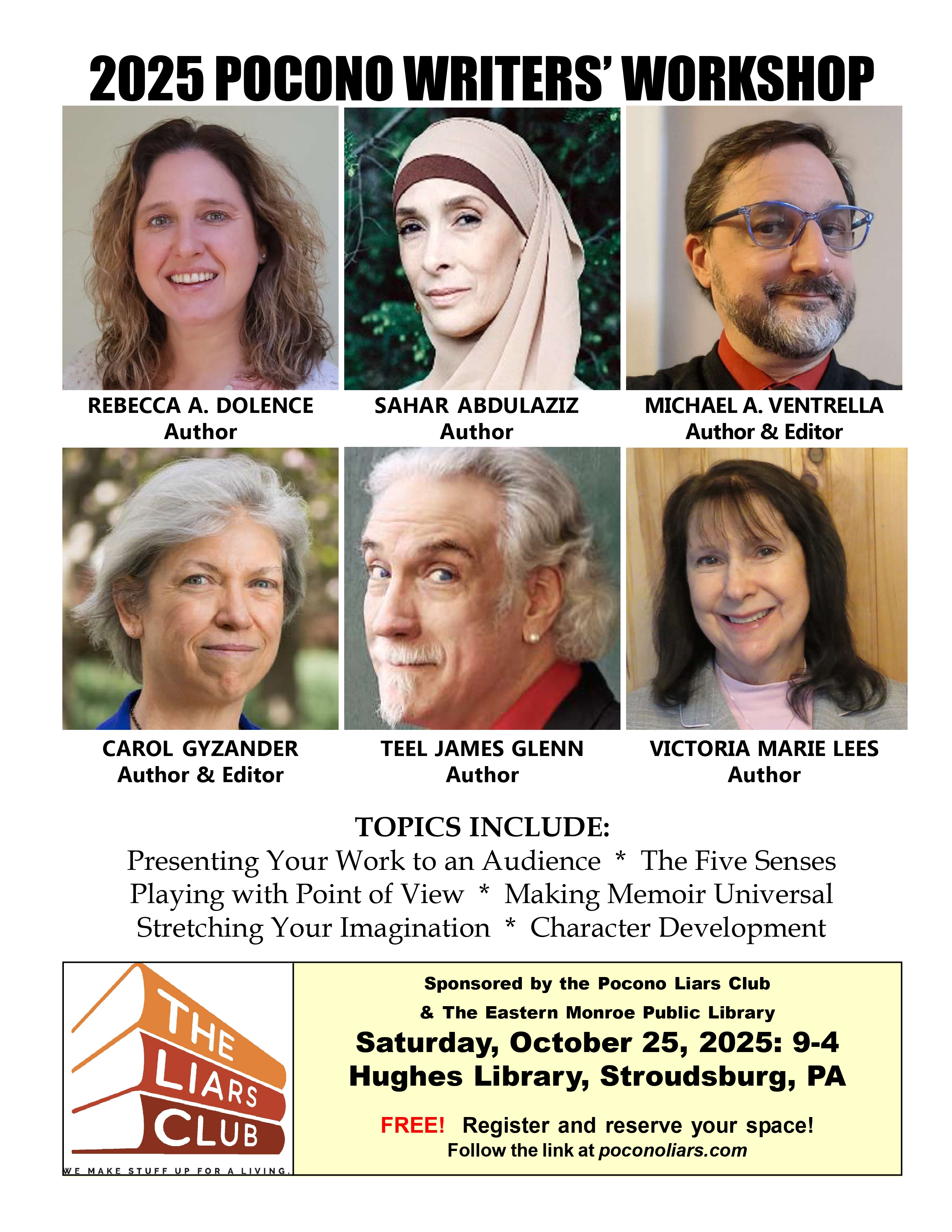
The Pocono Liars Club is sponsoring another free writers workshop in a few weeks. Click here to read up on the details!

My Capclave 2025 Schedule

Next weekend (September 19 – 21), I will once more be a guest at the Capclave convention in the DC suburbs. Capclave is a fun convention whose motto is “where reading isn’t extinct”! It’s a great way to meet authors, listen to readings, attend panels, and hang out at the bar until 3 am. When I’m not on a panel, you’ll probably find me at the Fantastic Books table in the dealer’s room.

Anyway, here’s my panel schedule.

Superheroes Versus the Law (Friday 6 pm): In what ways do superheroes like Batman, Superman, Spiderman, and Daredevil break the law? How can they change their normal operations to become more legal? Our panel of lawyers and informed civilians will discuss the legal ramifications of super-vigilantes and what advice they would give them.  With fellow panelists Catherine Green, Sherin Nicole, and Zack Be.

The Eye of Argon (Friday 10pm): The reading of the worst story ever written (and for which I edited a sequel!) With fellow panelists Ide Hennessey, Ian Randal Strock, and Jean Marie Ward.

Common SF/Fantasy Tropes (Friday 9 pm): Authors often use tropes as shorthand to push the plot forward. But when overused, they can make a story feel too predictable. Should writers avoid tropes entirely, or can authors strike a balance between creativity and genre expectations? Which tropes are overused, and what are examples of beneficial tropes in current novels, short stories, films or TV? How can (or should) writers free a story from tropes and create more complex and original works? With fellow panelists Doc Coleman, Morgan Hazelwood, Charles Oberndorf, and Joshua Benjamin Palmatier.

The Role of Editors (Saturday 2 pm): Editors tell all. What do editors do and why are they necessary?  How do different editors approach editing and how hands-on can (or should) they get? What are the best practices for editors and how do short story editors differ from book editors? What are editors looking for? How can a writer get the best possible editing? Writers and editors share their experiences with the editing process. With fellow panelists Scott H. Andrews, Michael J. DeLuca, Mike McPhail, and Wendy Delmater Thies.

Michael A. Ventrella Reading (Sunday 10 am): I am still deciding what to read so come in and be surprised.

Small Press, Self-Publishing or Big Press (Sunday 12 noon): Authors have options for their publisher — small press, self-publishing, or big press. What are the advantages and drawbacks of each method? How can an author choose which to try? How can a new writer get started with each? With fellow panelists Shahid Mahmud, Mike McPhail, Ian Randal Strock, and Nathan W. Toronto.

2025 Milford Readers and Writers Festival

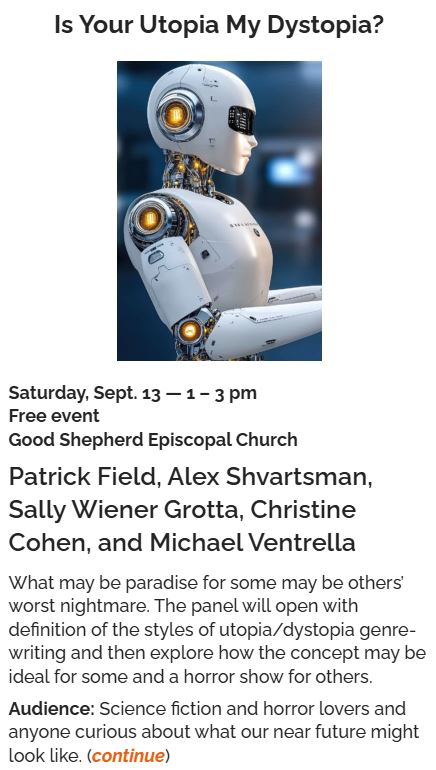
I’ve been honored to be asked to participate in this year’s Readers and Writers Festival in Milford, Pennsylvania the weekend of September 12th.

I’ll be hosting a panel called “Is Your Utopia My Dystopia?” and I’ve been preparing for it by paying attention to the Trump administration. No! Sorry! By reading about dystopian novels.

Anyway, I hope to see some of you there! Click the link above for details.

Interview with author Sahar Abdulaziz

MICHAEL A. VENTRELLA: I’m pleased today to be interviewing my good friend Sahar Abdulaziz!

Suspense writer Sahar Abdulaziz is the author of seventeen books–including BUT YOU LOOK JUST FINE, THE BROKEN HALF, TIGHT ROPE, EXPENDABLE, UNLIKELY FRIENDS, ASHES, WHO KILLED GARY? and others. She specializes in writing psychological thrillers, suspenseful narratives, thought-provoking social commentary, and clever satire. However, there’s nothing that Sahar enjoys more than exercising her demonic proclivity for crafting intricate, multifaceted protagonists confronting formidable challenges. The more dysfunctional, the better.

Let’s start by talking about your latest book, WHO KILLED KAREN? Tell us about the plot!

SAHAR ABDULAZIZ: WHO KILLED KAREN? is the second razor-sharp mystery in my Saber Squad series, where Grandville Luxury Apartments gains a new tenant—and another dead body. Kay W. Smith, a vicious book reviewer with a talent for tearing down even the best writers, has made more enemies than friends online and off. When her relentless critiques turn deadly, the quirky and loveable Saber Squad must jump in to unravel the mystery of her death before the killer strikes again. After all, karma doesn’t forget, and apparently, it’s got a hit list.

VENTRELLA: This is the second book in your “Saber Squad” series. How many do you think you will do?

ABDULAZIZ: Three books: Book 1: WHO KILLED GARY? Book 2: WHO KILLED KAREN? and Book 3: WHO KILLED KEVIN? I’m currently writing the third book, plotting yet another murder in Grandville while gently bringing closure to the series. 

VENTRELLA: Tell us how you chose the names for your dearly departed characters.

ABDULAZIZ: As you know, the online world and its memes made the names ‘Karen,’ ‘Gary,’ and ‘Kevin’ infamous. Being “a Karen” is often depicted as a specific type of personality that exhibits privileged behavior at the expense of others, typically targeting those who are minding their own business and simply trying to coexist in peace. However, the muse for my fictional Gary came from an honest, real Gary who, like his Karen counterparts, lived to make others’ lives miserable. This particular ‘Gary’ was predictably annoying, entitled, arrogant, a rule enforcer, but also the biggest rule breaker. He was a know-it-all who knew little, but wouldn’t hesitate to harass, hassle, report, or lecture anyone they felt had ‘broken the rules.’ This ‘Gary’ also made the time to report individuals, call the police, and write lengthy diatribes on the apartment complex’s website, outlining said infraction almost with psychotic glee. It was truly something to behold..

One day, after reading pages and pages of Gary’s lengthy carping posts about so-called tenant infringements—posts that included bylaws, local codes, quotes, and Bible passages that did not exist. He made them up. Full disclosure, I was sent these pages from someone, one of Gary’s many victims, who thought I’d find his musings hysterical, which I did. And that, I’m afraid, tells you all you need to know about my warped sense of humor. Anyway, after finishing, through laughing tears and a bad case of hiccups, I thought to myself, “I’m surprised nobody’s killed this guy.”

Because, you see, the thing is, we all know a Gary, a Karen, or a Kevin, not in name, but in persona. They are people we encounter daily, whether at work, on the bus or train, waiting in line at the supermarket, buying a cup of coffee, or in my character’s case, a neighbor in the same building. They get in our face, pointing their fingers with righteous indignation, believing the world operates by their rules, and their rules alone.

Now, let’s be clear: I said this in jest. I’m a writer; we do that… more often than I should probably admit here. However, that fleeting thought, once spoken aloud, was enough to spark the entire premise of my first mystery novel—a story I decided should unfold in my imaginary apartment complex called The Grandville Luxury Apartments—a place where the walls are thin, secrets run deep, and karma always gets the last word. 

VENTRELLA: Given the serious nature of most of your previous work, what made you move in this direction?

ABDULAZIZ: Great question. I have written many fictional novels that tackle complex topics. For example, my book, THE BROKEN HALF, is a raw, unflinching story of resilience, survival, and the high cost of reclaiming one’s life. AS ONE DOOR CLOSES—the legacy of generational child abuse, the trials of survivorship, and the difficult path toward healing and closure. SECRETS THAT FIND US—the deadly cost of loyalty, betrayal, and secrets too powerful to stay hidden. TIGHT ROPE: resilience, activism, and the high cost of speaking out. EXPENDABLE: the hidden horrors of an abusive marriage, and the fierce strength and bravery it takes to break free. ASHES & DUST: betrayal, sorrow, corruption, power, and how to survive in a rigged system.

There are more, but you get my point—heavy, heavy stuff. The messy, painful stuff I refuse as a writer to shy away from addressing, despite how uncomfortable it may make others. I use fictional suspense and thriller stories to weave these topics into my writing because writing fiction provides me more freedom to reveal truths. I don’t write to sensationalize violence. I write to expose malevolent, often lethal behaviors in the hope of bringing to light what predators, abusers, liars, and manipulators wish to keep locked away and in the dark. I use my writing platform to shed light on matters that are often hidden, misrepresented, misunderstood, or worse—ignored.

With that said, and while I will always tackle challenging subjects, I needed a break, or what I call a “palette cleanser,” not for my taste buds but for my brain, where I store all these characters and their dysfunctional stories. I also wanted to try a different approach—still unpacking challenging issues, such as entitlement, bullying, grief, addiction, friendships, love lost and found, and others— but through humor, because laughter is disarming. It allows us to look at ourselves with clear eyes while having the power to transcend pain and replace tears with joy.

VENTRELLA: Your previous series was also more light-hearted with an unusual main character who appears unlikable at first. Could you tell us a bit about that series?

ABDULAZIZ: Ah, you mean The Abernathy & Crane series: UNLIKELY FRIENDS, DEVOTED FRIENDS, UNEXPECTED FRIENDS, and FOREVER FRIENDS. Four novels that celebrate found family, fierce friendships, and the beautifully messy art of holding on when it’s time to let go. It also offers a heartwarming and humorous look into life’s most unexpected connections, from curmudgeonly beginnings to courageous goodbyes and all the humanly chaotic, cherished moments in between. 

My main character is Irwin Abernathy. He’s an old-school librarian who prefers books to people, until a stubborn, free-spirited young girl crashes into his life and refuses to leave. Irwin despises change and wants solitude. Harper needs change and wants a friend. What follows is a charming, oddball friendship that proves even the most unlikely connections can change everything.

VENTRELLA: What did you do to make the reader identify with him?

ABDULAZIZ: Through honesty. I never rush or bypass the emotions my characters feel; instead, I pay tribute to them.

I portrayed Irwin, a man grieving and afraid to let anyone get close to him again for fear that they, too, will be taken away, as authentically and as organically as I could envision, warts and all. I also conveyed through Harper’s eyes and heart how she would see and understand him. Lastly, I tried to write each story about the human connection—loyalty, unlikely heroes, and the chaos of friendship in a perfectly imperfect world, with room enough to let my eccentric, hilariously funny characters take care of the rest.

VENTRELLA: How has your educational and professional background assisted in writing your books?  (Do you think, for instance, it has helped you in creating your characters’ emotional backstories?)

ABDULAZIZ: Absolutely. I hold a Bachelor’s in Psychology and Education, as well as a Master of Science degree in Health, Wellness, and Administration. I also worked for many years as a domestic violence and sexual assault counselor/advocate. I firmly believe that my education and past experiences working with diverse communities and individuals have shaped my writing. What a waste if they hadn’t. 

VENTRELLA: How have you found your publishers? And what advice might you have for new authors trying to get their book published?

ABDULAZIZ: Writing is my passion and career, while publishing is a business. With that said, I have met incredibly kind and thoughtful publishers whose love for books and commitment to producing a fabulous product is as strong as my appetite for writing for them.

I have also crossed paths with less desirable publishers and have made it a practice to steer clear of them.

I could bore your reading audience with a list of advice on what to do and not do when it comes to publishers. Still, the biggest takeaway I can share is this: Never underestimate the impact of your story but practice due diligence. Please don’t rush into publication with the first publisher willing to look at it. You worked hard to create that book, and finding a home for it that will cherish, promote, and protect your story is as important as seeing your name on the cover. Choose wisely. Pour yourself into your story, but always remember that publishing is not a favor, but a business. Make sound choices.

VENTRELLA: Do you think it’s important for writers to avoid controversial topics on social media?

ABDULAZIZ: When you say controversial, do you mean take a stand against things like oppression, racism, fascism, bigotry, sexism, book banning, and hate? Um, no. I don’t believe in avoidance. Avoidance is nothing more than comfortable cowardice. Pretending not to see doesn’t make the hate disappear. In fact, it provides room for growth and expansion, as we can see happening now.

Wasn’t it George Orwell who said, “The most effective way to destroy people is to deny and obliterate their own understanding of their history.”

History, based on fact rather than conjecture and outright lies, is a valuable lesson. If we as writers avoid controversy, calling out the oppression, then aren’t we colluding… and helping to create the very conduit to our collective self-destruction?

Fun fact: The written word is under attack. Truth is under siege. Writers are being targeted. Books are being banned. People are being ‘disappeared.’ How do we ignore that? How do we look the other way, pretending we don’t see?

So no… if you’re a writer, be a writer. Take a damn stand. Use your words for change, or stay quiet, move out of the way, and let the rest of us do our job.

VENTRELLA: How much of writing is innate? In other words, do you believe some people are born storytellers who just need to learn technique? Or can anyone become a good writer?

ABDULAZIZ: Writing is a skill, a craft that can be taught and practiced, which means there is always an opportunity for improvement.

For many, writing is also a calling. For natural storytellers, it’s a way to bring their story to life on paper.  Does that mean all storytellers are natural writers? No. However, all writers are natural storytellers, and the stories they write become increasingly adept the more they are willing to put in the effort to hone their craft.

To answer your question, most people, if they are willing to put in the work, can become good writers. However, there are those among us who are innately great writers, and they serve as inspiration and aspiration. 

VENTRELLA: Writers are told to “write what you know.”  What does this mean to you? 

ABDULAZIZ: Not much.

Because it’s disingenuous, it’s one of those catchphrases that confuse new writers until it becomes clear that it means writing about what you have felt and experienced, even if it’s secondhand through observation, and using those experiences to create layered and complex new worlds and characters. However, it also means being willing to seek out what you don’t know and learn through research and by asking the right people the right questions. 

For example, when writing my suspense/thrillers, I have incorporated many dark sociopathic personalities between my pages. To get inside their heads, I have had to do the legwork—hours of research, investigation, watching documentaries, asking questions of those who work in the field, and reading—lots and lots of reading.

Not knowing something doesn’t automatically prevent me from writing about it, but it does make me, as a writer, responsible for learning enough information about the sociopathic personality and how they navigate the world so I can accurately portray this personality disorder and their dysfunctional, malevolent behavior. 

The same can be said for every character I write. Irwin Abernathy in UNLIKELY FRIENDS is a librarian. I’ve never been a librarian. My character, Sydney Hanes, in ASHES & DUST is a vigilante. Nope—haven’t dabbled in that either. Terri Ann Stone in SECRETS THAT FIND US is dead. Last checked, I still have a pulse, so…

VENTRELLA: What makes your fiction unique? In other words, what is it about your stories that makes them stand out against all the other similar stories out there?

ABDULAZIZ: I want to think it’s me. That I make my fictional stories unique because they are uniquely my stories to tell, and the characters of each different story have chosen me to be the catalyst of their telling. I feel this way for several reasons, but most importantly, because the characters in my books feel as real to me as living, breathing people do. They aren’t tropes; they are complex, multifaceted personalities with backstories, histories, dreams deferred, hopes crushed, loves lost, and promises broken. They are the people we meet, hope to meet, wish never to meet, or have met but didn’t appreciate, letting them slip away. They are those we fall in love with, lust with, love to hate, and hate to love. They are those we enjoyed, those we lost, and those we wish we had never known. They are the admired, the venerated, the distrusted, the feared. They are all of this and more, and the paper is their stage.

VENTRELLA: What is your writing process? 

ABDULAZIZ: I sit down and write. Some days I write a little. On other days, I write a lot. Some of it is good, but most of it sucks. Once in a while, I astonish myself with something great. At other times, I find myself staring at the computer screen, wondering if my time would be better spent watching someone else break in a new T-shirt. The bottom line is this: I show up. Not because there’s some unwritten rule that says I have to write every day to be successful, not because I’ll get into trouble if I don’t, not because of a deadline, but because I know that if I don’t invest in myself and my craft, who will?

VENTRELLA: Do you outline heavily or just jump right in, for instance?

ABDULAZIZ: I don’t write outlines. I have nothing against outlines; in truth, I think they are brilliant and would make my book writing go much smoother if I did. However, I can’t pull it off. I’ve tried everything—index cards, a board, notebooks, sticky notes, computer programs—you name it. No success. My creative brain doesn’t work that way. 

I am what is called a pantser. I jump in and write without knowing where I’m going, how I’ll get there, or who I might meet along the way. I keep the story, plot, and characters in my head, with little physical notes other than the occasional back of a napkin, an envelope, or a bill, where I jot down an idea I need to remind myself about. I also send myself text messages and emails.

I research as I write. I have been known to stop in the middle of a chapter and read a half-dozen novels about a topic to get the single sentence my character says right.

Naming my characters can take me weeks. If the name doesn’t feel right, I can’t ‘see’ them, and in order for me to write them, I need them to communicate with me. At other times, I know the name of the character before the title of the book. Go figure.

If I find I have written myself into a corner and don’t know where to take the plot, I empty the dishwasher. I fold laundry, bake bread, call a friend, or take a walk. I walk a lot because I seem to be attracted to corners.

If everything else fails, I contemplate the problem as I drift off to sleep, trusting that my subconscious will step in to provide the solution. It often does but I look like crap the next day…bags under the eyes, sallow skin—some scary stuff.

I highly do not recommend my manic writing methods. I do, however, strongly endorse finding what works for you and honoring it. There’s no right or wrong, as long as you show up for you.

VENTRELLA: What do you do to avoid “info dumps”?

ABDULAZIZ: I don’t find info dumps an issue when I write. Timelines are what drive me crazy.

However, when I need to convey information pertinent to the character, plot, or story, I interweave those facts with either the character’s actions, through the reflection of others watching, or shared conversations.

Dialogue is an excellent tool, as long as you don’t info dump in it. Don’t do that. It’s one thing for a character to list off a textbook of facts about a found dinosaur bone (boring, I have Google, too), and another for a character to lift it in the air, squinting and coming to the realization that in their hands they hold a rare find—one that will secure their position in the paleontology department at their university. It’s all in the delivery.

VENTRELLA: In this rapidly changing market, with the publishing industry evolving daily, how important is the small press?

ABDULAZIZ: Small presses serve as the first line of defense. They welcome writers overlooked by the magical gatekeepers of the Big 5. They are often willing to publish controversial books that no one else would dare to release. They are eager to introduce new ideas and take risks for the love of creativity, rather than solely for marketability. Yes, they are still in the business to make money, but they also provide a haven for many creatives whose books need a home.

VENTRELLA: Who do you like to read? 

ABDULAZIZ: I’m a huge reader of various genres. I prefer books with intricate plots, plenty of brilliant quirky characters, fearless prose, and well-paced dialogue.

I also enjoy reading non-fiction. I can dive into a novel about the history of pharmaceuticals like it’s nobody’s business, then read a cookbook, followed by a whodunit. As a kid, I read the backs of cereal boxes, comic books, and the Nancy Drew series. As a teen, I thought it was a good idea to do a book report on THE HAPPY HOOKER. And no, it turned out not to be a good idea.

VENTRELLA: Who are your favorite authors?

ABDULAZIZ: I enjoy the works of Agatha Christie, Sir Arthur Conan Doyle, Anthony Horowitz, Richard Osman, Octavia E. Butler, Matt Haig, Kirsten Miller, Erik Larson, Isabel Wilkerson, Fredrik Backman, Camille Pagán, and Malcolm Gladwell.

VENTRELLA: With a time machine and a universal translator, who would you invite to your ultimate dinner party?

ABDULAZIZ: Ha! Like I, of all people, would throw a dinner party!

Now, Michael, if you had asked me who I would have invited to an escape room on a deserted island with a killer on the loose, that’s easy!

Hercule Perot, Miss Marple, Elizabeth Best (From Richard Osman’s The Tuesday Murder Club), and Sherlock Holmes. Dr. Watson is also invited.

Interview with Kermit Woodall

MICHAEL A. VENTRELLA: I’m pleased to be interviewing Kermit Woodall today! I first met Kermit back in college, where we both worked at the college radio station, and now he works with Amazing Stories magazine. Kermit is an omni-competent individual who grew up in a former bawdy house before relocating to his state’s capital city. His family includes many talented artists and an uncle who founded a The Church of Bigfoot. He has a passion for storytelling often exploring new ways to engage audiences.

Tell us a bit about the history of this magazine.

KERMIT WOODALL: Amazing Stories was the first Science Fiction magazine in the world. It was founded, and later losted, by Hugo Gernsback. Hugo’s first name for our genre was “Scientifiction” but later he invented the term Science FIction as well. He was even was the first person to create a definition for what science fiction is.

“By “scientifiction” I mean the Jules Verne, H. G. Wells, and Edgar Allan Poe type of story – a charming romance intermingled with scientific fact and prophetic vision.”

VENTRELLA: How did you become involved with the magazine?

WOODALL: Quite simply I read about Steve Davidson, Amazing’s owner and driving force, acquiring the trademark on the website BoingBoing.net – I then asked my friend, the late Bud Webster, if he knew Steve. Bud did. We were introduced and started making plans together. Steve and I see Science Fiction in similar ways. We also have terrible sense of humor and inflict them without regard to human life.

VENTRELLA: What are your goals for Amazing Stories?

WOODALL: We want to support more Science Fiction. You might say, “Hard Science Fiction”, but we say our goals are to seek out and publish entertaining stories based on real science and logical extrapolations into the future. Towards that, we revived the magazine for a few years, but we ran out of money raised through a Kickstarter funding drive and the magazine went on hiatus. Ultimately the problem was lack of subscribers and advertisers. At that point we switched gears to publishing weekly short stories, and serialized novels, on our website (amazingstories.com) as the ad income there supported the stories. We also invested more time in working with authors like David Gerrold, Allen Steele, John Stith, David Brin, and more to publish their books under our Amazing Selects imprint. That’s going exceptionally well.

VENTRELLA: If I recall, there is some sort of legal dispute with Steven Spielberg over the use of Amazing Stories for his old TV show. Can you tell us about that?

WOODALL: There was a dispute relating to the Apple TV revival of that show It was settled to our satisfaction and I really shouldn’t say too much more about that. Feelings would be hurt, lawyers could get involved, and no one wants that.

VENTRELLA: Tell us about the anthology (which, I must disclose, does contain my story “Impersonating Jesus”).

WOODALL: Last year we published Amazing Stories: Best of 2023 and this year we did it again, but we decided that using the same name would be confusing, so we called it Amazing Stories: Best of 2024. It’s that last number/digit that prevents the confusion.

The books are collections of the best stories of the year from our website. Not only does this get our authors in a print format, but we pay them again for their stories! We just published Amazing Stories: Best of 2024 even as I answer your questions. Seriously. You can find it at Amazon and any of the other bookstores listed here.

VENTRELLA: Do you plan on doing that every year?

WOODALL: Wouldn’t you?

VENTRELLA: You’re clearly a fan of science fiction. Who do you like to read? Who are your favorite authors?

WOODALL: I lean strongly towards scientifically plausible stories. Unless it’s really funny. In no particular order here are the authors I rank the highest: Ron Goulart, R.A. Lafferty, Bruce Sterling, Robert A. Heinlein, Spider Robinson, Charles Sheffield, Isaac Asimov, Robert Sheckley, James Hogan, Allen Steele, Ray Bradbury, Theodore Sturgeon, Clifford Simak, Larry Niven (and Niven and Pournelle collaborations), Authur C. Clarke, Harry Harrison, John Varley, Vernor Vinge, David Brin, John Stith … And when it comes to fantasy there is only one. Terry Pratchett he wrote the best and most satiric fantasy ever! I’ve reread his Discworld books at least three times and will likely start again soon.

VENTRELLA: How much of writing is innate? In other words, do you believe there are just some people who are born storytellers but simply need to learn technique? Or can anyone become a good writer?

WOODALL: I think anyone can become a sort-of writer — but a good writer is a highly subjective thing though. Some people, through their upbringing and perhaps a creative environment, absorb a lot of good storyteller habits. So it seems to come more naturally to them, but I think they learned the craft nonetheless. It’s not innate in my opinion. I do think that through study and education you can learn how to write. However, if your imagination and creativity are lacking, your stories may not entertain.

VENTRELLA: What’s the best way to make the antagonist a believable character?

WOODALL: Make them not over the top evil but everyday evil. If you want the readers to really hate the antagonist, as others before me have pointed out, consider the Harry Potter series and Lord Voldemort vs Delores Umbridge. Voldemort is the personification of evil and power. Few of us know anyone that truly evil. But Umbridge is a more pedestrian incarnation of evil. I’ve had teachers who were unfair, even cruel, and most people I think have had similar. I even had a teacher in second grade who beat some of us (myself included) with a wooden paddle. (Yes, it was illegal and yes, she got fired and banned from teaching.)

If you’ve been watching politics for the last several years, then I’m sure you’ve realized that no amount of unbelievable behavior prevents you from being the bad guy.

VENTRELLA: Do you think readers want to read about “believable” characters or do they really want characters that are “larger than life” in some way?

WOODALL: I think they want someone they care about, that they can identify with, or “larger than life” who faces impossible odds. They want to root for them to win!

VENTRELLA: With a time machine and a universal translator, who would you invite to your ultimate dinner party?

WOODALL: Some of this is just the lack of funds to fly everyone to the same con so we can all have dinner and fun. In a few cases, time machines. Otherwise, just see my list of favorite authors above. Given only a one-time use time machine, then I’d go to England when Terry Pratchett was still alive and spend a day with him!

Writing groups are mostly worthless

Yeah, I know—many people will tell you that you should always find a writing group to help you with your work. That’s pretty standard advice.

Back when I had only one book out and was working on the second, I went to a writing group at a local Barnes & Nobles. Everyone gathered around and read from their works in progress, soliciting comments from the other writers. One fellow read his work and then people went around the room and said how much they hated it and how it would never be published in its current form. When it was my turn, I talked about how much I liked it, because it was really good. (What the people there didn’t know, but I did, was that the person reading the story was award-winning author Michael Flynn, who had numerous novels out already which you could get at that very same Barnes & Nobles. And I really did like what he had written; I wasn’t sucking up to him. Now, when he gave me comments about my story, I listened.)

The point is that a writing group is only as good as the people in it. If you write cozy mysteries and everyone in your writing group writes gothic horror, you’re probably not going to get very good feedback from them.

The mistake many authors make is in listening to the wrong people. You should pay attention to comments (especially from editors), but ultimately, it’s your story. Don’t let these people tell you what it should be.

For one of my novels, I asked for beta readers. I made sure these were people who had not only read my previous work but liked the genre. I uploaded a chapter a week or so and had them give comments. I’d ask them what they think would happen next, which allowed me to know if I had given away too much too early or if I had not given away enough. I asked what they thought certain characters would do. And sometimes they even had ideas better than my own. It was quite useful. (Also, it gave me deadlines to get the thing done, because I knew people were waiting to read the next chapter.)

But their advice and comments often contradicted each other. I had to decide which to pay attention to and which to ignore.

Too many new authors get comments and think they have to do what is suggested. No! You need to take into consideration who made the comment, what kind of story they like, what their experience is, and whether what they suggested is just bullshit you can ignore.

And that is why critique groups and writing groups can be bad.

Get a bunch of friends together and they won’t agree on what the best movies are, what’s best on a pizza, whose music is best—anything. That’s normal. That’s what you’ll get with any random sampling. We don’t all agree, and that’s what makes life interesting.

That’s not what you want.

No great literature has been written by committee. Have you ever watched the credits of an awful movie and notice there are twelve writers credited? With a committee, things get watered down so that everyone is willing to accept the compromise, but no one is thrilled about the final product. Well, you want a story people will be thrilled about! Don’t let the critics write the story for you.

If you can find the right people who will basically act as amateur developmental editors, giving you reasonable and productive criticism, then absolutely take advantage of it. But that is hard to come by, and I’ve seen too many authors go to critique groups and then try to take everyone’s advice and end up with a crappy end result.