Posted on September 9, 2024 by Michael A. Ventrella
I’ll be at Capclave near Washington DC the weekend of September 27. This is a reader-oriented convention for speculative fiction whose motto is “Where Reading is not Extinct!” The Guest of Honor this year is Matt Dinniman.
Here’s my schedule:
This One Time… (Friday 8 pm): It may not have been at band camp, but we are involved in stories our whole life. From a young age to the current day, something is almost always happening. Panelists tell brief funny stories from their life, career, and friends. With Morgan Hazelwood, Ian Randal Strock, and Jean Marie Ward.
Hold My Beer (Friday 10 pm): Just when you thought the world couldn’t get any stranger, this happened. A discussion of the current world. No topic off the table. Trigger Warning. With Danian Jerry, Jennifer R. Povey, Sheree Renée Thomas, and Jean Marie Ward.
Reading (Saturday 1 pm): I’ll be reading one of my stories! Out loud, so people can hear it.
Tribute to the Further Adventures of Grignr the Barbarian (Saturday 10 pm): Panelists and the audience read from “The Further Adventures of Grignr the Barbarian” without breaking up. Or not. Join the fun! With Sarah Avery, Morgan Hazelwood, Ian Randal Strock, Mary G. Thompson, and Jean Marie Ward.
So You Want to Be an Editor (Sunday 11 am): Well, it can be a lot of fun, but it isn’t for the fainthearted. You have to bring big vision, big heart, discipline, and helluva a lot of patience and time. Come with your questions and ideas for future projects (is there an anthology you’ve always wanted to read? A chapbook or chapbook series you’ve long wanted to create? A magazine or indie zine you’d love to edit with kindred spirits and friends?) If you can imagine you, you can create it. Let’s go! With Scott H. Andrews, Kel Coleman, Joshua Palmatier, and Sheree Renée Thomas.
Public Versus Private Faces (Sunday 12 noon): Time to put on the game face. That statement signals that a person needs to take on a public persona contrary to their private lives. How does one manage the difference? What do you do when you don’t want to be in public but the moment requires it? With Inge Heyer, Barbara Krasnoff, and L. Marie Wood
A while ago, I edited an anthology called “The Eye of Argon and the Further Adventures of Grignr the Barbarian” (details here) I just learned that an actual sequel was written by the original author! You can even buy it here!
I’ll be at the NASFIC convention this weekend (June 18-21) in Buffalo, along with some great guests (including Alan Dean Foster, Phil and Kaja Foglio, David Gerrold). When I’m not on panels or doing a reading or signing, you’ll probably find me at the Fantastic Books table in the dealer’s room.
Opening Ceremony (Thursday 6 pm): All the guests are introduced!
Are Traditional Conventions Dying? (Thursday 7 pm): Cons are having trouble attracting new fans. Coupled with the costs of hotel/program space, are were moving away from the traditional (non-comic con) model? What can be done to recover? Is hybrid the answer? withW. Randy Hoffman, Tony Lewis, and David Stephenson.
Science Fiction and Social Change (Friday 6 pm): Examining the Genre’s Role in Shaping the Future – Discuss the ways in which science fiction literature and media engage with social, political, and ethical issues, exploring how speculative narratives can inspire activism, empathy, and positive change in the real world. with Ed Buchan, Judy Johnson, Alexander Whitaker, and David L. Wayatt, Jr.
Writing Humor in SF (Friday 7 pm): What are the challenges? Is is still popular? with Christine Cohen, David Dvorkin, Vera Nazarian, Alex Shvartsman, and D. G. Valdron
Alternate History (Saturday 12 pm): Why is it so popular? What makes it work? Are there any rules you need to follow? with Bill Fawcett, Laura Anne Gilman, and Walter Hunt
Autographing (Saturday 2 pm): I’ll be at a table for autographing
Reading (Saturday 3:30): I’ll be doing a reading of one of my short stories
Eye of Argon Reading (Saturday 11 pm): A fannish tradition. Panelists and audience members will take turns reading, and TRY to keep a straight face. Good luck! with Daniel Kimmel, and Ian Randal Strock
MICHAEL A. VENTRELLA: I’m pleased to be interviewing my friend Caitlin Rozakis today! Marketer by day and writer by night, she has had short stories published in numerous magazines and anthologies, and her debut novel DREADFUL recently hit the New York Times bestseller list!
Your new book has been quite successful! That must give you a great feeling!
ROZAKIS: It’s extremely weird! I was honestly not expecting this to go so well, so hitting the New York Times Bestseller list was a bit of a shock. It’s pretty amazing, I have to admit. I was going upstate for a long weekend with my extended family, and figured I’d hit a couple of the Barnes & Nobles on the way up and sign copies. One had reached out to me the week before on Instagram asking for a signing… but the time I got there, they didn’t have any copies left at all. The other, which I chose completely randomly based on how close it was to our rental house, was immensely smug to have ordered an extra box. But they also hauled out the personal copies of all the employees who wanted signatures… and there were like 10 of them. They were so excited to meet me, which is very weird. I don’t actually know if this is a flash in the pan and I should just enjoy my month of fame, or something I should try to get used to, but I’m doing my best to enjoy the ride.
VENTRELLA: Tell us what it’s about!
ROZAKIS: DREADFUL is a fantasy farce featuring an evil wizard who loses his memory and has to fake his way along with his own evil plan. It’s about second chances, toxic masculinity, and moat squid.
VENTRELLA: How did you get it published?
ROZAKIS: I’d done the very standard querying thing and landed an agent, who circulated it to all the big U.S. publishers, none of whom were interested. My agent decided to make some changes for personal reasons and stopped agenting altogether. A junior agent at the agency was willing to take me on. I have to admit, I was nervous – but I shouldn’t have been. It was Sarah’s idea to submit to Titan, a mid-sized publisher in the UK I’d honestly never heard of and had to look up. At the time, I was kind of disappointed, but a deal is a deal, right?
Well, I had no idea how lucky I was. Titan is small but mighty, and their team decided to do a major marketing push for Dreadful that went so far beyond anything I’d ever dreamed of. They managed to land multiple book box deals, which are a huge impact for opening numbers these days. Even better, their US publicist managed to negotiate an amazing exclusive deal with Barnes & Noble that centered around Titan’s ability to do sprayed edges on paperbacks, which hasn’t been done in this country to my knowledge before. So Barnes & Noble got their own special edition, which lead to them picking it as their spec fic book of the month for June, which has led to much, much bigger sales numbers than I could have ever expected.
VENTRELLA: You’ve used a few different names for your books and stories. Why is that?
ROZAKIS: Marketing! Also, taking fifteen years to break in. So when I started, I just used my legal name, Rebecca Rozakis. I’ve got a bunch of short stories published under it. But I work in marketing, and started to generate a number of blog posts and whitepapers for my day job, which increasingly became an SEO issue. I tried switching to just R. Rozakis, but that made things worse; my father-in-law is the legendary DC writer/editor Bob Rozakis, and so people got confused if R. Rozakis was for Robert. Then in the middle of querying DREADFUL, I had a sudden brainstorm and popped out a Christmas romance novella which is so far off brand for me that I was worried that if agents and editors saw that was my first long work, they’d have trouble seeing me as a fantasy writer. So I self-published that under Catherine Beck. (And if I ever write more straight up romance, it will go under that pen name.)
When DREADFUL actually started looking like it might happen, I realized how big a branding mess my socials were. I made a list of potential pen names, figured out which one had the URL available, and then set up the whole Caitlin Rozakis brand – website, socials, and all. It does let me keep most of my personal stuff and author stuff separate, which is pretty convenient.
VENTRELLA: I first became aware of your work when I accepted a story from you for the Baker Street Irregular series. Tell us about that story! What was the inspiration for it?
ROZAKIS: The fun thing about Holmes is that at this point, he and Watson are basically archetypes. Which means you can do all the mixing and matching you want. In “Investigations Upon Taxonomy of Venomous Squamates,” I did a riff on the classic “The Spotted Band.” Only, Watson is actually a sentient AI and the snake in question is a bioengineered monstrosity. It’s fun to see where you can push the bounds, while still keeping enough of the shape that the reader can still recognize the source material. It’s even more fun to find ways to surprise them, when they know how the original turned out.
I have to admit, though, I have no idea where the idea came from. Sometimes I have origin stories behind the stories, but sometimes… it just sounded like fun?
VENTRELLA: We’ve both attended various conventions (and had lunch together!). I have to admit that I am getting frustrated by the fact that these are attracting less and less participants as the years go by. Do you find these useful, either for meeting readers or for networking?
ROZAKIS: Ooh, so this is a tricky one. Here’s the thing – I genuinely do like the small Northeastern sff literary conventions. (I specify the location only because those are the only ones I’ve been to; no idea if the culture is different in other areas of the world.) They’re a lot of fun, the staff works really hard to put together something enjoyable, and I’ve made some friends through them over the years. I feel lucky to have met a circle of authors who are wonderful people and who have been kind and welcoming. A couple anthology invitations have come out of them, and I’m sure some more short story opportunities will come in the future as well.
But in terms of meeting readers, I’m not sure they’re all that helpful to me at this particular stage of my career. There just aren’t that many people there, there tends to be a lot of overlap between the attendees of all the cons in a driving radius of me (which makes sense, it’s in a driving radius of them, too!), and because the audience tends to skew older, you don’t really get the multiplying effect from more social media-savvy audiences. I suspect I’ll go to 1-2 a year to catch up with friends and the time and money is better spent sending ARCs to Booktokers and running giveaways on Reddit. (And saving up for a couple of the bigger cons that require more travel.)
VENTRELLA: What projects are you working on now? Is a sequel likely?
ROZAKIS: Well, I have a book on contract that I just saw the cover for (but can’t share that bit yet) called THE GRIMOIRE GRAMMAR SCHOOL PARENT TEACHER ASSOCIATION. We’re pitching it as “Big Little Lies goes to magic school” – it’s about the mundane mom of a kindergartner who gets bitten by a werewolf and unexpectedly accepted into a magical school for wizards and cryptids.
I’ve got 8 chapters of something else that isn’t working at the moment – I’ll be ready to talk about it when I’ve fixed it.
I never intended for DREADFUL to get a sequel, but I’m starting to reconsider after seeing the reception. I don’t currently have a plan, though – I’ll need to give it a little while to brew in the back of my head before I give it a stab, if I ever do.
VENTRELLA: How much of writing is innate? In other words, do you believe there are just some people who are born storytellers but simply need to learn technique? Or can anyone become a good writer?
ROZAKIS: I think anyone can become a good writer, but I’m not sure anyone can become a great writer. (For the record—I consider myself a good writer but not a great one.) The thing is, even becoming a good writer is not a thing I think most people have the motivation and willpower to do. There’s a need to read widely and deeply, to analyze what does and doesn’t work and why, to observe humans closely and try to understand why different people do different things and why, and then to practice actually writing, a lot. But like any other major skill, even after you put in your 10,000 hours, there’s still differences in the level of skill that must be innate. There’s still a difference between a professional concert cellist and Yo-Yo Ma, you know? But we need professional concert cellists, and they bring a great deal of joy and artistry to the world, even if they’ll never be a household name soloist. And even if you never make it into an orchestra, that doesn’t mean playing the cello isn’t worthwhile in and of itself.
VENTRELLA: What is your writing process? Do you outline heavily or just jump right in, for instance?
ROZAKIS: I outline pretty heavily—I need to know where things are going to be able to get there. But I also edit very heavily, despite hating the editing process. Basically, the first outline is a roadmap but that doesn’t mean the planned destination is where I end up by the final draft. I find the outline really helpful in the editing process, as it lets me move the beats around until the arc actually finally clicks into place.
VENTRELLA: How did you get started? What was your first story or book published?
ROZAKIS: My first story was published in an online magazine that subsequently went out of business, way back in 2007. I’ve had a bunch of short stories published in a bunch of different markets, ranging from tiny magazines to pro-rate markets to anthologies from several different indie or small press publishers. I’ve self-published a novella that didn’t do particularly well, but did get optioned. I’ve written three novels before DREADFUL—one of which I’ll never let a living soul see because it was not even terrible but just embarrassingly meh and two which were steampunk after steampunk peaked. Those both got a bunch of really nice personal rejections from agents who thought they were good but unsellable. (I now see flaws in them I’d have to fix if I wanted to self-publish, and haven’t had time to go back and fix them. Maybe someday.)
Some of this game is just endless persistence—there’s so much luck involved. You have to be talented and you have to work hard, but you also have to be at the right place at the right time.
DREADFUL was written before the cozy trend started, but landed with pitch-perfect timing I never could have planned. I am deeply aware of how many people I know whose writing I personally think is as good or better than mine who haven’t been this lucky. I am incredibly grateful for and slightly disbelieving at DREADFUL’s success. Will it last? I have no idea. But I’m doing my best to enjoy the ride while I can!
Balticon is the annual literary science fiction convention that I always try to attend. It’s Memorial Day weekend, and this year, they’re keeping me real busy on panels! If not on a panel, you’ll probably find me at the Fantastic Books table in the dealer’s room. The Guest of Honor this year is L.E. Modesitt, Jr.!
Here’s my schedule:
World Build First, Ask Questions Later (Friday 4 pm): Have you ever imagined your own world of characters and concepts that you could integrate into an RPG? Come to this panel for budding GMs to learn how to integrate your imagination with game lore. We’ll discuss the challenges of burying the bones in the sandbox, or laying the countryside for the railroad, bringing the campaign to life within the realms of the game mechanics. Bring your ideas and questions! With Misha Bushyager, Lee Hawkridge, and Michael R. Underwood
How to Speak “Editor” (Friday 5:30 pm): Turning your work over to an editor means giving someone else control over your creation. The difference in perspective between an author and an editor can lead to tension and disagreements. How do you interpret feedback and what do you do when multiple editors give you conflicting advice? With Joshua Bilmes, J.L. Gribble, and Lezli Robyn
Writing Compelling Villains (Saturday 2:30 pm): Are you tired of stereotypical villains? Are you sick of bad guys who keep making Bond villain mistakes? Do you want to create a villain who will make your hero regret the day they were born? Then you’ve come to the right place… With Ken Altabef, Ken Schrader, Jean Marie Ward, and Mark Roth-Whitroth
Designing a Government (Saturday 4:00 pm): Even if your character isn’t involved in the government, or has no particular feelings about it, it’s still an important aspect of world building. This panel will discuss creating the most appropriate governing system for your story and how to blend it into your narrative. With Jo Miles, Mark Roth-Whitroth, and T. C. Weber
Reading (Saturday 8:30 p.m.): I’ll be reading something or another of mine, depending on what the audience requests
Virtual Reading (Sunday 4:00 pm): Another reading, this one for the virtual convention for people who cannot attend in person!
Write What You Love While Paying the Bills (Sunday 7:00 pm): As a writer, how do you balance writing what you love and writing what the market wants? Balancing what sells with your passion while earning enough money to keep the lights on is a juggling act. How do you decide on your next project? Panelists will discuss how they’ve found their own place in this turbulent mix. With Joshua Bilmes, Jennifer Della’Zanna, Tavair Dominque, and Scott Edelman
Eye of Argon (Sunday 8:30 pm): Reading aloud, can participants make their way through the worst prose ever written without laughing? You’re a true pro if you can last more than a minute… With Jean Marie Ward
Steering the Ship of State (Monday 11:30 am): How do technology and magic effect your governmental systems and political machines? What are the differences between governments in Science Fiction and Fantasy? Are there any? What are some examples of governments and politics done well? With Ruthanna Emrys, Tim Livengood, L.E. Modesitt, Jr., and John Robison
Religion and Government Conspiracies (Monday 1:00 pm): Let’s face it, we all love a good conspiracy theory. Some more than others… Why do we find them so fascinating? Why do people continue to believe in them after they’ve been debunked by actual science? Let’s talk about Ancient Aliens, the Freemasons, and Lizard People. Just don’t let the Illuminati in the door! With Tavair Dominque, Tom Doyle, Ruthanna Emrys, and Bob Oliver
I sadly had to cancel my appearance at Ravencon because I got sick with COVID (again!). Hopefully, I will be better by next weekend’s Heliosphere convention in Piscataway.
Here’s my schedule:
A short story is not simply a chapter from a novel (Friday 5 pm): As compared to a novel, a short story presents different needs in addressing the setting/world-building and character definition, as well as the focus on theme, action, and topic. How do some good short stories handle it well? With Neil Clarke, Carol Gyzander, Lee Hawkridge, and Hildy Silverman
To Epilogue or Not to Epilogue, That is the Question (Saturday 10 am): When does a novel warrant an epilogue, or a prologue? Do they slow the start of the story or change the impact of the ending? How has this changed over the years, and do authors think about what fans might want over whether it works well in the story? with Randee Dawn, Elektra Hammond, and Gordon Linzner
Group autograph sessions (Saturday 1 pm): A great way to get autographs from all the guests
So You Want to Make an Anthology (Saturday 2:30 pm): Cool ideas are easy to come by, and surely there is an audience for yours out there somewhere, but what do you need to know to put together a successful anthology? What pitfalls do you need to avoid? And how can you make yours happen without a publisher? Our experienced panelists share their insider knowledge to the delightful insanity that is anthologies. with Danielle Ackley-McPhail, Neil Clarke, Ian Randal Strock, and David Watson
My Disbelief Can Go But So Far… (Saturday 5:30 pm): We all have read or watched stories that we enjoy without thinking too much about if they are realistic ( here’s looking at you Doctor Who ), but other stories seem to go too far and become laughable at best. What determines which category a story falls into, and what do we like in this area as readers and viewers. Are there ways story creators can get readers/watchers willing to accept more challenging changes and assumptions? What authors have succeeded at pushing the boundaries without pushing their readers out of the story? With Christopher Burke, Lawrence Kramer, Godron Linzner, and Caitlin Rozakis
Masquerade (Saturday 9:00 pm): I’ll be hosting Heliosphere’s first masquerade!
Evolution of the Vampire (Sunday 10 am): How has our view of vampires changed over the years? With Vikki Ciaffone, Elektra Hammond, Gordon Linzner, and Darrell Schweitzer
Fact and Fiction: Hear from writers who write both (Sunday 11:30 am): Fictional stories and business/science/fact-based articles. What’s the same, what’s different, and how do you switch your brain from writing one to the other? With Hildy Silverman, Ian Randal Strock, and James Prego Reading (Sunday 1:00 pm): I’ll be reading my story from the anthology THE FOUR ???? OF THE APOCALYPSE
Ravencon is a fun convention held each year in my old hometown of Richmond, Virginia, held this coming weekend (April 26th). The Guest of Honor this year is Ursula Vernon / T. Kingfisher, who I interviewed recently. I’m looking forward to being on panels and seeing old friends. (EDIT: Unfortunately, I caught COVID and had to cancel, and I was really looking forward to it)
Here’s my schedule for this year’s convention:
Laughter Matters (Friday 4 pm): The panelists will discuss some of their favorite comedic science fiction and fantasy novels, why we need comedy, why writing comedy is so difficult, and what types of humor age well (or don’t). With Samantha Bryant, Fraser Sherman, Ken Schrader, and Ursula Vernon.
What Every Editor Wished Authors Knew (Saturday 4 pm): At some point in your writing career chances are you are going to work with an editor, but many authors know next to nothing about the field of editing. Copyeditors, acquisition editors, managing editors, line editors, developmental editors… What do they all do? How do you know what kind of editor you need? How do you find a good editor? How do you work with an editor of a magazine, anthology or publishing house? Everything you need to know but were afraid to ask. With Ellen Datlow, David Keener, Monica Louzon, and Gray Rinehart
Reading (Saturday 5 pm): I’ll be reading my humorous short story ‘Horseman, Horseman, Horseman, and Horseman, Attorneys at Law’ from the new anthology THE THREE ??? OF THE APOCALYPSE
The Eye of Argon (Saturday 11 pm): Can our panelists and audience members read this story without making a mistake or cracking up?
The Biggest Mistakes Made by New Writers (Sunday 11 am): I quickly go through a list of the biggest mistakes new authors have made: writing mistakes, editing mistakes, publicizing mistakes, printing mistakes….
Killing Jesus was an accident. Deciding to take his place was the mistake.
You can now read my humorous short story “Impersonating Jesus” on the Amazing Stories web page. And if you don’t want to read it, you can click on the link and hear me read it instead.
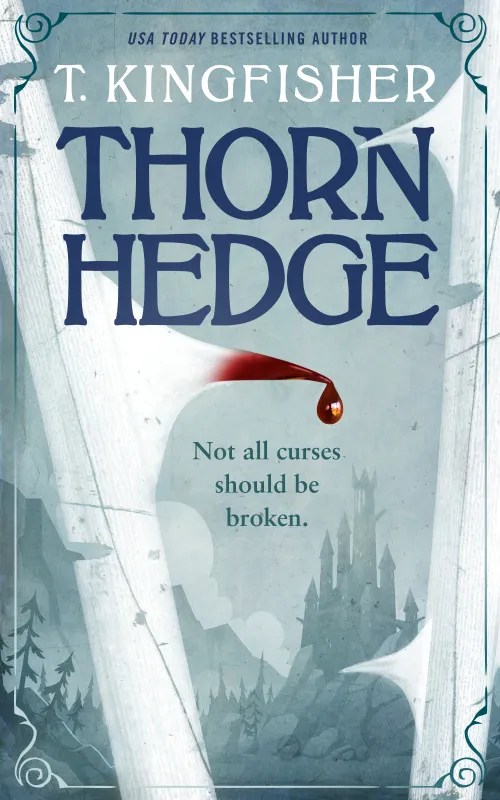
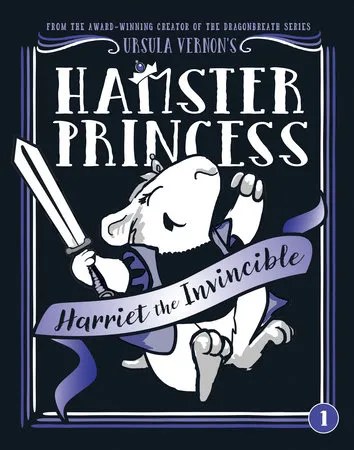
MICHAEL A. VENTRELLA: Today I’m very pleased to be interviewing Ursula Vernon a/k/a T. Kingfisher (which is how I know her work). Ursula does not limit her creativity. She is a Hugo-award-winning author not just for her novels but also for her graphic novels, and has also won a Nebula Award as well! In fact, she’s up for a Hugo again this year for her novella “Thornhedge.”
Let’s start by explaining to my readers why you have two names for your books (and how you chose your alter ego name)!
URSULA VERNON: The reason is simple: brand separation. Which sounds very marketing-speak, but actually means that I write both children’s books and adult horror and these are not streams that I want to cross. Particularly when you write for reluctant readers, there’s a tendency for parents to think “hey, they will read this author, so I will buy ALL their books!” Life is just easier when there’s a separation between them.
I picked the name partly because kingfishers are my favorite bird, and partly because of Ursula K. Le Guin. She sold a story to Playboy in the Seventies, but they asked her to be listed as “U. K. Le Guin” because they thought their readership would be intimidated by a female byline. She later wrote something to the effect of “ Who would they think it was? Ulysses Kingfisher Le Guin?” So it’s a bit of an homage there too.
VENTRELLA: My wife and I very much enjoy your Kingfisher books, although she was listening to the second Paladin audio book while some workers were in the house doing some remodeling and had to stop when it got to one of the sex scenes! Tell us about the Temple of the White Rat world and why you enjoy writing in it.
VERNON: Oh no! How awkward!
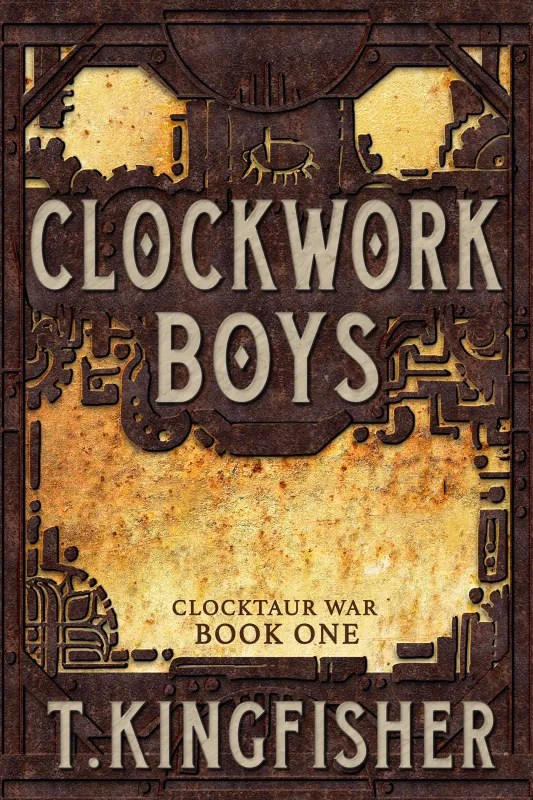
I sort of fell sideways into the Temple of the White Rat—I wrote a fantasy novel called CLOCKWORK BOYS and had the broad outlines of the world sketched in around it. Then when I had another fantasy novel to write, I already had this world lying around, so I figured I’d use it, and then another and another. Each one fleshed out more of the world, and there were elements that showed up in early books that I found myself wanting to know more about, like the Temple of the White Rat itself. (A faith dedicated simply to solving problems and making people’s lives better, so it employs a lot of social workers, lawyers, and organizers. The lawyers in particular keep showing up…)
VENTRELLA: As a lawyer, I appreciate their appearance. Can we expect more in that series?
VERNON: Absolutely! There’s seven books planned in the Saint of Steel series, and I’m only through book four!
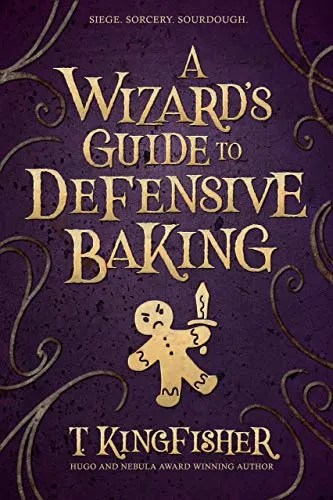
VENTRELLA: One of my favorites is A WIZARD’S GUIDE TO DEFENSIVE BAKING which won some nice awards. How did you come up with that concept?
VERNON: OK, there’s the good answer, which is about magic systems and small but versatile powers, and there’s the true answer, which is “I bet I can write a Kitchenaid mixer off on my taxes.” Despite these mercenary beginnings, I’m actually very proud of how it turned out, and it went much farther than I ever expected it to!
VENTRELLA: Admittedly, I have not read all of your books, but the “reluctant hero” seems to play a part in the ones I have read. (My books also tend to feature those kinds of characters!) What is it about those kinds of heroes that makes them appealing to you?
VERNON: I think it’s because that’s the kind I’d be? Being a hero is miserable work, or else everyone would be doing it! So it’s very easy to get in the headspace of wanting to cling to your comfort zone but having the world drag you out of it. Whatever you may think of Joseph Campbell, having “rejecting the call to adventure” as a major milestone of the hero’s journey is spot-on. I don’t want to save the world, who will weed the garden?!
I’ve only written one book, off the top of my head, (not yet published) with a character who genuinely wanted to be a hero, and most of that book is about learning that heroism can be very traumatic!
VENTRELLA: You started off doing graphic novels and then children’s books. Too many beginning writers think writing for a younger audience is easier. Tell us why it isn’t!
VERNON: Oh goodness. It’s definitely not easier! Writing for kids usually requires you to write very tight and fast-paced to keep readers engaged. In an adult novel, you have more time to stop and smell the roses, go off on tangents, and just plain noodle around. You can’t be boring in either, but you get a lot longer to prove yourself in an adult book.
Also it turns out that most editors really frown on arson in kid’s books. But sometimes burning down the the haunted house is the smart thing to do, dammit!
VENTRELLA: As an artist, what’s your opinion of AI art? Should conventions accept it into their art show?
VERNON: I haven’t heard a good case for letting it into art shows, no. Overall, I’m mostly annoyed that the technology in these visual generation algorithm were all fueled by plagiarism. I was enjoying fiddling with them until we all found out how the sausage was made.
Weirdly—or maybe not that weirdly!—I liked the output a lot better when it was worse? The early incarnations had a dreamy, distorted quality that got the ol’ pareidolia working hard, and was potentially a fun creative springboard. Now that it’s just stuff that looks exactly like other stuff, albeit with extra fingers, it lost a lot of that early hallucinatory charm. From visual magnetic poetry kit to mediocre stock photo, in a couple of software updates.
VENTRELLA: You’ll be a guest at Ravencon this year and I’m looking forward to meeting you. Do you enjoy going to conventions? What other ones do you have coming up so people can meet you?
VERNON: I frequently cling to my mattress going “Nooo, I don’t want to travel!” and then of course I have a great time at the conventions. (I suspect this is normal.) It’s awesome to meet readers and other authors and to see so much creativity and talent on display!
This year, I’ll be at Finncon, if anybody is out in Finland, and at Bubonicon in Albuquerque!
VENTRELLA: What can we expect next from you? What are you working on now?
VERNON: Oh man, too many things at once! I’m working on a weird retelling of Snow White, and the third Sworn Soldier book, and about to start editing a really squishy horror novel that I’m quite pleased with.
VENTRELLA: Any interest from Hollywood that you can talk about?
VERNON: Stuff gets optioned occasionally, but as my agent said, “A book has a one in a thousand chance of being a movie, and if it gets optioned, it has a one in nine hundred and ninety nine chance.”
VENTRELLA: Who do you like to read? Who has influenced your work?
VERNON: I’m one of those people who can’t read the genre I’m writing while I’m working on it, so when I write horror, I read romance, and when I write fantasy, I read non-fiction. Then I try to cram all the amazing genre books into my eyeballs while I’m doing edits!
VENTRELLA: Tell us how to found your agent/editor/publisher and how you first got started.
VERNON: It is safe to say that my career path would be awfully hard to duplicate. I was doing webcomics and putting up art with weird little stories under it. Then a romance writer friend of mine told a funny story about her weird artist friend, while at a professional dinner, and the agent sitting next to her said “oh, graphic novels are really hot right now.” My friend points her to my website and suddenly I had a literary agent without really having a book! (This is not how anything works. Ever.) Anyway, she asked if I could write a children’s book, and having both ignorance and confidence, I said “Sure!”
Fortunately, I was correct. (Seriously, though, luck is the great driving factor in a LOT of careers. Maybe mine more than most, but a lot of authors will freely admit that luck played a huge part.)
VENTRELLA: One thing writers sometimes fail to understand is how important connections matter in getting into the business.
VERNON: Well, see above! But also in things like “I knew this editor from conventions and talking online about fan fiction, gardening, and stuff like that. Then I made a joke on Twitter about the Worst Elevator Pitch Ever and she was in my DMs asking “Does this book really exist? Can I see it?” Luckily it did exist, but it’s not like I had started chatting with her online about gardening five years earlier, thinking “Someday she will be in a position to publish my book!” I just had opinions about weeds.
Connections really have to happen organically, I think. But also I’m bad at knowing when they’re happening. A friend of mine once had to say “That was networking. You networked. Right there. Networking occurred.” I had been excitedly telling some people about Irukandji jellyfish, over drinks at a Worldcon. Apparently some of them had been editors. (The people, not the jellyfish.) And of course I’m left flailing and going “But we just talked about being horribly stung to death!” And yet, in a few years, if you stick in somebody’s mind, even just as “entertaining weirdo who gets excited about marine invertebrates,” that may turn out to put you in the exact right place at the right time. Or not, in which case, hey, at least you had a fun conversation about jellyfish, which is really its own reward.
VENTRELLA: You’ve been fairly prolific, with quite a few stories published every year. How do you find the right markets for your stories?
VERNON: That’s a great question! I do not have a great answer. My agent helped a lot with placement of course, but I had a lot of books that editors would like but have no idea how to market, like WIZARD’S GUIDE TO DEFENSIVE BAKING. I started self-publishing mostly to get those weird little stories out there, and then publishers started actually asking for those stories and I was like “What? Really? Okay!”
I’ve been very lucky with Tor, who has realized that I write about three different genres and has been willing to publish all of them instead of trying to get me to narrow it down to one.
VENTRELLA: Let’s separate writing from storytelling for a minute. Writing skills can be taught, but do you think it’s possible to teach how to tell a good story, or is that just some kind of talent that not everyone has?
VERNON: Honestly, I have no idea. I think maybe it’s like comedic timing, though—there may be a few people on earth who absolutely cannot learn, but a lot of people who think they can’t actually could if they took an improv class or something. Maybe it’s not that storytelling can’t be taught so much as that it’s harder to wrangle and you have to go at it sideways.
VENTRELLA: What’s the best advice you would give to a starting writer that they probably haven’t already heard?
VERNON: If you get a book contract, do NOT have your family lawyer look it over, unless they happen to have retired from entertainment law. Words are used differently in book contracts than they are in, say, real estate, and it will only lead to sorrow. (Your agent will handle this bit for you if you’re agented. Thankfully.)
And once you’re a little further along, when you have perhaps published a couple of books, you will start getting email. A LOT of email. If this starts eating all your time, there are a number of people in the world who have executive function for hire and will triage your email for a small monthly fee. It is worth it.
VENTRELLA: What’s the worst piece of advice you’ve heard people give?
VERNON: Only work on one thing at a time! That shiny new idea is a sign that something is wrong with your current manuscript and you must dutifully knuckle down and fix it! Etc., etc.
Me, I have ADHD like whoa, I work on three to five projects simultaneously, and if I get an idea I’m excited about, I chase it every time. My enthusiasm is a much rarer commodity than my sense of duty. I’ll hammer out ten or fifteen thousand words, then go back to the other project. Frequently those shiny ideas get sent to my editor and she gets excited and it turns into a book too.
VENTRELLA: With a time machine and a universal translator, who would you invite to your dinner party?
VERNON: Oh gosh…Mark Twain, Terry Pratchett…Beverley Nichols so we could talk gardening… Maybe someone more out of left field, like Saint Hildegard of Bingen. (Though probably not at the same dinner party as Nichols.)
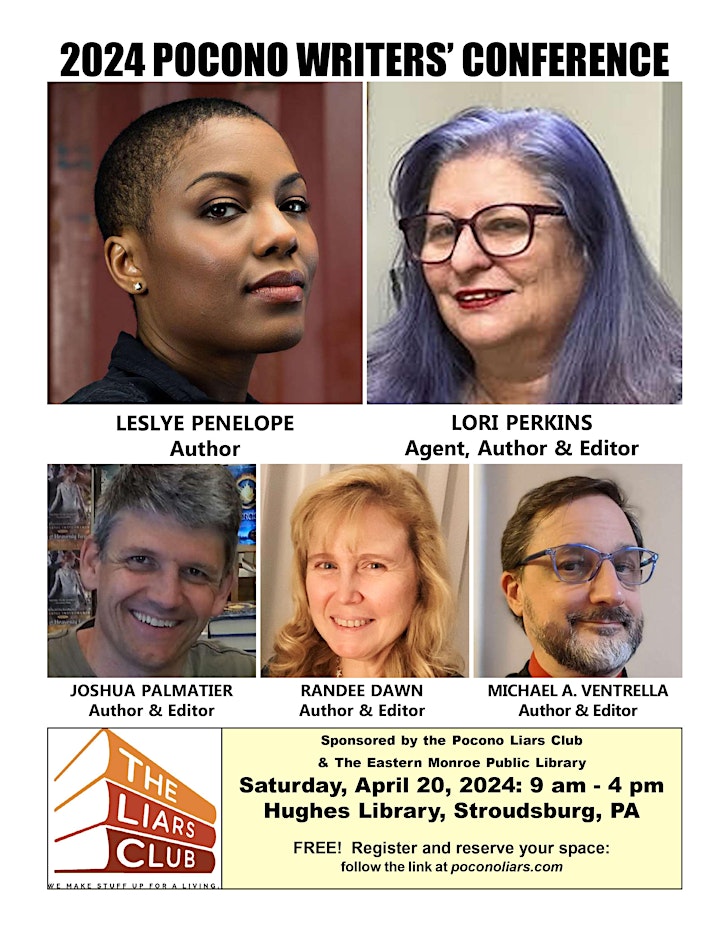
I started the Pocono Liars Club over ten years ago now. It’s local authors helping each other. We sponsor writing workshops and conferences for free, thanks to the Monroe County Library…
The next conference is coming up soon, and there are still open spots! We have some great speakers with lots of experience who are willing to assist you.
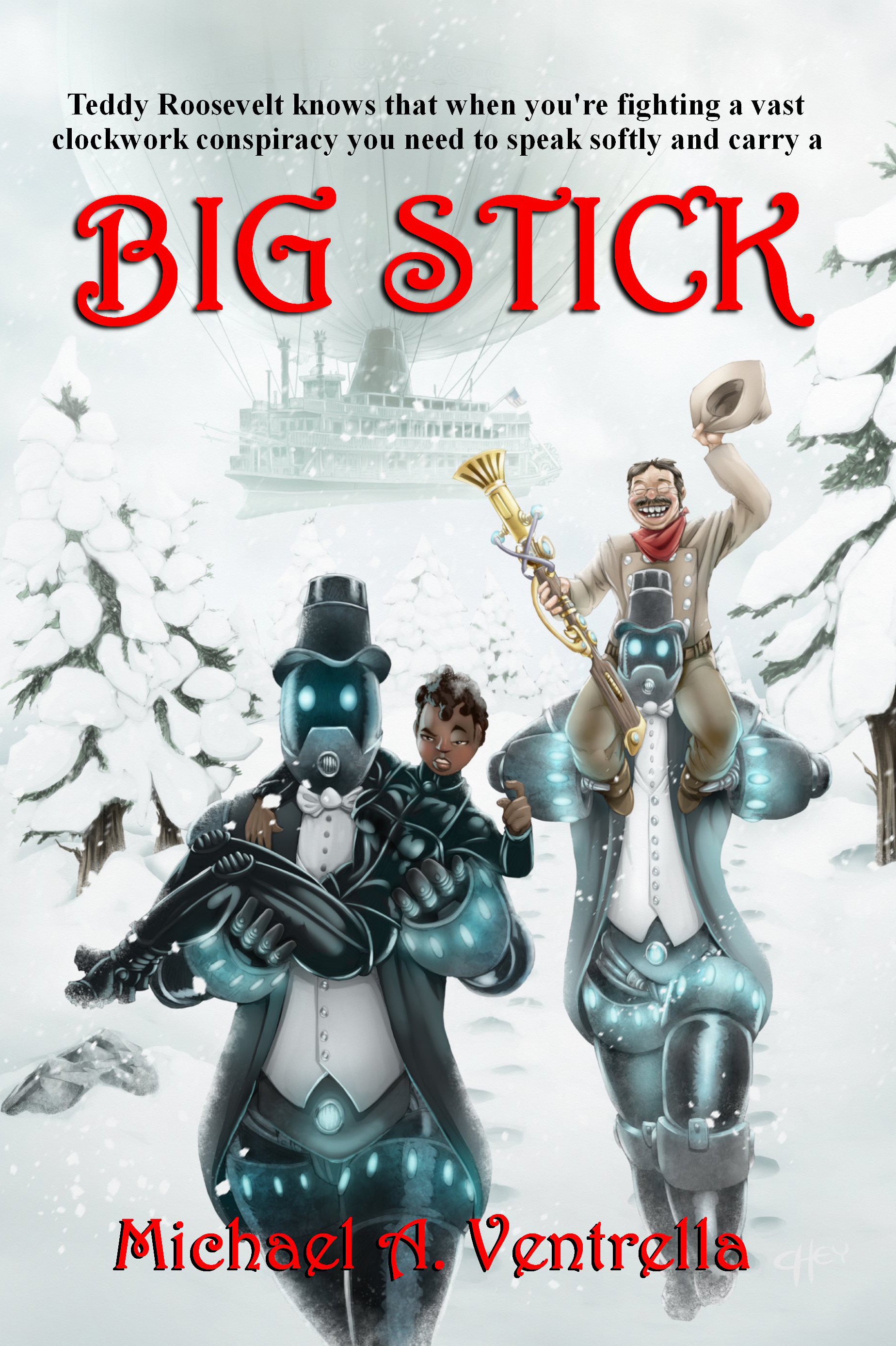
“A wild and thoroughly entertaining steampunk adventure featuring an improbable cast of historical figures, plenty of action, and lots of fun!” – Jonathan Maberry, New York Times bestselling author of Deep Silence and V-Wars










 Michael A. Ventrella