Interview with author Gray Basnight

MICHAEL A. VENTRELLA: Today I’m pleased to be interviewing Gray Basnight – a writer I used to play with when we were both little kids in Richmond, Virginia! Now we’re both writing political thrillers, except mine involve a lot more humor and vampires.

GRAY BASNIGHT: Hi Michael! Thank you for this terrific opportunity.Gray Cap
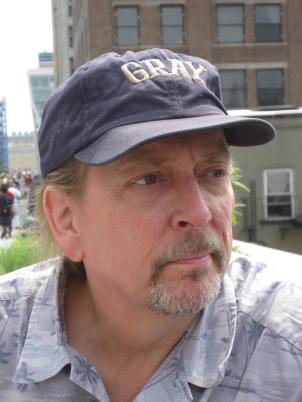
VENTRELLA: Introduce yourself to my readers, Gray!

BASNIGHT: I’m deeply immersed in my third career — fiction writing, after almost three decades in broadcast news as a writer, editor, producer, and reporter; preceded by a few years pursuing an acting career.

From our hometown of Richmond, to N.C., to D.C., I now live in New York where I’ve been for, ahem, forty years. That’s long enough to be a native.

But to step back in time, may I say I had a very good time visiting your house as a kid. I don’t remember much specifically about what we did. I don’t think we played at ordinary games like Monopoly or Hide-and-Seek, mainly because neither of us was ordinary. In fact, as you well know, we were both quite special in extraordinary ways. But I do know we had a good time, and not just because of our friendship. Your parents made it great fun because they encouraged creativity and, unlike most adults I knew at the time, actually enjoyed having children hanging about and doing natural child-like things. For me, that was wonderful.

VENTRELLA: I mostly recall us running around pretending to be James Bond. Both of us Bond, at the same time. We were kids.

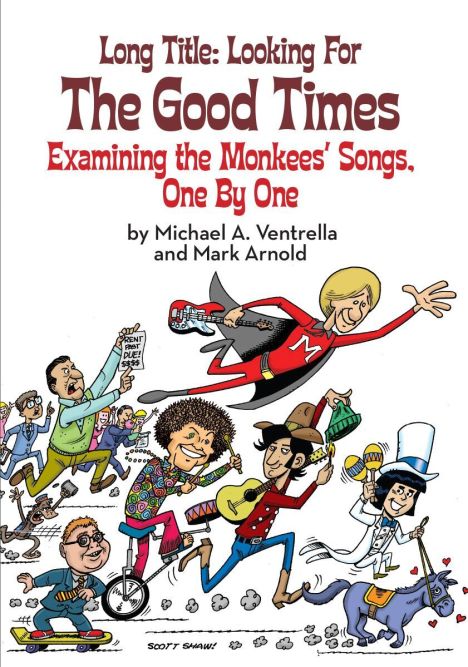
BASNIGHT: As for details of my life since then—well, I wish I could cut to a phantasm-style video in honor of your recent Monkees book: “Here I come, walking down the street, I get the funniest looks from…” (You know the rest).

So, let’s see, there was college at NC Wesleyan, followed by grad school at GW University for an MFA in Theatre, where I thought I’d become a college theatre  professor.

After GWU, I made the big move to NYC to be a struggling actor (cue: Daydream Believer), which I thought mattered if I planned to teach. Then it magically morphed into waiting tables at an Israeli nightclub in Greenwich Village. While I met many interesting people there, I decided it may be best to move on to—well, anything else. (cue: For Pete’s Sake).

Fortunately, I had an offer to work at WOR radio. This led to opportunities in broadcast news where I wore many hats including writer, producer, editor, and reporter.

Three decades and several stations and newsrooms later, I was laid off in 2009 from Bloomberg Radio in the midst of the financial crisis. My title on the day of my demise was “reporter,” and the last big story I covered was the Miracle on the Hudson. That company’s decision led me to the question—what now? My answer: write novels. It was a long time desire, and something I’d previously tried to squeeze into precious spare time. (Cue: I Wanna be Free.)

And that is the story of my…uh-oh, wait a second. Let’s not forget something important. Somewhere in that phantasmagoric Monkees-inspired cinematic montage—I met my wife Lisa, and eventually we got married on our 9 th boyfriend/girlfriend anniversary. We’ve now been married twenty-two years (cue: I’m a Believer).

And, as we all know, The Best Is Yet to Come (and that’s a song the Monkees would probably have recorded had Sinatra not beat them to it.)

VENTRELLA: Tell us about the plot of FLIGHT OF THE FOX!FoF-Finder
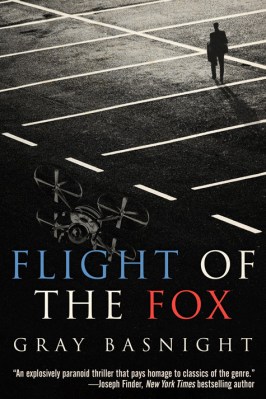
BASNIGHT: It’s a political run-for-your-life thriller. My central protag, Sam Teagarden, does not own a gun or know anything about how to karate chop people. He’s a university math professor whose only weapon is his intelligence and his will to live. After receiving an encoded file in his email inbox, he suddenly has drones trying to kill him for reasons unknown. During his race down the East Coast from teams of black-ops hitmen, he manages to decode the document. He learns that it’s a diary written by a former high ranking official with the FBI that reveals many unknown facts about the 20th century. If published, the decrypted diary will radically alter the public’s view of U.S. history.

VENTRELLA: How did you decide on that title?

Interesting story. It was originally titled “The Dear John File.” I liked it. Still do. It was intended as an homage to Robert Ludlum who made the run-for-you-life genre so popular with his Bourne novels. But the publisher was understandably concerned that my title would be misunderstood as an adolescent romance novel. Quite a reasonable observation! So, I changed it to FLIGHT OF THE FOX, based on the idea of a fox hunt. My protag even thinks of himself a fox in a fox hunt during his race for survival.

VENTRELLA: How did you go about finding a publisher?

BASNIGHT: I concentrated on small publishers. Several expressed interest, but when Down and Out Books stepped up with an offer, I was really pleased. I was introduced to D&O through a writer friend, Charles Salzberg, to whom I’ve dedicated this particular book.

D&O is a fast-growing outfit based in Florida that’s garnering quite a bit of respect in the crime and mystery genre, as well as tremendous interest from readers.

VENTRELLA: Tell us about your other books.

BASNIGHT:  THE COP WITH THE PINK PISTOL (2012) is a police procedural / mystery / romance / humor novel with three separate plots. I didn’t set out to blend all those genres and plots. For some reason, that’s what popped from my fingertips when they were poised over the keyboard.
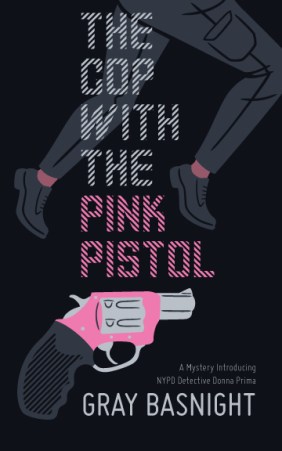
cpp_cover_for_pingg-small NYPD Detective Donna Prima (don’t ever call her prima donna) is a tough Brooklyn native who carries a pink .38 revolver strapped to her ankle in defiance of police regulations. To her astonishment, when she responds to a 911 burglary call, she gets romantically involved with the burglary victim. He’s a southern WASP who makes his living as an actor on a TV soap opera called “Vampire Love Nest.” (Hey, Michael—this one had vampires!)

It got super reviews from “Kirkus” and “Library Journal,” and is still available as an e-book.

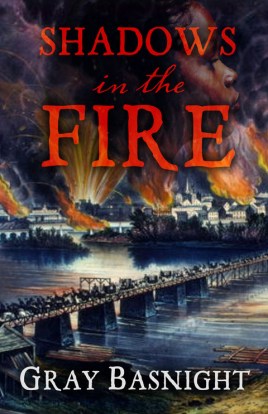
My second novel is SHADOWS IN THE FIRE (2015). It’s an historical novel set in Richmond during the city’s final days as capital of the Confederacy. Here’s the non-fiction story: the evacuating Confederate forces accidentally burned down much of the city and the next day a contingent of black soldiers wearing Union blue marched into town. They put out the fires and restored order. Not one shot was fired. There was no raping or pillaging. One day later, President Abe Lincoln walked (literally) into town for a brief look-see. To my knowledge, it’s the only war story where the conquering army actually made improvements, instead of adding to the destruction.

Now here’s the fiction story: all of the above is witnessed by my two central characters, a 12-year-old slave girl, and a 16-year-old slave boy. They hope to get married when the war is over, but lose sight of each other during the chaos.

All in all, it’s a dramatic story. But then, it’s natural for me to say that because I wrote it. And, by the way, this novel is dedicated to the idea that an American Slave Memorial should be located on Richmond’s Monument Avenue, home of many equestrian memorials to Confederate generals.

VENTRELLA: Let’s talk about writing. How much of writing is innate? In other words, do you believe there are just some people who are born storytellers but simply need to learn technique? Or can anyone become a good writer?

BASNIGHT: “Yes,” to the former question, and, “not really,” or even an outright “no” to the second.

Here’s the naked truth as I believe it. Let’s say I want to be a great piano player. Well, I happen to have no musical skill whatsoever. Even so, if I studied hard and practiced piano with great discipline, I think I could hammer out a pretty good version of “Rocky Raccoon” so that everyone at the cocktail party would be quite impressed. But I still wouldn’t be as good as, say, Elton John, let alone Chopin.

Writing is similar. So, yes, I believe true writing skill is innate. That doesn’t mean that those without natural talent cannot become writers. They can. They do. Study and practice will teach one how to write better sentences and compose better paragraphs. And some become commercially successful. But it’s generally true that solid, inventive, inspired, and insightful writing cannot be taught.

VENTRELLA: How important is a professional editor?SinF_Cover-small
BASNIGHT: Vital! I may be an unusual writer in that I like and appreciate editors. Having spent nearly 30 years in the news industry, I’m respectful of what a solid editor does to help produce improved results. I’ve been yelled at by good editors. And, having been one myself, I’ve even done the yelling. None of it means you have to fold your tent every time. You can fight for what you think works and must remain in your story. But most writers, I’m convinced, need to be accessible to the insights of a competent editor.

Learning how to do that can start with having a field of beta-readers that provide honest feedback on works on progress.

VENTRELLA: What’s your opinion on self-publishing?

BASNIGHT: To answer this question, may I focus on the definition of the word “professional?”

For me, that hinges on money, i.e., income. If you get paid for what you do, you’re a professional. Vanity publishing is fine, particularly if your principle wish is for friends and family to see your book. Although, because of eBooks and the ease of self-publishing via the Internet, the publishing industry is certainly going through tectonic changes and self-publishing may take on greater significance in the future. We’re all watching and waiting to see how everything shakes out and where the evolution leads.

VENTRELLA: What’s the best advice you would give to a starting writer that they probably haven’t already heard?

BASNIGHT: Regardless of what anyone has heard or not heard, there’s only one supreme rule: butt in chair. If you’re not sitting at the keyboard for a minimum of four-to-six hours a day, six-days a week, you’re not going to be a professional writer.

VENTRELLA: Do you think readers want to read about “believable” characters or do they really want characters that are “larger than life” in some way?

BASNIGHT: Believability is certainly important. But if the wider narrative is working well, what John Gardner called the “fictive dream,” then anything can be made believable by a skilled writer.

On the other hand, all characters are, indeed must be, special in some larger-than-life way that makes the reader care about them. Frequently what makes them special is their struggle to overcome some obstacle and how they go about meeting the challenge.

VENTRELLA: What’s the worst piece of advice you’ve heard people give?

BASNIGHT: The advice—write what you know—is dumb, though it can certainly work quite well as a starting point. If I recall correctly, New York firefighter Dennis Smith attended a writing class where he was told to “write what you know.” So he did. The result was “Report from Engine Company 82,” published in 1972. It’s a very good and highly successful book. I read it as a teenager and found it inspiring. But generally, it would be bad if writers only wrote about what they know. If Daniel Defoe only wrote about what he knew, we wouldn’t have “Robinson Crusoe.” Likewise for Flaubert’s “Madam Bovary,” Dostoyevsky’s “Crime and Punishment,” Carroll’s “Alice’s Adventures in Wonderland,” and thousands more.

VENTRELLA: What’s your next project?

BASNIGHT: I’m three-quarters of the way into the sequel to FLIGHT OF THE FOX. This features another race against time and death for my main character (no spoilers here, you’ll have to wait to find out who that is). In this story, the protagonist finds himself in the middle of a bureaucratic screw-up where the powers that be never, never, never get it right.

I have a completed YA that’s loosely based on “Treasure Island,” but features a contemporary 15-year-old female protag filling the Jim Hawkins role. NOTE: Any interested agents or editors reading this may call me for a look see.

After that, I’ve got about ten manuscripts in the mystery genre that all need attention. Some are partially written, others are complete first drafts. They are all good ideas, if I do say so myself. Unfortunately, they are all also in dire need of rescue in the categories of plotting, pacing, and characterization. So—time for some serious “butt in chair.”

Release the Virgins open for submissions

The anthology Release the Virgins! is now open for submissions.

Through a kickstarter campaign, we were able to raise enough to go ahead with this project, and we have confirmations from authors David Gerrold, Lawrence Watt-Evans, Jody Lynn Nye, Allen Steele, Steve Miller, Sharon Lee, Keith R.A. DeCandido, Gail Z. Martin, Cecilia Tan, Patrick Thomas, Shariann Lewitt, Alex Shvartsman, Hildy Silverman, and Daniel M. Kimmel.

We should have room for a few extra stories as well. But only a few.

Submissions are open for short stories that include, somewhere in the story, the phrase “Release the Virgins.”

The story should be no more than 5,000 words. This should be sufficient for what should most likely be a somewhat humorous tale. The payment is 5 cents a word. Do not take this as an invitation to pad your story in order to earn a few more bucks. If your story is complete at 3,000 words, then end it. A good but padded story may get rejected over a concise, fast-moving one, because we want to fit in as many stories as possible.

Unpublished authors are encouraged to submit, but will still face the same standards for submissions as the published authors. (Hint: Don’t send me a submission full of spelling and grammatical errors.)

An email proposal is required to make sure you are not duplicating an idea already reserved by one of the accepted authors. Send to michael.ventrella@gmail.com.

Once that is approved, your story should be double-spaced in rtf format with 12 point Times Roman font. There should be no spacing after the paragraphs. The first page must contain the name of the story, the word count, and your name, address, email, and phone number. Your cover letter should list any previous publications.

The deadline is September 1, 2018.

EDIT (ADDED A WEEK LATER):

I’m getting a lot of proposed story ideas for the anthology and if they all submit stories, I’ll have to reject a lot (or hold them in case we do a second book).

But here’s some advice:

1. Avoid unicorns. I’ve already had a bunch of proposals about unicorns and even if the submitted stories are all good, I’m not going to want to have more than one or two unicorn stories in the anthology. We want variety.

2. Be creative. If it looks like you just took a story you already had and found a way to work the phrase into the story in such a way that I could remove the phrase completely and it wouldn’t hurt the story, then I will probably not accept it. The phrase should be relevant and necessary to the story.

3. Don’t send me a proposal with spelling and grammatical errors. I mean, duh.

Thanks!


Release the Virgins!

Announcing a kickstarter campaign for a new anthology (edited by me!) where the only requirement is that each story must contain the line “release the virgins” somewhere within. We have commitments so far from award-winning authors David Gerrold, Lawrence Watt-Evans, Jody Lynn Nye, Allen Steele, Steve Miller, Sharon Lee, Keith R.A. DeCandido, Gail Z. Martin, Cecilia Tan, Patrick Thomas, Shariann Lewitt, Alex Shvartsman, Hildy Silverman, and Daniel M. Kimmel. More will be added (especially if we raise enough from the kickstarter).

We’re already over $3000 toward our goal of $5000, but the deadline is fast approaching, so don’t wait! Pledge today!

To pledge and reserve your book (and/or get other goodies)!: https://www.kickstarter.com/p…/667435382/release-the-virgins

My 2018 Balticon Schedule

I’ll be a guest at Balticon next weekend (May 25-28), a fun convention with guests including Catherine Asaro, Larry Niven, Charles Gannon, Keith DeCandido, and many more!B52_web_banner_4

On Saturday, I may be preoccupied because my wife, award-winning artist Heidi Hooper, will be doing an appearance at the local Ripley’s Believe it or Not museum where her dryer lint art is displayed!

But otherwise, here are the panels where you can find me:

Ordinary Heroes (Friday 4 pm): Some of the most powerful stories are about ordinary people who find themselves doing extraordinary things. What makes these tales and characters appealing and how do they differ from those featuring larger-than-life heroes and villains? With Valerie J. Mikles (moderator)Gail Z. MartinMelissa ScottJohn AppelMichael A. Ventrella

Autographing (Saturday 2 pm): I’ll be signing books for anyone who wants one!

Character Building in Fantasy (Saturday 4 pm): Worldbuilding is fun, but someone’s got to live in that world. Authors discuss how to how to make fictional characters that live in invented worlds feel like they didn’t fall our of ours. With Griffin Barber (moderator)Larry NivenScott H. AndrewsMichael A. VentrellaMichelle Sonnier

Readings (Saturday 6 pm): Authors read from their latest work. With Day Al-MohamedElektra HammondMichael A. Ventrella

What Makes an Idea Worth Exploring? (Sunday 1 pm): Bring the concepts you’re considering and we’ll discuss whether they’re worth your, or your reader’s, time. With Michael A. Ventrella (moderator)Gail Z. MartinDave RobisonJeff Young

A Judicial Framework for Superpowers (Sunday 5 pm): Is testimony obtained with Wonder Woman’s Lasso of Truth admissible? Does Spidey-Sense require a wiretapping permit? Come talk to our nerdy lawyers and find out. With James R. Stratton (moderator)Iver P CooperGriffin BarberJohn L. FrenchMichael A. Ventrella

Baker Street Irregulars: The Game is Afoot!

What if Sherlock Holmes was born in a different time and a different place in a different body?

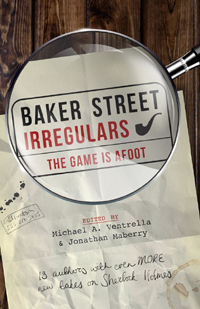
“The Game is Afoot!” is the second in the anthology series, wherein New York Times Bestselling author Jonathan Maberry and I invite prominent authors to have fun with the iconic character.  Baker Street 2

The book was released today from Diversion Books. You can get a copy through them, or use Amazon or Barnes and Nobles if you prefer. It’s also available for ebook, kindle, and soon as an audio book.

Here’s the great table of contents!

Introduction: My Old Friend Sherlock Holmes by Jonathan Maberry

The Problem of the Three Journals by Narelle M. Harris:  Sherlock is an Australian hipster

Six Red Dragons by Keith R.A. DeCandido: Sherlock is a young girl in modern New York City

The Adventure of the Diode Detective by Jody Lynn Nye: Sherlock is a home security system

Investigations Upon Taxonomy of Venemous Squamates by R. Rozakis: Sherlock is a graduate student at a lab

Papyrus by Sarah Stegall: Sherlock is a female librarian in ancient Egypt

My Dear Wa’ats by Hildy Silverman: Sherlock is an alien ship’s captain

A Scandal in Chelm by Daniel M. Kimmel: Sherlock is a rabbi

The Affair of the Green Crayon by Stephanie M. McPherson: Sherlock is a grade school teacher

A Study in Space by Derek Beebe: Sherlock is a teenager on a Moon station

Sin Eater and the Adventure of Ginger Mary by Gordon Linzner: Sherlock is a “sin eater” in rural post-Civil War

The Adventure of the Double Sized Final Issue by Mike Strauss: Sherlock is a comic book character

A Very Important Nobody by Chuck Regan: Sherlock is an investigator on one of Jupiter’s moons

Ho Ho Holmes by Nat Gertler: Sherlock is Santa Claus

Lestat de Lioncourt of Geeks.media writes:  “They say imitation is the sincerest form of flattery. The authors of this anthology series have elevated imitation to art. Each author’s interpretation of this classic character adds a new dimension to what Sherlock Holmes is or can be. Every time Sherlock is a different gender, of a different race, in a separate profession and living in a different time, the character attracts a new audience and becomes a relevant and new idol to whole new diaspora. Though not consistently engaging and polished, Baker Street Irregulars: The Game is Afoot is the kind of unmissable series every Sherlock fan will enjoy.”


My 2018 Ravencon schedule

Ravencon is a fun little convention that keeps growing — It used to be in my hometown of Richmond but now it’s in Williamsburg, right next to Busch Gardens where I spent many days riding roller coasters when I was younger… This year, the writer Guest of Honor is Chuck Wendig! Other guests include Philippa Ballantine, Tee Morris, Gail Z. Martin, and me (among many others!)

1544431_10155075465395416_9217342441446835317_n

Chuck Wendig, me, and Tee Morris.  I love this photo!

The entire program is here but here’s where you can find me:

Morally Ambiguous Bad Guys (Friday 5 pm): Those wonderful lawful- and neutral-evil bad guys. You love to hate them and hate that you love them. Panelists: John “Cal” Baldari, Kettle Maccaulay, Greg Smith, Michael A. Ventrella (Moderator)

Opening Ceremony (Friday 7 pm) Wherein guests are introduced and Mike Pederson tells some bad jokes

Elementary (Friday 8 pm): Why Sherlock Holmes is still popular after over 100 years.
The last of his stories just went into the public domain in the last year, has this increased the number of homages we’re seeing? Panelists: Sandra J. Baldari, Joshua LeHuray, Greg Smith, Michael A. Ventrella (M)

The Great Geek Debates (Saturday 11 am): Our panelists debate a variety of geeky subjects following standard debate club rules. We’ll focus on teen-friendly topics. Panelists: Michael A. Ventrella, Voices of Tomorrow Students, Michael J. Winslow (M)

The Allen Wold Writing Workshop (Saturday noon):  Allen Wold gives the writers attending a brief exercise. Then he and the panel will comment on each exercise, helping the writer understand what they have done well and where they can improve. Panelists: Paul Barrett, Michael A. Ventrella, Allen Wold (M)

Ignore this Advice: Writing Tips that Aren’t So Great (Saturday 2 pm):  Tips and tricks that turned out to be anything but helpful. Panelists: Darin Kennedy, Misty Massey, Greg Smith (M), Michael A. Ventrella

The Allen Wold Writing Workshop (Part Two) (Sunday 10 am): The conclusion of Allen Wold’s Writing Workshop. Only those that attended the first half may attend the second half. Panelists: Michael A. Ventrella, Allen Wold (M)

You Need an Editor (Sunday noon): You’ve gotten a piece written, but it’s not finished until it’s been through the editor’s hands. Panelists: Janet Carden, Darin Kennedy, Michael A. Ventrella, John G. Walker (M)

Interview with author Damon Suede

MICHAEL A. VENTRELLA: I’m pleased to be interviewing Damon Suede today! Damon Suede grew up out-n-proud deep in the anus of right-wing America, and escaped as soon as it was legal. Having lived all over, he’s earned his crust as a model, a messenger, a promoter, a programmer, a sculptor, a singer, a stripper, a bookkeeper, a bartender, a techie, a teacher, a director… but writing has ever been his bread and butter. Damon Suede - Spring 2012Though new to romance fiction, Damon has been a full-time writer for print, stage, and screen for two decades. He has won some awards, but counts his blessings more often: his amazing friends, his demented family, his beautiful husband, his loyal fans, and his silly, stern, seductive Muse who keeps whispering in his ear, year after year. Get in touch with him at DamonSuede.com.
Your background was not specifically in writing romance. How did you fall into that?

DAMON SUEDE: Crazy story that. And it happened almost by accident.

I had been making a healthy living in showbiz writing for film/TV/theatre/comics for over 20 years… but was starting to feel a little burnt out and creatively deadened. Corporate entertainment will do that to you.

Back in 2010, a friend who was working on an erotic romance asked if I had time to beat out a plot for her, something I did often for film/TV gigs. I had just finished a big money job and my husband was out of town working a case (he’s a forensic investigator). Well, my friend and I spent about an hour bashing out the plotting gaps and structural messes in her book when she said that if I didn’t write a romance I was and I quote, “the laziest idiot” if I didn’t sit down and write my own novel. She said writing a romance would bring my creative mojo back pronto and claimed the stuff I’d brainstormed off the cuff was fresher and sexier than books she was reading… She bet me I could write a novel in three months; it wound up taking me about six weeks, and I sold the book in two
days, and then it was number one for six months. Blew my mind. But more importantly, it did kickstart my writer brain. And then I was hooked! Suddenly I had all these stories I wanted to tell, and I didn’t have to navigate a path through the Hollywood maze. Sweet
FREEDOM! Delicious.

VENTRELLA: How did you choose this nom de plume? (And do you know Chuck Tingle?)

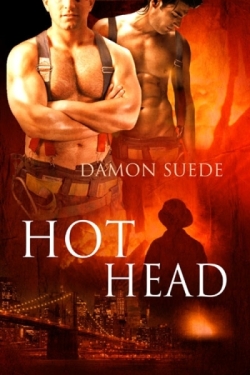
SUEDE: “Damon Suede” was originally a minor offstage character in a script from years and years ago. I liked the name so much that I decided if I ever became a professional wrestler or shot an erotic thriller it would be my nom de guerre. Well, when I submitted my first novel, I consciously needed a pen name just to keep the work separate from my scripting under my legal name, mainly so I wouldn’t confuse any googling producers. My publisher immediately told me I could never change the pen name and that she could sell thousands of books on the pen name alone, because Damon Suede sounded so much like my narrative voice. HotHead250pxShe was right. Having the right pen name gave me a terrific leg up in the early stretch of my career.

As for Chuck Tingle… I do. Or at least I know the partners who write as “Chuck Tingle” as an entity. And I think they are legit geniuses. Hilarious, brilliant, and managing to create something almost like performance art within the framework of Amazon. Mad respect for them.

VENTRELLA: Writers are told to “write what you know.” What does this mean to you?

SUEDE: Actually this is some of the best and worst advice ever given to young writers. The truth is I think you should know what you write. By that I mean, don’t write about your backyard and habits. Instead learn to tell stories that make people feel powerful emotions, that change their minds and hearts. Once you learn to do that, if you still feel like unpacking your own personal experiences… mazel tov. But until you develop those basic narrative skills, hone your craft and work your path. Chop wood, carry water.

In modern culture, self-involvement is rampant and other people’s ruts are simply not that interesting. Memoir is mostly boring and most lives are not worth the words wasted in print. Fascinating lives are hard to come by, and the odds against having a fascinating life and the ability to capture it on paper are ASTRONOMICAL.

Instead, write what you feel. Genre fiction is about eliciting a motion from an audience that turns up with certain generic expectations. If you can meet those expectations, exceed those expectations, and produce authentic emotion that changes their real life they will never forget you. Write what you feel and then know what you write.

VENTRELLA: Authors are often told that in order to create great characters, they should figure out the characters’ likes and dislikes and so on. Your opinion is that this is not the way to do it. Care to explain?

SUEDE: Yeah. I call that impersonal ads. For some reason, every young writer gets told to fill out these questionnaires and forms and charts which catalog a big pigpile of random factoids… Sort of free-form mosaic of specifics and trivia intended to fill in the gaps of the character, which somehow magically will make it easy to characterize imaginary people on the page.

It doesn’t.

Mostly it impedes the process because it’s digressive and reductive. 95% of that clutter has nothing to do with the writing process or what ends up on the page and yet most teachers tend to treat that wasted time as acceptable losses. LicketySplit-DamonSuede-250pxThis makes as much sense as smashing 100 eggs to make an omelette.
I come to fiction from scripted entertainment. Screenwriters don’t get to cast characters. A horror film you write for Cate Blanchett may end up a web cartoon starring a talking
radish. Scripts can’t rely on cutesy details and personal quirks. Nobody’s going to waste $100 million on a story held together with hair color and opinions. What people want is a story that makes them feel powerful transformative emotions and that requires action… Transformative arcs revealed by high-stakes choices.

VENTRELLA: That makes sense. But surely you fill in those details at some point.

SUEDE: Sure. At the very end… after I know all of the essential elements which bring the character to life. Why would I decide on all cosmetic details before I knew what kind of blood ran through their veins? Thing is, I think people start with characteristics because they feel productive but don’t require much work. It scratches the creative itch but accomplishes very little. It’s a trap… because it feels like you’re making progress, when you’re actually just throwing narrative spaghetti at the wall, most of which gets wasted anyways.

It’s one of those funny things… every young writer gets told to cobble together
interviews and backstory and bios and lists of characteristics: hair color, eye color, race, religion, politics, belief, backstory, family history. This strategy does make a silly kind of  ense. Presumably once you know all this stuff you can extrapolate character from it. After all, specificity is always at the root of greatness. Knowing facts seems useful. But how exactly?! That part’s never explained.

All these writing guides urging us to churn out piles of adjectives and categories which have nothing to do with characterization. Bizarre.

The trouble is that characteristics are not character. We know this in our lives, but in fiction we forget. Not all men are manly, not all scientists wear glasses, not all blondes are ditzy or what gentlemen prefer. That kind of nonsense leads to prejudice, stereotypes and worse. You cannot actually write a redhead or a soprano or a Sufi. You can only write a character’s actions, so although the details are essential they are only essential once you are able to pinpoint the actions which drive a story.

Stories based on trivia will be trivial. If characteristics were character we would never
need to meet people before we married them, we could hire people based on their stats,
and every assumption would match reality. Obviously this is nonsense. We learn this
from Aristotle, after all. The only thing that conveys character on the page is action,
because action expresses energy and requires no explanation. It auto-magically
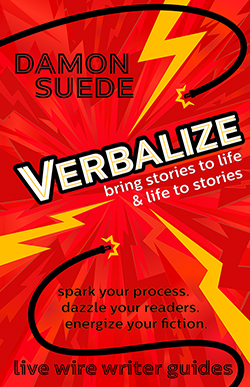
engages and intrigues an audience. Maximum impact, minimum waste.Verbalize250px

VENTRELLA: Your book VERBALIZE has just been released which builds on this. You’re also doing a workshop. Tell us about that!

SUEDE: The important thing to know is that when I first started writing fiction I thought everyone handled character and story planning the way I did. It just seems so logical.

A few years back I taught a character class with my friends Farrah Rochon and Kristan Higgins and my section of the class covering my oddball verbalization technique went viral. Confused the hell out of me! Because the approach made sense to me, I just assumed it made sense to everyone. Overnight I had people writing to say I’d entirely changed the way they planned and wrote stories. Kristan made it clear that my method was a radical departure for the same-old-same-old, and almost immediately the RWA membership loudly requested a two-hour master class from me the following year which in turn went viral via recordings… in addition to the regional workshops I did for various writing groups.

As I taught my technique, more and more my students began asking me to formalize my methods with the text they could take away complete with exercises and examples and
theory and all the things I want to read when I get stuck.

Well, VERBALIZE came out on 12 March and I’m really freaking proud of it. The NJRWA had already booked me for a weekend workshop last summer but all we knew is that it was on characterization. As soon as they found out the book would come out in advance, they asked if they could tie the two together and make the entire day of verbalization on 14 April, unpacking the techniques I covered in the book. I’m literally thrilled…I cannot wait.

Important to note. The morning will be a lecture with exercises, but the afternoon’s
format springs directly from my day with the Pocono Liars Club in January. Rather than
do manuscript critiques, I offered a verbalization session with the group of writers and
the results blew us away. Based on that success, and the feedback of your members, I
took the idea to NJRWA and they loved the idea of helping people directly on individual
projects in a lab setting. So I have Pocono Liars Club to thank for the hands-on portion
of the afternoon. It’s at least partially your doing, Michael!

VENTRELLA:  Hooray! I’m useful!

Which writers do you think are really great at characters? How do they do it?

BadIdea-DamonSuede250pxVENTRELLA: That’s like asking me to choose from my nearest and dearest! Jane Austen, Charles Dickens, Alexandre Dumas, J.R.R. Tolkien, Georgette Heyer, Madeleine L’Engle, Daphne DuMaurier, Toni Morrison, Damon Runyon, F. Scott Fitzgerald, Isabel Allende, John Le Carré, Roald Dahl, J.K. Rowling, Alice Walker, Robert Graves, Neal Stephenson, Ursula LeGuin, Mary Stewart, Charles Portis, Gore Vidal, Mike Carey…
Too many to name. They’re the folks that have gotten me through the darkest moments of my life.

How do they do it? They verbalize their characters. I mean that literally. Every one of the authors named above default to active dramatic, language that brings stories to life because they use the full firepower of potent words. They think eventfully about their stories and their casts, focusing on clear, dramatic, compelling action that wrings emotion out of an audience. They characterize and dramatize by verbalizing.

Once you start noticing the ways you can verbalize a character or story, you see it
everywhere. It’s intrinsic to human narrative, human language. And in fact it’s the way
that most entertainment has been structured since the dawn of structured entertainment. It stands to reason… verbs are the only words which can do anything. Of
course they are the core of storytelling. Especially with scripts because actors need
something to do. Actors act. Without action there is nothing for an audience to want or
watch. Everything always comes down to the verbalization.

VENTRELLA: Having written for other media, do you find that the way you write characters changes based on the medium?

SUEDE: Yes and no.

Fiction and film and stage and comics and video games and musicals and whatnot all operate with a different set of tools and tricks, traps and tripwires. It takes time to learn those each new media and each media bends in certain directions when it comes to things like character, plot, emotion, suspense, etc. much of that is determined by the actual media used for transmission. Film moves so it likes objects in motion. Fiction is solitary and requires internal, subjective processing and decoding so it tends to be more
subjective and psychological. There are overlaps but the various media vary drastically.

By the same token, the rules of characterization and dramatization don’t change. We learn this from Aristotle: character is action. Drama is action. What changes is the way
that action can best through stories in different formats based on fan expectation and
genre format. Again that’s more a function of craft than art, and it’s something that can
only be learned by experience.

VENTRELLA: What’s the best piece of writing advice you ever got?

SUEDE: Write from your joy. Write what you feel so strongly you need to give voice to it. Write the story you need to tell.51LNn0r5fBL

I spent 20+ years writing increasingly commercial projects in film/TV/theatre/comics, and little by little I let the business end of showbiz leach the joy out of my projects. By the time I started writing romance, I’d gotten to the point where every decision I made on the page was weighed against production costs and actors’ egos. I’d get myself so tied in knots that what I’d begun in enthusiasm became drudgery. That sucked. Romance really set me free to write forward. To write my own future. To write from joy every time I sat down. Writing in this genre has been such a blessing in my life because of that infectious energy and buoyancy.

VENTRELLA: How much of writing is innate? In other words, do you believe there are just some people who are born storytellers but simply need to learn technique? Or can anyone become a good writer?

SUEDE: Craft you can learn. Art comes from someplace… else. The two are mutually dependent though and not as easily separated as they might seem. I do think that there are some people with innate verbal gifts that make writing easier for them. There are born storytellers, definitely, but even they benefit from solid technique, because this is after all, a business. Still, anyone can learn the basics of craft and to be honest most bestsellers happen because of exceptional craft more than mindbending art. Craft is easier to control, schedule, to manage and therefore much better for a company’s bottom line. Art is much less predictable and much more erratic. We work at craft, we hope for art, and we take what comes.

I think of this job like masonry. Anyone willing to do hard labor can dig and haul rocks
into from one place to another. Some people might learn to shape the raw stone, organize the blocks, and raise structures which can withstand the weather. And a very few people can conceive and build palaces. All of us start out hauling stones, and with backbreaking labor and insane dedication you may discover you have palaces hiding inside you.

VENTRELLA: Thank you so much for stopping by today, Damon. I think you’ll be seeing several members of the Poconos Liars Club at the NJRWA event in April.

SUEDE: Thank you for having me, man. And thank you to the Liars Club for that weekend back in January. That breakout Character lab we did had such an impact on Verbalize as I was finishing the edits… and to the workshops I’ve done since. I’m sincerely grateful. I look forward to seeing some of y’all in a couple weeks. We’re gonna have a blast!

SUEDE


My 2018 Heliosphere schedule

Heliosphere is a fairly new convention just outside of New York city. The second one will be held on the weekend of March 9th, and guests include Charles Gannon, Eric Flint, Tom Kidd, Cecilia Tan, Danielle Ackley-McPhail, Lori Perkins, Mike McPhail, my wife Heidi Hooper (who was artist guest of honor last year!) and many more. Baker Street 2

My latest book Baker Street Irregulars: The Game is Afoot! will be promoted there. We’ll be having a raffle for prizes and although the book has not yet been released, the publisher has allowed us to sell Advance Review Copies (ARCs) for a discounted price. You can also meet some of the writers who have stories in the book, including Keith DeCandido, Hildy Silverman, R. Rozakis, Gordon Linzner, and Derek Beebe.  Autographs are free!

Here’s my schedule:

Solicited Advice: Editors Share Their Thoughts (Friday 5 pm): Get inside the editors minds and see why they accept and reject certain work. With Bjorn Haessler, Mike McPhail, Alex Shvartsman, and Ian Randal Strock.

Hogwarts House Party (Welcome to Heliosphere) (Friday 8 pm): A grand opening ceremony where all the major guests are introduced. I’m the emcee! We’ll also be placing the Sorting Hat on our guests and con attendees to see which Hogwarts House they’ll end up in.

Books ‘n’ Brew (Saturday 11:30 am): A time where you can sit down with some of your favorite authors over tea or coffee and just talk. With Laura Antoniou, Russ Colchamiro, and Hildy Silverman.

Ka Pow! the Art of the Fight Sequence (Saturday 4 pm):  How to integrate action scenes into your story without them taking over. With Keith R.A. DeCandido, Charles Gannon, and Mike McPhail.

Readings (Saturday 5:30): Authors read from their recent works. With Laura Antoniou, Carol Gyzander, and Hildy Silverman. 

Raffle (Saturday 10 pm): We’ll read off the raffle winners for the Baker Street Irregulars prizes!

Through the Ages With Sherlock Holmes (Sunday 2 pm): A not so elementary discussion of Sherlock and how he’s changed through the years. With Elizabeth Crowens, Teel James Glenn, and Mercy Van Vlack. 

Murder Your Darlings (Sunday 3:30 pm): Gerorge RR Martin has taken the art of killing off fan favorites to new heights. Others have tried to copy his style with…. mixed results. What makes this work for some stories and just plain suck for others? With Griff Barber, Eric Flint,  Charles Gannon, and Hildy Silverman.

Why no one is going to steal your work

Whenever we have a Writers Conference, there’s always at least one person in attendance who asks about copyrights and worries about sending their manuscript out because they think someone might steal all their hard work.

While I can understand the worry, it’s just not going to happen.

copy

First, remember that your ideas aren’t really that important. Seriously, everyone has ideas. It’s the way you put them into a story that matter. It’s your writing style and your voice that make the ideas yours.

There have been anthologies where the authors are given the same plot and then each writes a story, and every single one is different. How you tell the story is more important than what the story is.

As soon as you write your story, it is copyrighted. You don’t have to put a copyright mark on every page. It’s on your computer and there are ways to tell when it was written. I personally email my work to myself as I’m writing it. That way if my computer crashes, I can retrieve it. Note that this also clearly establishes that I am the author.

No one is going to steal your stuff. It’s very easy for you to prove you wrote the thing, and a lawsuit just isn’t worth the trouble.

Also, think of this: If you’ve written a really great story and you’ve sent it off to an agent or an editor, do you think they’re going to say, “This is great! I think I’ll steal it, invite a lawsuit, ruin my career, and never be able to work in publishing again!”? No, they’re going to say, “This person writes great! Let’s buy this story and get this person on our side so they can write more great stuff for us!”

There is no reason for anyone to steal your stuff and lots of reasons why they would want you to be on their side so you can create more.

Finally, for God’s sake, don’t send in a query letter that says “All this work is copyrighted by me!” or otherwise emphasize that point, because that is a red flag that agents and editors will interpret as “This person is not professional and may give me a hard time when I ask for changes.”

My turn to be interviewed

The Monkees Live Almanac page has a nice interview with me, discussing the book’s goal and origin. Check it out!
MonkeesFrontCover_preview