Interview with NY Times Bestselling Author Raymond Feist

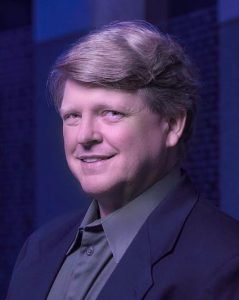
MICHAEL A. VENTRELLA: Today I’m pleased to be interviewing Raymond E. Feist!

His first novel was published in 1982, and recently he finished his massive Riftwar Cycle of thirty novels and is now embarking on a completely new series in a new RaymondFeistuniverse. His works have appeared on numerous Best Seller Lists, including the New York Times, the Times (London), and Publishers Weekly.  His books have been translated into more than twenty five additional languages and published around the world in more than a hundred countries.
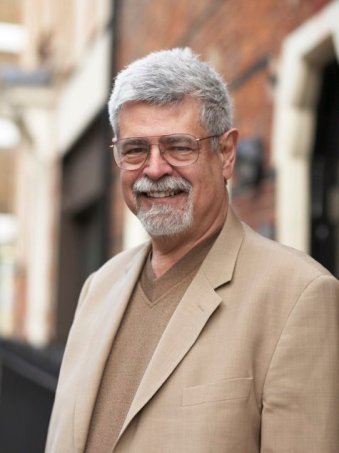
Raymond, What books were your favorites when you were young, and how do you think they influenced what you are writing now?

RAYMOND E. FEIST:  I remember Mom reading to me as a small child and the usual stuff in school from Dick & Jane.  The first book I remember Mom reading was Doctor Suess’s first book,  AND TO THINK THAT I SAW IT ON MULBERRY STREET.  The first adult book I can remember reading was TOM SAWYER, followed the day after I finished by HUCKLEBERRY FINN.  I fell in love with story telling.   I read “Boys Adventure Fiction,” a category that no longer exists, but besides Tom Swift and the Hardy Boys, and lesser known works.  I migrated into more adult story telling, people like Sir Walter Scott, Robert Louis Stevenson, Arthur Conan-Doyle (the Challenger Books more than Sherlock, and The White Company), Anthony Hope, Howard Pile, and the pulp writers, A. Merritt, H. Ridder Haggard, E. R. Boroughs, etc. and then into historical fiction, Mary Renault, Samuel Shellenbarger, Rosemary Sutcliff, and my favorite, Thomas Costain.  All of had one thing in common, other places and times, great heroic adventure.

Then when I was in about the 8th grade, I discovered Science Fiction.  My first taste was Hall Clement’s CYCLE OF FIRE, followed by Eric Frank Russell’s WASP, and I was hooked.  Joined the SF Book Club and grabbed anything off the spinner at the drug store.

Fantasy I didn’t really get into until college when Tolkien first took off around ’65 or so.   Fell in love with Fritz Leiber and Michael Moorecock’s work, the former for the great character driven shorts and novels, and the latter for the sheer brilliance of scope and the complex interweaving of the Eternal Champion myth.  Since then anything good.

VENTRELLA: What is it about fantasy that attracts you and makes you want to write in that genre?str2_ttraymond_covers_ma_3
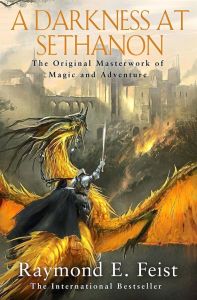
FEIST:  Simple.  There was no market for “Boys Adventure Fiction” when I decided to write, and I had a ready-to-go fantasy world I’d help build, Midkemia.  It was a no-brainer for me.

VENTRELLA: One thing many fantasy writers don’t pay enough attention to is creating a realistic and logical magic system. How did you go about making sure yours worked with the plots you wanted to explore?

FEIST:  That’s a tough one. It’s a bit intuitive, and a bit logical. You can’t have a guy who can rip down a mountain unable to blow a door off its hinges, unless there’s a compelling reasons, i.e. “I can tear down a mountain, but if I open this door, it will tear down the entire castle!” Also, some sense of the individual and social consequences need to be shown, else you’ve got a potential Superman and then everyone else gets to stand there and watch Superman solve every problem.

VENTRELLA: Do you usually start off with a basic idea or a character? How do your plots develop?

FEIST:  Ideas always come first, often with zero story attached.  My current book started with a question, one of those weird half-asleep just waking up thoughts, “Who is the King of Ashes?”  I had no flipping idea, but I loved the question. As I craft story, characters emerge and as they do, they shape the narrative, often taking it in unexpected directions. I know the end of a story—one has to, in my opinion—else you can wander though the wilderness for forty years like Moses, but you have to know where you’re going to end up. The fun is figuring out how to get there.

VENTRELLA: There is no correct way to write – I tend to outline fairly heavily before I delve in, but I also go way off that outline if inspiration strikes, for instance. How do you organize your writing?

FEIST: “Organize?” What is this word? Seriously, I’m about as unorganized as you can get and still get words on paper. I just sit down and make stuff up.

VENTRELLA: Is there any one character of yours that you identify with the best, who really has your personality?raymondefeist-silverthorn
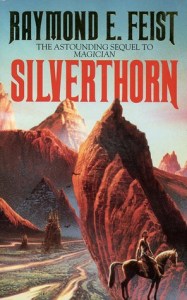
FEIST: Common myth promulgated by generations of Lit professors. I wish I was as clever as Jimmy The Hand, as competent as Prince Arutha, as charming with the ladies as Laurie of Tyr-Sog, as certain of what’s right as Pug, etc. But none of them is “me,” in any meaningful way.

VENTRELLA: Who do you like to read these days?

FEIST: Not much. It’s partially an age thing; at 71 my vision isn’t what it used to be, so after a long day in front of the computer, I’ll watch sports or politics on TV so I’m looking at something across the room. Eye fatigue is a myth when you’re 20, or even 50, but now . . . ? It’s why I moved up to the 12” iPad from the 9”. When I do read, it’s while I’m traveling, of if I take a day off and just sit in my home and read something for a few hours. I tend to prefer history and biography.

VENTRELLA: Like many authors (myself included), you started off as a gamer. How do you think that influenced your writing style and the way you structure your plots?

FEIST: Not at all. Two entirely different entertainment constructs, with different narrative requirements. Perhaps the backstory of the environment, insofar as you need to know how the bloody dungeon got there in the first place, and maybe the lore over some of the mythic loot, but the only thing gaming gave me was a rich physical environment in which to work. Game plots are pretty repetitive and boring, “kick down the door, kill the monsters, loot, heal, next door; rinse and repeat.” The part that did influence me wasn’t the gaming but the postmortems. “Remember, that time, when we went down into the desert and ran into that bunch of outlaws, who chased us into the ruins where we found the entrance to . . . ”  over many beers.  Some of that stuck, but most of it is just learning how to tell a story and write a coherent English sentence.

VENTRELLA: Do you think it is important for your books to be read in any specific order – for instance, should one start with the Magician series and then go on to another?

FEIST: Ya, it’s sort of a 30 volume trilogy, as we joke around here. However, it is broken up into five “riftwars,” Riftwar, Serpentwar, Darkwar, Demonwar, and Chaoswar, and each has its own “jumping in’ book. 8664327 So you can start with A KINGDOM BESIEGED, the first book of the Chaoswar, and it’s a complete arc, though a lot of characters and their backstories may be less than they would be had your read the earlier series.
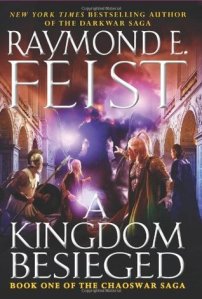
Some of the books, like the Jimmy The Hand/Krondor titles, can be skipped or read at any time, as can the Legends of the Riftwar, the three books I collaborated with Joel Rosenberg, S.M Stirling, and William Forstchen.  The Empire Series I cowrote with Janny Wurts comes in half-way through MAGICIAN and ends after A DARKNESS AT SETHANON, but also can be read at any point.

VENTRELLA: Your books inspired the Krondor video games that I remember playing way back when – were you happy with the results?

FEIST: For the most part. Nothing is ever as you imaged it would be, and there were serious corporate problems during Return to Krondor that make me glad it finally saw the light of day. Betray was for its time a massive hit with players, and I still get complements about it.

VENTRELLA: Will we ever see any other computer games based on your books?

FEIST:  All someone has to do is make an offer.

VENTRELLA: Do you like to play computer games, and if so, which ones do you prefer?krondor-the-betrayal
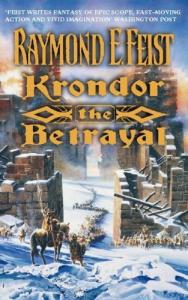
FEIST: My one black hole for time is World of Warcraft, which I play long distance with my kids, one in Northern California, and the other in Massachusetts. I play it alone to say at the computer until I feel guilty then go back to work, because if I get up and turn on the TV or pick up the book, there’s a high probability I’m done working for the day.

VENTRELLA: You’ve also inspired some tabletop and on-line RPGs. Tell us about them! Are you happy with those results?

FEIST: Not really. We had a long running texted base Mud/Mux type online game. As for the RPG stuff, it came first. Midkemia Press was publishing our system and supplements while I was writing MAGICIAN.  I’m  happy that people enjoyed them.

VENTRELLA: You haven’t avoided politics on your Facebook page – do you worry about how your readers may react?

FEIST: Not any more. I got scolded back when I first joined because of a remark I made about something Bush did, when someone felt it his job to take me to task and warn me I might lose some readers. Then I realized I have a max of 5,000 “friends” and maybe 20,000 followers, only some of whom might be annoyed by my opinion. I’ve got 15 million books sold over 30+ years, so if I lost all of my Facebook folks, I’d survive. While I don’t thing a stand-up comic and former-Playmate should be giving medical advice to people, I do think just because someone is a musician or an actor they’re supposed to pretend they have zero interest in larger issues. Same for writers.

VENTRELLA: Do you think new writers who are trying to gain a following should avoid discussing controversial issues?

FEIST: There’s no one size fits all answer, I guess. Controversy might actually sell some books; I do not know. I do know that I’m a dinosaur in publishing, that how I broke in is impossible to duplicate today. Over 30% of my first sales were through independent bookstores, and we had no Amazon, on-line blogs that reviewed books, etc. It’s a different world.magician_apprentice
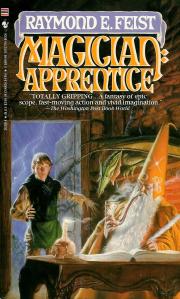
VENTRELLA: How much of writing do you believe is innate? In other words, do you believe there are just some people who are born storytellers but simply need to learn technique? Or can anyone become a good writer?

FEIST: There are two skills. One, writing, can be taught. Most people who got out of college can write a coherent English sentence, a report to their boss, a love-letter, a contract proposal, or any number of things that communicate clearly.

Telling a story is a whole other thing. I can maybe help a young writer learn how to tell a story, but I can’t teach them if that makes sense. You either have the knack or you don’t.  If you have even the tiniest bit of the knack, then you can learn to improve on it. If you have no knack, then it’s hopeless. It’s like that guy everyone knows who just can not tell a joke, no matter how he tries.

VENTRELLA: Do you think it is important to start by trying to sell short stories or should a beginning author jump right in with a novel?

FEIST: Is there even a short story market today? Back in the pulp days you could pay the rent at a penny a word, which is why so many writers from the 1930s to 1960s did both. But short fiction and novels are two different critters with entirely different structure rules. at-the-gates-of-darknessSome of us can’t do one or the other. Me, I can do both, but I’m far more comfortable with novels. Short stories are much harder for me to do.
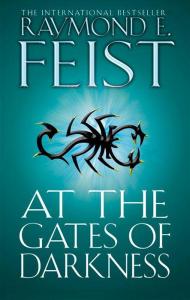
VENTRELLA: What’s your opinion on self-publishing, especially for a beginning writer?

FEIST: I have none. I am 100% ignorant of the self-publishing reality now. When I broke in there were vanity presses, people who would print your book and send them to you and a lot of unhappy wannabe writers had garages full of books no one would buy. Today, I really know nothing about self-publishing, because I’ve never not been published by a traditional house. As of two years ago, I am HarperCollins’ senior writer.  They have books in print before MAGICIAN, but none by a currently published author.  I’ve never had a book go out of print in English, so I’ve never been interested in spending time learning about self-publishing.

VENTRELLA: What’s the best advice you would give to a starting writer that they probably haven’t already heard?

FEIST: Butt in seat, fingers on the keyboard, or pen in hand, or pencil and yellow legal tablet, whatever. Write. Keep writing until you get good. If you stop, you’re not a writer.
1236436_10153919150845416_81090401_n

My 2017 Balticon Schedule

I’ll be at Balticon soon (Memorial Day weekend) along with some great authors including Eric Flint,  Catherine Asaro, Charles Gannon, Mark Van Name —  not to mention three authors who are in the Baker Streets Irregulars book: Keith R.A. DeCandido,  Gail Z. Martin, and Hildy Silverman! (The full list is here).

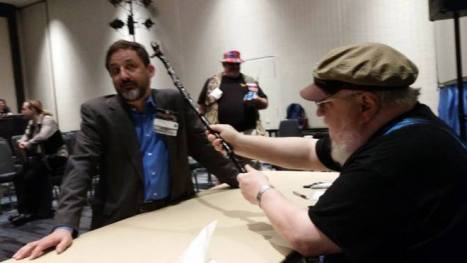
Here’s a picture of me being hit over the head by George R.R. Martin at last year’s Balticon.  (If you want to know why, click here).

grrm

Anyway, here’s my schedule (always subject to change):

Opening Ceremonies (Friday 8:00): Meet the Guests of Honor and hang out with the pros!

Freelancing in the Publishing Industry (Saturday 11:00): what kinds of opportunities are available for authors looking to publish? With Mike VanHelder

Harry Potter and the World of Fan Communities (Saturday 12:00): The universe of Harry Potter has one of the largest and most robust online fan communities ever – writing fiction, engaging in online roleplaying, blogging and sharing quizzes and media.  Was it just in the right place at the right time, or are there traits it has that inspire fans (and can be appropriated by other authors & worldbuilders)? With Oni Hartstein, Holli Mintzer, and L.G. Ransom. 

Autograph Session (Saturday 3:00): I’ll sign anything! Anything, I tell you!

Social Media Promotion Without Being Obnoxious (Sunday 12:00): Promoting yourself these days is a requirement for any writer. How can you do so without alienating everyone? With Melissa Hayden, Nathan Lowell, Hildy Silverman, and Jean Marie Ward.

Reading (Sunday 1:00): Come hear me read stuff.

Pacing the Novel (Sunday 6:00): How to make sure the pacing of your novel works. With Paul E. Cooley, Gail Z. Martin, Ken Schrader, and Fran Wilde.

Fiction Writing for Gamemasters (Monday 12:00): How to turn your ideas into books, games, and both. With Phil Kahn, Chris Lester, Mike McPhail, and Robert Waters 


My 2017 Ravencon schedule

Ravencon is a fun little convention that keeps growing — It used to be in my hometown of Richmond but now it’s in Williamsburg, right next to Busch Gardens where I spent many days riding roller coasters when I was younger… This year, the writer Guest of Honor is Mercedes Lackey! Other guests include Chuck Gannon, Philippa Ballantine, Tee Morris, Jack McDevitt, Bud Sparhawk, and me (among many others!)  Here’s where you can find me:

RavenConBanner

Opening Ceremony (Friday 7 pm) Wherein guests are introduced and Mike Pederson tells some bad jokes

What Rules to Break and Which Don’t Apply (Friday 9 pm): Many new authors have heard the rules: One POV per scene, don’t use adverbs, limit the POVs to no more than three per story. These “rules” have been taught for over a hundred years, but who came up with them and do they still apply to the modern reader? With Nicole Givens Kurtz, Kelly Lockhart, and Melissa McArthur

The Dystopia is Already Here; It’s Just Not Evenly Distributed (Friday 10 pm): Unable to change abortion laws that have already been decided upon by the Supreme Court at the federal level, many state legislatures have gotten laws approved that effectively ban abortions by curtailing various freedoms for “medical” reasons. Protections for voting rights have eroded in a similar manner, at the state level. While dystopian literature has all but taken over the field of Young Adult SF, the resolutions offered by these narratives are often violent. How could SF/F predict more realistic/more feminist ways to combat local hostile governments? With Nancy Northcott, Carolyn O’Neal, and Gray Rinehart 

Time Travel in Literature (Saturday 1 pm): Many books include time travel, some more successfully than others. How does time travel affect plot lines and history in different ways in different books? What are some of the more creative uses of time travel and ways around the paradoxes? With Lou Antonelli, Darin Kennedy, and Steve White 

Ethics Behind the Story: Moral Dilemmas In SFF (Saturday 2 pm): Science fiction as a genre is rife with future ethical issues. Fantasy is all about the moral choices of heroes and villains. Learn about ethical dilemma, receive a brief overview of Western ethical philosophy including the diverse approaches to resolving moral dilemmas, and discuss what important moral issues we will face in the future. With Charity Ayres and Fabian Rush

Pre-Judging for the Masquerade (Saturday 6 pm): In which I give a pep talk and advise the masquerade participants in how to present themselves for the judges and the audience.

Reading (Saturday 9:25 pm):  I’ll be reading something (audience choice)!

Signing (Sunday 10 am) I’ll be signing anything anyone wants me to sign (preferably my books)

Zombipalooza!

Zombiepalooza radio recently did a five-hour show (!) dedicated to my latest anthology BAKER STREET IRREGULARS. It was great fun, and we took in questions from viewers and had a lot of laughs.

I was the main guest for the first hour, but I stuck around for the entire thing since I was the co-editor of the book. Every hour would be another guest author: First there was Jim Avelli, then Keith DeCandido, Jody Lynn Nye, and Ryk Spoor.

We discussed Sherlock, writing, talent, and many other things, with lots of advice for writers (based on what the authors interviewed said they did to prepare a story).

Please check it out!

My Lunacon 2017 Schedule

Another convention, a week after the last. It’s been a busy month — and now it’s time for Lunacon, featuring Guests of Honor Ben Bova and Bob Eggleton.logo_lunacon

Here’s my schedule:

What Makes it Go, Besides Steam? (Friday 8:30): How do you effectively develop the historical setting for a steam-billowing plot? Research? Reading? Imagination? Exploration? Steampunk writers discuss their methods for determining the time, the place, and the brass to make it all work. With Danielle Ackley-McPhail and Russell J. Handelman.

Writing Social Change in SF (Saturday 2:00): This panel explores how speculative fiction can present the social, environmental and political challenges of our society. What is the best way to discuss these challenges without alienating readers? Is it our responsibility as artists to incorporate these issues in our work, whether overtly or covertly? How can we avoid prejudices and stereotypes in our work? With Marcy Arlin, Richard Herr, and Matthew Kressel.

Sherlock Holmes, From Page to Stage to Screen (Saturday 5:00): A discussion of Sherlock Holmes in all the myriad forms that have come from the works of one man. From stage to screen to games to LARPs and beyond. With Ef Deal, Russell J. Handelman, Debra Lieven, and Terence Taylor.

Masquerade (Saturday 8:00): The annual costume competition, in which I will be hosting (again)! Judges will be Bob Eggleton, Marianne Plumridge, Roberta Rogow, and Carol Salemi. Here’s a video of last year’s Masquerade:

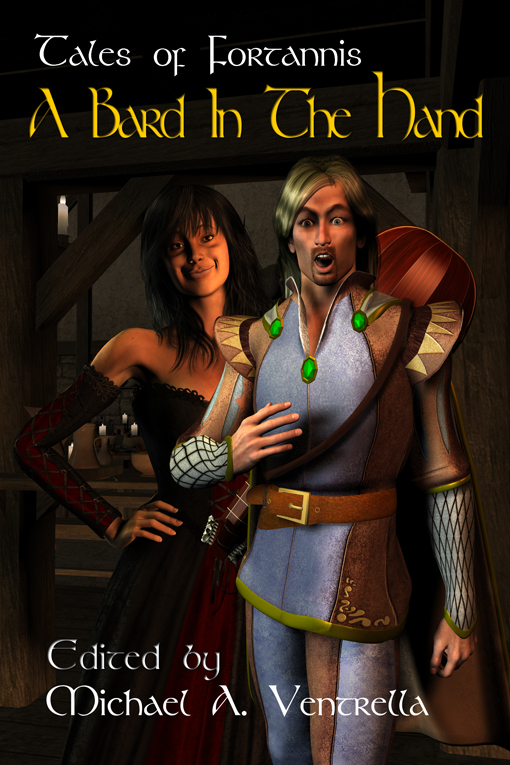
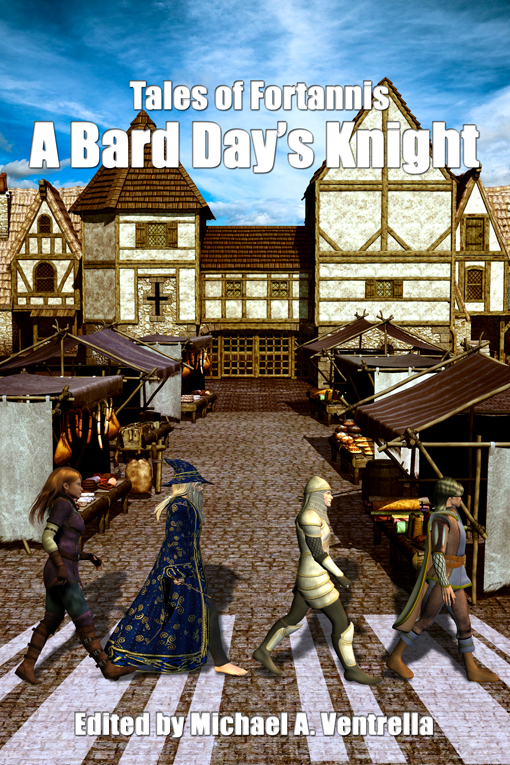
Reading (Sunday 12:30): I’ll be reading from either Bloodsuckers or the short story “Remembering the Future” from Tales of Fortannis: A Bard Act to Follow (audience choice).

Edit Me (Sunday 1:00): Editors chat about today’s and tomorrows challenges in editing genre works. With Danielle Ackley-McPhail, Neil Clarke, Elektra Hammond, Gordon Linzner, and Ian Randal Strock.

My Albacon 2017 Schedule

I’ll be at the Albacon convention this weekend in Albany, New York. The Guest of Honor is Charles Gannon!

Here’s my schedule:

ceghead-239x300

Chuck Gannon

What Publishers (and Readers) Want (Friday 10 am): A look into what makes a story appealing. With Charles Gannon, Hildy Silverman, Rick Ollerman and Ryk Spoor.  

Writing Techniques — Revising, Editing, Outlining (Friday 1 pm): Some tips on how to work better. The panel will answer questions from the audience about issues that they have problems with. With Charles Gannon,  Melissa Mead, Hildy Silverman, Rick Ollerman and Ryk Spoor.  

Critiquing Panel (Friday 4 pm): Workshop participants will bring their work. The panel will read it and then make suggestions. With Anatoly Belilovsky, James Cambias, Lawrence Connelly, Chuck Rothman, and Ryk Spoor.

Improvisational Storytelling (Friday 10 pm): An old Albacon favorite! Authors create stories from suggestions from the audience. With Don Sakers, Ryk Spoor, and Ian Randal Strock.

Autographing (Saturday noon): Signing books (or anything else you want autographed).

Games Into Fiction (Saturday 3 pm): How does one format enhance the other? With Cameron Calkins, Charles Gannon, Walter Hunt, Ryk Spoor, and Robert Waters.

The Eye of Argon (Saturday 11 pm): The worst story ever, as you’ve never seen it before! With Hildy Silverman and Ian Randal Strock.

Reading (Sunday 10:30 am) I’ll be reading from either Bloodsuckers or my latest Fortannis short story (audience choice).

My Turn to be Interviewed!

The web page Random Chatter has a short interview with me today where I discuss Sherlock Holmes, why I don’t like the Star Wars prequels, and the Monkees. ‘Cause, you know, they’re all so similar.

Baker Street Irregulars

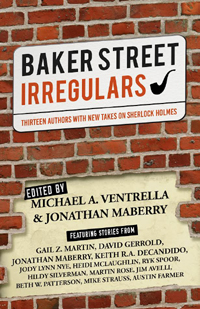
What if Sherlock Holmes was born in a different body in a different time and place? In this new series, New York Times Bestselling Author Jonathan Maberry and I invite others to speculate as to what that might be! It’s officially releasing from Diversion Books on March 21 in paperback, ebook, and an audio book as well. You can pre-order it now on Amazon or Barnes and Nobles or anywhere, really.

Here’s the great Table of Contents:baker-street

“’Locked” by Mike Strauss: Sherlock is the host of a reality show

“Identity” by Keith R. A. DeCandido: Sherlock is a young girl in modern New York City

“The Scent of Truth” by Jody Lynn Nye: Sherlock is a doglike alien

“The Adventure of the Reluctant Detective” by Ryk Spoor: Sherlock is not what he thinks he is

“A Scandal in the Bloodline” by Hildy Silverman: Sherlock is a vampire

“The Fabulous Marble” by David Gerrold: Sherlock is a bio-synthed, augmented, 7 percent human, upgraded, unmortal, consulting extrapoloid

“The Scarlet Study” by Jim Avelli: Sherlock is a worker in a dystopian world

“Delta Phi” by Heidi McLaughlin: Sherlock is an eighteen-year-old female college student

“Beethoven’s Baton” by Austin Farmer: Sherlock is a musician in Beethoven’s orchestra

“The Adventure of the Melted Saint” by Gail Z. Martin: Sherlock is a transgender detective in Charleston

“Automatic Sherlock” by Martin Rose: Sherlock is an automaton in a near-future Russia

“The Hammer of God” by Jonathan Maberry: Sherlock is a nun who works as a field investigator for the Office of Miracles

“Code Cracker” by Beth W. Patterson: Sherlock is a parrot

Here’s what Kirkus Reviews says:

When has Sherlock Holmes changed so much that he’s no longer Sherlock Holmes? In this aptly titled collection, 13 new adventures of Holmes and Watson, more or less, push the envelope far beyond Baker Street.

Not surprisingly, fantasy mavens Ventrella and Maberry (who alone published Kill Switch, 2016, etc.) have one and a half eyes out for outlandish, often futuristic incarnations of Holmes, and so do their contributors. Jody Lynn Nye’s Holmes is a doglike alien “a bit addicted to shag”—carpet, that is. Jim Avelli posits a dystopian world in which Holmes is arrested for shooting his ex-wife, Irene Adler. Martin Rose presents a robotic Holmes, a failure as a medical surgeon, who gets a new lease on nonlife as a nosy detective. Editor Maberry’s reimagining of Holmes as Mother Frey, who investigates miracles for the church, drives perhaps the deepest into fantasy territory. Meanwhile, back in the past, Austin Farmer puts Holmes and Watson to work as violinists in Beethoven’s orchestra. In the present, Gail Z. Martin reinvents Sherlock as Shelley Holmes, a transgender Charleston sleuth who works for store credit at an antiques shop; Hildy Silverman reveals that Holmes and Watson (and Irene and Godfrey Norton) are vampires; Heidi McLaughlin makes Holmes an insecure college coed whose first case leads to her first kiss; Mike Strauss imagines Holmes as a particularly annoying reality show host; and Ryk Spoor dramatizes Holmes and Watson’s painful awakening to their status as fictional characters. In the three most successful stories, Beth W. Patterson makes Holmes an unusually reflective parrot, David Gerrold festoons his cyber-Holmes and -Watson with some hilarious acronyms, and Keith R.A. DeCandido scores with a surprisingly faithful update of one of Conan Doyle’s most treasured tales.

Less notable as independent creations than as provocations to think about Holmes and the Sacred Canon in innovative ways bound to lead to next year’s anthologies.

We had the official book release party at the Heliosphere convention and it was quite successful — we almost sold out of the many advance copies the publisher provided.

If you get a copy, please remember to post your review on Amazon and Goodreads and elsewhere!

The game is afoot!

17192616_10158357559215416_7848686659677971700_o

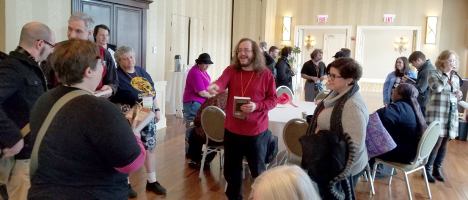
Keith DeCandido signs books at the release party. Off to the right, you can see Hildy Silverman and to the left, there’s Jim Avelli. Also in attendance but not in this picture were David Gerrold, Austin Farmer, Ryk Spoor, and me!


My Heliosphere 2017 schedule

Heliosphere is a brand new convention I will be attending next weekend (March 10th) and is very special because it will be hosting the book release party for my latest:  Baker Street Irregulars!baker-street

The Guest of Honor at the convention is David Gerrold, who has a story in this new anthology, so this is the perfect place for our release party. Also in attendance will be other contributors to the book, including Keith R.A. DeCandido, Ryk Spoor, Hildy Silverman, and Austin Farmer!

Heliosphere will be held in Tarrytown, New York, just outside of the city. (Also I have to brag a bit: My wife Heidi Hooper is the “Special Guest” artist!)

Here’s my schedule:

Reading (Friday 3:30): I’ll be reading from my work, along with Anthony Balilovsky, Keith DeCandido, Alex Shvartsman, and Grant Carrington.

Books and Brews (Saturday 10:00) Come join me for coffee (no brews at 10 am, unless you want to) and we can talk about anything you want!

Capturing and Changing History in Speculative Fiction (Saturday noon): History is always subjective. Or at least written by the winners. How do you keep it close enough to recognize but different enough to be exciting? Listen to discussions among Pros and Fans. With Charles Gannon and Roberta Rogow.

Baker Street Irregulars book launch party (Saturday 1:30): A celebration for my new book, with prizes!

Elementary, My Dear Watson (Saturday 4:30): Why is Sherlock Holmes still so popular? People are flocking to recent comic releases, films, and plays. Panelists will discuss why Sherlock is still such a popular figure in contemporary culture. With guests Carol Bugge, Elizabeth Crowens, Keith DeCandido, and Marvin Kaye.

Autographing (Sunday 11:15): I’ll be sharing autographing space with David Gerrold and David Harten Watson.

The Biggest Mistakes Made by Beginning Writers (Sunday 2:00): My solo presentation for new writers.

My Mysticon 2017 Schedule

I’ll be a guest at Mysticon next weekend (February 24-26) in Roanoke, with author Guest of Honor David Weber and media Guest of Honor Jason Carter (best known as Marcus on Babylon 5). carter(My wife, award-winning artist Heidi Hooper, is also a guest.)

Mysticon is a fun little convention. Here’s where you can find me!

Just the Basics: LARP (Friday 3:00): LARPing? What? Ooh, you mean Live Action Role Playing! Join our panelists for a glimpse into the world of Role Playing and what it means to bring it live! LARPing can be for anyone, and this is just the first step in what could be a wonderful journey! With Bob Flack

Surprisingly OK (Friday 4:00): A panel to discuss all things Sherlock (BBC, and any other incarnation). I’m the moderator. With Alexandria Christian, Jesse Knight, and Spencer Lovell

The Eye of Argon (Friday 10:00): The worst science fiction story ever written gets a reading by our brave panel as they compete to go the longest without tripping over a misspelled word or laughing uncontrollably. Audience members are also encouraged to take a chance. Can you keep a straight face, especially when the panel begins acting out the story? I’m the moderator.  With Gail Z. Martin, Peter Prellwitz, and Gray Rinehart 

Little Green Men (Friday 11:00): July 1947. Did a UFO crash in Roswell, New Mexico? Have we already encountered extra-planetary aliens? If so, what happened to them and their spaceship? These questions have been on the minds of UFO hunters for many years. Our panelists take us back to that first week of July 1947 and dig into the truths and myths of Roswell. I’m the moderator. With Butch Allen, Spencer Lovell, and Christopher Weuve.

Writers Workshop (Saturday 9:00): How to structure your story and write a great opening plus other exercises With Peter Prellwitz, Allen Wold, and Darcy Wold.

Whose Line is it Anyway? (Saturday 8:30): The science fiction and fantasy version of the popular TV show where the points don’t matter. With Gail Z. Martin, Peter Prellwitz, and Gray Rinehart.

Writers Workshop (Sunday 10:00): More of how to structure your story and write a great opening plus other exercises With Peter Prellwitz, Allen Wold, and Darcy Wold

The Last Racebenders/Genderbenders (Sunday 11:00): Changing races, genders, etc. of established characters in movies, comics, and television. It’s been time and time again- how does this impact a series or film?  With James Beall, Madalyn McLeod Johnson, Andrew T. Macht, Amanda McGee, and Maya Preisler.

Do AIs Have a Soul? (Sunday 12:00): Artificial Intelligence has long been a topic in many books, movies, and games. Can uploaded personalities possibly have souls?  With Michael D. Pederson, Maya Preisler, Abigail Wallace and Christopher Weuve.

Collaborating in a Shared Universe (Sunday 2:00): Collaborating with others can be hard. Collaborating in a shared universe can also be hard. Learn how to do both in this panel! With Rodney Belcher, Tera Fulbright, Kim Headlee, and Christopher Kennedy.

(Schedule subject to change!)


bakerbook

Coming March 21st!