Interview with NY Times Bestselling Author Tad Williams

I first became aware of Tad Williams upon reading the Memory, Sorrow and Thorn series in the early 90s and was engrossed with the characters and the great twist at the end. He’s gone on to write further acclaimed New York Times bestselling novels, comic books, and young adult novels, and I’m pleased and honored to be interviewing him today! His webpage is www.Tadwilliams.com.tadwilliams

MICHAEL A. VENTRELLA: Tad, you have a varied background with which I can identify. There’s nothing wrong with having worked in radio and been in a band, moving from one job to another and finding out what you want to do with life (I did much the same, although fortunately I never had to work in a shoe store). Was writing always in the background for you, just waiting for the will? When did you say to yourself “This is what I want to do in life”?

TAD WILLIAMS: Creative work was always in the background, but writing was only one of the things I pursued. It just happened to be the one that turned into a possible career. If I’d sold a screenplay or got a gig cartooning I might have gone that way instead.

VENTRELLA: Many aspiring writers say to me that they just can’t seem to find the time to write given that they have jobs to do and real life getting in the way. How did you do it?

WILLIAMS: If you can’t find time to write, you’re not a writer. That’s not to be glib, but some people would rather talk about the reasons they can’t do something than just do it. (My son and his homework spring to mind.) You either do it or you don’t. If you don’t write, you’re not a writer.

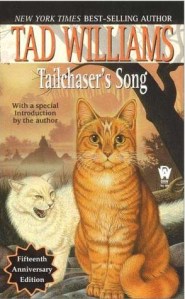
VENTRELLA: Was TAILCHASER’S SONG the first novel you wrote? How did you grab the attention of editors?
tailchaserTadWillilams
WILLIAMS: Yes, TAILCHASER was my first book. I was a bit naive and didn’t have an agent, but I was fortunate that the book itself caught my editors’ attention. If I had to do it again, I’d be more aware that I was very lucky. I’d probably try to get an agent first.

VENTRELLA: Has the publishing industry changed as dramatically as everyone says since that time?

WILLIAMS: It’s always been a small-margins business, but the advent of electronic media and the internet have really confused things. Nobody knows what publishing’s even going to look like in ten years, but I think it’s likely it will be less vertical — that is, one company buying books, editing books, designing books, printing books, binding books, warehousing books — and more of a collaboration between smaller businesses. Also, electronic media are only going to become a bigger part of the industry.

VENTRELLA: What do you know now about the industry that you wish you had known when you first started out?

WILLIAMS: I wish I had understood the career arc better, and the complexity of the process of publishing a book. I might have paid more attention to deadlines and to thinking long-term about what I wanted to write.

VENTRELLA: Why are the third parts of your books so huge that they have to be released in two volumes? Can’t you stop? (OK, that’s a joke question.)

WILLIAMS: I have an illness, and it’s not nice to make fun of it. Jeez.
shadowrise-by-tad-williams
VENTRELLA: You currently are working on the SHADOWMARCH series. Do you outline the series completely in advance or prepare something more basic?

WILLIAMS: I like the balance between knowing too much and knowing too little, so I certainly outline, but I leave lots of room for things to change, grow, whatever, as I write the story. That way the story stays fresh, but the fact that there’s structure means it doesn’t meander too badly.

VENTRELLA: Please tell us about SHADOWMARCH!

WILLIAMS: The end is finally in sight for this project, which has moved through three or four media and a couple of decades. It started with a possible tv series or film, then became an internet serial, and I’ve given the story its greatest realization as a series of books, of which I am now writing the ending. It’s a return to epic fantasy, but it also has its own particular twists that separates it from my other books. I’m pleased with what it’s turned into, and think it’s much better and deeper now than it would have been in another medium.

VENTRELLA: Do you see yourself working in other genres in the future?

WILLIAMS: Within reason — I probably won’t be writing any westerns, for instance. But my next set of books will be closer to modern fantasy with a touch of extreme romance (mid-level angel and high-level demon fall painfully in love), so, yeah, I’ll be skipping around like I usually do.

VENTRELLA: How is writing Young Adult series different? tadwilliamsdragon
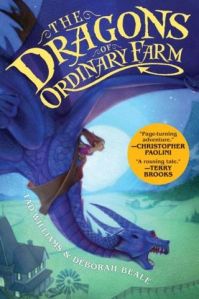
WILLIAMS: Certainly the main difference for me is keeping the complexity down and the action fast-paced. I don’t believe in writing down to an audience, so we haven’t written anything deliberately “young”. The main characters are young, and — as with almost all good YA fiction — they are forced to solve problems the adults should solve but don’t. Other than that, though, it’s a book — all books should be written like something the writer himself or herself would enjoy reading.

VENTRELLA: Since you are using characters created by someone else when writing for comic books, do you feel constrained in any way?

WILLIAMS: I felt very constrained, but most of that was problems in communication with that particular situation. I thought I’d have more leeway than I did, and I thought I’d have more time to try to turn the thing around than I did. That said, when I can afford to do it again I probably will…

VENTRELLA: What are you most proud of? What would you like to be remembered for?

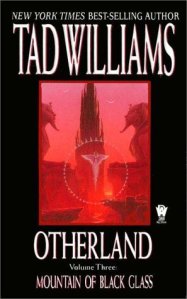
WILLIAMS: I think I’ve always brought something bigger than the genre to my genre fiction — I think of myself as a gateway drug for genre readers, leading them down the slippery slope to real literature. (This doesn’t mean that I don’t think lots of fantasy and science fiction are literature, only that because they’re genres they contain primarily books written for a genre market, ie, tending toward the formulaic.) Of all my books, I think so far the OTHERLAND novels are my signature — the best example of the width of my range.
williamsotherland
VENTRELLA: Off topic a bit: What kind of music did you play in your band?

WILLIAMS: The original band was very influenced by folks like Beatles, The Who, the Bonzo Dog Band, David Bowie, Brian Eno, and maybe even the Tubes. (We would have been influenced by They Might Be Giants, but we predated them.)

VENTRELLA: What do you listen to today?

WILLIAMS: I still listen to all that sort of stuff, but also lots of modern stuff, Beck, Radiohead, Sigur Ros, and pretty much anything Damon Albarn does, just to name a few. Robyn Hitchcock. Fountains of Wayne. Yeah Yeah Yeahs. Also some hiphop, some folk, jazz occasionally, lots of classical — you name it, really.

VENTRELLA: You have very good taste in music (because it’s very similar to mine). Add in XTC, Elvis Costello and Sparks and we’d be just fine.

WILLIAMS: I like all those bands very much, Michael. I was caught between “who influenced your band” and “who do you listen to now”, and they all sort of fit into both — well, XTC not so much the former, because we were already writing music when they came out. But Elvis may be my all time favorite artist other than my top three — Beatles, Who, Bowie. (Yes, I love the Stones and the Kinks and Hendrix and a ton of other first-generation guys, but I’d probably have to put Elvis C into the top four.)

Interview with World Fantasy Award winning author Tim Powers

Tim Powers has won the World Fantasy Award twice now, for LAST CALL and DECLARE, the Philip K. Dick award twice for THE ANUBIS GATES and DINNER AT DEVIANT’S PALACE, and has multiple Nebula award nominations.tim-powers

Tim Powers has always been one of my favorite authors. I look forward to every new release and move it to the top of my “Must Read” pile. My wife likes his work too, and turned him into a piece of dryer lint art which Tim purchased and now has hanging on his wall. (No, I’m serious — check out my wife’s page at www.HeidiHooper.com).

I met Tim at a convention a while ago and now it gives me great pleasure to be interviewing him.

MICHAEL A. VENTRELLA: Tim, one of my favorite books of yours is the pirate novel ON STRANGER TIDES. Let’s start with the big news then: How did this end up as the fourth Pirates of the Carribean film?

TIM POWERS: Disney optioned the book a couple of years ago for a projected fourth Pirates movie, and now it seems likely that the movie will happen! I imagine it’s the Fountain of Youth element in the book that they mainly want to use, but I haven’t talked to the script writers or anything, so I’m only guessing. In any case, I’m very pleased with this new attention being paid to a book I wrote 23 years ago!

VENTRELLA: Are you worried that the book may change too much upon being transferred into a film with already established characters? Do you have any say in this?

POWERS: No, I have no say in it, and that’s okay with me. I never feel that a movie must accurately reflect a book it’s based on — look at “Bladerunner”, or “To Have and Have Not”! Both were great books made into great movies, and the movies had very little to do with the original books. And obviously this movie can’t be based at all closely on the book, since the movie is using characters that are already separately established. I mainly want to be surprised when I see the movie!

VENTRELLA: Is it true that you get to have a cameo?TIDES

POWERS: No, that was an internet rumor. I’ve often said that if anybody were to make a movie of one of my books, I’d have three non-negotiable demands: (1.) That my wife and I get parts as extras in some crowd scene; (2.) That we get a free lunch from the catering truck; and (3.) that we get six of those cool jackets they make for the crew, with the movie logo on the back. This was, though, a joke!

VENTRELLA: Most of your novels follow a technique unusual for other writers, in that you take items from real history and find ways to make them interconnect in magical and fantastic ways that cause a reader to say “Aha! That makes perfect sense now!” when in fact it’s just make believe. How did this style come to being?

POWERS: Back in the mid-’70s, Roger Elwood proposed a series of books in which King Arthur was reincarnated at various points in history to save Western civilization. K. W. Jeter and Ray Nelson and I signed up to write these books, and I drew three places in history: 1529 (the Siege of Vienna), 1650 and 1810. Elwood’s project collapsed, which was just as well, but by then I had noticed the virtues of historical fiction! Such as — you get your exotic world ready-made, with its geography & maps, climate, government, currency, cuisine, mythology –! Even a lot of usable characters and events come with the package, all free. All you’ve got to do is look at the settings and the events and figure out a story that could be woven among them without knocking anything over. Find the inexplicable bits and connect the dots. It’s much easier than making up a consistent other-world, and I like to think it makes the supernatural developments more plausible, since they occur in places and among people that the reader has actually heard of.

VENTRELLA: Do you look for the connection first, or do you read a lot of history and biography and then see what jumps out at you?

POWERS: I approach it sort of like a paranoid detective. I read heaps of biographies and journals and whatnot, and my attention is polarized to look for things that don’t fit — which any biography has. And I ask myself, “Aha! What was really going on there?” And I make it a rule that nothing is a coincidence — if Keats did something on the same day that the King of Prussia did something, they’re secretly connected. And as I look for clues to the secret back-story, I eventually come up with one!

VENTRELLA: Has it ever not worked? Have you ever decided “You know, I’d love to do a book about X” and then after research, determined there wasn’t enough there?

POWERS: Not so far! I think anybody’s biography — Louisa May Alcott, Beatrix Potter — if it was thorough enough, could provide this sort of clues, this sort of evidence of a secret supernatural real story. Of course I’ve got to let the clues dictate it — it might turn out to involve vampires, or ghosts, or werewolves, or anything. If the research is going that way, I let my story go that way too.

VENTRELLA: What do you think of Dan Brown’s work? Do you think he is just copying your style, but not as well?

POWERS: Well I doubt that he’s copying me! That is, I doubt he’s read my books. But if I were ever (per impossibile) to collaborate with him, I’d tell him, “No, our made-up history has to be plausible enough to at least stand up to a quick search in the Encyclopedia Britannica!”

VENTRELLA: What gave you the idea for THREE DAYS TO NEVER? never

POWERS: It started with me noticing that, in all the photographs of Albert Einstein, his hair was white after 1928. So I wondered what had happened to him in that year — the biographies said he had some sort of stroke, or heart attack, or seizure, but I thought, “I wonder what really happened?’ So I started reading all the biographies of him, which led me to histories of Israel, and Charlie Chaplin, and Kaballah, and God knows what-all else. And of course at every turn I found odd details that couldn’t entirely be explained. One significant thing was this “maschinchen” or “little machine” that Einstein was working on for years; I eventually concluded that it must have been a time machine.

VENTRELLA: Were you a Chaplin fan before that? Or was it just research that led you to including him in?

POWERS: I wasn’t really a Chaplin fan, before I had to research him! Now I love his movies, especially “City Lights” and “Modern Times” and “The Kid.” Eventually I realized that the reason I had thought I didn’t like Chaplin was because I connected him with people like Lucille Ball and Carol Burnett doing imitations of him. Hardly fair.

VENTRELLA: You’ve commented before that you dislike it when authors try too hard to give messages or when readers try to read too much into the work. Have you been the victim of this, and how do you counter it?

POWERS: If people claim to find themes or messages in my books, that’s okay with me, as long as it’s nothing nasty. There may, for all I know, be themes and messages in them! But certainly I don’t have “things to say” in my stories — any themes that may show up are from my subconscious, not from any deliberate intention of my own.

VENTRELLA: What do you know now about the publishing industry that you wish you had known when you first started out?

POWERS: Oh — hard to say. My first publisher, Laser Books, surprised me by re-writing bits in my books, but nobody’s done that since. Really I haven’t learned anything that would have made me behave differently if I’d known it from the start! I guess I have no real complaints!DECLARE

VENTRELLA: What sort of advice would you give an aspiring writer that you wish someone had given you?

POWERS: Finish what you start, don’t do dozens of unconnected “Chapter Ones” that extend for only a couple of pages each. That’s kind of obvious, I know, but you specified what I could have benefited from hearing. To aspiring writres in general, I guess I’d say — read a whole lot, and not just in the field you want to write in and not just in the century or centuries you’ve lived in; and try to ditch your reflexive 2009 mind-set when you’re reading the old stuff. Don’t be cynical or ironic or tongue-in-cheek or Post Modern — that is, take your characters and their concerns at least as seriously as you take the elements in your own life. Don’t fret about the fact that your first drafts are dumb; they’re supposed to be. Print your stories out in the correct format and send them to editors — and start with the best publishers and magazines, don’t anticipate disappointment by starting with the lower ranks. Don’t self-publish.

VENTRELLA: And finally, what work would you like most to outlast you? What do you want to be remembered by?

POWERS: Oh gee — I suppose ANUBIS GATES or LAST CALL or DECLARE! I think those are my best. After I’m dead I won’t care, of course, but there’s something charming about the idea of somebody a hundred years from now finding a book of mine in a junk store and enjoying it, and trying to find more!

Interview with Mark Waid

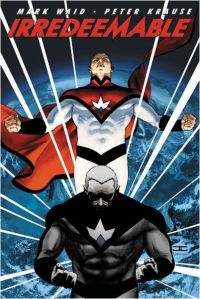
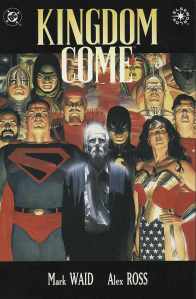
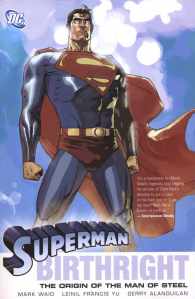
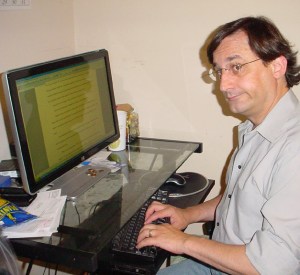
MICHAEL A. VENTRELLA: I’m very pleased to be interviewing Mark Waid, one of the biggest names in comics today. He’s been an editor with DC and as a freelance writer has become one of the most well-known and prolific writers of quality comics. In 1996, with artist Alex Ross, he released his best-known work, the graphic novel KINGDOM COME, which depicted the fate of Superman, Batman, Wonder Woman and other heroes as the world around them changed. Its popularity led to him receiving the Comics Buyer’s Guide Award for Favorite Writer in 1997. He has since gone on to fame with the FANTASTIC FOUR and with the re-imagining of Superman’s origins in BIRTHRIGHT. Currently he is an editor-in-chief with Boom! Studios and has been writing for THE AMAZING SPIDER-MAN, including one of my favorite books in which Spider-Man saves Stephen Colbert. (You can see it on the shelves behind Stephen if you watch the show). Waid headshot His web page is here.

Mark is also the only big name in comics who I’ve known since High School, who was in my Dungeons and Dragons group in college, and who went to my wedding. It’s always great to see a good friend make it big in a job he loves! Mark is a true Superman purist, and I still recall leaving the theater with him after watching “Superman 2”, hearing him curse because “Zod shouldn’t have had that stupid power to point his finger at someone and make them float into the air!”

MARK WAID: It’s true. I’m still traumatized, by the way. At least the recently released Richard Donner cut finally set my mind at ease. But don’t get me started on Superman IV.

VENTRELLA: Mark, writing for graphic novels involves a different type of writing skill than would be needed for a short story or novel, but still requires a mastery of words. What is your creative process?

WAID: As an incredibly general rule, for me, every story springs from images. As I tell young writers who are breaking into comics, you don’t have to tell super-hero stories–comics is a wide medium that covers all genres–but for the love of God, it’s a visual medium, so it’s not the best fit for your J.D. Salinger riff or the extended inner-monologue. The short rule of thumb is that, in comics, you should take advantage of your unlimited visual budget and shouldn’t waste a lot of space on talky plainclothes scenes unless they’re visually interesting in and of themselves. Use the medium to its fullest. Tell a story that couldn’t be told just in dialogue or in prose or in iambic pentameter.

And be aware that comics is a collaborative medium, so don’t fall into the trap of thinking it’s all about dialogue. It ain’t a Mamet play. It’s words and pictures together, in concert.

For me, I’ll start thinking about the characters I’m writing about–whether of my own invention or established characters like Superman or Spider-Man–and, with a very general idea of the sort of story I want to tell or the sorts of character beats I want to hit, I’ll let my mind wander until I hit an idea for a scene that has impact. (“Hmmm…I want to write a story about Spider-Man’s enemy, Electro, having lost all his stolen-but-invested money in the same economic crash that’s recently ruined so many honest lives–and how a very powerful villain who feels he’s been robbed would react to the idea of government bailouts. Huh. I should have him stage a scene at the New York Stock Exchange. He can rant and rave like Rick Santelli, but with electrical bolts coming off of him, stronger and more chaotic as he gets more and more worked up, NYSE monitors exploding around him.”)

Once I come up with three or four of those scenes, I start to knit them together in my head to form a narrative, tossing out (or, more likely, saving in the S.O.S. file [Some Other Story]) the scenes that don’t support the tale.

Then it’s creating a rough outline or beat-sheet for a story, with a 1000-stories-under-my-belt sort of instinctive feel for how many pages to allot each scene (knowing that, in the actual writing, they ALWAYS take up more room than allotted). Then the hard part: typing “Page One, Panel One” and going from there.

But, as I say, it’s about conveying your ideas visually as well as verbally. The entire working process hinges on being able to do that.Bk 1 (2)

VENTRELLA: Do you find yourself limited in that you primarily are writing for established characters?

WAID: Not really. Honestly, there are trade-offs. No, I can’t have Superman or Batman do anything I want them to do given that I don’t own them, but at the same time, having grown up reading the adventures of these established characters as a fan, what they do and don’t do is burned into my DNA. In that sense, I don’t find writing for them any more limiting than I do being behind the wheel of a car that I can’t make fly. It’s not like I drive around feeling “limited.” I just feel like I’m working with a familiar tool and automatically know what it can and can’t do.

On the other hand, when I write my own characters in series that I own, all limitations are off–but that’s as daunting as it is freeing, because there are more decisions to make as a writer, and the freedom that brings is counterbalanced by the sometimes paralyzing number of choices literally at my fingertips.

VENTRELLA: Do space considerations stand in your way?

WAID: Always. Constantly. Always. Always. Oh, God, how I envy screenwriters. You need an extra page, Mr. Movie Writer? Take an extra page. American mainstream comics, on the other hand, are generally about 22 pages long, give or take, and if you’re doing a story that’s in one installment, you have to fit it to that space. If you’re doing a longer story that spans several issues, you still have to construct each individual issue with some sense of climax/resolution or obstacle/victory or what have you in order for the reader to enjoy each issue as it comes. Honestly, most of the storytelling choices I make on a daily basis have less to do with plot and character than then do with trying to figure out how to fit those things into this rigid structure. It’s like writing haiku.

And even if you’re setting out to do a longer-form graphic novel, space is still a consideration. Only so much art will fit on a page. Only so many words will fit comfortably within each panel without crowding out the art. AND your job as a writer is to try to convey information as economically as possible without sacrificing plot or character, so there’s that plate to juggle, too; again, even when you’re working longer-form, real estate is precious. Each panel of a comic story is a “frozen moment,” a snapshot from your story, and only so many can fit.

I go into excruciating detail on these points on my blog, markwaid.com, which is full of craft essays. And because I’m not always sober when I write them, they’re probably more entertaining than this answer has been.

VENTRELLA: Do you ever plan on writing a novel?

WAID: Dear Jesus God, no. Never. I don’t have the attention span for it, I don’t have the linguistic chops, and I don’t have time to teach myself without starving to death. I am endlessly appreciative of writers who have that level of vision or that work ethic, but the few times I’ve tried my hand at prose (a Superman short story and The Flash: The Life of Barry Allen), it nearly killed me.

VENTRELLA: How has being an editor helped your writing?1

WAID: Being an editor before I was a full-time writer was the greatest career boon you can envision. At DC, I edited several scripts a month from, eventually, every major and minor writer in the medium at that time, including Neil Gaiman, Grant Morrison, and others. Reading their scripts and constantly observing how they solved storytelling problems was like boot camp. I learned more in those two years as an editor than I could have in ten years as a writer.

VENTRELLA: What is the biggest mistake you see young writers making? And what was your biggest career mistake?

WAID: Without fail, young writers give me scripts that are far too dense. I’m sorry, but you cannot fit a shot of a baseball stadium interior, a supermarket parking lot crowd of 200, and an establishing shot of downtown Tokyo all on one page and still have room for fourteen captions, six balloons, and three close-ups. They don’t picture in their own heads what they’re describing, or else their heads would explode. Even someone with no art training should be able to realize that you can’t show an Olympic swimming event AND the gold crown on a swimmer’s tooth all in the same image.

My biggest career mistake? How long to you expect me to keep typing here? This could go on a while, but to pick one at random: I should have written less so I could have written it better. Early on, I did the whole panicked-freelancer thing and took on as much work as I could handle only on my very best, most productive weeks–and, in doing so, churned out more than a few clunkers. Looking back, I wish I’d always taken one less assignment than common sense would tell me I could handle. My wallet might not have been as full, but my batting average would be higher because I wouldn’t have been swinging at every pitch.

VENTRELLA: To balance that last question, what was your best career decision?

WAID: Never, ever, ever, ever taking a job for the money. Well, okay, once . Okay, twice. But only twice. And both times, the money was never as much as promised, and both times, I turned out esthetically indefensible work despite how hard I tried to convince myself at the time that it was good. So, lesson learned. Never hack.

VENTRELLA: Since you’ve established quite a name for yourself, do you pitch ideas now or do they come to you?

WAID: The advantage of being Editor-In-Chief at my own comics company is that I have a launch pad for all my new ideas and don’t have to “sell” them to anyone other than the readers. That’s huge for me. And for non-BOOM! Studios projects, I’m lucky enough now that, after all these years, I’m approached on things far more often than I have to do the approaching. But I’ll never take that for granted; the Comics Old Folks’ Home is still full of writers who were kings in their day and now can’t get phone calls returned.

VENTRELLA: How important is finding an agent in your field?

WAID: Almost negligible. Publishers deal with some agents who rep handfuls of artists, mostly overseas guys who need a point man who can speak English, but domestically, it’s not important. It’s good to have a lawyer who can look over contracts for you, but frankly, there’s still not enough money to be made in comics to make an agent career worthwhile.

VENTRELLA: In some ways, you’ve achieved geek power most of us only dream about: to make a very good living doing what you love. (I tried that with LARPing; didn’t work.) What do you think separates the Successful from the Wannabes?

WAID: Like I want to tell all the Wannabes. I don’t need the competition. But seriously…I’ve talked about this a lot in lectures, and I think much of it has to do with fearlessness. The reason so many aspiring creators have so many three-quarters-finished fantasy novels or film scripts perpetually on their hard drives is because they’re stuck on their stories. And the reason they’re stuck, frozen, isn’t because of anything as esoteric as “fear of success”…it’s because they’re afraid of the truth: that they screwed up somewhere earlier in the work, made some choice that didn’t work, and now in order to go forward, they’re gonna have to screw up the courage to tear up the floorboards and “unwrite” days’ or weeks’ worth of work in order to backtrack to the problem. That sucks. That’s the worst part of writing. Anyone who’s ever put together a piece of Ikea furniture and gotten to stage 47 only to realize with a sickening wave of horror that they screwed up stage 3 and have to go back…they know that feeling. It SUCKS. But the successful get out their crowbars and attack the problem. The wannabes are afraid of throwing stuff away.

VENTRELLA: As someone who is going through a vigorous editing process on my second novel, I know exactly what you’re talking about! Huge sections of my first novel were tossed aside before I even submitted it as well. It’s not fun, but necessary.

Of your work, what are you most proud of? What would you like to be remembered for? Bk 1

WAID: At the moment, I’m proudest of two things. I’m proud of SUPERMAN: BIRTHRIGHT, the graphic-novel that was commissioned by DC as the “definitive” origin of Superman for the 21st century, because it’s just flat-out the best thing I’ve ever written and said everything about Superman I’ve wanted to say for thirty years.

But I’m equally proud of my first issue of FANTASTIC FOUR, because on a pure-craft level, it’s a pretty good capsule of what One Good Stand-Alone Issue Of A Comic Should Read Like.

VENTRELLA: And what would you most like to see buried far away?

WAID: There’s not a landfill big enough. One of the two aforementioned jobs I took for money–1996’s SPIDER-MAN TEAM-UP #1 Co-Starring The X-Men–is still an unreadable mess.

VENTRELLA: Have to ask: Knowing how much you love the original, what do you think of “Superman Returns”? What’s your opinion on the current crop of movies based on comics and graphic novels?

WAID: Being a minority of one, I liked “Superman Returns.” I can see its flaws, but it truly was like Bryan Singer was making a movie specifically for me.

And c’mon…tell me “Iron Man” and “Dark Knight” didn’t raise the bar on comics-based movies! Like any film in any genre, there’ll be good ones and bad ones…but I’m thrilled that, in my lifetime, I get to see comics-sourced movies that are taken “seriously.”

VENTRELLA: Couldn’t agree more on those two; “Dark Knight” being my favorite film last year!

And finally: Did you meet Colbert?

WAID: NO! I was robbed. But it still warms my heart to see that something I wrote is hanging on his wall of fame as it’s in almost every show!

Where Do You Get Your Ideas?

One of my blog readers (Stop laughing! Seriously, I do have some!) said that he appreciated the focus of this blog — helping aspiring writers with advice and examples — but wanted to know more basic information. For instance, he asked, how do I get ideas?

I recall reading somewhere that same question being asked of Isaac Asimov who responded with “How do you not get ideas?”

Most of the times ideas come from a “what if” scenario, especially when you’re writing speculative fiction. Everyone’s played “what if”. My writing has followed that pattern.

I read a lot of fantasy fiction. A common thread in many of these is The Special One who has some prophecy to fulfill and goes through a rigorous training in order to meet their destiny. Think of “Star Wars” for instance. With ARCH ENEMIES, I began with “What if they got the wrong guy? What if he was suddenly thrown into the adventure and didn’t have all those years of training and preparation?”writing

With THE AXES OF EVIL (the sequel, due out early 2010), I asked “What if he was faced with three prophecies which contradict each other and had to solve all three?”

Those were just the starting points, of course, because then the fun was throwing in the monkey wrenches. I love plot twists and turns and surprising my readers. Usually, that just involves looking at my outline and saying “Things are going smoothly in this part. What can I do to mess it up?”

Basically, the adventure should never be too easy and should never be predictable. I dislike books and movies where I can figure out what’s going to happen next, so I try my best to avoid cliches like the plague. (That was a joke.) My readers have told me that they really like the “Whoa! Wasn’t expecting that!” sections of my books, and the “How the heck is he going to solve this problem?” that isn’t revealed until the very last minute.

Doing that well takes preparation (which I have discussed in an earlier blog entry) because in order to work, all the clues have to be in place. Pulling something out of a hat at the last minute is a cheat and feels like one, especially if you’re writing a book with magic. I’ve seen too many movies and books where the solution is something magical: The “All you had to do was click your heels three times” ending doesn’t reward the hero in the slightest. Take Disney’s “Sleeping Beauty” — the hero Prince is fighting the dragon. What an exciting battle! How does he defeat the creature? Oh, the three fairies come in and give him magic. Yawn, boring.

I like my heroes to do something special and unexpected yet completely in character. To be honest, that’s one of the hardest parts of writing, but also the most fun.

In THE AXES OF EVIL, there is a scene where a werewolf who can only be destroyed by a silver dagger through the heart must be killed. There is an elaborate plan laid out in which the the four main characters, armed with two silver daggers, attempt to accomplish this feat. But that’s too easy. Things go awry and soon Terin (the cowardly hero) gets stuck in a room full of werewolves with no weapon whatsoever. “This is great!” I thought. “This is exactly the situation I want.” Of course, it took me another month to think of a solution, but it’s much more satisfying and surprising than if there was just a great battle and the hero managed to stab his enemy.

I was recently given an assignment to write a short story “using pirates and magic.” Arrr! I love pirates! I had no idea for a story, however, so I just began thinking of typical pirate props — parrots, ships, peg legs, treasure maps and the like. Treasure maps led me to “X Marks the Spot” and being the lover of puns I am (oh, you can’t tell that from the two previous book titles?) this quickly became “X Spots the Mark.” What if the treasure map was a fake and the pirate was merely a “mark” for the scam? That began the adventure, but it didn’t lend itself to much of a story — until I brought out my monkey wrench.

Once THE AXES OF EVIL is finished with its editing (that will be the subject of another blog, I promise), I’ll begin work on BLOODSUCKERS: A VAMPIRE RUNS FOR PRESIDENT. The idea for that began when I heard someone refer to Congress as a bunch of bloodsuckers and I thought “Hey! What if….”

Bottom line: My technique is to start with the “What if”, come up with a basic story, and then throw as many unpredictable barriers in the way of my heroes as possible. This does not work for all types of fiction or all types of writers, but seems to keep me happy with my storylines.

Next week: back to interviews!

Interview with Jon F. Merz

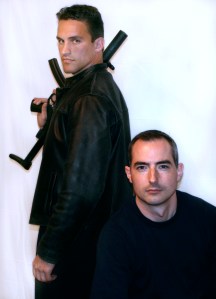
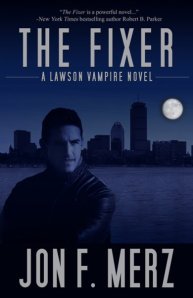
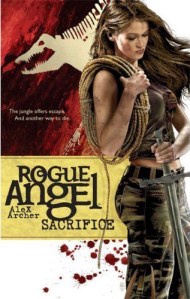
MICHAEL A. VENTRELLA: I’m pleased to be interviewing Jon Merz. Jon has published over a dozen novels including four Lawson Vampire adventures (2002-2003), the Jake Thunder mystery/thriller DANGER-CLOSE (2004), and eight installments in the internationally bestselling adventure series Rogue Angel (2006-present). His latest thriller PARALLAX debuted in March 2009 as an exclusive ebook. His short fiction story “Prisoner 392” (appeared alongside Stephen King in FROM THE BORDERLANDS, 2004, Warner Books) earned him an Honorable Mention in 2004’s Year’s Best Fantasy & Horror edited by Ellen Datlow. As a producer, Jon has formed New Ronin Productions with longtime friend Jaime Hassett to create television and feature film projects in the New England area. Their first project is THE FIXER, a new supernatural action series based on Jon’s Lawson Vampire novels. That’s Jon there, seated, next to actor Brandon S. Stumpf.merz

Jon, what happened to your website? When I follow the link from Wikipedia, it leads to one of those spam sites.

JON F. MERZ: Jonfmerz.com was basically hijacked and turned into some European gambling site for some bizarre reason. I’ll need to file a grievance and pay about $1500 in order to get it back, so I just decided to let it go and use jonfmerz.net instead. My website is currently being designed and should be done by the end of the month.

VENTRELLA: How important do you believe a website and blog are to a writer?

MERZ: Vital. Seriously. If you don’t have a blog, a website, and a presence in social media (meaning at the bare minimum Facebook and Twitter) you are killing your career before you even get started. It amazes me to no end that bestselling authors are on twitter, have thousands of followers, but only follow a few people back themselves. They totally miss the idea of social media – that being to develop relationships with your audience.

Facebook has definitely replaced Myspace (thank god) as being the go-to place for a presence. And with Facebook Fan Pages, you can have both a personal profile and a Fan presence out there. Synchronized with Twitter feeds, these sites serve to reinforce your position in the market, help build an actual audience for your work, and even help you secure publishing deals if you can develop a large enough fan base. I’ve seen some writers pull out of social media and say they only want to do one of them, but that’s truly stupid. In order to reap maximum benefits from social media, you need to integrate them so they work together like gears in a cog. One drives audiences to the other and so on and so on. If one piece is missing, the machine falls apart. And quite frankly, in the 21st century, if you are a writer, you must positively be engaged in social media and actually understand it. It’s not enough to hide away in a room tapping away on a keyboard in anonymity. Readers want to know their authors and develop relationships with them. If you aren’t out there, you lose ’em.fixer

VENTRELLA: Your vampire novel THE FIXER is being made into a TV series, and, from what I understand, you are one of the main producers. How did this come about?

MERZ: I’ve been flirting with Hollywood for years. I’ve been lucky to have some great friends in the industry, but each time I got close to making a deal, the numbers simply weren’t good enough to make me sign away rights. So a few years back, a buddy of mine and I talked about doing it ourselves: we’d form a production company, raise private equity, and do the thing ourselves. And that’s just what we’ve done. Backed by private investors, THE FIXER will be produced with the same (or better) production quality that Hollywood delivers in its television shows. We’re shooting the pilot later this month and from there, an additional twelve episodes for season one. It’s tremendously exciting.

VENTRELLA: What inside scoops can you share with us? Do you have a distribution deal yet?

MERZ: Unfortunately, we can’t release details on this just yet. But soon, I promise!

VENTRELLA: How does writing TV scripts differ from writing novels? Which do you prefer?

MERZ: I’ve always enjoyed challenges, so when it came time to learn how to write scripts, I studied the form for a long time and then started working on my own. Screenwriting or teleplays are obviously a lot more visual given the medium, but I tend to write pretty visually anyway, so the difficulty wasn’t too great. As for which I prefer, it actually depends on the story itself and what medium it’s best suited to. I don’t have a favorite anymore, which I think is probably a relief to both my literary agent and my manager in Hollywood since they both want me writing books and screenplays.

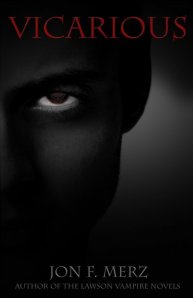
VENTRELLA: As I am now working on my own vampire novel, I keep getting told that the “trend is over”. Do you agree? Or do you think we’ll always have a love for a good vampire story?vicarious

MERZ: A love of vampires will always be with us. It’s just a question of what can you do to your spin that makes it new, or at least offers a different perspective. I get exhausted hearing about “new” vampire stories or series that are coming out. But they never explore anything different. It’s always the same old thing: undead, sleep during the daytime, feed at night, woe-is-me I’m immortal. I wish writers would challenge themselves to really explore something new. Something fresh. Vampirism is in itself very primal, but that doesn’t mean the storylines have to be primitive.

VENTRELLA: What trends in the industry are you tired of? What about the publishing industry really ticks you off?

MERZ: Publishing as an industry is broken. It annoys me when people in New York City claiming that it’s not. It is. They’re using an antiquated business model that simply does not work any longer. So change it! What’s the definition of insanity again? Doing the same thing over and over and expecting a different result? Please. With all the many forms of content delivery these days, people aren’t just reading a printed book anymore. Publishers need to remember that they aren’t in the book business any longer – they publish content. So figure out how to embrace new delivery technology and build a business around that. Don’t get me wrong: I love books and always will, but printed books are just one faction of how people get their written entertainment these days.

VENTRELLA: Of which book (or series) are you most proud? What would you like to be remembered for?

MERZ: My Lawson Vampire series is dearest to my heart. I’m very proud of the universe I’ve created and THE FIXER TV series will be an extension of that. I’m proudest also (so far) of my short story “Prisoner 392,” which appeared in a great anthology edited by Tom and Elizabeth Monteleone. They’re fantastic editors and it was an honor to appear in Borderlands 5. But I’m also very proud of the work I have yet to release. It keeps me constantly excited.

As for what I’d like to be remembered for…well, perhaps that I was just focused on giving people an escape from their everyday lives. That’s all I’ve ever set out to do as a writer. But as someone who has been around in the industry for a while now, I’d like folks to remember me as someone who threw away the rulebook and the box that everyone else (well except for one or two folks) seems imprisoned by. My mantra has always been pretty simple: why would I muck about in the mud puddle when there’s a huge ocean out there I can swim in?

VENTRELLA: Here’s the question I’ve asked everyone so far: What’s the biggest mistake you have made?

MERZ: The assumption that having an agent would be the gateway to riches. It’s not. I’ve had three agents. The first one sold four books for me but only wanted me writing vampire stories, so I fired her. The second one only sold projects that I’d done all the legwork on – basically bringing the deals already done to him – but I made the mistake of staying in that purgatory for six long years. Finally, on the 3rd try, I got the right agent. He’s fantastic. I’ve heard it said before that a bad agent is worse than no agent, and it’s true. Don’t settle because you think you have to. Look for the right person to represent your work. They need to care about it as much as you do. Make them earn that 15% – they work for you. If you find yourself cringing because you need to write them an email to check up on things and you’re worried about how sarcastic or snarky their response is going to be, don’t be like me and wait six years hoping they’ll get better. Fire them fast and find someone else.

VENTRELLA: And what is the best piece of advice you could give a starting writer (other than “write good books”)?
rogue angel

MERZ: I’ve seen scores of writers try to dissuade people from getting into this business because it’s hard. Yeah, it is. But I wouldn’t dream of discouraging anyone from a challenge. Hell, that’s the problem with our country today – people want it easy, they want it fast, and they want it with no work or effort. But it doesn’t happen that way. I wold always encourage people to dig deep and find the resolve and spirit to soldier on, keep working on their craft and find a way to become successful in this business. We need more people who conquer their challenges and serve as an inspiration to others – show them they can do the same if they’re willing to invest time and effort into something they believe in.

The last thing this country needs is someone else telling people “It’s too hard. Just go work a 9-5 cubicle job.” In this age, where we’re rapidly being out-classed by countries whose citizens struggle and succeed. We need more people in the US who understand that striving to accomplish something isn’t a bad thing – it’s what made us great in the first place. So put away the fear and tell the Negative Nancies to piss off – you’ve got mountains to climb.

VENTRELLA: And finally, isn’t Boston a great place to live? I lived there from 81 to 93 and miss it quite a bit…

MERZ: I think so! Boston’s a great city and the restaurants here are fantastic. Just had a great lunch at my favorite Chinese restaurant yesterday and I’m craving the hot-and-sour soup all over again today!

Interview with Daniel Kimmel

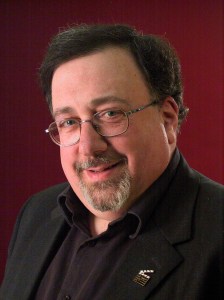
MICHAEL A. VENTRELLA: Since I write fiction – and fantasy fiction at that – most of the interviews I have done have been with writers with similar interests. Today I’m going off in a different direction by interviewing a nonfiction writer … But we still have a lot in common. Like me, Daniel Kimmel graduated from law school in Boston and within a few years after graduating started writing about movies.

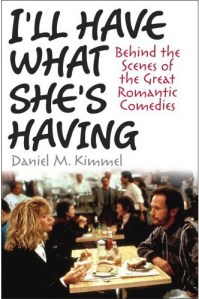
His love of movies propelled him to a career as a newspaper film critic, Variety correspondent, and TV reviewer. He has five books in print, the most recent being I’LL HAVE WHAT SHE’S HAVING: BEHIND THE SCENES OF THE GREAT ROMANTIC COMEDIES. His book about Fox TV (THE FOURTH NETWORK) won the “Cable Center Award” for best book about the television industry in 2004. He’s also written a play about Hollywood blacklisting. IMG_3294

DANIEL KIMMEL: I actually passed the bar and worked as a lawyer for two or three years. I didn’t start reviewing professionally until the end of 1983.

VENTRELLA: Dan, how is writing non-fiction different from fiction? Do you think it’s easier or harder? Are the skills similar?

KIMMEL: Well, a big difference is you can’t make things up. I have written fiction, both in a humor column I did in college and law school and managed to do for local newspapers for a few years. In both cases it’s a matter of figuring out the story I want to tell, but having to work around the facts with non-fiction. Some writers of non-fiction do make things up and when they get caught it gets messy.

VENTRELLA: Did Law School help or hurt your writing style?

KIMMEL: I think it helped, but not from legal writing. In my first year I had Rikki Kleiman for my writing instructor (who went on to Court TV and even appeared as herself in a few episodes of “Las Vegas”) and I remember her telling me after reading some of my early efforts that she could teach me what I needed to know about legal style and research, but that I had already developed a clear writing style. Later a professor reading a draft of a paper on pornography and the law said when he got to my paper he put down his red pen and sat back to enjoy reading it. (And all the quotes were from court cases, so it’s not what you think.) However I continued doing humor columns for the law school paper and for an “underground” college paper at Boston University and I kept pushing myself as a writer to get out of my comfort zone of doing Art Buchwald style columns and try other forms.

VENTRELLA: Besides your play, have you written any fiction? Do you have any such desire? Would you ever consider writing a screenplay?

KIMMEL:Yes, yes, and yes. I have several unproduced screenplays in collaboration with other writers. We actually made money off of “The Waldorf Conference,” our blacklist script, which was produced in a staged reading for “L.A. Theaterworks” and nationally broadcast on NPR. (The audiotape is available through Amazon.) It’s currently sitting on a shelf at Warner Bros., unlikely to ever be made. I’ve also written two novels, both humorous and one decidedly science-fiction. However since my name is not Terry Pratchett, publishers haven’t expressed any interest. Any publishers interested in an SF comedy about Hollywood should contact my agent, Alison Picard.

VENTRELLA: For a starting writer, in order to have a fiction book published, you have to have a completed manuscript. How does selling a nonfiction book work? Do your publishers give you a contract based on a summary, for instance?cover pic

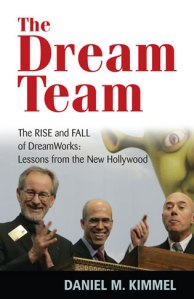
KIMMEL: My last two books (THE DREAM TEAM and I’LL HAVE WHAT SHE’S HAVING) were done on simple descriptions and outlines since I was dealing with the publisher of my FOX book (THE FOURTH NETWORK). That book had a troubled history. I had a proposal out for a book on science fiction films but the SF publishers didn’t want to do film books and the film books publishers weren’t interested in SF. However one editor liked my writing and asked what other ideas I had. I went through several e-mails coming up with numerous ideas and the one that he liked turned into THE FOURTH NETWORK. That was sold on an outline and a description. When I was finished — I was down to writing captions for photos that were to be included in the book which had been fully edited — the editor left the company and the publisher got cold feet. I started getting ridiculous demands (like securing letters from every person I had interviewed allowing me to quote them) and I quickly saw they were trying to get me to breach our contract. So instead I contacted my own lawyer who succeeded in getting the manuscript back from them. It took almost three years for my agent to place it with another publisher and at that point I had to do some new interviews and write an additional chapter to bring it up to date.

For a current proposal I have a much more complicated package which includes not only a description and an outline, but sample chapters, quotes from reviews of my previous books and a marketing plan. I find the last particularly galling but that’s the state of the publishing industry today. If you’re not a superstar author you’re largely expected to do your own publicity. Maybe the publisher will help a bit before he/she is distracted by the next book on the release schedule.

VENTRELLA: Do you have any specific books on writing that you use as a guideline?

KIMMEL: No, although I do give Strunk and White’s ELEMENTS OF STYLE credit for teaching me the difference between “its” and “it’s.”

VENTRELLA: I would assume that outlines play a much larger role in nonfiction than in fiction. Since you are not “telling a story” in the strictest sense most of the time, how do you decide the organization of your books?

KIMMEL: Each book had its own organization. The FOX book was set up so each chapter followed a television season. The DreamWorks book tended to be thematic rather than chronological. One chapter was on their building a studio except they never really did. Another was about animation. Another was about their publicity machine.

For the romantic comedy book I had agreed with the publisher it would cover fifteen films. I selected them based on their importance (“It Happened One Night,” “Annie Hall,” “When Harry Met Sally”) as well as making sure they were spread out over the decades. I could have easily focused on just movies from the 1930s (a great era for romantic comedies) but I limited myself to three. When I got to the ’50s I decided to focus on three different iconic actresses: Audrey Hepburn, Marilyn Monroe, and Doris Day. If my agent sells my current proposal I’ll be happy to share how that’s organized as well.

VENTRELLA: What kinds of fiction do you like to read?

KIMMEL: Science fiction, of course. The occasional legal thriller or mainstream novel. For the former I much prefer Scott Turow to John Grisham. For the latter I’m a big fan of Philip Roth. Of contemporary SF writers I like William Gibson, David Brin, the late Octavia Butler, and John Varley. I am in awe of Dan Simmons and have his massive latest novel, “Drood,” waiting for me.

I’ve also become a fan of some authors I first got to know at local conventions, like Walter Hunt and Jeffrey Carver, and only later started to read. Recently I found that someone I had met under other circumstances, Shariann Lewitt, was a published author and I was embarrassed I didn’t know it. I went out and got one of her books and subsequently wrote her that she had a new fan. That’s one of the neat things about the world of science fiction: you can actually get to know the writers of the books you read.

VENTRELLA: I’ll never get to meet the characters I have created for my novels. One of the advantages of writing nonfiction, I suppose, is that you get to meet some of the people you are writing about. Care to share any interesting stories about encounters with the famous? (Not counting me, who is quoted in your DreamWorks book)
cover

KIMMEL: I’ve met lots of famous people over the years, but that’s not a reflection on me. It’s my job. When I did a Facebook survey on 25 famous people I’d met, I had no trouble coming up with 25 and had stories to spare. I do have a short list of people I can’t believe I was lucky enough to meet: Gene Roddenberry, Edwin “Buzz” Aldrin,” Jonathan Winters, and John Cleese. I was interviewing Cleese about some hilarious business training films he was involved in making and distributing and afterwards he had nothing on his schedule and so he invited me out for a cup of coffee and conversation. He told me about a script he was then working on that would become “A Fish Called Wanda.” When I asked him what else he had been up to he mentioned that he had co-authored a book with his therapist called FAMILIES AND HOW TO SURVIVE THEM which he didn’t expect would get much notice. I reached into my briefcase and pulled out a copy. I told him that was what I had brought him to autograph. He was very pleased.

I suppose the best story about a celebrity encounter is when I met Penn & Teller after having reviewed their film PENN AND TELLER GET KILLED for Variety. It was a favorable review and when I met them Penn — a big scary looking guy in person — gave me a big smile and thanked me for the nice review. I said there was no need to thank me. I was simply expressing my opinion. He said he understood, but if I hadn’t liked it he would have had to tear my heart out. I’d like to think he was only kidding.

VENTRELLA: That’s the second John Cleese reference in an interview I’ve done in two weeks! I’m a big fan of Cleese and also Penn and Teller. This has nothing to do with writing, but I’m just curious: What are your favorite movies of all time?

KIMMEL: “Annie Hall” is my all time favorite. Also in the pantheon are “The Producers,” “North by Northwest,” “Holiday” (1938), “The Fly” (1986), “Dr. Strangelove.” “High Noon,” “Sunset Boulevard,” “Love Actually,” “When Harry Met Sally” and “Casablanca.” When I first met my wife she had not seen a lot of films. We soon had a VCR festival to educate her but there were two movies I would only let her see on the big screen, which she did eventually: “2001: A Space Odyssey” and “Lawrence of Arabia.” People who have not seen these films should do so immediately, except for the latter two which really do need to be seen on a big screen.

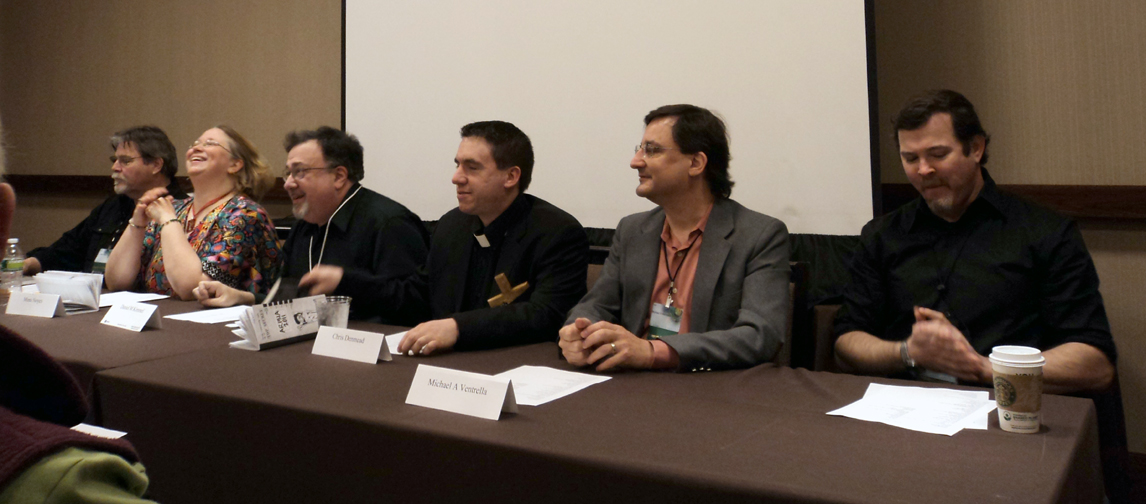
Dan and me on a panel at the Arisia 2011 convention

My Turn to be Interviewed…

And now, a break from my regular updates and interviews … because today, I’m the interviewee over at author Chris Redding’s blog!

Check it out!

Interview with Nick Pollotta

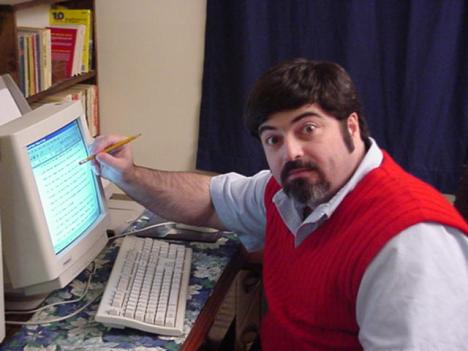
MICHAEL A. VENTRELLA: Nick Pollotta has 56 novels released under a wide assortment of pseudonyms. Specializing in Fantasy/Humor and Military/Thrillers, his books have sold in the millions, and been translated into a dozen foreign languages. A former stand-up comic, Nick still performs at SF cons just for fun, and occasionally teaches Creative Writing seminars at local colleges. He lives in northern Illinois with his wife Melissa, 14,000 books, and two cats who plan on conquering the world as soon as they figure out how to operate the can opener.nick2008

Nick, you’re one of the most prolific writers I know.

NICK POLLOTTA: Really? Try reading Alexander Dumas, he wrote six hundred novels. I’m a slug-a-bed compared to that dynamo!

VENTRELLA: But I don’t know him. Nick, I first heard of you when I read ILLEGAL ALIENS with Phil Foglio back in the 80s. How did that come about?

POLLOTTA: Funny story. I was living in Philadelphia at the time, and the local SF club, PSFS was trying to win the WorldCon for 1986. They wanted something different at their bid parties to make them stand out, so I offered to do some stand-up comedy. (I used to perform in NYC night clubs). That worked great – at first. But PSFS threw so many parties, I needed new material fast, and come up with the idea of performing a series of ‘radio plays’ live at the parties about the adventures of Phil A. Delphia, fannish secret agent 86 in his never-ending battle against The-Evil-Dr-Salvatore (one word) and his Agents of Chaos. They were an smash hit, and soon I had a cast of six, with a sound effects man, and we were playing to packed rooms. Standing room only. Phil Foglio caught a performance one night, we became friends, and soon were performing together. Naturally, we joked about turning the radio plays into a novel, and somewhere along the way that morphed into our SF/Comedy novel, ILLEGAL ALIENS.

VENTRELLA: Didn’t Phil also have a comedy troupe at the time? The Zanti Misfits? Were you involved in that? I think I still have one of their programs but I think that was at a Lunacon…

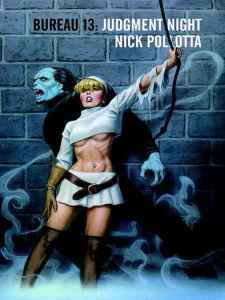
POLLOTTA: The Zanti Misfits was my comedy group, which Phil joined. After a couple of years I added radio plays (all new stuff) to the sketches, and renamed the group, The Gunderson Corporation (after our fake sponsor). “If it fits in the palm of your hand, is made is plastic, costs under five bucks, and breaks in a week – then its another fine product from.. The Gunderson Corporation!”Judgment-Night

The Gundersons had over two hundred performances at SF cons across the nation, (and for free, we did not charge for a show. This was our hobby) People came and went, including Phil when he moved away, but the group was still performing inl 2005 when our Sound Effects Master Kevin McLaughlin, a very good friend of mine, died in a tragic accident. We took a short hiatus, and it just kept getting longer. Four years later, I’m now way too busy to perform anymore, so I guess WTGC (all radio, all the time!) has finally gone off the air after 25 years.

VENTRELLA: You tend to write a lot of articles to help other aspiring writers; have you thought of producing a book of these essays?

POLLOTTA: I have considered it, but I simply do not have enough articles to make a whole book. However, they have been reprinted dozens of times, and now are posted for free on my Facebook page. What the Hell, somebody has to write books for me to read, eh?

VENTRELLA: What’s your writing process? Do you use extensive outlines? And do you plan out the series or just work one book at a time?

POLLOTTA: This depends entirely upon the project. But on average: I get an idea, flesh it out to two rough pages, then design my characters, and now do a full outline of about ten pages, or so. Next, I do chapter breakdowns, do whatever research is necessary (antique weapons, advanced physics, farming, ballet, high-explosives, whatever.) Then I book the time, sit down and charge. I am usually scheduled for a year in advance, sometimes even two or three.

VENTRELLA: I note that “nickpollotta.com” links to the “Fantastic Fiction” web page. Are you planning to have your own page or has this been just as good? Do you think a web page is important for a starting writer?

POLLOTTA: Once you have sold a book, a web page is vital to a new author. The ‘Fantastic Fiction’ web page is merely a place-holder while I change over from my old SFWA (Science Fiction Writers of America) web page to my new AG (Authors Guild) web page.

VENTRELLA: Of which book are you most proud? What would you like to be remembered for?

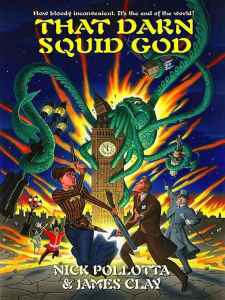
POLLOTTA: I am very proud of THAT DARN SQUID GOD and the Deathlands novel ZERO CITY. However, I would like to be remembered for my next novel – whatever it is. A writer lives in the future. We never stop trying to beat our last book.THAT DARN SQUID GOD

VENTRELLA: Your bio says you “almost” became a lawyer. As an attorney myself, I am curious as to how you escaped. Was it the lure of writing that drew you away?

POLLOTTA: Oddly enough, that was it exactly. I had gotten a scholarship, but turned it down to work as a video store clerk to have more time for my writing. Somebody very wise once said that if you do what you love, you’ll never work a day in your life. Sage advice, indeed. It took me many years to get here, but nowadays I start every morning with a smile, eager to get back to the computer, and start writing again.

VENTRELLA: What’s your opinion on e-books? Do you think they’re the wave of the future or a step down from traditional publishing? Should an author whose book is only available as an e-book be concerned?

POLLOTTA: According to every expert in the field, the sale of e-books have had no direct effect on the sale of traditional books. Bookies (slang for bibliophiles, AKA the readers) love to hold the actual book, to own it physically, and see it sitting on their shelf. E-book sales are gravy, but not the meat.

VENTRELLA: Here’s the question I’ve asked everyone so far: What’s the biggest mistake you have made?

POLLOTTA: Hmm, that’s a tough question. I’ve made quite a few, and suffered the consequences. However, I would say that my biggest goof was forgetting that writing is part of Show Business. Half of it is show (the art), but the rest is pure business. Learning how to write is merely half of the task. You must learn how to conduct yourself in a professional manner, never emotionally, or excitedly. Never promise something that you can not deliver. Never take anything personally. Never miss a deadline. Learn the tax laws. Save your money. Get printed business cards and letterhead stationary, not stuff you print at home on an ink jet. To be a pro, act like a pro.

It is also vital to remember that this is a small field, and you will constantly keep bumping into the same people over and over. Just because an editor is leaving a publisher, does not mean you will never see them again as, say a literary agent, as a fellow writer, or a chief editor at another publisher. The Dale Carnegie book, “How to Win Friends” is just as important to a writer as “Strunk & White: The Elements of Style”.

VENTRELLA: What is the best piece of advice you could give a starting writer?

POLLOTTA: To quote the movie, “Galaxy Quest”: Never give in, and never surrender! This is rough business, sometimes even cut-throat, and good writers who simply aren’t tough enough to withstand rejection often fall by the wayside, and disappear. You have to learn how to armor-plate your ego, and ignore the fools, yet remain open to intelligent advice, and constructive criticism. Plan for failure, but hope for success, and never stop writing!

Interview with Gregory Frost

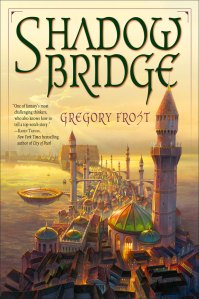
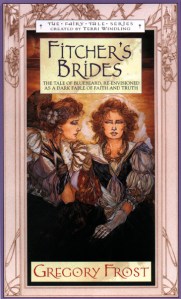
Gregory Frost is the author of the Shadowbridge duology, SHADOWBRIDGE and LORD TOPHET. His latest short fiction appears in the anthology POE, edited by Ellen Datlow. He’s been a finalist for every award in the sf, fantasy, and horror genres. Other works include LYREC, TAIN, REMSCELA, THE PURE COLD LIGHT, FITCHER’S BRIDES, and the short fiction collection ATTACK IF THE JAZZ GIANTS & OTHER STORIES. His essay on Slipstream fiction appears in Modern Fantasy Literature (Cambridge University Press), co-edited by Farah Mendelsohn. For two years he was the principal researcher for a non-fiction television producer, for shows that appeared on The Learning Channel and The Discovery Channel. Currently he is the acting Fiction Writing Workshop Director at Swarthmore College, in Swarthmore, PA, and teaches in writing programs in and around the Delaware Valley. His web page is Gregoryfrost.com.

MICHAEL A. VENTRELLA: I’m pleased to be interviewing Gregory Frost. I first became aware of Frost with his initial novel LYREC which I remember reading on the Boston subway back in the 80s. Although I have not re-read it since then, I recall it being quite fun with some real issues about religious beliefs…

Gregory, was LYREC the first novel you had written? What made you decide on that theme for your first novel? (PS: My wife says to tell you she loved that book.) Any news on it being re-issued?

GREGORY FROST: LYREC was the first novel that was published. Hardly the first one I’d written. In fact my first attempt at a novel was about 70 pages long. The second attempt was, at least, of an appropriate length, around 250 pages. But it and numerous others live in a box in a closet, which is where they belong. That second one made its way to Lin Carter, who was editing the Ballantine Adult Fantasy Series in those days (that should date me), courtesy of a letter of introduction from one David Gerrold, who’d never even met me. And Carter, bless him, did a line edit on the first 10 pages, showing me how much I did not understand of the craft. It would be a decade after that before I sold LYREC. But both Gerrold’s letter and Carter’s efforts were acts of kindness on their part. I think apiring authors should always stiffen their spines and talk to published writers. Trust me, only some of us bite. The zombie writers…yeah, you should probably not talk to the zombies.

I expect LYREC would have been a YA novel had there been such a category in ’84. Main character is an alien who has little experience with human emotions and finds himself greatly overcome by them as he inhabits a human body; he has to sort out his angry, warring and violent impulses. And his sidekick is unable to manifest as a human and so goes through the book as a large talking cat with attitude. I was trying to do something with fantasy besides interminable trilogies and quests. So there’s way more Fafhrd and the Grey Mouser in there than there is Tolkien or Robert E. Howard. I love Fritz Leiber, and those stories of his were unquestionably influential. Roger Zelazny’s work, too. It’s fresh, funny, different. I was shooting for all that with LYREC. A really good ride.

And at the moment there’s a possibility it’s coming back into print from Wilder Press this winter. Negotiations on that front continue, and I don’t know how that’ll fall out.

VENTRELLA: How did you break into the publishing business at that time?

FROST: I broke in by publishing a short story (in The Twilight Zone Magazine for the old people in the audience), and then in quick succession two more in F&SF, and around then at a convention I met Terri Windling, who at the time was an editor at Ace Books. I was in the middle of a draft of a novel based on the Irish epic The Tain, and the idea excited her. She agreed to look at LYREC, I think, pretty much on the strength of the idea that I was going to do my version of Cú Chulainn.

VENTRELLA: Has the business changed much since then?

Back then a publisher would try to develop a relationship with you—grow your career, so to speak. Now you’d better write a bloody best-seller coming out of the chute or you’re for it, mate. The bean-counters will look at your numbers and instead of thinking, “We can promote her next book and sell even more,” they go “Huh, your numbers weren’t great, so we’re not going to publish you at all!” That is the current reality. I can’t even tell you how many writers I know of who published a portion of a trilogy or series with a full character arc, only to have the publisher say in the middle of it, “Don’t bother to finish. We don’t want the last book(s) because your sales haven’t been great.” It’s ugly—and bovinely stupid—out there.

One of the books I use in teaching writing is THE GREAT GATSBY because so much of the correspondence between Fitzgerald and Maxwell Perkins, his editor, is available to us. And it’s interesting to see how much of that book was pulled together during the editing and revision process. Fitzgerald did not turn in a fine, complete, perfect manuscript. Far from it—the original Jay Gatsby was a complete cypher, even to the author. But nowadays that’s what you’re expected to do, turn in a perfect, finished work. Editors are now responsible for twenty more times the number of books in any given minute, so they can’t take the time to guide, to work in close that way. Someone like David Hartwell may still take such carewith selected authors, but he’s a dying breed. Everything now is Walmartized, the whole process. And it is not giving us better literature.

VENTRELLA: You have not limited yourself to one specific genre. While certainly that is very admirable artistically, do you feel that may harm you professionally? Should authors try to “specialize”?

FROST: I wouldn’t recommend the genre hopping as a career move. But then I wouldn’t recommend you be slow and methodical, either, in the genres.

Okay, I was having lunch with two contemporary authors a few days ago, Rachel Pastan (LADY OF THE SNAKES) and Asali Solomon (GET DOWN). And Rachel expressed to Asali how prolific I am. I mean, I had two books out last year. I’m now working on what I hope are final revisions of a supernatural mystery. I protested that I’d been working on this thing for 18 months and that was after setting it aside to write LORD TOPHET when Random House picked up SHADOWBRIDGE. And in discussing this, I realized that for a contemporary—let’s say (snootily) literary—author, a decade between books isn’t particularly shocking or unusual. Lord-Tophet_web

Asali’s collection came out a few years ago, and she’s under contract to produce a second book. But nobody’s going mad wondering where it is, and she’s still pondering it. Now, I took seven years probably from beginning to end to write SHADOWBRIDGE, and got nothing but shit about it from reviewers and interviewers. You take that much time in the genres and you’re immediately suspect. There’s this kind of “You’re writing entertainments, so if you took that long there must have been a problem” thing going on. We’re expected to knock out a book a year, in the same mold as the last book. You want a career, you should be doing that. You’re not supposed to be spending years crafting sentences.

Anyway, not answering your questions exactly, am I? Short answer: I write what I feel like writing. Always have. Always will. No, it’s not a smart career move when the industry and fan-base wants volume 18 of the seemingly endless saga of Morgock the Swordbelcher, or the eighth alternate history of some damn war that you haven’t added laser weapons to yet. Truth is, if you can stomach doing that and you’re fast, go do it, because you will definitely see more financial reward. Going off into the dark and changing up every time will likely not do this for you. Especially if you’re slow. But I’m stuck with me and that’s how I am. Contrarian by nature.

Having said that, I do write stories for anthologies that I’m invited to contribute to, provided I can think of something that fits within the proposed theme. But I have to get interested. I turned in a werewolf story for an anthology Darrell Schweitzer put together. But I only did it because I got to write a Donald Westlake werewolf story. And for another anthology of Darrell’s, of vampire stories, I wrote one because it allowed me to create a fifteen minute version of Homer’s The Iliad.

There has to be something to interest me and get me beyond the “oh, great, another vampire book” response, which is invariably my first reaction. TWILIGHT? Oh, please kill me now. (Of course, he said, mine wouldn’t be like that.) Also my response to anything to do with King Arthur, bands of small hairy men on terrible quests, or brutish brooding barbarians. The best King Arthur work since T.H. White was a throwaway piece penned originally as a Christmas card by the late John M. Ford. No one else has even come close. The best barbarian was in Ian Banks’ THE BRIDGE.Shadowbridge-web1

VENTRELLA: What is the basic theme of the SHADOWBRIDGE series? What’s the long term plan for the storyline?

FROST: The basic theme is that the books are and will be all about stories and storytelling. The first two are about Leodora aka “Jax”, who travels the world of Shadowbridge collecting stories and performing them. She sort of finds herself obsessed with learning stories and eventually discovers that her own exploits are becoming mythic, stories are being told of her. And finally her very life depends on knowing one particular story, one particular truth.

I built the world to be open-ended, and part of the first book’s challenge was winnowing down the breadth of possibilities into one large canvas on which creation myths, kitsune tales, stories about Death, and ghost stories could all float. With one exception the stories were written where they showed up. And I have a couple that never found their place, so they’re sitting off in a notebook, raring to be used somewhere, sometime.

VENTRELLA: Not every writing technique works for everyone, but what’s your writing process? Do you use extensive outlines?

FROST: No, not every technique works, and no two people have the same process. So I cannot advocate what I do in the sense of saying “you must do this.” In fact, anyone who says “You must do this” is at best telling you what they must do.

I’ve adopted what I call the John Cleese method of outlining, which sounds like a joke but isn’t. I heard him interviewed, describing how he and Connie Booth had written “Fawlty Towers” episodes by stretching a sheet of butcher’s paper across his living room and then writing the things they knew, or thought they knew, in about the place where that seemed it should happen. Started out with just a few things and then added to it, building a timeline of a sort.

So I have boxes of this old useless pinfeed paper, and I now take five or more sheets of it and do the same thing—write what I think I know, approximately where it seems to belong in the book, and then add to it. Build it up. And once it’s done, I’ll pretty much ignore it and go write. Usually by that point I’ve already done a few scenes or chapters anyway, because something got me interested. For the Shadowbridge books, I had a draft of the final dialogue between Leodora and Tophet done before I’d started the second book or had any notion of how I would arrive at that dialogue.

And about a third of the way into the book, I’ll usually find that the outline is invalid, because something better came along while I was writing and I took a left turn at Albuquerque. So I’ll do another outline as verification that I’ve still got a story going. And then I’ll write forward. And on top of that, I’m writing longhand. With a fountain pen (and Noodler’s Inks). Now, how in the world could I recommend that process to any sane human being?

VENTRELLA: Of which book are you most proud? What would you like to be remembered for?

FROST: Currently, I’d like to be remembered for the Shadowbridge duology and for FITCHER’S BRIDES, which I think was a hellishly good novel of horror. I think I did up Bluebeard pretty well for Terri Windling with that book (I seem destined never to stray very far from Terri’s influence). On the other hand, since joining Facebook and other online communities, I’ve been floored by people who have read TAIN and REMSCELA to the point where the pages are falling apart and claim these are their favorite books in the world. So (to quote Bill Murray), I’ve got that going for me…which is nice. Fitcher-Cover

(Oh, and there’s a limited small-press edition of those books in one volume, by a publisher who went out of business, so if anyone’s still searching for them, get in touch, because I have all the remaining copies…)

VENTRELLA: What’s your opinion on e-books? Do you think they’re the wave of the future or a step down from traditional publishing?

FROST: It may be the thing that saves us all. My agent swears by her Kindle. I expect Apple will come up with an iNovels reader in the near future (you heard it here first) that tries to do for literature what the iPod did with music. I think we’ll reach the point where bookstores become places that make the book for you on the spot, eliminating the returns and distribution problems that plague this idiotic industry now. Put in your order, get your book in twenty minutes, like a pizza. I think if America wasn’t so pig ignorant we’d be making books from hemp paper now, which would cut costs ridiculously since, you know, it’s a weed that grows almost anywhere, like kudzu. But that would not make timber and paper industries happy, just as alternative energy sources infuriate Big Oil…so until you kill the chuckleheads, it probably won’t happen and you’ll shortly pay $10 for a mass market paperback.

Essentially, I’m for anything that puts books in the hands—and minds—of people, and makes them kill their TVs. Invite me to your house. I’ll kill your TV for you.

VENTRELLA: Tell me about the Liar’s Club and what you hope to accomplish with it. And be sure to let me know when you are accepting applications for other members.

FROST: The Liars Club of Philadelphia is a small collective of authors from across and outside the genres who felt that we could do more to promote ourselves as a collective. The baker’s dozen includes Bram Stoker Award Winner Jonathan Maberry and bestselling author William Lashner. We’ve been doing a “Liars Club Tells the Truth” tour now for about 6 months in and around the Delaware Valley, strictly at libraries and independent bookstores. We’re trying to promote the indies as well as ourselves. When the dinosaurs die (and Borders, I’m talking to you), then our hope is the independents will move back into the spaces that they were squeezed out of by these small-brained leviathans. We’re doing our part to help by throwing bashes at the bookstores and bringing in as many people as we can get. Here’s a link to our latest outing, at Aaron’s Books in Lititz, PA (http://liarsclubphilly.com/?p=189)

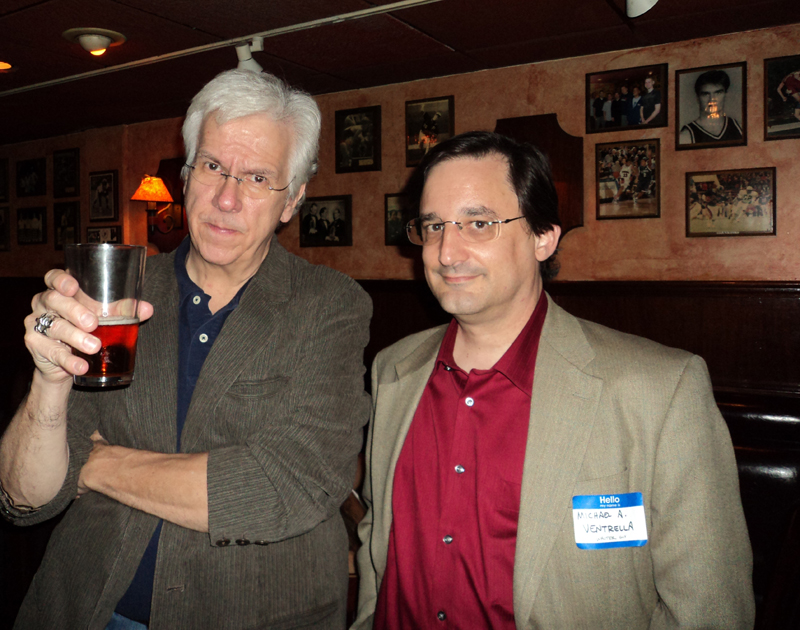
Greg and me

Honesty is the best plot twist

Ages ago when I began this blog (March, actually, but it feels like ages ago), my first entry was about creating a believable “reluctant hero”. In it, I discussed how Terin, the main character in ARCH ENEMIES, never becomes a superhero, but saves the day “with intelligence, honesty, and bravery.” I then promised to discuss honesty in a future blog, and then never did.

Which made it seem like I was lying. Time to clarify and rectify.

I value honesty as the highest virtue. No! Wait! Decisiveness. Definitely decisiveness is the highest. Or maybe punctuality. No, decisiveness. Or charity.ArchEnemies-510

All kidding aside, I define “honesty” very broadly to include having high ethical standards, honoring your word, and being trustworthy. This is not an easy standard to meet but it is always a worthy goal.

This is a lesson that young Terin in ARCH ENEMIES learns through his adventures. No, it’s not the Pinocchio story, nor is it a heavy-handed morality play. But (as I stated in another blog post), character development is very important to me. A story in which the hero is unchanged by his journey is unsatisfying.

In ARCH ENEMIES, the final chapter isn’t the one where the goal is achieved and Terin is proclaimed a hero due to his bravery during battle. It’s the next one — where he feels guilt over his deceptions and faces a challenge just as daunting: admitting the truth to everyone even when it could hurt his own interests. That’s the kind of conflict I love.

I’ve never had to face something as serious as what Terin faces, and I hope I could do the same. The closest I’ve experienced is having some of my clients decide to fire me as their lawyer because I refused to let them lie or present false testimony. The damage there is only a loss of income.

Being brave and true sometimes requires much more.