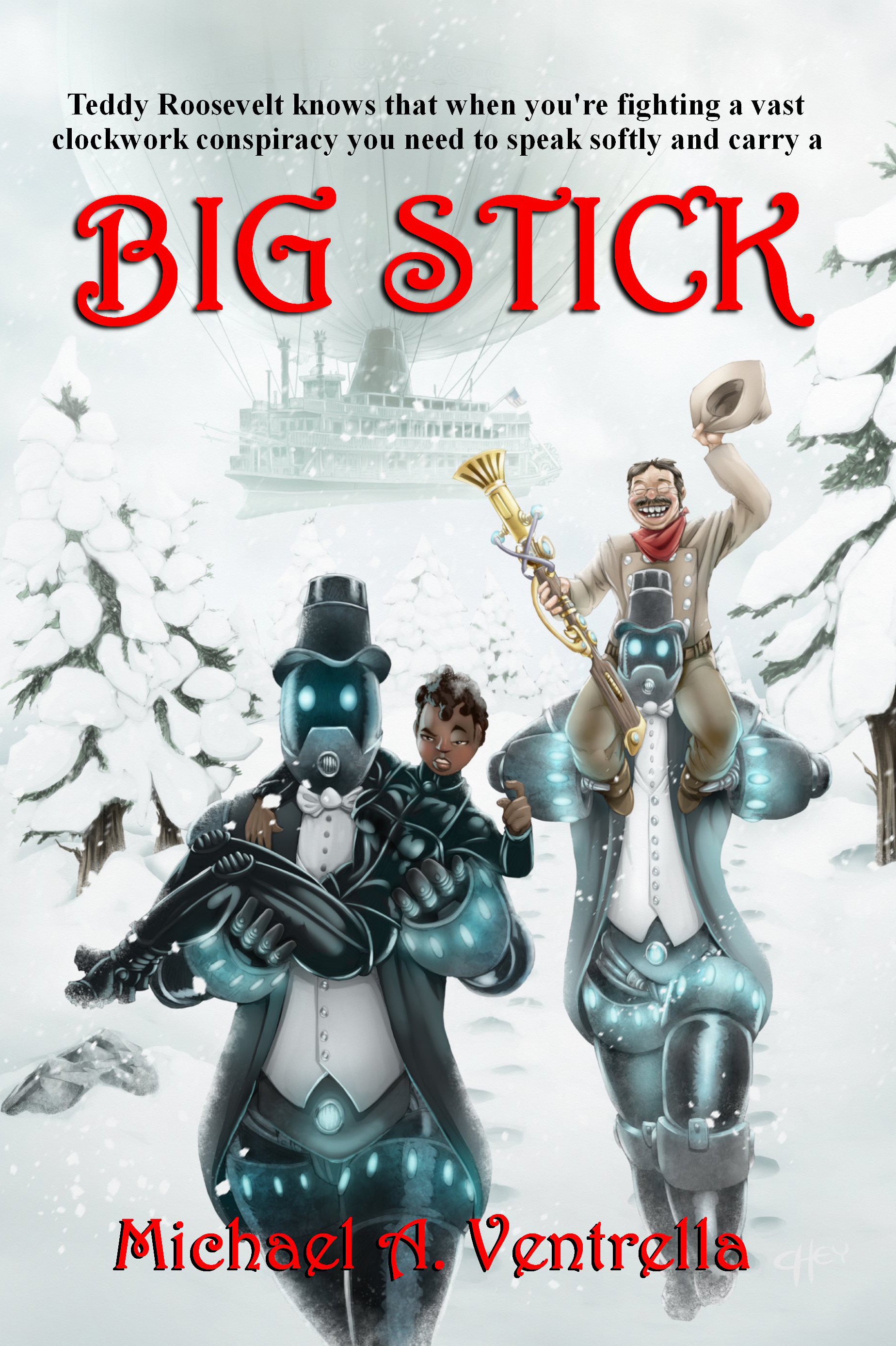
And now, a break from my regular updates and interviews … because today, I’m the interviewee over at author Chris Redding’s blog!
Filed under: writing | Leave a comment »
And now, a break from my regular updates and interviews … because today, I’m the interviewee over at author Chris Redding’s blog!
Filed under: writing | Leave a comment »
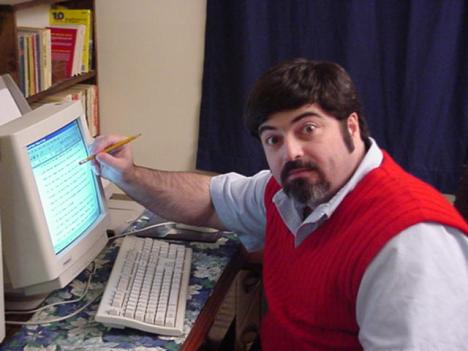
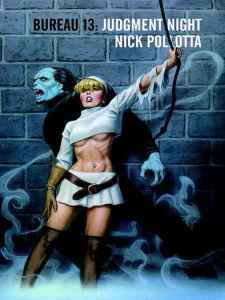
MICHAEL A. VENTRELLA: Nick Pollotta has 56 novels released under a wide assortment of pseudonyms. Specializing in Fantasy/Humor and Military/Thrillers, his books have sold in the millions, and been translated into a dozen foreign languages. A former stand-up comic, Nick still performs at SF cons just for fun, and occasionally teaches Creative Writing seminars at local colleges. He lives in northern Illinois with his wife Melissa, 14,000 books, and two cats who plan on conquering the world as soon as they figure out how to operate the can opener.
Nick, you’re one of the most prolific writers I know.
NICK POLLOTTA: Really? Try reading Alexander Dumas, he wrote six hundred novels. I’m a slug-a-bed compared to that dynamo!
VENTRELLA: But I don’t know him. Nick, I first heard of you when I read ILLEGAL ALIENS with Phil Foglio back in the 80s. How did that come about?
POLLOTTA: Funny story. I was living in Philadelphia at the time, and the local SF club, PSFS was trying to win the WorldCon for 1986. They wanted something different at their bid parties to make them stand out, so I offered to do some stand-up comedy. (I used to perform in NYC night clubs). That worked great – at first. But PSFS threw so many parties, I needed new material fast, and come up with the idea of performing a series of ‘radio plays’ live at the parties about the adventures of Phil A. Delphia, fannish secret agent 86 in his never-ending battle against The-Evil-Dr-Salvatore (one word) and his Agents of Chaos. They were an smash hit, and soon I had a cast of six, with a sound effects man, and we were playing to packed rooms. Standing room only. Phil Foglio caught a performance one night, we became friends, and soon were performing together. Naturally, we joked about turning the radio plays into a novel, and somewhere along the way that morphed into our SF/Comedy novel, ILLEGAL ALIENS.
VENTRELLA: Didn’t Phil also have a comedy troupe at the time? The Zanti Misfits? Were you involved in that? I think I still have one of their programs but I think that was at a Lunacon…
POLLOTTA: The Zanti Misfits was my comedy group, which Phil joined. After a couple of years I added radio plays (all new stuff) to the sketches, and renamed the group, The Gunderson Corporation (after our fake sponsor). “If it fits in the palm of your hand, is made is plastic, costs under five bucks, and breaks in a week – then its another fine product from.. The Gunderson Corporation!”
The Gundersons had over two hundred performances at SF cons across the nation, (and for free, we did not charge for a show. This was our hobby) People came and went, including Phil when he moved away, but the group was still performing inl 2005 when our Sound Effects Master Kevin McLaughlin, a very good friend of mine, died in a tragic accident. We took a short hiatus, and it just kept getting longer. Four years later, I’m now way too busy to perform anymore, so I guess WTGC (all radio, all the time!) has finally gone off the air after 25 years.
VENTRELLA: You tend to write a lot of articles to help other aspiring writers; have you thought of producing a book of these essays?
POLLOTTA: I have considered it, but I simply do not have enough articles to make a whole book. However, they have been reprinted dozens of times, and now are posted for free on my Facebook page. What the Hell, somebody has to write books for me to read, eh?
VENTRELLA: What’s your writing process? Do you use extensive outlines? And do you plan out the series or just work one book at a time?
POLLOTTA: This depends entirely upon the project. But on average: I get an idea, flesh it out to two rough pages, then design my characters, and now do a full outline of about ten pages, or so. Next, I do chapter breakdowns, do whatever research is necessary (antique weapons, advanced physics, farming, ballet, high-explosives, whatever.) Then I book the time, sit down and charge. I am usually scheduled for a year in advance, sometimes even two or three.
VENTRELLA: I note that “nickpollotta.com” links to the “Fantastic Fiction” web page. Are you planning to have your own page or has this been just as good? Do you think a web page is important for a starting writer?
POLLOTTA: Once you have sold a book, a web page is vital to a new author. The ‘Fantastic Fiction’ web page is merely a place-holder while I change over from my old SFWA (Science Fiction Writers of America) web page to my new AG (Authors Guild) web page.
VENTRELLA: Of which book are you most proud? What would you like to be remembered for?
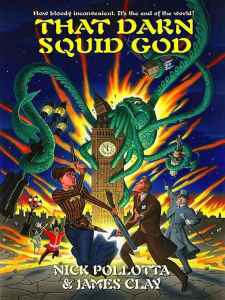
POLLOTTA: I am very proud of THAT DARN SQUID GOD and the Deathlands novel ZERO CITY. However, I would like to be remembered for my next novel – whatever it is. A writer lives in the future. We never stop trying to beat our last book.
VENTRELLA: Your bio says you “almost” became a lawyer. As an attorney myself, I am curious as to how you escaped. Was it the lure of writing that drew you away?
POLLOTTA: Oddly enough, that was it exactly. I had gotten a scholarship, but turned it down to work as a video store clerk to have more time for my writing. Somebody very wise once said that if you do what you love, you’ll never work a day in your life. Sage advice, indeed. It took me many years to get here, but nowadays I start every morning with a smile, eager to get back to the computer, and start writing again.
VENTRELLA: What’s your opinion on e-books? Do you think they’re the wave of the future or a step down from traditional publishing? Should an author whose book is only available as an e-book be concerned?
POLLOTTA: According to every expert in the field, the sale of e-books have had no direct effect on the sale of traditional books. Bookies (slang for bibliophiles, AKA the readers) love to hold the actual book, to own it physically, and see it sitting on their shelf. E-book sales are gravy, but not the meat.
VENTRELLA: Here’s the question I’ve asked everyone so far: What’s the biggest mistake you have made?
POLLOTTA: Hmm, that’s a tough question. I’ve made quite a few, and suffered the consequences. However, I would say that my biggest goof was forgetting that writing is part of Show Business. Half of it is show (the art), but the rest is pure business. Learning how to write is merely half of the task. You must learn how to conduct yourself in a professional manner, never emotionally, or excitedly. Never promise something that you can not deliver. Never take anything personally. Never miss a deadline. Learn the tax laws. Save your money. Get printed business cards and letterhead stationary, not stuff you print at home on an ink jet. To be a pro, act like a pro.
It is also vital to remember that this is a small field, and you will constantly keep bumping into the same people over and over. Just because an editor is leaving a publisher, does not mean you will never see them again as, say a literary agent, as a fellow writer, or a chief editor at another publisher. The Dale Carnegie book, “How to Win Friends” is just as important to a writer as “Strunk & White: The Elements of Style”.
VENTRELLA: What is the best piece of advice you could give a starting writer?
POLLOTTA: To quote the movie, “Galaxy Quest”: Never give in, and never surrender! This is rough business, sometimes even cut-throat, and good writers who simply aren’t tough enough to withstand rejection often fall by the wayside, and disappear. You have to learn how to armor-plate your ego, and ignore the fools, yet remain open to intelligent advice, and constructive criticism. Plan for failure, but hope for success, and never stop writing!
Filed under: writing | Tagged: e-book, new writers | Leave a comment »
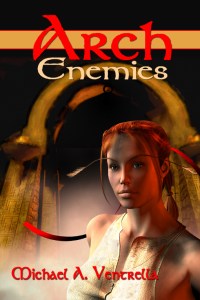
Ages ago when I began this blog (March, actually, but it feels like ages ago), my first entry was about creating a believable “reluctant hero”. In it, I discussed how Terin, the main character in ARCH ENEMIES, never becomes a superhero, but saves the day “with intelligence, honesty, and bravery.” I then promised to discuss honesty in a future blog, and then never did.
Which made it seem like I was lying. Time to clarify and rectify.
I value honesty as the highest virtue. No! Wait! Decisiveness. Definitely decisiveness is the highest. Or maybe punctuality. No, decisiveness. Or charity.
All kidding aside, I define “honesty” very broadly to include having high ethical standards, honoring your word, and being trustworthy. This is not an easy standard to meet but it is always a worthy goal.
This is a lesson that young Terin in ARCH ENEMIES learns through his adventures. No, it’s not the Pinocchio story, nor is it a heavy-handed morality play. But (as I stated in another blog post), character development is very important to me. A story in which the hero is unchanged by his journey is unsatisfying.
In ARCH ENEMIES, the final chapter isn’t the one where the goal is achieved and Terin is proclaimed a hero due to his bravery during battle. It’s the next one — where he feels guilt over his deceptions and faces a challenge just as daunting: admitting the truth to everyone even when it could hurt his own interests. That’s the kind of conflict I love.
I’ve never had to face something as serious as what Terin faces, and I hope I could do the same. The closest I’ve experienced is having some of my clients decide to fire me as their lawyer because I refused to let them lie or present false testimony. The damage there is only a loss of income.
Being brave and true sometimes requires much more.
Filed under: writing | Tagged: Arch Enemies, character development, reluctant hero | Leave a comment »
Talent isn’t enough.
Unless your daddy’s rich or has connections, every single person who has made themselves successful has been obsessive about their craft. They understand that it takes more than talent to get ahead — self-promotion plays a large role, along with a willingness to never give up no matter the rejections.
Without getting too far into that discussion, however, let’s limit this to the topic of appearing at conventions. Assuming you are an aspiring writer and assuming you want to promote yourself, you need to go where you can meet (a) other similar writers, editors and publishers, and (b) readers who may be interested in your work.
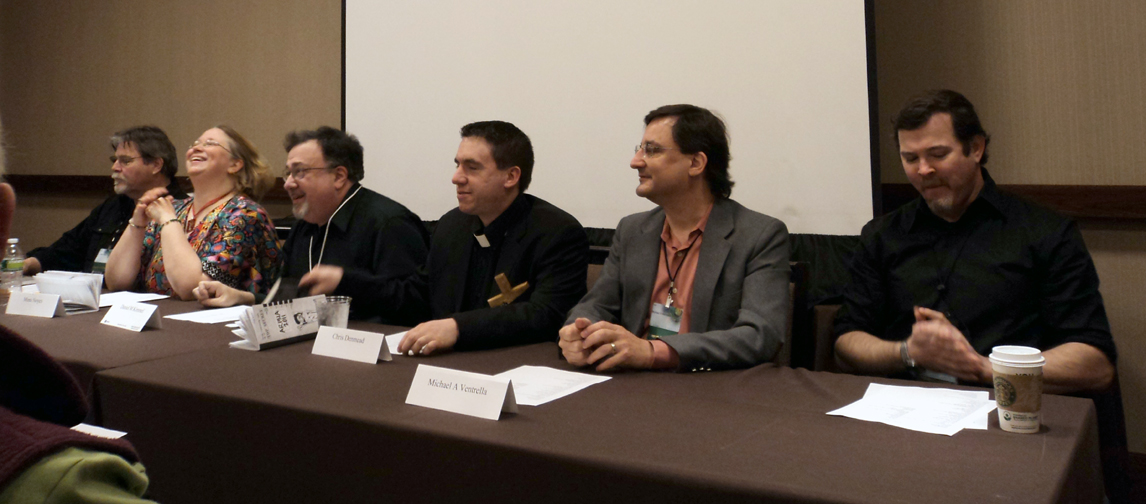
Since I write in the science fiction/fantasy genre, I have tried to attend as many science fiction conventions as possible. (See my schedule to the right under “Upcoming appearances”.) Since I had published a magazine on film animation in the 80s and early 90s (Animato!) and since I wrote a Rule Book and Players Guide for one of the largest live action roleplaying games in America (see The Alliance), I was able to present myself to these conventions as someone they would want to have as a guest, to speak on their panels. This provided me with free admission, a few perks, and the opportunity to promote myself to people who would actually be interested in what I had to say. I also was listed on their web pages and in their program books, along with a short bio.
When ARCH ENEMIES was released, it provided one more opportunity for promotion, and I now was able to sell myself to the conventions as a published author.
A few days ago, I returned from the World Science Fiction Convention which this year was held in Montreal, Canada (a lovely city but with the world’s worst Chinese food, even in Chinatown). It’s in Australia next year. I don’t think I will be able to make that one.
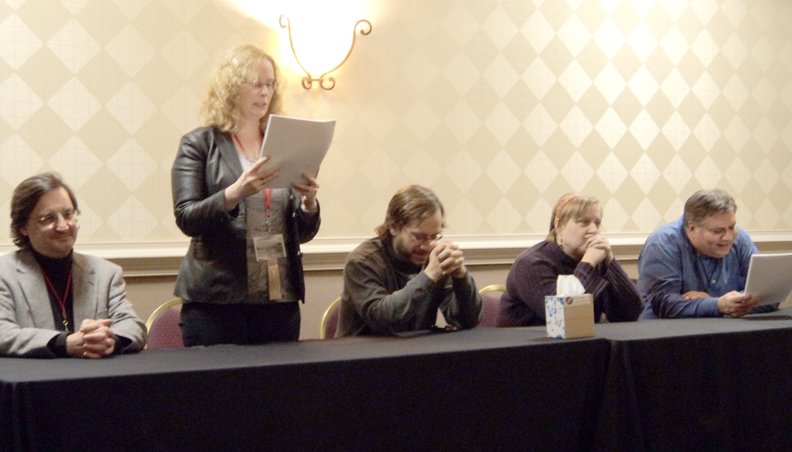
It was tremendous fun. I had the opportunity to meet and speak with many famous writers, editors, and artists, and was on a number of panels — the largest of which was about computer animated films. (As an aside, it was a pleasure to meet Mike Resnick in person after interviewing him for this blog a while ago. “Ask tougher questions!” he admonished me.)
Most importantly, I had my book for sale in the dealer’s room, and was listed in the program for a reading and a book signing. Not surprisingly, in a convention packed with many things to do, I did not receive a huge crowd for either, but the books in the dealer’s room sold out — a good sign that perhaps my promotions were successful.
For the reading, I decided to present the pirate short story I am working on (“X Spots the Mark”). I loved doing the pirate accents and the audience seemed to have a good time. After, they requested that I read some from ARCH ENEMIES and being the ham I am I was pleased to oblige.
The nicest encounter came during the book signing. I was given the assignment of being at the signing table from 6:30 to 7:00 pm on Saturday night, when basically everyone is at dinner and preparing for the big Masquerade an hour or so later, so I had nice conversations with the other not-so-well-known authors, artists and editors who wondered if anyone would show up. A teenage girl came to me and asked me to sign her autograph book. “Ah, in case I become famous some day?” I asked. “Well,” she shrugged, “you’re already more famous than me.”
But back to the topic: Every time you attend these things, you get better known in the community. People say “Oh, I remember him; he spoke well at that panel. Maybe I’ll try his book.”
And you make connections. I had a nice conversation with Jim Morrow, for instance, who agreed to submit to a future interview for this blog.
Now I just need some tougher questions.
Filed under: writing | Tagged: Arch Enemies, convention, promoting yourself | 1 Comment »
Hildy Silverman is the publisher and editor-in-chief of Space and Time, a 43-year-old magazine featuring fantasy, horror, and science fiction. She is also the author of several works of short fiction, which can be found in Wild Child, Phobos, Dark Territories (ed. Gary Frank and Mary SanGiovanni, Garden State Horror Writers, 2008), Witch Way to the Mall? (ed. Esther Friesner, Baen Books), an as yet-to-be-titled vampire anthology (ed. Esther Friesner, Baen Books) and Bad-Ass Fairies (ed. Danielle Ackley-McPhail). She is a member of the Philadelphia Science Fiction Society and the Garden State Horror Writers. She lives in New Jersey with one husband David, one daughter Rayanne, and one Bichon Frise, Frosty. She is a freelance consultant who writes corporate training, marketing communications, and SEO articles for major companies throughout the U.S.

MICHAEL A. VENTRELLA: First of all, Hildy, how did you end up with this position, following in Gordon Linzner’s footsteps?
HILDY SILVERMAN: It was a spur-of-the-moment decision. I had met Gordon at a convention and saw him a few times due to mutual friends. I started reading Space and Time and really liked the unique fiction he ran. He told me that he was looking to sell the magazine and had some possible buyers interested, so I didn’t think much more about it.
Later, at a SFWA (Science Fiction Writers of America party), Gordon told me that none of the buyers had come through, so he was just going to shut down the magazine. Maybe I had a few too many Cosmos, because my response was, “Well, what if I wanted to buy it?” Long story short, we talked it over, I performed my due diligence, and in the end we were able to work out a good deal. Thus my career as a small publisher began.
VENTRELLA: When reviewing submissions, what will send a story to the slush file quickest?
SILVERMAN: Well, pretty much all of the stories start in the slush file anyway. Space and Time has six associate editors, who serve as first readers of the slush. They weed out the stories that aren’t up to snuff then forward the “goodies” to our fiction editor, Gerard Houarner. If he gives the story his blessing, it’s usually in…I just look them over and, except for a few rare occasions, rubber-stamp his choices.
If what you mean is what will get a story rejected quickest, there are a few obvious (or what should be obvious) things. Stories that are mailed to the business address without first requesting to do so are rejected out-of-hand (we accept electronic submissions only). Stories that clearly haven’t been proofread – full of typos, spelling and grammatical errors, formatting problems, etc – are also Right Out. Also, if the story doesn’t contain some sort of speculative fiction element, it is not for us. Those are the kinds of things that get weeded out first and fastest.
VENTRELLA: Do you advise aspiring writers to begin with short story submissions or do you feel that in today’s market, it is no longer necessary as a way to make a name for yourself?
SILVERMAN: I’ve heard conflicting advice and statements on this subject for awhile now. If a writer ultimately wants to make it as an author of full-length books, I’d say that writing ANYTHING until you’ve perfected your craft is a good idea. There’s certainly a lot less of a time investment in practicing your craft perfecting short stories for submission than if you write full-length manuscripts over and over. If you’re good enough to have you short stories published in a number of respected short fiction magazine and anthologies, perhaps win an award or two, it certainly wouldn’t hurt your reputation when ready to peddle a longer work to agents and editors. Credits are credit – they always look good on a submission letter.
VENTRELLA: Is there a talent needed for short stories that is separate from the skill needed for novels?

SILVERMAN: Oh, yes. Some people mistakenly believe that because short stories are – well, shorter, they are faster and easier to write. Not true. You need to be able to convey an entire story – full plot, characterization, world building, etc. – in 10,000 words or fewer (usually fewer). That takes a great deal of skill. Your writing has to be tight, your use of language precise. Folks who write novels may have those abilities, but others will tell you they just can’t fit everything they want to say into the short story form. By the same token, there are short fiction writers who can’t “go long.”
VENTRELLA: Are there any taboos that would prevent you from accepting a story? Any trends you’re sick of?
SILVERMAN: I’m pretty hard to offend, especially when it comes to often-taboo subjects like sex or religion. In fact, I daresay I have or will publish some stories that are bound to get me into trouble with a few readers! As long as the story is well-written, with involving characters and a plot with a beginning, middle, and end I will give it fair consideration.
That said, pure “snuff” fiction holds no interest for me, mostly because there’s no plot there, just a vignette showcasing the abuse of one character by another. If someone sent me a piece featuring abuse, rape, or torture that is clearly all about wallowing in some disturbing fantasy, that’s not getting published, mostly because such work has no character, plot development, or anything of interest to say (except, maybe, “I need help.”)
As for trends I’m sick of, nope, haven’t run into any yet. We only open for submission windows, so I don’t see what a lot of other editors do, which is the same vampire plot or the same space opera story repeatedly throughout the year. There was a funny mini-trend I noticed last time we were open, though. Several stories about Quetzalcoatl came in all at once. I assume there was a planned anthology that didn’t go through; that’s usually the reason for an odd theme to suddenly rear its head in multiple submissions.
VENTRELLA: What do you personally like to read? Does that influence the choices you make as an editor?
SILVERMAN: I am a big fan of dark urban fantasy and horror these days. However, my tastes have changed over the years…I started out reading only hard science fiction (Asimov, Bova), transitioned to fantasy (Tolkien, McCaffery), and went on from there (King, Butcher). I also enjoy some literary fiction (Russo) – referencing the category here, not my personal opinion that it is more “literary” than other fiction. I supposed personal taste always comes into play when making editorial decisions, but I try to focus on how engaging a given story is, rather than be distracted by it not being my “thing.” If I feel unqualified to judge the merits of the story, I’ll leave it up to Gerard or one of the associate editors who is into that kind of story to make the final call.

VENTRELLA: Does having an agent make a difference to you?
SILVERMAN: No, not for short fiction. In fact, I would find it odd to receive a piece brokered by an agent. There’s simply nothing to negotiate with a magazine publisher – our payment offerings, the rights requested, they’re all pretty standard. I can’t remember every getting a piece that was submitted by someone’s agent, though many of our authors do have agents to represent their longer works.
VENTRELLA: What’s the best piece of advice (other than “learn to write better”) you can give an aspiring writer?
SILVERMAN: Don’t forget to send your work out. It does you little good to write a huge number of short stories only to let them pile up in a drawer because you can’t or won’t get around to sending them to a market for consideration.
Also, learn the business side of writing. Too many writers are so focused on the craft – which IS important – but they never bother to learn the rules of the trade. You need to know how to research a potential market, understand guidelines, adhere to those guidelines, read a contract and understand the rights you are signing away, things like that. There are resources all over the Web and in how-to books that can tell you how to manage the money-making side of your career as well as the creative aspects. You should be equally versed in both.
VENTRELLA: As a writer yourself, what are your long term goals and what are you doing to make them happen?
SILVERMAN: Long term, I would like to see my novel published. I’ve been shopping it around to agents and have gotten some lovely rejections. Oh, that’s another thing for aspiring writers to remember – you’re going to get rejections. A lot. And some more. So has pretty much every major author you’ve ever heard of. The key is how you handle it. You can’t take them personally…it is your work being rejected, not your baby, not you. Everyone rejects work for a huge number of reasons, most of which are not because you suck as a writer. This is something I have to remind myself of all the time, because it is easy to be stung by rejection, even if you have a thick leathery skin like me.
In the meantime, I’m continuing to submit my short fiction to a variety of markets and have been enjoying some success there. I currently have three pieces published or about to be published in three different anthologies this year, plus a couple more pending.
I need to set some time aside to do more writing and submitting, but between running the magazine, my “day” job, and family life, time is a factor. I need to push past that and get on the stick, though, especially when it comes to sending out the next round of queries on the book.
Filed under: writing | Tagged: agents, editors, rejection letters, writing advice | 1 Comment »
More than once, I have been approached by someone saying, “Oh, you’re a writer? Listen, I’ve got a great idea for a book. Tell you what, I’ll give you the ideas and you’ll write it and we can share authorship.”
Are these people coming to me because I am not a successful full-time author (yet)? Would they approach a famous writer with the same request?
I’ve actually had one person get upset at me when I refused, as if I had turned down free money. “Don’t you understand? I’m going to do all the hard work; all you have to do is write it down.”
Obviously, these people have no idea what it means to write. Everyone has ideas; I have more book ideas than the time I have to write them in. And I expect everyone reading this has ideas as well.
Expressing those ideas? Not everyone can do that.
As a lawyer, I see the same thing in court. Some attorneys are much smarter than I am yet don’t go to court very often and don’t know how to present their arguments. Having control over your words is not an easy skill to acquire.
God knows, I am still trying to acquire it in my writing. Some reviews for ARCH ENEMIES spoke of the great plot twists and character development while at the same time noting that the writing was still rather pedestrian.
Hey, give me a break; it was the first novel I ever wrote. I’m just thrilled it was at least good enough to get published.
But it’s true. The sequel (THE AXES OF EVIL, expected to be published late this year or early the next) is a big improvement over the first. I’m learning each day that little tweaks here and there can make huge differences in the story.
A few months ago, I attended a writer’s workshop that pushed this further, and in the last week J. Thomas Ross, a professional editor, while once more admiring my story and characters, reduced the first two chapters of THE AXES OF EVIL to bits, making points about my writing style that seem so obvious that I slap myself and say “Why didn’t I see that?”
It’s kind of like when I learned to play guitar. I was justly proud of myself, and the bands I played in as a teenager were not bad, but in retrospect amateurish. It took years of practice and playing until I felt really confident. Writing is the same.
This blog is meant to help those writers who, like myself, are just starting out and making mistakes along the way. I learned early on that coming up with a good story is not enough. I am still working on the second part: the writing. And I probably will always be working on that part.
When I think about this topic, I am often reminded of my favorite author, Charles Dickens. I read PICKWICK PAPERS years ago, and had an epiphany at one point. Dickens was describing Pickwick’s meal and dinner conversation, and at the end of the chapter, it hit me that nothing had happened. Nothing in that chapter pushed the plot forward or developed the characters in new ways, but I couldn’t put it down. Dickens, being such a master writer, had kept me enthralled writing about nothing. Ideas aren’t everything.
Very few authors can accomplish that, but the very best can come close. And that’s the lesson for today: The best ideas in the world are meaningless if you cannot express them in a way that makes people want to read them. And that’s a skill that you have to learn.
Filed under: writing | Tagged: Arch Enemies, ideas, The Axes of Evil | 4 Comments »
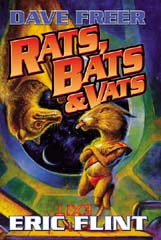
Over the past month or so, I’ve posted interviews with authors, but let’s get a perspective behind the scenes this week with Mike Kabongo, whose OnyxHawke agency represents authors like Dave Freer and James Enge. His web page is http://www.onyxhawke.com/index.php
MICHAEL A. VENTRELLA: Michael, unlike most agents, you prefer to read the work before the query letter. Why is that?
MICHAEL KABONGO: Cover/query letters are interesting, but they are not the same type of writing as a novel. Some people will tell you that if you can write X you can write Y; I think the best thing that can be said for that point of view is that it is more aggressively optimistic than is wont in anyone old enough to cross the street by themselves. That said, they do serve a purpose, and they tell their reader far more about the writer than their fiction may.
I think that on the whole the best effect a cover letter can have is a null effect. I doubt any novel has sold purely on the basis of a cover letter, I suspect that many make it no further based on them. No agent, no editor wants to work with someone who is going to take an inordinate amount of their time and energy. That said, I don’t always skip the cover letter, it’s something done almost at random. I tend to read a bit of the novel, and if I make it through a couple chapters and haven’t read the letter I’ll go back to it.
A writer who is an energy sink could be one in several ways, among them: A) higher than average need of editing; B) constant need for attention of some sort; C) inability to stay on task; D) inability to write something marketable; E) emotional maintenance.
VENTRELLA: Can you usually tell within a page or so whether you might be interested in representing a particular author? Anything that makes you immediately toss a manuscript in the “rejected” file?
KABONGO: I can usually tell if I’m not interested well before I can tell if I might be interested. I have had a few books that I thought “Hey, this person can actually write and not just string words together, but I think they started in the wrong place.” I’ll usually keep reading these even if the first chapter is subpar. I’ve signed one or two clients with books that started that way. I don’t think I’ll give any direct examples, but when the science is worse than BRAVE NEW WORLD or I can hear the author’s voice over the character’s, or they have done something completely counter to a character’s established character, yes I’ll toss it quickly.
VENTRELLA: At the Ravencon science fiction convention, you humorously summarized your advice to aspiring authors as simply “Don’t be an asshole.” This is, of course, good advice for anyone, but for authors, how is that rule usually broken?
KABONGO: Well, it’s broken in a number of ways. One of the most disgusting acts I’ve seen lately was an author who publicly told their fans (or if one is being less charitable, “sycophants”) to attack someone who had given them a bad review. Another is being (needlessly) rude to people who they encounter in public places. Towards the people in the inside of the industry, the other writers, editors, and us invisible agents it is often worse. The infighting that goes on publicly in the SF/F community is startling to me. I can’t possibly imagine the heads of new products at ATT Wireless and T-Mobile or Samsung and LG engaging in the sniping that goes on as a matter of course in our commuinty.
VENTRELLA: Do you feel you can adequately represent an author whose work doesn’t really interest you yet in whom you can see the business potential? Or do you have to love the work in order to sell it?
KABONGO: I would really, really like to love the work I pick up, or at least the writing potential of the writer, and I can’t see myself picking up any work I don’t see strong marketability in. I’ve never accepted anything I hate for sale, but I suppose if someone who’s been on the best sellers list for twenty five years came to me and said they need a new agent I’d probably say yes. This is a business after all.
VENTRELLA: Now that vampire books are on the way out, I have of course started work on mine. How much do you follow and to predict trends in the market when deciding which books to push?
KABONGO: I pay attention to what the editors are saying about stuff they reject and what they are buying. I think that is a better set of indices than what is in the bookstores now.
VENTRELLA: What’s the biggest misconception new authors have about what agents do?
KABONGO: That an agent can sell something the market won’t support.
VENTRELLA: What piece of advice do you think is imperative that never seems to get mentioned in any of the standard “How to attract an agent” articles that populate the web?
KABONGO: First: Write well. Second: Be patient.
Filed under: writing | Tagged: agents, Mike Kabongo, new writers, query letter | Leave a comment »
Mike Resnick has 5 Hugo Awards to his name (having been nominated 33 times — so far!) and has won numerous other awards for his fiction. As of 2009, he is first on the Locus list of all-time award winners, living or dead, for short fiction, and 4th on the Locus list of science fiction’s all-time top award winners in all fiction categories. He’ll be attending the World Science Fiction convention in Montreal in a few weeks, as will I, except he, of course, is once more nominated for a Hugo award.
His web page is here.
MICHAEL A. VENTRELLA: I am thrilled to be interviewing one of my favorite writers, Hugo and Nebula award-winning Mike Resnick.
Mr. Resnick, you seem to embody what many people advise all new writers: write a lot and write about everything. You’ve done fiction, non fiction, articles, editing, and so on. Do you agree that this is important and how do see a varied background as helping your writing?

MIKE RESNICK: Anything a writer can learn will eventually prove useful. Editing shows you how other people attack their stories, lets you see the strengths and weaknesses of certain approaches. Writing non-fiction teaches you to be careful of your facts, and that’s almost equally important in science fiction, where you strive for verisimilitude. Short stories and novels have different approaches, and the more you can learn about both, the less likely you are to put yourself at a competitive disadvantage against writers who do learn all that they can about their craft.
VENTRELLA: How has the publishing industry changed since you began?
RESNICK: The main change is that while they are printing more books, less houses are printing them. When I started selling in the early 1980s (I won ‘t count the three science fiction books I did in the late 1960s; my post-1980 career is a public penance for them), 18 New York publishers had science fiction lines. Today there are maybe half a dozen mass market houses with science fiction lines. Signet, Fawcett, Gold Medal, Pyramid, Lancer, Paperback Library, Playboy Press, Doubleday, and half a dozen others have gone – or seen their lines go – the way of the dodo.
VENTRELLA: Did you have an agent and do you think agents are necessary these days?
RESNICK: I had an agent after my first couple of sales; a lousy one. I got a top one in 1983, and I still have her, and she is absolutely not allowed to die or retire before I do. Yes, they’re necessary, for any number of reasons:
1. A lot of houses – most, in fact – won’t read unagented manuscripts.
2. Your agent, because of all the contracts that pass through her office and all the deals she’s negotiated, has a far better idea of what will be a contract-killer that you do, and will know what Publisher A will accept that Publisher B won’t.
3. A good agent will have a top foreign desk, will make you more money overseas than you’ll make in the US, and will have working relationships with top foreign agents in each country.
VENTRELLA: Self-publishing seems to be the trend; do you believe that if a starting writer self-publishes it destroys their chance of being taken seriously by “real” publishers and editors?
RESNICK: John Scalzi to the contrary – and he had a unique situation, with 25,000 daily hits on his blog – I believe, and have always believed, that a self-published book practically screams out that it was not good enough to compete in the economic market place. 
VENTRELLA: What process do you use in writing? How important are outlines, for instance?
RESNICK: I have a very brief outline I use to sell the book to a publisher, and a slightly more detailed but far less formal outline – a set of notes,
actually – that I use when I sit down to write the book.
VENTRELLA: Do you plan an entire series at once or concentrate on each book separately?
RESNICK: If you’re writing a series, you have to know a little about where each book starts and finishes, but you concentrate on the book you’re writing, because if you do a lousy job there won’t be any more in the series.
VENTRELLA: Do you usually have more than one project at a time, or do you tend to get one finished and then move on? Do you think it is better to concentrate on one?
RESNICK: I only write on one novel at a time, but while I’m writing it I often take a couple of days off to write a story or an article, and then come back refreshed. For example, I just handed in STARSHIP: FLAGSHIP, the 5th and final book in that series…but while I was writing it, I wrote and sold a story to Asimov’s, 2 to Subterranean, 1 to Analog and 1 to GATEWAYS, plus an article for Challenger and one for the SFWA Bulletin. That’s probably why it took me 9 weeks to write the novel instead of 6 weeks.
VENTRELLA: What’s the biggest mistake you have made professionally? What is the biggest mistake you see new authors making?
RESNICK: I sold 3 very derivative, not-very-good science fiction books in the late 1960s. I was busy learning my trade as an anonymous hack in the “adult” field, and I made the mistake of doing hackwork in a field I cared for. I realized it very quickly, and stayed away from science fiction – as a writer, not a con-attending fan – for 11 years to give readers a chance t forget. They forgave, but those damned books still turn up at every autographing session to humiliate me.
The biggest mistake new authors make? Either sending a manuscript out when they could make it better (this is a murderously competitive field), or signing a lousy contract with a second-rate publisher just to get their book into print.
VENTRELLA: I understand that Hollywood has just taken an interest in your “Galactic Midway” series, which I recall discovering and loving back when they were published 27 years ago. How did that come about, and why that series among all of yours? Can you give any details about this deal yet?
RESNICK: There aren’t any details to give. I met with Jupiter 9 Productions when I was in Los Angeles for the Nebulas this spring. They have options on a couple of my properties, and asked what else I had. I mentioned that I had a 27-year-old novel called SIDESHOW that I have thought, from the day I wrote it, was very filmable: good story, almost no special effects, emotional rather than cerebral, all you really need is a good make-up artist and good actors. They asked to see it, I send them a copy, and they optioned it.
That doesn’t mean it’ll be a film. SANTIAGO has been under continuous option since 1990. I’ve been paid 4 times for the screenplay that Carol and I wrote. You haven’t seen it at your local theatres, have you? Another one was THE WIDOWMAKER. Sold it to Miramax; they paid Carol and me to write the screenplay, hired Peter Hyams to direct – and then lost interest. It’s currently under option with Jupiter 9. The Penelope Bailey trilogy – SOOTHSAYER, ORACLE and PROPHET – has been under option to Intrinsic Value Films for about 5 years now; they’ve had a screenplay for 4 ½ years, they hired a director 2 years ago – and you haven’t seen that one in theatres either, have you? Other projects under option include “Hunting the Snark” and KIRINYAGA. (On Hollywood’s behalf, the economics are different. If a publisher had to raise $75 million every time he wanted to publish a book, you wouldn’t see a lot of them, either.)
VENTRELLA: What is your favorite of your own work and why? Of what are you most proud?
RESNICK: My favorite novel is THE OUTPOST, because it was the most fun to write. Far and away my favorite character is Lucifer Jones, who over 20 years has starred in ADVENTURES, EXPLOITS, ENCOUNTERS, and (this summer) HAZARDS, and will be in VOYAGES and INTRIGUES before he’s barred from every land mass on Earth. If I could write only one thing the rest of my life, it’d be Lucifer Jones stories; I love them.
I’m most proud of PARADISE, because no one had ever used that approach in that way, and I thought I did it about as well as it could be done. And I’m pretty proud of KIRINYAGA, which is up to 67 awards and nominations and still chugging along.
VENTRELLA: And finally, what is the best piece of advice you would give an aspiring writer?
RESNICK: Books don’t write themselves. Writers write; dilettantes who will never amount to much talk about writing.
Filed under: writing | Tagged: agents, new writers, outlines, self-publishing, writing advice | 1 Comment »