Interview with Award Winning Author Jonathan Maberry

JONATHAN MABERRY is the multiple Bram Stoker Award-winning author of novels (PATIENT ZERO, GHOST ROAD BLUES, etc.), nonfiction books (ZOMBIE CSU, THE CRYPTOPEDIA, etc.), comics (BLACK PANTHER, PUNISHER: NAKED KILL and WOLVERINE: GHOSTS), and over 1100 magazine articles.  Jonathan is the co-creator (with Laura Schrock) of ON THE SLAB, an entertainment news show for ABC Disney / Stage 9, to be released on the Internet in 2009. Jonathan is a Contributing Editor for The Big Thrill (the newsletter of the International Thriller Writers), and is a member of SFWA, MWA and HWA.

Visit his website at www.jonathanmaberry.com or on Facebook and MySpace

Jonathan Maberry author photo 2009

MICHAEL A. VENTRELLA: Jonathan, thank you for being the first to submit to the interrogation, which I promise will be free from “enhanced techniques.”   To begin, can you discuss how and why you made the transition from non-fiction to fiction?

JONATHAN MABERRY:  I was doing research for a vampire folklore book –VAMPIRE UNIVERSE (Citadel Press, 2006) and realized that popular fiction rarely mines the richness of folklore for source material.  Most takes on vampires are variations of Dracula, and Bram Stoker was by no means a folklorist.  His vampires different considerably from most European vampires, and even from Transylvanian vampires.  There are hundreds of different kinds of vampires in world myth and few of them every appear in fiction.

I thought how interesting it would be to read a novel in which the characters realize they’re up against vampires but everything they try fails because all they know about vampires comes from novels and movies.  The more I thought about how much fun a book like that would be, the more I wanted to see if I could write it myself.  My only previous attempts at fiction had been a couple of shorts stories way back when that sold to magazines that pay only in contributor copies.  But…I decided to give it a shot anyway.

When I set about it, I was consciously writing the kind of book I wanted to read.  I had no expectations of it actually selling.  After I had the book roughed out I realized that it was a much larger story than I thought and it would have to be a trilogy.  That really stacked things against me because until then there had been no horror trilogies.

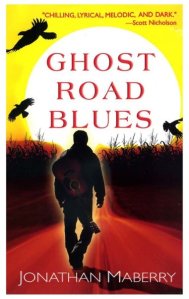
I went through the process of scouting for an agent, got the book into her hands, and she was able to place it –and the two other as-yet-unwritten books—with a major house.  That book, GHOST ROAD BLUES, was published as a paperback original by Pinnacle Books in 2006 and went on to win the Bram Stoker Award for Best First Novel and was in the running against Stephen King and Tom Piccirilli for Novel of the Year.  As you can imagine that was a pretty strong dose of validation.

And, just writing the book gave me the bug.  Now I’m totally hooked on writing fiction and am work (simultaneously) on my 8th and 9th novels, one for St. Martins Griffin and one for Simon & Schuster.

Ghost Road Blues

VENTRELLA: You have also not limited yourself in your writing, having produced novels, short stories, plays, and comic book scripts.  Do you advise a starting writer to concentrate in one area first?

MABERRY:  Always start with your strength.  I started with magazine feature writing about martial arts.  I’ve been practicing jujutsu since I was a kid, so when I pitched my first article at age twenty I was able to speak with some authority.  From there I went to how-to pieces, and later I wrote martial arts textbooks while teaching Martial Arts History, Jujutsu and Women’s Self-Defense at Temple University.  Once I had myself established as a writer I went outside my comfort zone and started pitching on what I liked.

This doesn’t always apply to fiction, though.  If I was just starting out now, with no writing credentials, I’d probably tackle a novel in the genre that I read most.  Knowledge of your favorite genre –its history, its greatest works, its best writers—creates a comfort zone that lends authority, confidence and passion to your own work.

VENTRELLA: What’s the biggest mistake you made when starting out?  What’s the best piece of advice you got?

MABERRY:  I made two whoppers.  The first was believing that I was skilled enough to represent my own books.  That came back to bite me on the ass when I published with a small press owned by a lawyer.  Looking back, that had red flags all over it, and I got bent over a barrel.  Then I wised up and got an agent.  She looks after the legal end of things, and she does a hell of a lot better job of it than I ever did.

The other mistake was believing that old propaganda that creative people are bad at business.  Once I got burned by the small press shark, I made sure that I learned everything I could about the writing business.  I found that learning the business side of things was just a matter of research, and writers are good at research.  It also helped me identify the kinds of people I needed to work with —agents, accountants, etc— and learning how the business works.  One of the first things you learn is that publishing IS a business, and everything that occurs within it is part of business.  Art is the product, not the method.

VENTRELLA: Your latest series involves Joe Ledger, who works for a top-secret government agency and who has all sorts of advanced training.  While it is true that you have a martial arts background yourself, what sort of research did you do to get into the mind of your character?

MABERRY:  I talk to pros in the field.  Like most writers I love research.  I’m a knowledge junkie.  I want to know how things work, how people do their jobs, and so on.  To get into the head of Joe Ledger I spoke with SWAT operatives and people currently or formerly in Special Ops.  Always ask the pros.  Find out what makes them tick, what drives them…and find out what they know about their job that Joe Average doesn’t know.

Because of that research I have a strong fanbase among present and former soldiers, cops and agents.

VENTRELLA: Do you think it is better for starting writers to, as they say, “write what you know” and create a main character with the writer’s experience and background?

MABERRY:  At first, sure.  If you build on your strengths you imbue the character with passion, confidence, and reality.  But don’t discount the value of paying attention to people around you.  I draw on a lot of people I know, or have known, when creating characters.  Rarely is a character made completely from whole-cloth…most have elements of real people.

VENTRELLA: What’s the best way to grab the attention of an agent?  What’s the biggest mistake you can make?

MABERRY:  Start with things in motion.  Don’t lead up to it (that’s a page waster and an interest-killer).  I like to jump in and make the characters scramble to catch up to something big and nasty already rolling.

VENTRELLA: Do you have a favorite of your own work?  Which, and why?

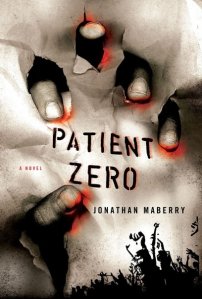
MABERRY:  So far it’s a tie between PATIENT ZERO and the second in the series, THE DRAGON FACTORY.  I delivered that a couple of months ago and my editors tell me that it’s better than the first…and they loved the first.Patient Zero SMP

In truth, though, I’m always in love with whatever I’m currently writing.

VENTRELLA: PATIENT ZERO also has the unusual (to me) technique of being written both in the first person and third person, depending on the chapter and the main character’s point of view.  How did you decide to adopt this technique and is it being used in the sequels?

MABERRY:  It’s a thriller, which means it’s a race against the clock.  In most thrillers that have a political or military angle the hero seldom gets to meet the bad guy behind everything.  I wanted Joe Ledger to tell his own story, but I wanted the reader to get to know the villains in the piece and learn who they are and why they do what they do.  So I switch from first to third.  A few other writers do this effectively.  John Connolly, Robert Crais, and others.  It works well if you stay on top of it and make sure the voice of the first person sections is different than the voice of the third person sections.

VENTRELLA: Just because I want to know:  The “zombies” in “Patient Zero” were not supernatural in the traditional sense of the word; will the Ledger novels continue in this vein?

MABERRY:  First off…zombies in most fiction aren’t supernatural.  In Night of the Living Dead it’s suggested that radiation from a returning space probe caused them to rise.  In many other stories they rise as a result of toxic spills, a mishandled bioweapon, or a mutation of some naturally occurring pathogen.  My take is that the pathogen is deliberately re-engineered to make a doomsday weapon for reasons that will benefit the villain, a pharmaceutical mogul named Sebastian Gault, who intends to profit from the panic and the resulting rush to create and distribute treatments or cures.

The other books in the series focus on different bio-threats.  In THE DRAGON FACTORY, a cabal of scientists are using cutting-edge genetic science to create pathogens for ethnic cleansing and to further the Nazi master race program.  In the third book, THE KING OF PLAGUES, a scientist discovers that the Tenth Plague of Egypt –the death of the firstborn from the story of Moses—was actually a pathogen; he recovers it and attempts to weaponize it so he can sell it to terrorists.

I have little faith in the sensible use of extreme science.  I like science, but research, profit and morality seldom occur all at once in the same people.  To me, that’s far more frightening than zombies!

maberry

Resources for new writers

After a nice talk with Jonathan Maberry (whose new book “Patient Zero” is excellent!), I have decided that perhaps the focus of this blog should change.

I am still in the process of learning all about the publishing industry, and it occurs to me that I am not alone.   Perhaps instead of just discussing my own personal writing I should instead be discussing the processes I have taken in order to get a book finished, find a publisher, locate an agent, and traverse the strange world hidden behind the curtain.

To that end, I will begin with listing a number of very reliable source of information: blogs for starting writers.  Future blogs will discuss the query letters I have used (what worked, what didn’t), what I’ve done to promote myself, ways to get reviews, and so on.  

I also plan on having interviews with agents, published writers, and editors where I can ask their advice.  

If you follow, you can learn along with me, and perhaps avoid my mistakes while capitalizing on my successes.  

So let’s start by giving a list of  resources.  This list was compiled by Janice Gable Bashman.  Thanks, Janice!

A Newbie’s Guide to Publishing – http://jakonrath.blogspot.com/

Alice’s CWIM Blog – http://www.cwim.blogspot.com/

Anthology News and Reviews – http://anthologynewsandreviews.blogspot.com/

BookEnds, LLC – A Literary Agency – http://bookendslitagency.blogspot.com/

Buzz, Balls & Hype – http://mjroseblog.typepad.com/buzz_balls_hype/

Crowe’s Nest – http://acrowesnest.blogspot.com/

by Ken Levine (more TV writing) – http://kenlevine.blogspot.com/

Editorial Ass – http://editorialass.blogspot.com/

Evil Editor – http://evileditor.blogspot.com/

Guide to Literary Agent’s Editor’s Blog – http://www.guidetoliteraryagents.com/blog/

Janet Reid, Literary Agent – http://jetreidliterary.blogspot.com/

Nathan Bransford – Literary Agent – http://nathanbransford.blogspot.com/

Pub Rants – http://pubrants.blogspot.com/

Query Shark – http://queryshark.blogspot.com/

Tess Gerritsen’s Blog –http://tessgerritsen.com/blog/

The Blood-Red Pencil – http://bloodredpencil.blogspot.com/

The Kill Zone – http://killzoneauthors.blogspot.com/

The Rejecter – http://rejecter.blogspot.com/

The Renegade Writer Blog – http://therenegadewriter.com/

There Are No Rules – http://blog.writersdigest.com/norules/

Weekly List of Anthologies – http://writersreliefblog.com/post/Anthologies-Contests.aspx

C. Hope Clark – http://www.hopeclark.blogspot.com/
(and don’t forget to sign up for her free newsletters: Funds for Writers and Funds for Writers for Small Markets)

Jonathan Maberry’s Big, Scary Blog – http://jonathanmaberry.com/

Editor Unleashed – http://editorunleashed.com/

Don Lafferty’s – Practical Social Media Strategies and Tactics for Connecting with Your Public – http://www.donaldlafferty.com/blog/

Seth Godin’s blog (not writing but excellent info on marketing) –http://sethgodin.typepad.com/

Using outlines before you write

I often speak to aspiring writers and commonly hear “Oh, I never use outlines.”

Maybe that’s why they are still aspiring, because every published writer I know of certainly does some sort of outline beforehand.

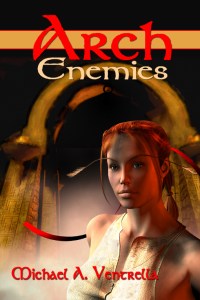
While ARCH ENEMIES was my first novel, it was not my first writing assignment.  As a practicing trial attorney, I write many briefs.  I have also written for various magazines and newspapers over the years, as well as many events for my game.  And if there is one thing I have learned, it’s not to turn your computer off before saving your work.  No!  Wait!  I mean, never write without using an outline.  See, if I had used an outline here I wouldn’t have made that mistake.writing

My outline for ARCH ENEMIES (film rights available) was not organized in numbered paragraphs, with roman numerals for each section like they might teach you in writing school. Instead, it was the story in the most basic form:

Chapter One:  Terin is about to perform when he is grabbed by the Duke’s squires and told he has been ordered to appear.  In fear, he tries to escape, causing pandemonium at the tavern. After being captured, he is dragged to the castle. Along the way, a barbarian sees him and runs in fear, much to Terin’s wonder…

You get the idea.  I tried to end each chapter on a cliffhanger to encourage those “I couldn’t put your book down” reviews, and whenever a great new idea appeared, I worked it in and was able to set it up with some foreshadowing.

I also knew that I wanted to pace Terin’s evolution properly. What good is a story that has no effect on the main character?  His transformation from absolute coward to accepting his fate grudgingly to becoming the reluctant hero had to make sense. People don’t change without the proper stimulus, and by looking at my outline, I could plant the seeds and pace it accordingly.

Using an outline is especially important in my writing because ARCH ENEMIES and its soon-to-come sequel THE AXES OF EVIL rely so heavily on unexpected plot twists and mysteries that don’t explain themselves until the very last chapter or so.  In fact, I write the ending first and then place the clues along the way;  without an outline, this just wouldn’t work.

At the same time, I’m never tied to the outline.  Scenes I thought would take one chapter end up lasting two.  Exposition that I imagined working well early in the book proved to be stronger later.   But at least I had a guide to make sure everything I needed was mentioned and in basically the order I wished.

So for those of you aspiring writers out there:  trust me.  Use an outline.

Batman gets arrested!

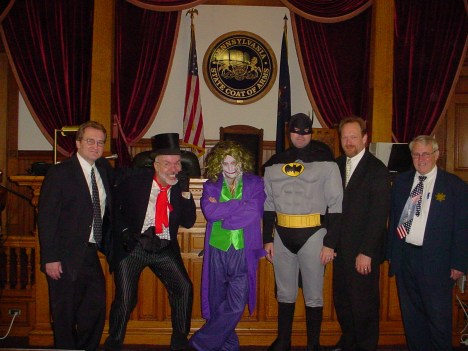
I had a great time this week with the annual Monroe County Bar Association’s so-called “Fairy Tale Trials” in which the local lawyers put on a fake trial for 5th graders at the courthouse so they can see what a trial is like.  For example, Goldilocks was put on trial for breaking and entering.Batman on trial

They’ve been doing this long before I moved here, but I took over as chair of that committee a while ago and have had a great time writing the trials.  I’ve written ones based on Robin Hood, Harry Potter, and this year Batman,  who is accused of trespassing when he breaks into a warehouse to arrest the bad guys.

There are five courtrooms at the local courthouse, and different teams perform the trial before different schools.

I played the Joker with this one, and had a great time!  I’ve been in the local paper many times for cases I am working on, but usually not pictured.  Of course, this time, my picture makes the paper — but in complete costume and makeup.

Here’s the short script we use.  It is written in such a way that each team can decide which bad guys to use.   We had Jokers, Riddlers, Catgirls, Poison Ivies, and Penguins…
 

GOTHAM CITY v. BATMAN

PARTS TO ASSIGN:

District Attorney

Two Batman enemies (Joker, Riddler, Penguin, Catgirl, etc.) 

Defense Attorney

Batman (defendant)

Commissioner Gordon (defense witness)


THE CASE

This is a criminal case because we find the kids understand “guilty” and “not guilty” better than they do comparative negligence.  Remember as well that for most of these kids, they will know Batman from the recent movies and not the campy 60s show. 


THE FACTS

Batman broke into the secret hideout of enemies (Joker, Penguin – depends on who you get to play the parts) where they were planning a new bank robbery.  Crashing through a plate glass window and miraculously not getting cut, he swooped in and engaged in a fist fight with these villains and their henchmen. 

Soon after the police arrived.  Surprisingly, after interviewing everyone, they arrested Batman on charges of Trespassing and Assault. 

Don’t get too complicated so as not to confuse the kids.  Let’s not get into definitions of whether the bad guys were already “conspirators” and whether character evidence should be excluded.

Before calling Commissioner Gordon as a character witness, the defense should first call for “Bruce Wayne” who will, for some reason, not show up.  “I don’t understand it,” the Defense Attorney can state.  “I spoke to Mr. Wayne personally and he assured me that if Batman showed up, he definitely would be here.”


EXHIBTS 

You are encouraged to come up with whatever exhibits you can create; it never fails that when we write these things, great ideas we never thought of come out of the teams.  If you do come up with a great idea for an exhibit, please share these with the other teams.

Some exhibit ideas include:

A rap sheet for the prosecution witness (probably on a long roll of paper)

Message from the Riddler

A map of the bank with escape routes and other notes

We will try to provide many of these but make no guarantees; they are not necessary for the case but will help explain to the kids how a trial works.


Coordinators should distribute this entire packet to all their actors since there is information in everyone’s testimony that will be important.


THE CONCLUSION

It might be fun to have something happen after the verdict is read.  If Batman wins, the bad guys can get upset and attack him and if Batman loses, well, the bad guys can attack him anyway just to taunt him.  Batman music should play and a fight can break out, accompanied by signs saying “Bam!” and “Pow!”  The deputies can eventually grab the bad guys and haul them away.  We do have an mp3 of Batman fight music you can play.


BATMAN (DEFENDANT)

I am The Batman.  I must keep my identity secret in order to protect myself and those I love.  I wear a costume in order to strike fear into the hearts of criminals, a cowardly and superstitious lot.

Since I started patrolling Gotham City, crime has fallen greatly.  I have been able to accomplish things the police never could.  The police thank me for helping them and in fact sometimes use the “bat signal” to let me know if there is something important I need to do for them.

I do not work for the police however and accept no compensation or assistance from them. 

Recently, I received a message from the Riddler which said “Riddle me this, Batman:  What is it that has hands and a face but no body?”  Well, I knew at once that it was a clock!  Obviously, he was telling me that the First Bank of Gotham was going to be robbed that night, since that is where the biggest clock in Gotham is! 

I knew that criminals often hid in abandoned warehouses down by the docks so I hopped in the batmobile and headed to the waterfront.  Sure enough, I found a building where I could hear plans being made for the robbery!  They were gathered around a table with a large map of the bank, with escape routes planned out.

The doors were all locked, so I broke in and was immediately set upon by the bad guys and their goons!  They were no match for me, and soon they were all knocked out and tied up with my batrope.

It was then that the police arrived and I was arrested.  I of course did not fight the police, and have appeared voluntarily for my trial today, knowing that the good citizens of Gotham will never find me guilty – for that would guarantee that the criminals would run rampant over the city!


 COMMISSIONER GORDON 

I am Police Commissioner Gordon.  I have known Batman for years, and often call him using the batsignal.  He is honest and trustworthy.

The District Attorney wanted to make a name for himself and told other officers to arrest Batman the next chance they could get.  I never approved of this.

Yes, Batman does technically break the law when he does these things but we have never prosecuted him because the benefits outweigh the negatives.  Besides, it’s only breaking the law because he is not an officer.  If one of my officers had been outside that warehouse and heard what was going on and then broke in, there would be no problem at all.

It  would not be a good idea if everyone was allowed to go around being a vigilante.  People can be wrong after all.  We don’t want people breaking into other people’s homes trying to arrest everyone.

It is true that technically, none of the evil bad guys that Batman tied up that day had broken any laws at that point.  It’s not illegal to talk about robbing a bank, it’s only illegal to do it.


 BAD GUY #1

This is a generic guide for the two Batman villains who will testify.  Each group may have different ones, and the actors portraying them should ham it up appropriately for each character.

I am (Batman bad guy).  As a purely hypothetical intellectual exercise, my friend and I met in an abandoned warehouse to discuss a game we are planning to produce called “Bank robber”.  You use a map, and you roll the dice, and you see if you can steal the money.  It’s just a game.  We’re hoping Milton Bradley takes an interest.

We didn’t want anyone to steal our game idea, so we met in the warehouse.  Since so many criminals hang out in the docks, we hired bodyguards to protect us and gave them all matching costumes.  We do have class, don’t we?

We were working on the rules of this game when this crazed crusader broke the window and starting attacking us for no reason!  We tried to protect ourselves but he beat us senseless and then tied us up!  What is this city coming to when innocent people get attacked for no reason?

Well, yes, technically we were trespassing I suppose, but no one has used the warehouse for years, and even if we were, that means Batman was too!  And we’re not on trial here.

Yes, I do have a long record of crime but I’ve done my time and I’m off parole now.  I’ve mended my ways!  Trust me.


BAD GUY #2 (PROSECUTION WITNESS) 

Bad Guy #2 should echo the same information, with a different personality, but at one point should let something slip:

Well, (Bad Guy #1) had this great idea that if we didn’t want to ever get in trouble any more, we should get the new District Attorney on our side!  So we told the DA that he should arrest Batman and he’d be sure to get lots of publicity for his re-election campaign!  So we had the Riddler send Batman a message and then we pretended we were going to rob a bank, knowing Batman would show up!  It’s brilliant plan!  But don’t tell anyone.

How the Grinch Stole Gay Marriages

Recently, right wing nutjob William Murchison had a column in which he argued that gays should not be allowed to get married because they cannot have children, and children is what marriage is all about.

I was so angry at this outright stupidity that I wrote a Letter to the Editor about it, which was printed today in my local paper.   Here it is:


Columnist has a sadly limited view of marriage

Editor, the Record:

My wife and I have been happily married for more than 26 years now. We’ve helped each other out through thick and thin, including years of cancer treatments and a current handicap because of it. We’ve never needed counseling, never cheated, and never separated. I’d like to think we are an example of what all good, loving marriages should be.

So imagine my surprise when I discover that, according to your columnist William Murchison, our marriage is a sham because we have no children. Apparently marriage “is all about children” — or at least that’s what he claims in order for him to deny marriage to people in love. This would apparently include those who get married later in life, past child-bearing age — so for all of you seniors who are reading this: Forget about marriage. Love, according to Murchison, has nothing to do with it.

I do admit that I am confused by those, like Murchison, who stand Grinch-like above it all, sneering down haughtily while trying to prevent others from having joy. Shouldn’t we be encouraging happy couples in stable relationships? Isn’t that really the goal of marriage — not producing offspring (which unfortunately seems to happen a lot without marriage)?

In the meantime, I guess my wife and I will continue in our strange belief system that marriage is, despite Murchison’s view, all about love.

MICHAEL A. VENTRELLA

http://www.poconorecord.com/apps/pbcs.dll/article?AID=/20090416/NEWS04/904160313/-1/NEWS0401


The responses so far have been wonderful.  When I walked into court this morning, the security guards there clapped their approval.  I received good emails from friends and a call from a judge thanking me as well.  

My only worry afterwards was that I didn’t make it clear enough that this was about denying gays the right to marry.  That’s the mentality I really can’t understand:  How does it hurt you in the slightest to allow others to be joyous and happy?  This puritan “I don’t like this so therefore no one can do it” attitude is just completely foreign to me.

Fortunately, the US is changing, and I’m optimistic;  people are beginning to see this as a true civil rights issue.

Disclaimer:  I know this blog is supposed to be about writing, but hey, I did write something and it was published.  Doesn’t that count?  (Insert cliche smiley face here)

Bloodsucker: A vampire runs for President

Every politician has some skeletons in their closet, but for only one is this literally true.  Presidential candidate Norm Palmer’s road to the White House is progessing smoothly but for those crazed right-wing fanatics who are accusing him of being a vampire!  Their accusations are the laughing stock of the campaign, until one investigative reporter stumbles across some very interesting evidence — but who would ever believe him?

“Bloodsucker!”  It’s the West Wing meets the bat wing.

Yes, I’ve started work on my next book.   More on this later.

At the recent Society of Children’s Book Writers and Illustrators’ writers conference here in the Poconos, I had the pleasure of meeting a number of great writers, agents, and editors.   As one of the few in attendance who wrote Young Adult novels, I sometimes found that I had little in common with those who wrote children’s picture books, but it was still a learning experience especially since the things we did have in common (finding agents, dealing with publishers and editors) provided fuel for conversations.

I was honored to be asked to participate as a moderator for a group of aspiring unpublished writers and to join the other published authors in a question-and-answer period.  

There were seminars and group sessions where we had our work critiqued, and I was able to pitch the idea for Bloodsuckers to other writers and editors, where it was well received —  well, except for the “Oh, not another vampire novel” comments.

I’ve never been a huge vampire buff.   I haven’t read or seen “Twilight” or “True Blood.”  But I am a big political junkie.  I graduated cum laude with a degree in Political Science before going off to law school, and have worked as a lobbyist and political reporter as well as spending a summer as a campaign manager for a state representative up in Boston.  I’m still actively assisting local campaigns.

Anyway, when someone made a comment about all those “bloodsuckers in Congress” recently, the proverbial comic light bulb illuminated the brain.   I expect this will end up more as a political novel than a supernatural one.

In some ways, I plan on making fun of those extremists who believe in every conspiracy about a candidate.  Of course, this time they happen to be right…

I see this on the political boards I visit.  The right wing crazies who hate Obama attack him for the stupidest things:  He wasn’t born in America!  He is a closet muslim/socialist/drug dealer!  He wants to create a North American monetary system and work toward a world government, making us all subservient to the UN!  — You know the type.  

The problem with this kind of “Chicken Little” hysteria is that when they finally have a real issue to criticize him on (and there are real issues, of course) no one pays any attention to them.

So what if these same loonies uncovered the fact that the candidate was a vampire?  I mean, they’re crazy already, but this is going too far, right?

I should have a lot of fun with this!

Help! I’m being pursued by an albino monk!

In my last blog, I mentioned that I always attempted in my writing to not handle character development the way Dan Brown handles character development, which is to say “not at all.”

It has been brought to my attention that speaking ill of one of the biggest selling authors of all time is probably not a good way to endear myself in the writing community as I attempt to interest an agent and publisher for future works…

So allow me to state, in all honesty, that I have read three of Dan Brown’s books and enjoyed them quite a bit.  In fact, in some ways, I have tried to copy some of his techniques (if not his “character development”).  

What Dan Brown does great is set up secrets and mysteries and twists, which if you have read my work or at least the reviews, I obviously love.  I enjoy books and movies where the reader/viewer is not spoon-fed the plot at the start and can be just as surprised as the main character when mysteries are revealed.

One of my favorite SF series is James P. Hogan’s “Giants” series, which begins with INHERIT THE STARS.  Mr. Hogan writes that hard SF that I could never do, and is also a very nice man I have had the pleasure of meeting in the past.  In this series, a scientific mystery erupts (what is a 10,000 year old human skeleton in a spacesuit doing on the Moon?) and the main characters attempt to scientifically solve this mystery.  At the end of the first book, you say to yourself “Ah! Glad that was solved!”

Then the sequel begins, and something new is added and suddenly the mystery is renewed and the earlier theory is abandoned.  And throughout the books, I am thrilled to be confident in my understanding of the situation only to discover that what made absolute sense earlier now is meaningless.

It’s the scientific method at its finest.

In any event, I attempt to do that with the Terin Ostler books.  Terin has mysteries he has to figure out, and he comes up with theories that are perfectly logical and make absolute sense — until he learns something new and his world turns upside down.

And that’s something in which Dan Brown excels.

The other thing I like about Dan Brown’s books are that they are action-filled, as if he knows they are going to be movies.  Now, there is such a thing as having too much action, but it’s better to err on the side of keeping the reader anxiously continuing than to bore them with too much descriptive prose.  

So, to those Dan Brown fans, forgive me.  I am merely a writer hopeful, with one minor novel with a minor publisher, and I should not have maligned his work without also acknowledging his strong points.

But seriously, dude, have the characters develop, OK?

How not to develop characters

At one of the panels in which I was a guest at Lunacon this past weekend, we had a nice discussion about character development in books.  I used the example given by Dan Brown, writer of THE DAVINCI CODE.

“Dan Brown always lets you know if, for instance, a character is cynical with a good sense of humor,” I said.  “He writes: ‘Dr. Smith was cynical, with a good sense of humor.'”

If you can’t tell from the way my characters act and what they say whether they are cynical and have a good sense of humor, then I have failed as a writer.

To me, the most important aspect of any story is how it affects the characters.  Oh sure, the plot is important and keeps it exciting, but I really don’t like books (and movies) in which the hero is exactly the same before and after the adventure.

axesofevilARCH ENEMIES and its just completed sequel THE AXES OF EVIL are all about how Terin changes from the cowardly bard to a more confident “hero.” The things he goes through change him, slowly, but not unreasonably.

For instance, by the end of AXES he’s still a bit of a coward, but he considers it a reasonable reading of reality.  He doesn’t shy away from speaking his mind and showing bravery in other ways, but when a battle breaks out, he still runs to the back and tries to stay out of the way.

But I guess that goes toward another pet peeve of mine:  Main characters who within a sort span go from being a nobody to the best swordsman in the kingdom or most powerful wizard of what-have-you.  Character development to me means more than just emotional development — it means realistic development in other ways, too.

And the more real the character, the more believable all the other fantasy things I can throw into the mix!

Latest news: Conventions and a new Rule Book

Since this blog is about writing, I wanted to take a quick break and review where I am professionally (?) at this moment…

I have been attending Jonathan Maberry’s monthly wrirter’s coffee and it has been very inspiring and helpful.  Next month I will be attending a writer’s weekend here in the beautiful Poconos which also should help me hone my writing skills as well as make some connections and better learn how to promote myself.

Next weekend (March 20th) I will be at the Lunacon science fiction convention near New York city, where as a featured guest I will be on a few panels as well as participating in an autographing session.  In April, I will be doing the same at Ravencon in Richmond and in May at Balticon in Baltimore.

The “Arch Enemies” sequel (“The Axes of Evil”) is done (first draft anyway) and I have sent out copies to friends and fans for comment.  If anyone reading this wishes to help, I would appreciate it!  Contact me!

My new Rule Book for the Alliance LARP has just been released and is selling well on Amazon and Double Dragon.  Links at my web page:  http://michaelaventrella.com.  I’m quite proud of it!

But other than that I have been tremendously busy and haven’t had much time for writing.  More next time!

Establishing a fantasy world

When writing and creating a fantasy world for a novel, I knew that I needed to explain the world and the way it works in non-sleep-inducing manner. Too many fantasy novels begin like a history text, explaining the background and setting the scene. I hate that. I don’t want to have to study before understanding the story.

In ARCH ENEMIES, Terin is a young lad who has very little knowledge of the world and the ways of magic. He has lived at home until just before the book begins, runs away to find fame and fortune, and learns as he goes along. Rather than having the narrator explain everything at the start, ARCH ENEMIES is told in first person. Things happen in the early chapters that don’t make sense to Terin until much later.ArchEnemies-510

Our reluctant hero is accompanied on his quest by an older squire who teaches him along the way, but her lessons never take so long that the action stops. In fact, much of my second and third drafts consisted of me saying “This gives away too much too soon” and “this slows things down too much” and moving whole chunks to later in the book. I even removed entire sections that explained much about the world but were irrelevant to the story.

Terin also asks many questions about the novel’s basic mysteries along the way. What am I supposed to do to solve the prophecy? Why am I not allowed to read it? What if I am not the person named in the prophecy and they grabbed the wrong guy? Why are the dwarves being attacked and having their memories erased? Who stole the magical homestone needed for the ritual? Why did that barbarian look at me in fear and call me “Bishortu?” He comes up with theories for each of these which almost always are proven wrong, but this allows the reader to consider them as well and come up with their own ideas.

Giving away everything at the start is no fun. Everyone loves a mystery. And the same goes to the “rules” of the fantasy world in which the book exists.