Interview with Agent Lori Perkins

MICHAEL A. VENTRELLA: Lori Perkins is the Editorial Director of Ravenous Romance, a new publisher of romance ebooks and audiobooks. She has been a literary agent for 20 years, and is currently President of L. Perkins Agency, which has foreign agents in 11 countries and working relationships with Hollywood agents. She was the agent for HOW TO MAKE LOVE LIKE A PORN STAR: A CAUTIONARY TALE by Jenna Jameson, which made the New York Times best-seller list for 7 weeks. She was also the agent for J.K. ROWLING: THE WIZARD BEHIND HARRY POTTER by Marc Shapiro, which was on the N.Y. Times Children’s best-seller list.

As an author herself, she has produced four books: THE CHEAPSKATE’S GUIDE TO ENTERTAINMENT; THE INSIDER’S GUIDE TO GETTING A LITERARY AGENT and THE EVERYTHING FAMILY GUIDE TO WASHINGTON D.C. and THE EVERYTHING FAMILY GUIDE TO NEW YORK. She has also written numerous articles on publishing for Writer’s Digest and Publisher’s Weekly.

As an editor, she has edited thirteen erotica anthologies. when she is not teaching at N.Y.U.’s Center for Publishing. And somehow she found time to be interviewed by me.

Lori, how did you decide to start Ravenous Romance, and has it been as successful as you hoped?

LORI PERKINS: As an agent, I sell the stuff that other agents won’t handle — SF/Fantasy, pop culture and erotica. So after 9/11 I became the literary agent for the porn industry — I am Jenna Jameson and Vivid’s literary agent. But I also wondered what had happened in the erotica world that I had read as a younger woman, and I was surprised to find that the erotica market was becoming more and more female-centric. I took on Cecelia Tan — who writes SF/Fantasy erotica, as well as baseball books (another passion of mine) — and started selling erotica anthologies. I started reading all these wonderful writers with excellent writing chops who made their living writing short stories, and groomed a few of them into novelists for this burgeoning erotic romance and chick lit market.

At that time, I met Holly Schmidt and Allan Penn, who were nonfiction packagers doing a lot of sex books. They wanted to start a romance publisher, and I suggested that there were enough romance publishers out there, but erotic romance was young and growing. When they examined the market, they came back and said, yes, let’s do all ebooks, and that’s how Ravenousromance.com was born.

VENTRELLA: What is currently selling at Ravenousromance.com, and what are you looking for?

PERKINS: We’ve made a name for ourselves by crossing genres. Our most popular category is M/M romance, which means gay male romance. We’ve taken popular romance classics and rewritten them in contemporary settings — AN OFFICER AND HIS GENTLE MAN, PRETTY MAN, SLEEPLESS IN SAN FRANCISCO. We will be doing the same thing for lesbian F/F fiction now, so we are looking for someone to write THE PRINCESS’S BRIDE and MUST LOVE CATS. You get the idea.

Our paranormal romance is selling really well. We have seven vampire series, and the zombie fiction does well. HUNGRY FOR YOUR LOVE, our zombie romance anthology, is one of our best-sellers, as is our gay zombie romance, FOR LOVE OF THE DEAD by Hal Bodner. And our kinky stuff does well too, such as our THREESOMES anthology. We currently have a call out on the RR blog, ravenousromance.blogspot.com for stories for a paranormal threesomes anthology, THREE’S A CHARM, and an historical threesome anthology, ONCE UPON A THREESOME. We have two more big anthologies coming up soon — FANGBANGERS, which is romance with anything with fangs and claws, and APOCALYPSE TODAY: LOVE AMONG THE RUINS, which is end-of-the-world romance.

VENTRELLA: Do you see e-books being the wave of the future?

PERKINS: Ebooks is the future of the mass market. There will always be collectors and bibliophiles, but when it comes to books as entertainment, you can’t beat an ebook.

VENTRELLA: Do you think there is any stigma attached to books that are primarily sold as ebooks?

PERKINS: Only if they are self-published. We published 150 titles this year and sold reprint rights to a third of them to major houses.

VENTRELLA: Given that it is relatively inexpensive to produce ebooks, is there a worry that some will assume that the standards are lower for publication?

PERKINS: It is not much less expensive to “publish” an ebook. We pay an advance against royalties; we hire an editor, a copy editor, a cover designer; the book has to be converted into eformats from Word, and then it needs to be uploaded to the various Estores that sell it. Plus we need an office and an accounting department. I sell subrights. All Estores (Amazon, B&N, Fictionwise, Audible, etc.) take a huge portion of the sale price of the book (just like a bookstore and a distributor in print). The only part of the ebook system (with a real pubisher) that is less expensive is the cost of printing, shipping and storage, and that is returned to the author in the higher than print royalties — most epublishers pay between 25% and 35% royalties.

VENTRELLA: What will usually get a submission rejected for Ravenous Romance?

PERKINS: All erotic romance must have a happy ending or a happy-for-now ending. We might ask you to change it, and if you won’t, we won’t publish it. And then just plain bad writing will get you turned down — alternating perspectives, passive voice, etc.
VENTRELLA: Have you ever liked an author’s style and voice but rejected a story based on other grounds?

PERKINS: I am an editor who can fix things, so I can usually walk an author through a rewrite.

VENTRELLA: Audiobooks also seem to be growing tremendously. How are the ones with Ravenous Romance produced?

PERKINS: Erotic romance audiobooks do very well, because there aren’t many of them (they are still quite expensive to produce, since they must be done in a studio).

VENTRELLA: Do you think eventually the book publishers will change their pricing to accommodate a new economy model?

PERKINS: I think ebooks should be affordable, and that if they are too high they will encourage pirating. I think the print world needs to get rid of “reserve against returns”, which is an antiquated system that makes the publisher and the author a lender to the book seller. I think books are entertainment, and they must learn to complete with DVDs and games and music, all of which needs to be affordable. So a new blockbuster book should be $20, an ebook $10 and a mass market/backlist $5, IMHO.

VENTRELLA: What is your background? In other words, how did you get to become a literary agent?

PERKINS: I was journalist. I was the publisher of a neighborhood newspaper in Upper Manhattan with a degree in journalism from NYU. I became an agent becuse I wanted to sell both fiction and nonficiton, but I have always been an editorial agent (I fix the books before they go out and I often come up with ideas for my authors). I’ve also written four books and edited 15 anthologies. And I teach writing/editing at NYU.

VENTRELLA: As a literary agent, what do you see as the biggest mistake new authors make?

PERKINS: They are too eager to get published. They don’t work on their craft. They have fantasies about the marketplace that are no longer real.

VENTRELLA: How do you deal with receiving work that you think is well written but to which you don’t think the market wants?

PERKINS: I’ll tell them just that and tell them what’s selling, and if they want to rework something, fine. Otherwise put it in the trunk and get me something commercial.

VENTRELLA: What’s the best way for a new writer to find a literary agent who likes their genre and style of writing?

PERKINS: Get WRITER’S DIGEST’S GUIDE TO LITERARY AGENTS or Jeff Herman’s and go through the book with a marker, making a list of all the agents who sell what you’ve written. Then email the top five, wait a week, and go on to the next five, etc. You can also join Publisher’s Lunch and look up agent sales for the past three months to see who has sold something that sounds like what you are writing. Then send a query letter that starts: “I read on Publisher’s Lunch that you recently sold a….”
VENTRELLA: And finally, who are your favorite authors? Who do you like to read, and why?

PERKINS: My three favorite books are 1984, ALICE IN WONDERLAND and DRACULA, and I would say GONE WITH THE WIND is my fourth. I love Stephen King (am reading UNDER THE DOME now). I especially loved SALEM’S LOT because it was DRACULA set in America and he deftly portrayed the death of a small town. I think MISERY is his finest book — brilliantly crafted. I also love Peter Straub, who has mastered the art of telling a story like the peeling of an onion. He always amazes me.

Interview with James Enge

MICHAEL A. VENTRELLA: I’m pleased to be interviewing fantasy author James Enge today. James, how did you get started in the business?

JAMES ENGE: I’ve been writing since forever, but I was first published when I saw a newish magazine called “Black Gate” had started up. They specialized (and still specialize) in adventure fantasy at shorter lengths (i.e. shorter than a novel) and that’s what I was most interested in writing, so I sent them something. When the editor, John O’Neill, finally wrote me back after many months I assumed it would be another in a long string of rejections … but, in fact, he bought the story (“Turn Up This Crooked Way”) and told me he was interested in more. So that’s when it really started for me. That was in 2005, if I’m remembering right.

VENTRELLA: Creating a fantasy world is never easy, because it must be rooted in believability. What have you done to make your world both fantastic and believable? Have you found it difficult?

ENGE: I try to maintain a certain tension between free invention and concrete realism. My favorite bits in my own writing are physical descriptions which are probably invisible to everyone else. In my first story, the hero has occasion to peer through “a dark shoe-shaped patch of nothingness”. It makes perfect sense in the world of the story, but it’s not something that you’re likely to see on the street on your way to work.

VENTRELLA: Along those same lines, what steps have you taken to plant your characters in this world? In other words, many fantasy novels tend to have characters that behave like modern-day people, only in a different setting. How do you avoid that while still making the characters likeable?

ENGE: Someone called this the phenomenon of the “vegetarian Viking” — anachronistic modern attitudes grafted onto people in non-modern societies. It is tricky, because whenever the characters may be living, the audience is a modern audience and they’re not likely to laugh off chattel slavery or infant exposure (to name only two unsavory customs of the past). But, in my fantasies, it’s much more difficult to say what’s anachronistic, since it’s a secondary world. Writers can get themselves some oxygen but writing a different kind of society than lords and ladies and dukes and peasants: not every imaginary world has to be the Middle Ages with real dragons. And the actual Middle Ages were more complicated than some people think: one can plunder history for interesting ideas. Your standard Viking, for instance, would not have been a vegetarian… but he may have lived (if he came from Iceland) in a republic strikingly free from all that kingy junk we associate with medieval states. Likewise a Florentine banker (and so on).

VENTRELLA: Is religion in fantasy novels something to embrace or avoid, given the controversy it may bring?

ENGE: I think you have to tell the story that you want to tell, and if religion comes up, it comes up. Religion is a normative part of human society, so a society without any religious expression would need some justification … but that in itself might make for an interesting story or world. The novel I’m working on now is starting to feature one set of deities (the Strange Gods) very strongly. I didn’t expect it, but it’s been kind of interesting to watch it develop.

VENTRELLA: What’s your biggest gripe about fantasy novels in general?

ENGE: I can’t claim to have read a representative sample — there’s just too much out there. But I think the tendency to view multivolume narratives as the norm is really not good. The longer the narrative, the more difficult it is to bring to a satisfying conclusion. I’m not knocking George R.R. Martin, by the way: I read A GAME OF THRONES years ago and loved it. But I have resisted reading the other volumes in “A Song of Ice and Fire” since then: I’ll wait till he’s done and read the whole thing, and I have every confidence the end will live up to the beginning. But not everybody is GRRM. Also, he’d been writing for a generation, producing work of classic stature long before he tackled this heroic project.

VENTRELLA: What are your favorite fantasy novels? Favorite authors? Why?

ENGE: Tolkien, Leiber, Zelazny, Le Guin, Brackett, Vance. Zelazny has a great line in THE HAND OF OBERON. He actually speaks to his main character, Corwin, and he says that he’s writing “a philosophical romance shot through with elements of horror and morbidity.” I think that’s what all these guys do, to some extent, and that’s what I’m trying to do. I coined the term philorohorrmorbmance for it once, but it didn’t catch on for some reason, so I usually say I write sword-and-sorcery.

VENTRELLA: How important is an agent for a starting writer?

ENGE: Key. I mean, if what you want to do is sell stories to zines, you don’t need an agent. And small presses don’t usually demand that the writer be represented by an agent. But if you want to sell novels to even medium-sized publishing houses, I think writers mostly need an agent nowadays. More and more work that used to be done by publishers is being offloaded to agents — essentially, they’ve become the first readers for the publishing houses. I’m not saying there are no exceptions, but I know that my novel-writing career went nowhere until I got an agent (the great Mike Kabongo who runs the OnyxHawke Agency).

VENTRELLA: What is your writing style?

ENGE: I have to know how a story ends or I can’t make much progress on it. So I begin with the end and a beginning, and the stuff between I usually negotiate as I go.

VENTRELLA: My second novel comes out in a few months, and, like your work, it is a stand-alone story but set in the same world with the same characters as the first novel. One of the difficulties I had is in giving enough background for a new reader while not boring someone who is already familiar with the world from the first novel. How do you handle that sort of thing?

ENGE: It is hard. Mostly I’ve solved that so far by sending my hero, Morlock Ambrosius, to new places. But, in general, I think that writers have to develop a sense for what exposition is genuinely necessary for the story and what isn’t. A writer should always know more about his or her world than will fit into a story, and because the world is our creation we’re often eager to fill the audience’s ear with excessive detail. On the other hand, new and different worlds are one of the reasons people read sf/f, so what’s excessive for one reader will be just an hors d’oeuvre for others.

VENTRELLA: How has your educational background influenced your writing?

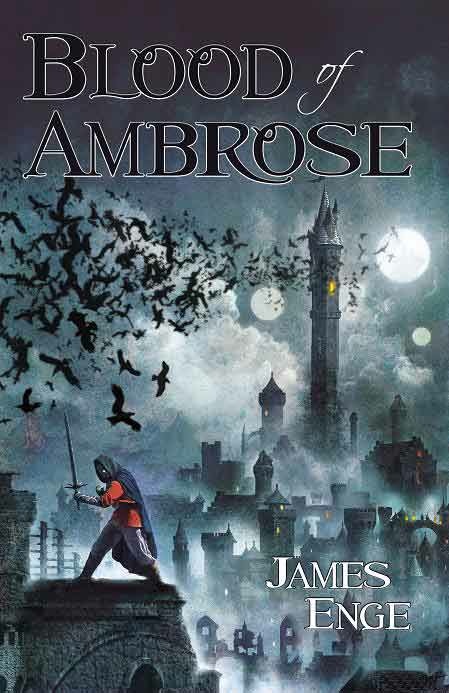
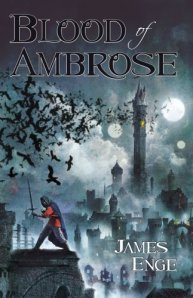
ENGE: I steal stuff from it constantly. My degrees are in Classics, and I studied a few medieval Germanic languages in school, too — all because I was (and remain) nuts about language, mythology and history (three fields that overlap more than one might think). This stuff is a tremendous storehouse for story ideas. For instance, Morlock’s move to defeat the Big Bad in BLOOD OF AMBROSE will seem a little familiar to people who know the myth of Hercules and Antaeus, and when Morlock is confronted by a stone beast in THIS CROOKED WAY he again takes a leaf (or limb) from Hercules’ book to save himself. The trick, when you steal something as blatantly as I do, is to make the borrowed element native to your work. You don’t need to know the Herc myths to read the Morlock stories, but if you do you’ll get an extra smile of recognition sometimes.

VENTRELLA: All authors these days spend a large amount of time on self-promotion, from posting a regular blog to producing podcasts to appearing at conventions. What’s your opinion on the relative value of each?

ENGE: I have no idea. There are so many forms of online community these days, one could spend a working week every week just keeping up. One thing I do feel strongly: online and offline communities may be useful for self-promotion, but they shouldn’t be used solely for that. The communities are meant to be conversational exchanges among people with common interests, and that’s really their primary value.

VENTRELLA: Do you advise aspiring novelists to begin with short stories?

ENGE: I would have said “yes” a few years ago. Now I’m not so sure: the markets are very different in what they want to see, and the forms themselves are diverging radically. When the standard novel was sixty or seventy thousand words and magazines regularly published novelettes and novellas of tens of thousands words, writers with the same skill-set could comfortably operate on book length and short-story length. Now stories seem to be getting shorter and novels are certainly getting longer (at least in sf/f). No doubt a credits-list of stories in reputable publications increases the likelihood that an agent or an editor will take a chance on a new writer. But if novels are what people want to write, maybe they should head straight for that — likewise with stories.

VENTRELLA: Of what work are you most proud?

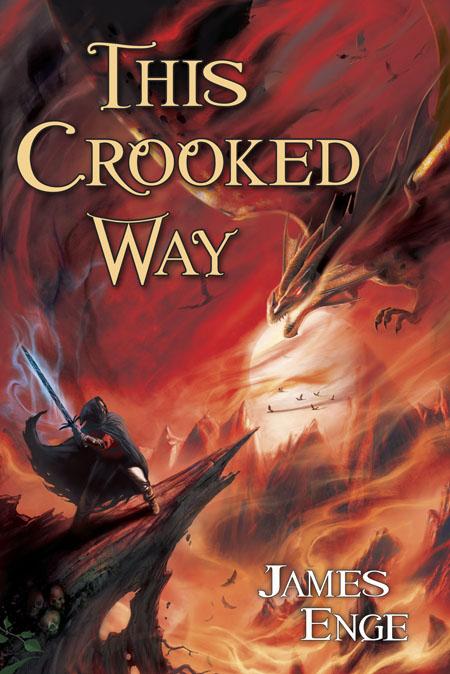
ENGE: You force me to tell you! Okay, since I have no choice in the matter (not that I want one), I really like my second book, THIS CROOKED WAY. The story begins with Morlock’s horse, Velox, being stolen by an unknown enemy. In tracking down the horse, he has a number of adventures that turn out to be clashes with his veiled enemy. When unmasks his enemy, he finds that he’s already involved in a struggle that hinges on someone else’s life-or-death. The book is an homage to the episodic novels of sword-and-sorcery past (like Fritz Leiber’s Lankhmar books, or Vance’s Cugel books, or Moorcock’s Elric books). I got to sneak in some elements that one doesn’t usually see in a heroic fantasy, like robots (i.e. golems), the internet (a.k.a. Whisper Street) or alien species (e.g. the buglike Khroi or the wormlike dark gnomes). There’s an antiheroic dragon-fight that I’m particularly fond of. And there’s some emotional resonance for me in the over-arching plot, which deals with the death or non-death of Morlock’s mother. THIS CROOKED WAY has not, in fact, made a big splash, but even if it never sells another copy it’s the book I’m likeliest to point to and say, “That’s what I do; that stuff.”

VENTRELLA: What’s your opinion on self-publishing? Do you advise new authors to go this route, or is it better to not publish at all than to be self-published?

ENGE: Self-publishing is risky because there are so many people involved who really don’t have a realistic sense of their work’s merit. Everyone, but everyone, can afford to take a hint every now and then, and the self-publishing route usually involves trimming out all the gatekeepers who might say, “This bit doesn’t work” or “Your hero looks like a jerk here. Is that what you want?” The process of traditional publishing may keep some work from being published, but it unquestionably improves the stuff it does let into the light of day. I’m not saying that everyone involved in self-publishing is engaged in self-deception: it provides an outlet for lots of stuff, like local history, textbooks — niche work that would always have trouble with a commercial publisher but may still find an audience. But so much self-published fiction is so problematic that I think it’s a hard sell for most readers.

VENTRELLA: Any last minute words of wisdom for those wanting to break into the publishing business?

ENGE: Write the kind of stuff you’re interested in reading. This seems like obvious advice, but lots of people get involved in writing work they would never look at twice if it were written by someone else.

I’m not sure if those were words of wisdom, but at least they were words. Thanks for the chance to bend your and your audience’s collective ear!

Interview with Kelly Jameson

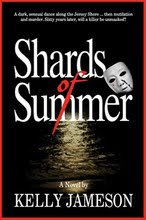
MICHAEL A. VENTRELLA: After last week’s blog about self-publishing, this week we have Kelly Jameson, a self-published author, to discuss her experiences. Kelly has two thrillers published, SHARDS OF SUMMER and DEAD ON.

Kelly, tell me about your books!

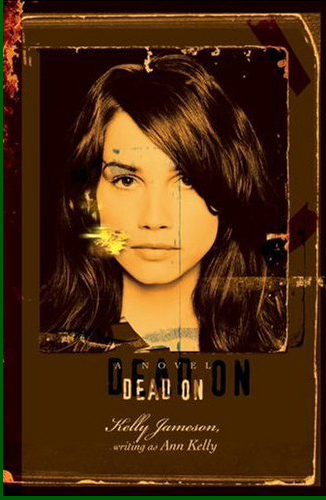
KELLY JAMESON: DEAD ON is the story of a medical examiner being stalked through different lifetimes by the same killer. History seems to be repeating itself. I set the story in Doylestown, PA because I grew up in the area. While the story is fictional, there are a lot of real-life places used in the book. I even put a body in the CB West football stadium. DEAD ON was film-optioned for two years by Gold Circle Films (they produced “White Noise” and “My Big Fat Greek Wedding”). It was also named Runner-Up in the 2006 DIY Los Angeles Book Festival. So I feel very fortunate and I think it shows that good things can happen with independently published books that you write and edit yourself. It is possible. In fact, when I was contacted by Gold Circle about movie rights via email, I almost fell out of my chair. The rights are back with me now and I’m working on a screenplay with another screenwriter on the script. We hope to have it completed by end of December and ready to pitch.

VENTRELLA: What’s your writing background?

JAMESON: I’ve wanted to be a writer since I was five years old. I used to write poetry all the time. Some of it was really bad. But that’s how you learn to be a writer—by writing. And reading.

I have a Journalism background. Got a degree from Bloomsburg University. I wanted to be a local sports reporter. Somehow I ended up a medical editor by day. Being an editor, editing my own books, has helped me to polish my indie novels and make them stand out.

VENTRELLA: How did you decide to write these books?

JAMESON: One of the characters in DEAD ON seemed to be tapping me on the shoulder and wanted to have her story told. That’s how it began. With a character and a “what if” situation. SHARDS OF SUMMER was really fun to write. I love the beach and Ocean City and wanted to write a story about lust, love, and obsession, about the wars going on inside each and every one of us every day. I like to write about flawed characters. The story starts with an elderly woman being arrested for the murder of a decorated WWII soldier on the beach 60 years ago. But of course, things aren’t as they seem … As a young woman, the main character was a dancer in a girlie show who got tangled up in an affair with a married homicide detective investigating murders in Ocean City.

VENTRELLA: How did you decide to self-publish?

JAMESON: I’m not very patient. The industry is a tough nut to crack and it seems to be changing on a daily basis. After a few positive rejections for DEAD ON, I followed my intuition and published it myself. I think that’s important in this biz—there’s more than one way to get your work out there and sometimes you just gotta take chances and do something.

VENTRELLA: Had you previously submitted your books to editors and publishers?

JAMESON: Yes. I even had an agent for eight months. However, when the recession hit, he pared his client list down and as a new writer, I was on my own again even though he thought my writing was excellent. I quickly became frustrated with the process. For my second novel, same thing. Got some positive rejections and some incoherent, nonsensical dismissals. It’s a very subjective biz. I decided to see if I could get it cookin’ myself … and fortunately I’ve had the support of established authors such as Ken Bruen (ONCE WERE COPS and GUARDS) who not only read SHARDS OF SUMMER but called it “THE GREAT GATSBY for the beach generation.” It’s so encouraging when a ‘new’ writer finds an established, best-selling author who is willing to read your material and blurb it. Jonathan Maberry says, “DEAD ON by Ann Kelly is a stunning first novel that blends ghostly happenings, romance, eroticism, time travel and intrigue into a genuine page-turner. The Ann Yang character (Bucks County, PA medical examiner) is particularly well-drawn, and the story builds nicely to a satisfying conclusion. I highly recommend it.” Kat Martin, NYT best-selling author says, “She’s a brilliant writer. No questions asked. She has a gift for the eerie. The words she chooses are absolutely brilliant. She has an incredible talent for stringing words together.”

If you like CSI meets the X-Files, you’ll probably like DEAD ON.

VENTRELLA: What do you see as the advantages of self-publishing?

JAMESON: You get to put the book out there pretty quickly and the way you want to. It’s fun to market it yourself, even on a limited budget. There are many local independent stores willing to help out. The Doylestown Bookshop sold 600 copies of DEAD ON so far! They’ve been really great. I think I’ve managed to sell about 2,000 copies of DEAD ON. I’ve read that a traditionally published first book has typical sales of 1,000. So I feel pretty good about my sales and I’d like to thank all my readers.

VENTRELLA: In my last blog, I made some comments about how there is a stigma against self-published books, even if they may be excellent. Do you agree?

JAMESON: I agree that a bias still exists against independently published novels but I think we are seeing some definite, and positive changes, in the publishing arena. I’ve had many positive experiences with my books. I don’t agree with the statement on your blog that “if you really want anyone else to consider you a real writer, avoid these things [self publishing companies] completely.” Of course most of us want to crack the traditional publishing nut and see our books at the front of bookstores everywhere.

Getting published traditionally is becoming more and more like winning the lottery. American publishing is basically averse to taking risks with new writers and tends to want to put everything in a box or a category. The ones who take a chance on multi-genre or slightly literary works still put out literary best sellers. It can happen. And I’m going to keep trying to crack the nut. I believe in my work 200% and I’m following my intuition in putting my books out there and marketing them. In fact, because of my first two novels, a small publisher who likes my style and storytelling approached me about writing a zombie novel and I just got the green light to write it based on my pitch! I’m also working on a new werewolf novel.

If you do publish yourself, investigate the companies. Some are vastly better than others and more fair. Ask other authors about their experiences. Look into the backgrounds of the companies…are there any complaints on the Internet about them? Are there glowing praises?

VENTRELLA:Did you hire an editor?

JAMESON: No … I’m an editor so I did it myself. But sometimes you don’t see things in your own work, so I also have fellow writers and family members who graciously read my work and comment.

VENTRELLA: Did your publisher provide the cover or was that your responsibility as well? Did you have any say in the decision?

JAMESON: For DEAD ON, I gave iUniverse my idea and loved what they came back with. The front looks like sort of an old photograph that’s fading. The book goes back and forth in time between the present and the early 1900s and Ann Yang, the medical examiner, uses all her forensic skills as well as past life regression to solve the present-day crimes. I interviewed a past life regression specialist in Doylestown while writing the book and it was fascinating.

For SHARDS OF SUMMER, I did not go with the cover BookSurge provided because I felt it was too colorful and not right for the tone of the book. A designer from a small publisher helped me out and gave me a great cover, a dark mysterious cover that’s perfect for the book. I’m really pleased with it because I think it’s stunning. And covers are critical if you want readers to check out your book.

VENTRELLA: For those readers who would like to self-publish, what do you advise? How do you decide which company to go with and so on?

JAMESON: Do an Internet search. Keeping in mind your goals for the book, compare prices and services, percentage royalties paid, additional free services and distribution channels, and make a decision. Then go for it…and have fun with it. Don’t plan on making a whole lot of money. Plan on meeting lots of great people who are truly supportive of your work. Plan on making community connections. Plan on doing something that feeds your soul. Plan on your material maybe leading to other unexpected experiences, like trying your hand at screenwriting. Plan on meeting other authors and supporting each other. Set up your own local signings and write press releases and send to the local media.

I’ve also started writing short stories to practice things like dialogue and so far I’ve been published in The Summerset Review, The Mammoth Book of Best New Erotica 8 and 9, Dispatch Litareview, Amazon Shorts, Withersin Magazine, Barfing Frog Press, The Twisted Tongue, The Big Stupid Review, Ruthie’s Club, The American Drivel Review, sliptongue, ThugWorks and Ramble Underground. I have three shorts slated for publication in 2010 in Revenant magazine, TangledBank Press (Australian anthology) and Sex in the City (Paris edition).

VENTRELLA: What have you done to publicize the book?

JAMESON: For my first book, I did a lot of local signings, was interviewed by the Philadelphia Inquirer and other local newspapers, did some advertising myself (on a limited budget) and I’ve kept in touch with several hundred readers who ask for updates on my books and short stories, etc. I did co-op advertising with iUniverse and twelve authors were featured on a one page ad in the NY Times Book Review. That’s where Gold Circle saw my book and contacted iUniverse about the movie rights.

SHARDS OF SUMMER just went live on Amazon.com and so I will be setting up signings very soon. I hope to do some fun things and contests with beach glass because that’s a theme throughout the novel. I have a very limited budget so I’ll be peppering the media with news releases and hoping to do a few signings where the book is set, in Ocean City, New Jersey, too. I just set up a blog at http://kellyjameson.blogspot.com/. Hope you’ll keep in touch!

Interview with Gail Z. Martin

MICHAEL A. VENTRELLA: I’m pleased to be interviewing Gail Z. Martin today. Gail is the author of The Chronicles of The Necromancer series. The books are available in your favorite bookstore, as ebooks from my publisher Double Dragon, and will be released as audiobooks by Audible.com soon. 0061-eWomenNetwork She is also host of the Ghost in the Machine Fantasy Podcast, and you can find her on MySpace, Facebook and Twitter. She enjoys attending science fiction/fantasy conventions, Renaissance fairs and living history sites. Her web page is here.

Gail, tell me about your fantasy series The Chronicles of the Necromancer.

GAIL MARTIN: The Chronicles of the Necromancer series includes four books so far: THE SUMMONER, THE BLOOD KING, DARK HAVEN and DARK LADY’S CHOSEN. The story begins when a young man’s family is murdered, and he discovers that he is heir to a very rare type of magic, the ability to intercede between the living and the dead. He needs to learn to control that magic before it destroys him in order to avenge his family. I’ve really written two two-book sets. The Summoner and The Blood King are one story arc, and then a new story arc with the characters picks up in Dark Haven and Dark Lady’s Chosen.

VENTRELLA: Do you have a set number of books planned for this series?

MARTIN: Well, I’ve given my publisher abstracts for about 20 books I’d like to write, so we’ll see! There are two exciting pieces of news about the series. First, DARK LADY’S CHOSEN comes out December 29, and it will launch as a paperback, an ebook and an audiobook. And second, Orbit Books has picked up the next four books. The Fallen Kings Cycle is the name of the new series, and it will pick up after DARK LADY’S CHOSEN. I’m already working on Book One: THE SWORN.

VENTRELLA: Do you plan the entire series in detail or do you do one book at a time?

MARTIN: A little of both. I have a pretty clear idea of the full story arc and the arc for each major character. And I’ve given my publisher abstracts for quite a few other books set in the world of the Winter Kingdoms. And my publisher asks me to turn in a chapter-by-chapter outline before each book. That said, things do arise as I’m writing that often changes the way I saw things unfolding. Usually not a change to the ultimate outcome, but changes in how things go along the way. So the overview and outlines help, but the story develops on its own as we go along.

VENTRELLA: How did you become published? Did you obtain an agent first?

MARTIN: Yes, I did get an agent first. I really didn’t have time to work, write and shop my manuscript, and I knew that fewer and fewer large publishing houses accept unagented submissions. Having an agent has been very important, especially when it comes to negotiating contracts and understanding what options exist. A good agent is also valuable for negotiating translation sales and other contracts, such as ebooks and audiobooks.

VENTRELLA: Do you think you will ever write in another genre?

MARTIN: Well, I have the first book in a new nonfiction series for writers coming out in January, THE THRIFTY AUTHOR’S GUIDE TO LAUNCHING YOUR BOOK WITHOUT LOSING YOUR MIND. Dark HavenIt’s a book on book marketing for authors who want to make sure readers find out about their books! And as far as fiction goes, I do have some ideas I’m developing, but they’re not ready for prime time yet!

VENTRELLA: I keep hearing that publishers are not that interested any more in traditional high fantasy. As a writer in that genre myself, I am worried. Do you find this to be the case?

MARTIN: I think the more important question to ask is, “Are readers interested in traditional high fantasy?” From my experience, I would say yes. So long as there are readers who want a certain genre, there will either be publishers who will supply it or authors will meet the demand directly by self-publishing. My bet is that so long as publishers sense there is money to be made in a genre, they will keep publishing it.

VENTRELLA: What’s your opinion on self-publishing? Do you advise new authors to go this route, or is it better to not publish at all than to be self-published?

MARTIN: I think it’s easier to succeed with nonfiction in self-publishing than fiction because most nonfiction authors have the opportunity to sell from the “back of the room” at workshops, speaking engagements, etc. Also, if nonfiction meets a need and creates a benefit, people buy it, regardless of who publishes it. Fiction is a little harder, because it doesn’t have that clear need/benefit link. With fiction, distribution through bookstores and online booksellers is still crucial, and that can be more difficult if you’re self-published.

On the other hand, a good book will find a market. THE SHACK was a self-published book that couldn’t get a publisher until it sold a gazillion copies and then was picked up by a big publishing house. If you decide to self-publish, you’ll have to work twice as hard on distribution, personal appearances, being a vendor at conventions and basic selling. But if you believe in your book, then you do what you have to do to bring it to life. I would probably advise authors to exhaust their options for traditional publishing with large and small publishers before self-publishing fiction, but I’m sure there are other authors who feel differently and that’s OK. Even when you’re traditionally published, there is a lot of work that goes into promoting the book.

VENTRELLA: Gail, you are one of the most active authors when it comes to publicity and promotion, because of your background. While it is clear that published authors must promote themselves, do you think it is appropriate for unpublished authors to maintain a web presence and otherwise promote themselves, and if so, how can that be done tastefully and effectively?

MARTIN: I think part of that depends on your definition of “unpublished.” If you post your short stories on your web site, that is a form of publishing. If you release your book as a podiobook, that’s a form of publishing.

I think you always have to be clear about what it is you’re promoting. thesummonerSome authors, like J.C. Hutchins, started out by releasing free podiobook versions of their stories and gathered so many readers/listeners that they ended up getting a book contract with a traditional publisher. So think first about what your goal is in promotion yourself and what you have to promote. If you write an entertaining blog, host a good podcast or even create an online serial that gets good buzz, you may attract a publisher.
VENTRELLA: You and I run across each other at conventions often and you attend many more than I do. Please tell us why you think attending these is important, and whether you think they are important even for unpublished authors.

MARTIN: Cons are important because they’re a great way for authors to meet other authors and of course, to meet readers. Today’s readers like to meet the authors of the books they read, just like they enjoy connecting online and on social media. It’s also a great way to attract new readers who may decide to try your books because they liked what you said on a panel, had a good chat with you in the lounge or came to a reading and liked what they heard.

For unpublished authors, cons can be great places to meet published authors and get advice. Lots of cons have writing and publishing tracks where there are panels with editors, agents and publishers, or with authors talking about the business and mechanics of writing. It’s a great free education. I definitely think it’s worth it.

VENTRELLA: What advice do you wish someone had given you when you first began trying to break into the business?

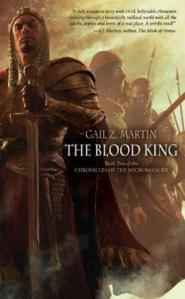
MARTIN: Expect to spend twice as much effort promoting the book as it took to write it. blood_king_med_coverRealize that if you don’t promote the book and you don’t sell well, you don’t get invited to write a second book.
VENTRELLA: Can you think of a personal anecdote about the writing life you’d like to share?

MARTIN: Going on book tour really does require you to check your ego at the door. You spend a lot of time driving around, setting up table displays and schlepping your stuff from store to store. No matter how many big signs in the store have your photo on them, inevitably more than one person will ask you where the bathroom is or where somebody else’s book is shelved because they just assume you work there. Smile. It’s all part of being an author, and it’s worth every moment. But just to be safe, make sure you really can direct people to the bathrooms!

VENTRELLA: You’ve got audio and excerpts from DARK LADY’S CHOSEN online, plus there are other sites participating in your Days of the Dead blog tour. Where can we find all the goodies?

MARTIN: Check out my site at www.ChroniclesOfTheNecromancer.com, for all the downloads and more Days of the Dead stuff. Also, please find me on Twitter.com as GailZMartin and on Facebook and MySpace as well.

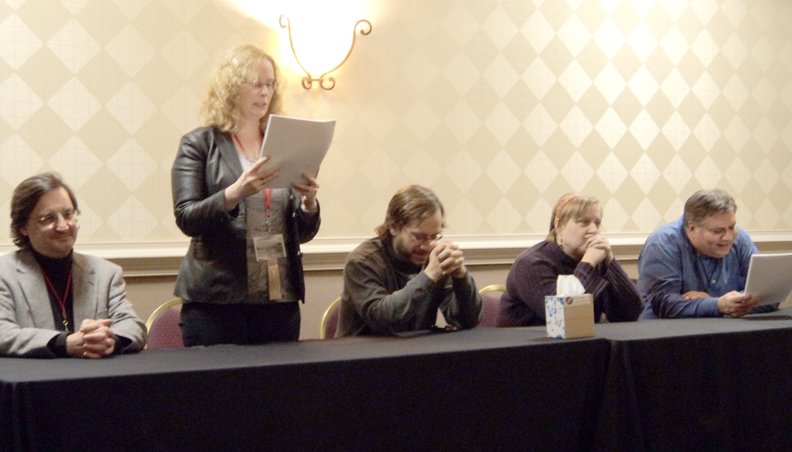
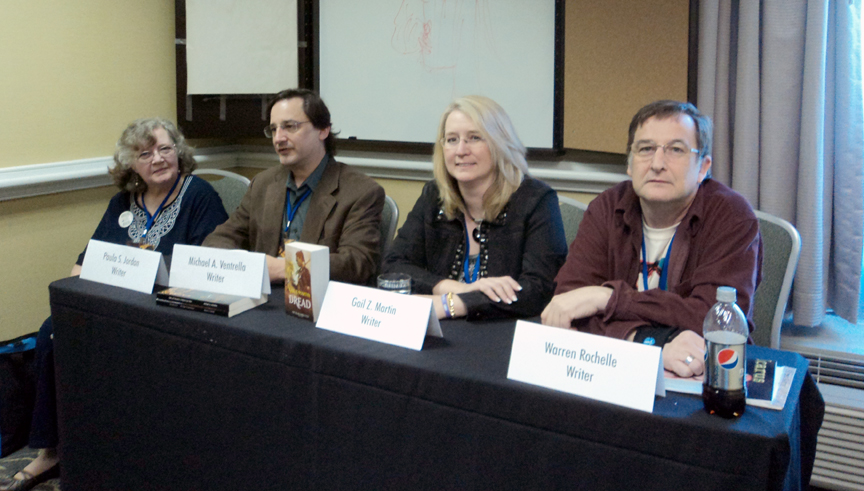
Me and Gail Z. Martin on a convention panel

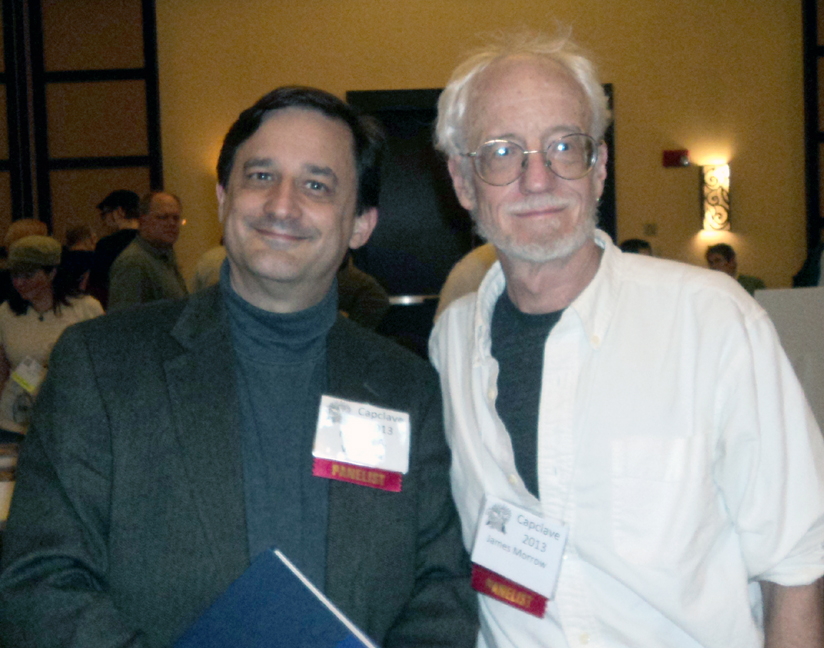
Interview with Nebula Award Winning Author James Morrow

MICHAEL A. VENTRELLA: Years ago, a friend pushed the World Fantasy Award-winning novel TOWING JEHOVAH on me, and it sounded fascinating. Being a typical writer/reader, I always have dozens of books on my “Have to Read and Will Get Around to Some Day” pile. James Morrow_PhotoCredit Didier LeclercAtelier N89JEHOVAH jumped to the top of the list after I had the pleasure of meeting James Morrow at Worldcon in Montreal a few months ago as we both patiently waited in line for substandard Canadian coffee. It was as good as had been recommended (the book, not the coffee), and now I have the two sequels next in line on my “Have to Read” pile.

James Morrow is a graduate of Harvard and the University of Pennsylvania (not necessarily in that order) and has won acclaim for a variety of fantastic novels which weave together religion, politics, and philosophy. A Nebula-award winner, Morrow continues to challenge and entertain. His web page is here.

James, thanks for taking the time! It is obvious that much of your work concerns religion, from the Godhead Trilogy to ONLY BEGOTTEN DAUGHTER. What do you find in this subject that makes it so desirable?

JAMES MORROW: Every day, I wake up and I say to myself, “How extraordinary! Here I am, James Morrow, thrown into a world in which the vast majority of bipedal beings believe in benign supernatural intervention, and I don’t buy one bit of it! What’s going on here? Why am I totally at odds with most of my fellow thinking primates? How could such a large majority of humans, many of them brighter and better traveled than I, subscribe to a world-picture that is manifestly not the case? How can they imagine that the Bible enjoys a divine origin, when so much of it bespeaks our pettiest impulses? How can they not see the bankruptcy of the benevolent-God hypothesis? Why will they not face the probability that all deities are human inventions?

This paradoxical state of affairs variously confounds, amuses, saddens, frustrates, and infuriates me — but mostly it gives me the energy to create my stories and novels. I’ve been accused of writing primarily out of anger, but I believe I’m more bewildered than bitter. My bedrock perplexity seems to make for compelling fictive thought experiments, or so my more sympathetic readers tell me. towingEvidently God put me here to argue against His existence.

VENTRELLA: Have you faced any censorship or protests because of these works?

MORROW: No serious protests. Occasionally I’ll receive an e-mail from a Christian conservative who, having blundered into my website, is concerned about the status of my salvation. Normally this correspondent will prescribe a verse or two from Saint Paul, but sometimes he’ll glibly inform me that I’m going to Hell.

VENTRELLA: Are you disappointed?

You’ve actually struck a nerve here, Michael. Like all novelists, I’m a bit of a narcissist: I think my readership should be significantly larger. So, yes, I am indeed disappointed that Ralph Reed or the Vatican has not yet come gunning for me.

VENTRELLA: What was interesting to me after reading TOWING JEHOVAH was that the truth of the matter was just accepted; the novel does not disavow the Christian God nor does it satirize Him, but it certainly looks at Him in a new way. Had earlier versions and drafts taken a different approach?

MORROW: I’m glad you found that novel to be relatively nonpolemical. Preaching is the death of fiction. When I embarked on the thought experiment that became TOWING JEHOVAH, I wasn’t sure where I was going, and I was pleased to be surprised by many of the scenes that emerged from my pen. A literal pen: that particular novel was initially written in longhand.

At the start of the project, I didn’t realize TOWING JEHOVAH would give me a chance to satirize my own worldview in the form of the Central Park West Enlightenment League. Nor did I foresee the weirdly reverent tone of the inverse-Eucharist scene, in which the starving supertanker crew survives a famine by eating God’s deconsecrated flesh. And Neil Weisinger’s search for the En sof is also supposed to be taken at face value. I guess you could call TOWING JEHOVAH a novel by an atheist who’s trying to empathize — up to a point — with people of faith.

VENTRELLA: In TOWING JEHOVAH, a message is that “enlightenment” isn’t always truthful. The church wants to hide the truth in its own interest. The atheists, represented by the Central Park West Enlightenment League, also want to hide the truth for their own interest. Deceit is not something to be admired on either side, but in the sequels, the consequences of the truth are severe. Do you believe that it is sometimes better to not know the truth?

MORROW: As an equal opportunity satirist, I wanted to suggest that any group that would style itself the Central Park West Enlightenment League might very well — at the end of the day and faced with an apocalyptic challenge — decline to embrace a body of data that contradicted its worldview.18281941 When you’re in the business of fashioning sardonic comedies, nothing is sacred, not even atheism. My sympathies lie almost entirely with my secular brethren, but in a crisis I suspect that most of us would behave as mere feeble and fallible humans, not as courageous avatars of the truth.

Truth is a sticky commodity. The physical sciences long ago figured out that they can get by perfectly well without making grandiose truth claims (merely predictions based on theories), but philosophy and religion and the arts don’t have that option. Like the Ibsen of THE WILD DUCK and the O’Neill of THE ICEMAN COMETH, I can certainly imagine situations where the truth proved fundamentally destructive, and I was indeed playing with that idea in the Godhead Trilogy — though I ultimately come down on the side of truth-telling, as I also did in my novella CITY OF TRUTH.

Offhand, I can think of no greater sin than to consciously lie to a child, which is why I’m impatient with many conservative Christians, whose God is evidently so feeble that He can be sustained only through falsehoods systematically advanced on His behalf — falsehoods about the alleged evangelical foundations of the American republic, falsehoods about Darwin’s theory of natural selection, falsehoods about the blatant anti-Semitism of the Gospels, falsehoods about priestly sexual misconduct, and so on. As the saying goes, you can have your own opinions, but you can’t have your own facts.

VENTRELLA: Was the series planned in advance or did you decide to write the sequels after the first was completed?

MORROW: Based on some preliminary TOWING JEHOVAH chapters and an outline, I managed to convince Harcourt Brace to sign up for the whole trilogy. Needless to day, all three finished manuscripts departed radically from my original plan. BLAMELESS IN ABADDON was initially titled TERRA INCOGNITA, and the outline was more concerned with the trip through God’s brain, with the Trial of the Millennium functioning merely as a denouement. My first sketch for THE ETERNAL FOOTMAN had the characters searching for the Holy Grail. Eventually their quest leads them to a divine bedpan, an idea I rejected as sophomoric even by my standards.

VENTRELLA: What sort of research do you do for your novels, especially when discussing areas in which you may not be trained?

MORROW: For better or worse, the advent of Google has made the task of research 100 percent easier than in days gone by. I say “or worse” because I believe there was something vaguely romantic and even heroic about the novelist’s quest for the sort of quirky facts and period details that can bring a scene to life. But today these gritty particulars are available at the stroke of a key. It feels like cheating.

I like to say, “First I write the novel, then I do the research.” That remark is not entirely facetious. In the case of my novel-in-progress, an epic about the coming of the Darwinian worldview, I’ve already written scenes set at Darwin’s estate and on the Galapagos archipelago. I intend to visit both sites before putting the book to bed: in my experience such on-the-ground investigations can enrich a novel immeasurably — and yet the present drafts are not entirely lacking in credibility, and I could probably get away with simply claiming I’d done the primary research.

VENTRELLA: How did your education affect your writing? (As an aside, do you miss Boston? I went there for law school and loved it…)
apprentice-us
MORROW: Boston is a terrific city, commensurate in my affections with New York, Paris, and London. My days at the Harvard Graduate School of Education particularly paid off in my recent novel called THE PHILOSOPHER’S APPRENTICE, in which a philosophy student is hired to implant a conscience in an adolescent clone. When I was at Harvard, everyone was excited about Lawrence Kohlberg’s profile of children’s moral development. I ended up keying Londa Sabacthani’s education to the famous Kohlbergian dilemmas.

VENTRELLA: Do you tend to think of the story first, or a concept that will lead to a story? It seems that much of your work involves interesting questions of religion and philosophy that lead to a “what if?” scenario…

MORROW: Although most novelists, myself included, want to reach the reader at an emotional level, I believe that fiction writing is primarily an intellectual process. When a scene isn’t working, the problem is not that you’re failing to channel some cosmic Muse from a transcendent plane of reality — the problem is that you’re not thinking hard enough.

I couldn’t imagine beginning a novel or short story without an audacious premise in mind. Many writers evidently work in a completely different fashion. They’re happy to start with a memorable character, a vivid setting, a personal theme, or an intriguing initial situation, with the overarching concept emerging only during the composition process.

VENTRELLA: What do you know now about the publishing industry that you wish you had known when you first started out?

MORROW: My career was launched in a fashion that I took to be ideal: hardcover publication by a major New York house — to wit, the edition of THE WINE OF VIOLENCE that issued from Holt, Rinehart and Winston in 1981. I gradually came to realize that such an achievement, while not an occasion for sneezes, is by no means synonymous with having a career. I had not found the Holy Grail after all.

It took me awhile to figure this out, but unless the publisher is really behind you, with a fired-up sales force, a serious publicity budget, and a viable marketing strategy, any given novel is likely to die a dog’s death at the box office.hiroshima Not until TOWING JEHOVAH, my fifth book, did I actually enjoy the services of an in-house publicist.
VENTRELLA: What projects are you currently working on? Give us a teaser!

MORROW: I just finished a short story called “The Vampires of Paradox.” It will appear in IS ANYBODY OUT THERE?, a forthcoming anthology about the Fermi Paradox, edited by Nick Gevers and Marty Halpern. Now I’m free to return to the Darwin project, which I believe will be my best book yet — though I must admit I adopt that attitude towards all my novels: otherwise I would never finish them!

VENTRELLA: What sort of advice would you give an aspiring writer that you wish someone had given you?

MORROW: Try to figure out a way to make fiction writing its own reward. You can’t count on the marketplace or the publishing industry to validate your efforts — but you can learn to take satisfaction in a well-turned phrase, a witty description, a remarkable character, or a puissant idea.

VENTRELLA: What are you most proud of? What would you like to be remembered for?

MORROW: I hope that my posthumous biographer will pay particular attention to BLAMELESS IN ABADDON and THE LAST WITCHFINDER. In those two novels I believe I came fairly close to realizing my artistic ideal — that is, fiction in which the dance of ideas is at once complex and entertaining. Among my shorter efforts, I like to think that people will be reading SHAMBLING TOWARDS HIROSHIMA long after I’ve gone to live with Jesus.

46

Interview with Mark Waid

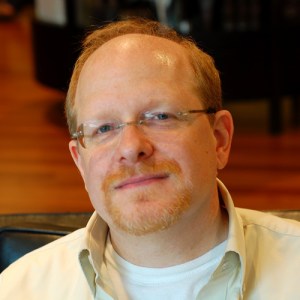
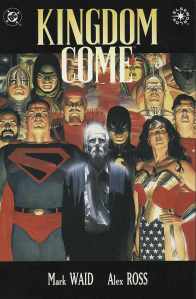
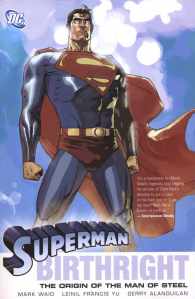
MICHAEL A. VENTRELLA: I’m very pleased to be interviewing Mark Waid, one of the biggest names in comics today. He’s been an editor with DC and as a freelance writer has become one of the most well-known and prolific writers of quality comics. In 1996, with artist Alex Ross, he released his best-known work, the graphic novel KINGDOM COME, which depicted the fate of Superman, Batman, Wonder Woman and other heroes as the world around them changed. Its popularity led to him receiving the Comics Buyer’s Guide Award for Favorite Writer in 1997. He has since gone on to fame with the FANTASTIC FOUR and with the re-imagining of Superman’s origins in BIRTHRIGHT. Currently he is an editor-in-chief with Boom! Studios and has been writing for THE AMAZING SPIDER-MAN, including one of my favorite books in which Spider-Man saves Stephen Colbert. (You can see it on the shelves behind Stephen if you watch the show). Waid headshot His web page is here.

Mark is also the only big name in comics who I’ve known since High School, who was in my Dungeons and Dragons group in college, and who went to my wedding. It’s always great to see a good friend make it big in a job he loves! Mark is a true Superman purist, and I still recall leaving the theater with him after watching “Superman 2”, hearing him curse because “Zod shouldn’t have had that stupid power to point his finger at someone and make them float into the air!”

MARK WAID: It’s true. I’m still traumatized, by the way. At least the recently released Richard Donner cut finally set my mind at ease. But don’t get me started on Superman IV.

VENTRELLA: Mark, writing for graphic novels involves a different type of writing skill than would be needed for a short story or novel, but still requires a mastery of words. What is your creative process?

WAID: As an incredibly general rule, for me, every story springs from images. As I tell young writers who are breaking into comics, you don’t have to tell super-hero stories–comics is a wide medium that covers all genres–but for the love of God, it’s a visual medium, so it’s not the best fit for your J.D. Salinger riff or the extended inner-monologue. The short rule of thumb is that, in comics, you should take advantage of your unlimited visual budget and shouldn’t waste a lot of space on talky plainclothes scenes unless they’re visually interesting in and of themselves. Use the medium to its fullest. Tell a story that couldn’t be told just in dialogue or in prose or in iambic pentameter.

And be aware that comics is a collaborative medium, so don’t fall into the trap of thinking it’s all about dialogue. It ain’t a Mamet play. It’s words and pictures together, in concert.

For me, I’ll start thinking about the characters I’m writing about–whether of my own invention or established characters like Superman or Spider-Man–and, with a very general idea of the sort of story I want to tell or the sorts of character beats I want to hit, I’ll let my mind wander until I hit an idea for a scene that has impact. (“Hmmm…I want to write a story about Spider-Man’s enemy, Electro, having lost all his stolen-but-invested money in the same economic crash that’s recently ruined so many honest lives–and how a very powerful villain who feels he’s been robbed would react to the idea of government bailouts. Huh. I should have him stage a scene at the New York Stock Exchange. He can rant and rave like Rick Santelli, but with electrical bolts coming off of him, stronger and more chaotic as he gets more and more worked up, NYSE monitors exploding around him.”)

Once I come up with three or four of those scenes, I start to knit them together in my head to form a narrative, tossing out (or, more likely, saving in the S.O.S. file [Some Other Story]) the scenes that don’t support the tale.

Then it’s creating a rough outline or beat-sheet for a story, with a 1000-stories-under-my-belt sort of instinctive feel for how many pages to allot each scene (knowing that, in the actual writing, they ALWAYS take up more room than allotted). Then the hard part: typing “Page One, Panel One” and going from there.

But, as I say, it’s about conveying your ideas visually as well as verbally. The entire working process hinges on being able to do that.Bk 1 (2)

VENTRELLA: Do you find yourself limited in that you primarily are writing for established characters?

WAID: Not really. Honestly, there are trade-offs. No, I can’t have Superman or Batman do anything I want them to do given that I don’t own them, but at the same time, having grown up reading the adventures of these established characters as a fan, what they do and don’t do is burned into my DNA. In that sense, I don’t find writing for them any more limiting than I do being behind the wheel of a car that I can’t make fly. It’s not like I drive around feeling “limited.” I just feel like I’m working with a familiar tool and automatically know what it can and can’t do.

On the other hand, when I write my own characters in series that I own, all limitations are off–but that’s as daunting as it is freeing, because there are more decisions to make as a writer, and the freedom that brings is counterbalanced by the sometimes paralyzing number of choices literally at my fingertips.

VENTRELLA: Do space considerations stand in your way?

WAID: Always. Constantly. Always. Always. Oh, God, how I envy screenwriters. You need an extra page, Mr. Movie Writer? Take an extra page. American mainstream comics, on the other hand, are generally about 22 pages long, give or take, and if you’re doing a story that’s in one installment, you have to fit it to that space. If you’re doing a longer story that spans several issues, you still have to construct each individual issue with some sense of climax/resolution or obstacle/victory or what have you in order for the reader to enjoy each issue as it comes. Honestly, most of the storytelling choices I make on a daily basis have less to do with plot and character than then do with trying to figure out how to fit those things into this rigid structure. It’s like writing haiku.

And even if you’re setting out to do a longer-form graphic novel, space is still a consideration. Only so much art will fit on a page. Only so many words will fit comfortably within each panel without crowding out the art. AND your job as a writer is to try to convey information as economically as possible without sacrificing plot or character, so there’s that plate to juggle, too; again, even when you’re working longer-form, real estate is precious. Each panel of a comic story is a “frozen moment,” a snapshot from your story, and only so many can fit.

I go into excruciating detail on these points on my blog, markwaid.com, which is full of craft essays. And because I’m not always sober when I write them, they’re probably more entertaining than this answer has been.

VENTRELLA: Do you ever plan on writing a novel?

WAID: Dear Jesus God, no. Never. I don’t have the attention span for it, I don’t have the linguistic chops, and I don’t have time to teach myself without starving to death. I am endlessly appreciative of writers who have that level of vision or that work ethic, but the few times I’ve tried my hand at prose (a Superman short story and The Flash: The Life of Barry Allen), it nearly killed me.

VENTRELLA: How has being an editor helped your writing?1

WAID: Being an editor before I was a full-time writer was the greatest career boon you can envision. At DC, I edited several scripts a month from, eventually, every major and minor writer in the medium at that time, including Neil Gaiman, Grant Morrison, and others. Reading their scripts and constantly observing how they solved storytelling problems was like boot camp. I learned more in those two years as an editor than I could have in ten years as a writer.

VENTRELLA: What is the biggest mistake you see young writers making? And what was your biggest career mistake?

WAID: Without fail, young writers give me scripts that are far too dense. I’m sorry, but you cannot fit a shot of a baseball stadium interior, a supermarket parking lot crowd of 200, and an establishing shot of downtown Tokyo all on one page and still have room for fourteen captions, six balloons, and three close-ups. They don’t picture in their own heads what they’re describing, or else their heads would explode. Even someone with no art training should be able to realize that you can’t show an Olympic swimming event AND the gold crown on a swimmer’s tooth all in the same image.

My biggest career mistake? How long to you expect me to keep typing here? This could go on a while, but to pick one at random: I should have written less so I could have written it better. Early on, I did the whole panicked-freelancer thing and took on as much work as I could handle only on my very best, most productive weeks–and, in doing so, churned out more than a few clunkers. Looking back, I wish I’d always taken one less assignment than common sense would tell me I could handle. My wallet might not have been as full, but my batting average would be higher because I wouldn’t have been swinging at every pitch.

VENTRELLA: To balance that last question, what was your best career decision?

WAID: Never, ever, ever, ever taking a job for the money. Well, okay, once . Okay, twice. But only twice. And both times, the money was never as much as promised, and both times, I turned out esthetically indefensible work despite how hard I tried to convince myself at the time that it was good. So, lesson learned. Never hack.

VENTRELLA: Since you’ve established quite a name for yourself, do you pitch ideas now or do they come to you?

WAID: The advantage of being Editor-In-Chief at my own comics company is that I have a launch pad for all my new ideas and don’t have to “sell” them to anyone other than the readers. That’s huge for me. And for non-BOOM! Studios projects, I’m lucky enough now that, after all these years, I’m approached on things far more often than I have to do the approaching. But I’ll never take that for granted; the Comics Old Folks’ Home is still full of writers who were kings in their day and now can’t get phone calls returned.

VENTRELLA: How important is finding an agent in your field?

WAID: Almost negligible. Publishers deal with some agents who rep handfuls of artists, mostly overseas guys who need a point man who can speak English, but domestically, it’s not important. It’s good to have a lawyer who can look over contracts for you, but frankly, there’s still not enough money to be made in comics to make an agent career worthwhile.

VENTRELLA: In some ways, you’ve achieved geek power most of us only dream about: to make a very good living doing what you love. (I tried that with LARPing; didn’t work.) What do you think separates the Successful from the Wannabes?

WAID: Like I want to tell all the Wannabes. I don’t need the competition. But seriously…I’ve talked about this a lot in lectures, and I think much of it has to do with fearlessness. The reason so many aspiring creators have so many three-quarters-finished fantasy novels or film scripts perpetually on their hard drives is because they’re stuck on their stories. And the reason they’re stuck, frozen, isn’t because of anything as esoteric as “fear of success”…it’s because they’re afraid of the truth: that they screwed up somewhere earlier in the work, made some choice that didn’t work, and now in order to go forward, they’re gonna have to screw up the courage to tear up the floorboards and “unwrite” days’ or weeks’ worth of work in order to backtrack to the problem. That sucks. That’s the worst part of writing. Anyone who’s ever put together a piece of Ikea furniture and gotten to stage 47 only to realize with a sickening wave of horror that they screwed up stage 3 and have to go back…they know that feeling. It SUCKS. But the successful get out their crowbars and attack the problem. The wannabes are afraid of throwing stuff away.

VENTRELLA: As someone who is going through a vigorous editing process on my second novel, I know exactly what you’re talking about! Huge sections of my first novel were tossed aside before I even submitted it as well. It’s not fun, but necessary.

Of your work, what are you most proud of? What would you like to be remembered for? Bk 1

WAID: At the moment, I’m proudest of two things. I’m proud of SUPERMAN: BIRTHRIGHT, the graphic-novel that was commissioned by DC as the “definitive” origin of Superman for the 21st century, because it’s just flat-out the best thing I’ve ever written and said everything about Superman I’ve wanted to say for thirty years.

But I’m equally proud of my first issue of FANTASTIC FOUR, because on a pure-craft level, it’s a pretty good capsule of what One Good Stand-Alone Issue Of A Comic Should Read Like.

VENTRELLA: And what would you most like to see buried far away?

WAID: There’s not a landfill big enough. One of the two aforementioned jobs I took for money–1996’s SPIDER-MAN TEAM-UP #1 Co-Starring The X-Men–is still an unreadable mess.

VENTRELLA: Have to ask: Knowing how much you love the original, what do you think of “Superman Returns”? What’s your opinion on the current crop of movies based on comics and graphic novels?

WAID: Being a minority of one, I liked “Superman Returns.” I can see its flaws, but it truly was like Bryan Singer was making a movie specifically for me.

And c’mon…tell me “Iron Man” and “Dark Knight” didn’t raise the bar on comics-based movies! Like any film in any genre, there’ll be good ones and bad ones…but I’m thrilled that, in my lifetime, I get to see comics-sourced movies that are taken “seriously.”

VENTRELLA: Couldn’t agree more on those two; “Dark Knight” being my favorite film last year!

And finally: Did you meet Colbert?

WAID: NO! I was robbed. But it still warms my heart to see that something I wrote is hanging on his wall of fame as it’s in almost every show!

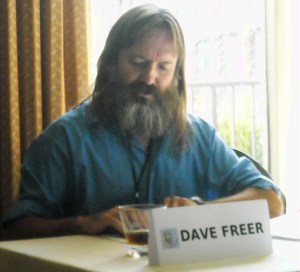
Interview with Dave Freer

This week, I am pleased to present an interview with Dave Freer. Dave writes mostly humorous or alternate history novels and has collaborated with Eric Flint and Mercedes Lackey as well. His books do not always fit into nice little categories that publishers like, but that’s also what makes them interesting. Before pursuing a writing career, Dave was an ichthyologist, and (not making this up) fish farm manager. He is a rock-climber, chef, and all around athletic kind of guy, especially when compared to most writers. He lives in South Africa with his wife and children.
daveatluna

MICHAEL A. VENTRELLA: Dave, what’s your writing process? Do you use extensive outlines?

DAVE FREER: I must write 200 words before I get up, go to ‘loo, make coffee, read e-mail, or any other displacement activity. Trust me: there is nothing like twisted legs or desperate need for coffee to focus the mind, and once focussed you often over-run the 200 by several thousand. Outlines? Oh yes, very useful… until the characters take over and ignore them. I still do them. They provide a framework to disregard… well, to build on. In the end the book fits the concept if not the verbatim outline.

VENTRELLA: What’s your writing background? Did you begin with fiction?

FREER: Writing background… when I was a final year schoolboy back just before the age of dinosaurs, I went to my English Master (Old British style Boarding School) and said “Sir, I want to be a novelist.” He laughed at me and replied: “Freer, you can’t spell, and no one can make a living at it.” He was right about the spelling, so I assumed he was right about the rest (he was a teacher, see, and teachers are right, except, as I later learned, when they are wrong), so I listened and embarked instead (after my two year stint as a conscript in Medical Corps) on a career in fantasy writing in which no could make a living. Okay, so it was lightly disguised as Fisheries Science (I am an ichthyologist) but it involved writing a lot of papers and reports about the status of the Shark Fishery and the biology of sharks. I blundered into writing from there in an unrepeatable fashion. (I started my fiction writing career in a stuck in a bathroom with amoebic dysentry for a week. There are many other better ways to do this. In fact, almost any other way works better. And is less horrible. I’m a GREAT bad example.)

VENTRELLA: What skills are needed for short story writing that are different from novel writing?

FREER: Shorts are a bitch to write well. Harder than novels. I always hold that writing shorts is best training for writing novels and I wish a lot of verbose novelists would do it. So, to me, there is no real difference.
dr2

VENTRELLA: You’ve do a lot of collaborations with other authors. Do you meet in advance? Work through email? Is it basically one person’s ideas and the other’s work? What happens when there is a disagreement?

FREER: Eric and I met through a e-flamewar that ended in mutual respect. We became good friends and offered a collab proposal to our mutual publisher. Don’t try this at home, as you’re probably not going to get as lucky with a guy who can be gentleman and admit he was wrong – or be one yourself. My publisher set the Lackey collab up. We work through e-mail in multiple colors for our replies.

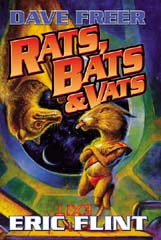
It’s usually one author’s seed-idea – for example RATS, BATS & VATS: Eric Flint had a short in which he had a talking uplifted rat and a bat rejected by one of the major magazines, with the editor profoundly informing him that the skull capacity of rats was too small for the volume of brain needed for uplift. Eric — knowing I was a biologist — asked me if this was true. I said I could think of at least three ways to solve the problem, and suggested the best. He said that would make a great story… and then we plotted the backround and setting. The book is still selling, and the mechanism I suggested was reported in Scientific Journals as a successful neurological implant technique. Of course a book is really rarely about science — it’s about the characters — and this one was no exception. I then wrote the first draft, e-mailing it to Eric to read as we went along. We’ve modified that over time — I now write the first draft with notes where I need him to put in stuff. We then do circulating edits.

SLOW TRAIN TO ARCTURUS was a similar evolution. Eric said he’d really love to do another generation ship story, they’d gone out of vogue — but it would have to be something different. So we touched on the core problem with generation ships — they take a long time to get there and it’s quite possible the planet will suck for habitability when you get there. And then you have to do it all over again… and biosystems are fragile. We solved the problems in a rather unique way.

It’s more — with us — a case of two lumps of fissionable material being pushed into close proximity, than one person’s ideas. It’s about as much fun as you can have as a writer, provided you get the right collaborator. As forthe disagreement thing… it happens. We both give ground and reach compromises. That’s ideal, but otherwise resign yourself to “yes sir,” if you’re a junior partner.

VENTRELLA: How did you break into the business? Did you start with an agent?067131940X

FREER: Through the slush pile. Took me two years to the day from submission to acceptance. No agent back then.

VENTRELLA: How important is an agent, in your opinion?

FREER: Important. Getting more important every week. I actually think this is another case of publisher penny-wise pound-foolish, as the task (and relatively small expense) of trawling slush has been handed increasingly to agents. Some are good at it, but the reality is the short term saving is recovered from publishers, because it means authors get agents right off the bat (instead of many mid career as was once true). Agented sales inevitably cost publishers more, after the initial ‘get in’ — so by saving on slush reading they’re now paying more, sooner, for more expensive books. Agents have less resources and, in some cases, less experience with publishing than junior editors at a publishing house, so it may not be wise in quality terms. But that’s the status quo, it’s not going to change soon. Live with it, and pick out the good agents. There are some excellent ones.

VENTRELLA: Here’s the question I’ve asked everyone so far: What’s the biggest mistake you have made?

FREER: Turned down a collab suggestion from publisher… He wouldn’t tell me who it was. It was David Weber.

VENTRELLA: What is the best piece of advice you could give a starting writer?

FREER: You don’t need amoebic dysentry or the approval of your English teacher to write. You just have to write.

Interview with “Space and Time” editor Hildy Silverman

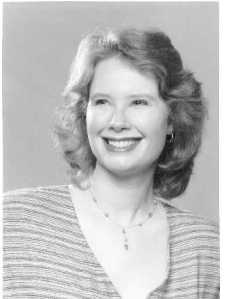
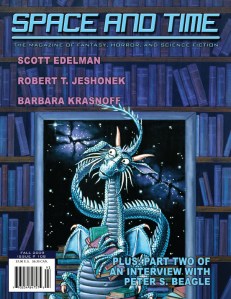
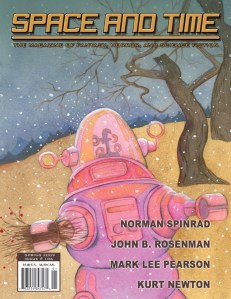
Hildy Silverman is the publisher and editor-in-chief of Space and Time, a 43-year-old magazine featuring fantasy, horror, and science fiction. She is also the author of several works of short fiction, which can be found in Wild Child, Phobos, Dark Territories (ed. Gary Frank and Mary SanGiovanni, Garden State Horror Writers, 2008), Witch Way to the Mall? (ed. Esther Friesner, Baen Books), an as yet-to-be-titled vampire anthology (ed. Esther Friesner, Baen Books) and Bad-Ass Fairies (ed. Danielle Ackley-McPhail). She is a member of the Philadelphia Science Fiction Society and the Garden State Horror Writers. She lives in New Jersey with one husband David, one daughter Rayanne, and one Bichon Frise, Frosty. She is a freelance consultant who writes corporate training, marketing communications, and SEO articles for major companies throughout the U.S.
Hildy_Silverman_B7W_Head_Smile_small

MICHAEL A. VENTRELLA: First of all, Hildy, how did you end up with this position, following in Gordon Linzner’s footsteps?

HILDY SILVERMAN: It was a spur-of-the-moment decision. I had met Gordon at a convention and saw him a few times due to mutual friends. I started reading Space and Time and really liked the unique fiction he ran. He told me that he was looking to sell the magazine and had some possible buyers interested, so I didn’t think much more about it.

Later, at a SFWA (Science Fiction Writers of America party), Gordon told me that none of the buyers had come through, so he was just going to shut down the magazine. Maybe I had a few too many Cosmos, because my response was, “Well, what if I wanted to buy it?” Long story short, we talked it over, I performed my due diligence, and in the end we were able to work out a good deal. Thus my career as a small publisher began.

VENTRELLA: When reviewing submissions, what will send a story to the slush file quickest?

SILVERMAN: Well, pretty much all of the stories start in the slush file anyway. Space and Time has six associate editors, who serve as first readers of the slush. They weed out the stories that aren’t up to snuff then forward the “goodies” to our fiction editor, Gerard Houarner. If he gives the story his blessing, it’s usually in…I just look them over and, except for a few rare occasions, rubber-stamp his choices.

If what you mean is what will get a story rejected quickest, there are a few obvious (or what should be obvious) things. Stories that are mailed to the business address without first requesting to do so are rejected out-of-hand (we accept electronic submissions only). Stories that clearly haven’t been proofread – full of typos, spelling and grammatical errors, formatting problems, etc – are also Right Out. Also, if the story doesn’t contain some sort of speculative fiction element, it is not for us. Those are the kinds of things that get weeded out first and fastest.

VENTRELLA: Do you advise aspiring writers to begin with short story submissions or do you feel that in today’s market, it is no longer necessary as a way to make a name for yourself?

SILVERMAN: I’ve heard conflicting advice and statements on this subject for awhile now. If a writer ultimately wants to make it as an author of full-length books, I’d say that writing ANYTHING until you’ve perfected your craft is a good idea. There’s certainly a lot less of a time investment in practicing your craft perfecting short stories for submission than if you write full-length manuscripts over and over. If you’re good enough to have you short stories published in a number of respected short fiction magazine and anthologies, perhaps win an award or two, it certainly wouldn’t hurt your reputation when ready to peddle a longer work to agents and editors. Credits are credit – they always look good on a submission letter.

VENTRELLA: Is there a talent needed for short stories that is separate from the skill needed for novels?
space&time1
SILVERMAN: Oh, yes. Some people mistakenly believe that because short stories are – well, shorter, they are faster and easier to write. Not true. You need to be able to convey an entire story – full plot, characterization, world building, etc. – in 10,000 words or fewer (usually fewer). That takes a great deal of skill. Your writing has to be tight, your use of language precise. Folks who write novels may have those abilities, but others will tell you they just can’t fit everything they want to say into the short story form. By the same token, there are short fiction writers who can’t “go long.”

VENTRELLA: Are there any taboos that would prevent you from accepting a story? Any trends you’re sick of?

SILVERMAN: I’m pretty hard to offend, especially when it comes to often-taboo subjects like sex or religion. In fact, I daresay I have or will publish some stories that are bound to get me into trouble with a few readers! As long as the story is well-written, with involving characters and a plot with a beginning, middle, and end I will give it fair consideration.

That said, pure “snuff” fiction holds no interest for me, mostly because there’s no plot there, just a vignette showcasing the abuse of one character by another. If someone sent me a piece featuring abuse, rape, or torture that is clearly all about wallowing in some disturbing fantasy, that’s not getting published, mostly because such work has no character, plot development, or anything of interest to say (except, maybe, “I need help.”)

As for trends I’m sick of, nope, haven’t run into any yet. We only open for submission windows, so I don’t see what a lot of other editors do, which is the same vampire plot or the same space opera story repeatedly throughout the year. There was a funny mini-trend I noticed last time we were open, though. Several stories about Quetzalcoatl came in all at once. I assume there was a planned anthology that didn’t go through; that’s usually the reason for an odd theme to suddenly rear its head in multiple submissions.

VENTRELLA: What do you personally like to read? Does that influence the choices you make as an editor?

SILVERMAN: I am a big fan of dark urban fantasy and horror these days. However, my tastes have changed over the years…I started out reading only hard science fiction (Asimov, Bova), transitioned to fantasy (Tolkien, McCaffery), and went on from there (King, Butcher). I also enjoy some literary fiction (Russo) – referencing the category here, not my personal opinion that it is more “literary” than other fiction. I supposed personal taste always comes into play when making editorial decisions, but I try to focus on how engaging a given story is, rather than be distracted by it not being my “thing.” If I feel unqualified to judge the merits of the story, I’ll leave it up to Gerard or one of the associate editors who is into that kind of story to make the final call.
Space&Time2

VENTRELLA: Does having an agent make a difference to you?

SILVERMAN: No, not for short fiction. In fact, I would find it odd to receive a piece brokered by an agent. There’s simply nothing to negotiate with a magazine publisher – our payment offerings, the rights requested, they’re all pretty standard. I can’t remember every getting a piece that was submitted by someone’s agent, though many of our authors do have agents to represent their longer works.

VENTRELLA: What’s the best piece of advice (other than “learn to write better”) you can give an aspiring writer?

SILVERMAN: Don’t forget to send your work out. It does you little good to write a huge number of short stories only to let them pile up in a drawer because you can’t or won’t get around to sending them to a market for consideration.

Also, learn the business side of writing. Too many writers are so focused on the craft – which IS important – but they never bother to learn the rules of the trade. You need to know how to research a potential market, understand guidelines, adhere to those guidelines, read a contract and understand the rights you are signing away, things like that. There are resources all over the Web and in how-to books that can tell you how to manage the money-making side of your career as well as the creative aspects. You should be equally versed in both.

VENTRELLA: As a writer yourself, what are your long term goals and what are you doing to make them happen?

SILVERMAN: Long term, I would like to see my novel published. I’ve been shopping it around to agents and have gotten some lovely rejections. Oh, that’s another thing for aspiring writers to remember – you’re going to get rejections. A lot. And some more. So has pretty much every major author you’ve ever heard of. The key is how you handle it. You can’t take them personally…it is your work being rejected, not your baby, not you. Everyone rejects work for a huge number of reasons, most of which are not because you suck as a writer. This is something I have to remind myself of all the time, because it is easy to be stung by rejection, even if you have a thick leathery skin like me.

In the meantime, I’m continuing to submit my short fiction to a variety of markets and have been enjoying some success there. I currently have three pieces published or about to be published in three different anthologies this year, plus a couple more pending.

I need to set some time aside to do more writing and submitting, but between running the magazine, my “day” job, and family life, time is a factor. I need to push past that and get on the stick, though, especially when it comes to sending out the next round of queries on the book.

Me and Hildy at the Philcon 2010 convention

Interview with Agent Mike Kabongo

Over the past month or so, I’ve posted interviews with authors, but let’s get a perspective behind the scenes this week with Mike Kabongo, whose OnyxHawke agency represents authors like Dave Freer and James Enge. His web page is http://www.onyxhawke.com/index.php

MICHAEL A. VENTRELLA: Michael, unlike most agents, you prefer to read the work before the query letter. Why is that?

MICHAEL KABONGO: Cover/query letters are interesting, but they are not the same type of writing as a novel. Some people will tell you that if you can write X you can write Y; I think the best thing that can be said for that point of view is that it is more aggressively optimistic than is wont in anyone old enough to cross the street by themselves. That said, they do serve a purpose, and they tell their reader far more about the writer than their fiction may.

I think that on the whole the best effect a cover letter can have is a null effect. I doubt any novel has sold purely on the basis of a cover letter, I suspect that many make it no further based on them. No agent, no editor wants to work with someone who is going to take an inordinate amount of their time and energy. That said, I don’t always skip the cover letter, it’s something done almost at random. I tend to read a bit of the novel, and if I make it through a couple chapters and haven’t read the letter I’ll go back to it.freer

A writer who is an energy sink could be one in several ways, among them: A) higher than average need of editing; B) constant need for attention of some sort; C) inability to stay on task; D) inability to write something marketable; E) emotional maintenance.

VENTRELLA: Can you usually tell within a page or so whether you might be interested in representing a particular author? Anything that makes you immediately toss a manuscript in the “rejected” file?

KABONGO: I can usually tell if I’m not interested well before I can tell if I might be interested. I have had a few books that I thought “Hey, this person can actually write and not just string words together, but I think they started in the wrong place.” I’ll usually keep reading these even if the first chapter is subpar. I’ve signed one or two clients with books that started that way. I don’t think I’ll give any direct examples, but when the science is worse than BRAVE NEW WORLD or I can hear the author’s voice over the character’s, or they have done something completely counter to a character’s established character, yes I’ll toss it quickly.

VENTRELLA: At the Ravencon science fiction convention, you humorously summarized your advice to aspiring authors as simply “Don’t be an asshole.” This is, of course, good advice for anyone, but for authors, how is that rule usually broken?enge

KABONGO: Well, it’s broken in a number of ways. One of the most disgusting acts I’ve seen lately was an author who publicly told their fans (or if one is being less charitable, “sycophants”) to attack someone who had given them a bad review. Another is being (needlessly) rude to people who they encounter in public places. Towards the people in the inside of the industry, the other writers, editors, and us invisible agents it is often worse. The infighting that goes on publicly in the SF/F community is startling to me. I can’t possibly imagine the heads of new products at ATT Wireless and T-Mobile or Samsung and LG engaging in the sniping that goes on as a matter of course in our commuinty.

VENTRELLA: Do you feel you can adequately represent an author whose work doesn’t really interest you yet in whom you can see the business potential? Or do you have to love the work in order to sell it?

KABONGO: I would really, really like to love the work I pick up, or at least the writing potential of the writer, and I can’t see myself picking up any work I don’t see strong marketability in. I’ve never accepted anything I hate for sale, but I suppose if someone who’s been on the best sellers list for twenty five years came to me and said they need a new agent I’d probably say yes. This is a business after all.

VENTRELLA: Now that vampire books are on the way out, I have of course started work on mine. How much do you follow and to predict trends in the market when deciding which books to push?

KABONGO: I pay attention to what the editors are saying about stuff they reject and what they are buying. I think that is a better set of indices than what is in the bookstores now.

VENTRELLA: What’s the biggest misconception new authors have about what agents do?

KABONGO: That an agent can sell something the market won’t support.

VENTRELLA: What piece of advice do you think is imperative that never seems to get mentioned in any of the standard “How to attract an agent” articles that populate the web?

KABONGO: First: Write well. Second: Be patient.

Interview with Hugo and Nebula Award Winning Author Mike Resnick

Mike Resnick has 5 Hugo Awards to his name (having been nominated 33 times — so far!) and has won numerous other awards for his fiction. As of 2009, he is first on the Locus list of all-time award winners, living or dead, for short fiction, and 4th on the Locus list of science fiction’s all-time top award winners in all fiction categories. He’ll be attending the World Science Fiction convention in Montreal in a few weeks, as will I, except he, of course, is once more nominated for a Hugo award.

His web page is here.

MICHAEL A. VENTRELLA: I am thrilled to be interviewing one of my favorite writers, Hugo and Nebula award-winning Mike Resnick.

Mr. Resnick, you seem to embody what many people advise all new writers: write a lot and write about everything. You’ve done fiction, non fiction, articles, editing, and so on. Do you agree that this is important and how do see a varied background as helping your writing?
Mike Resnick photo

MIKE RESNICK: Anything a writer can learn will eventually prove useful. Editing shows you how other people attack their stories, lets you see the strengths and weaknesses of certain approaches. Writing non-fiction teaches you to be careful of your facts, and that’s almost equally important in science fiction, where you strive for verisimilitude. Short stories and novels have different approaches, and the more you can learn about both, the less likely you are to put yourself at a competitive disadvantage against writers who do learn all that they can about their craft.

VENTRELLA: How has the publishing industry changed since you began?

RESNICK: The main change is that while they are printing more books, less houses are printing them. When I started selling in the early 1980s (I won ‘t count the three science fiction books I did in the late 1960s; my post-1980 career is a public penance for them), 18 New York publishers had science fiction lines. Today there are maybe half a dozen mass market houses with science fiction lines. Signet, Fawcett, Gold Medal, Pyramid, Lancer, Paperback Library, Playboy Press, Doubleday, and half a dozen others have gone – or seen their lines go – the way of the dodo.

VENTRELLA: Did you have an agent and do you think agents are necessary these days?

RESNICK: I had an agent after my first couple of sales; a lousy one. I got a top one in 1983, and I still have her, and she is absolutely not allowed to die or retire before I do. Yes, they’re necessary, for any number of reasons:

1. A lot of houses – most, in fact – won’t read unagented manuscripts.

2. Your agent, because of all the contracts that pass through her office and all the deals she’s negotiated, has a far better idea of what will be a contract-killer that you do, and will know what Publisher A will accept that Publisher B won’t.

3. A good agent will have a top foreign desk, will make you more money overseas than you’ll make in the US, and will have working relationships with top foreign agents in each country.

VENTRELLA: Self-publishing seems to be the trend; do you believe that if a starting writer self-publishes it destroys their chance of being taken seriously by “real” publishers and editors?

RESNICK: John Scalzi to the contrary – and he had a unique situation, with 25,000 daily hits on his blog – I believe, and have always believed, that a self-published book practically screams out that it was not good enough to compete in the economic market place. resnickflagship

VENTRELLA: What process do you use in writing? How important are outlines, for instance?

RESNICK: I have a very brief outline I use to sell the book to a publisher, and a slightly more detailed but far less formal outline – a set of notes,
actually – that I use when I sit down to write the book.

VENTRELLA: Do you plan an entire series at once or concentrate on each book separately?

RESNICK: If you’re writing a series, you have to know a little about where each book starts and finishes, but you concentrate on the book you’re writing, because if you do a lousy job there won’t be any more in the series.

VENTRELLA: Do you usually have more than one project at a time, or do you tend to get one finished and then move on? Do you think it is better to concentrate on one?

RESNICK: I only write on one novel at a time, but while I’m writing it I often take a couple of days off to write a story or an article, and then come back refreshed. For example, I just handed in STARSHIP: FLAGSHIP, the 5th and final book in that series…but while I was writing it, I wrote and sold a story to Asimov’s, 2 to Subterranean, 1 to Analog and 1 to GATEWAYS, plus an article for Challenger and one for the SFWA Bulletin. That’s probably why it took me 9 weeks to write the novel instead of 6 weeks.

VENTRELLA: What’s the biggest mistake you have made professionally? What is the biggest mistake you see new authors making?

RESNICK: I sold 3 very derivative, not-very-good science fiction books in the late 1960s. I was busy learning my trade as an anonymous hack in the “adult” field, and I made the mistake of doing hackwork in a field I cared for. I realized it very quickly, and stayed away from science fiction – as a writer, not a con-attending fan – for 11 years to give readers a chance t forget. They forgave, but those damned books still turn up at every autographing session to humiliate me.

The biggest mistake new authors make? Either sending a manuscript out when they could make it better (this is a murderously competitive field), or signing a lousy contract with a second-rate publisher just to get their book into print.

VENTRELLA: I understand that Hollywood has just taken an interest in your “Galactic Midway” series, which I recall discovering and loving back when they were published 27 years ago. How did that come about, and why that series among all of yours? Can you give any details about this deal yet?
resnickoutpost

RESNICK: There aren’t any details to give. I met with Jupiter 9 Productions when I was in Los Angeles for the Nebulas this spring. They have options on a couple of my properties, and asked what else I had. I mentioned that I had a 27-year-old novel called SIDESHOW that I have thought, from the day I wrote it, was very filmable: good story, almost no special effects, emotional rather than cerebral, all you really need is a good make-up artist and good actors. They asked to see it, I send them a copy, and they optioned it.

That doesn’t mean it’ll be a film. SANTIAGO has been under continuous option since 1990. I’ve been paid 4 times for the screenplay that Carol and I wrote. You haven’t seen it at your local theatres, have you? Another one was THE WIDOWMAKER. Sold it to Miramax; they paid Carol and me to write the screenplay, hired Peter Hyams to direct – and then lost interest. It’s currently under option with Jupiter 9. The Penelope Bailey trilogy – SOOTHSAYER, ORACLE and PROPHET – has been under option to Intrinsic Value Films for about 5 years now; they’ve had a screenplay for 4 ½ years, they hired a director 2 years ago – and you haven’t seen that one in theatres either, have you? Other projects under option include “Hunting the Snark” and KIRINYAGA. (On Hollywood’s behalf, the economics are different. If a publisher had to raise $75 million every time he wanted to publish a book, you wouldn’t see a lot of them, either.)

VENTRELLA: What is your favorite of your own work and why? Of what are you most proud?

RESNICK: My favorite novel is THE OUTPOST, because it was the most fun to write. Far and away my favorite character is Lucifer Jones, who over 20 years has starred in ADVENTURES, EXPLOITS, ENCOUNTERS, and (this summer) HAZARDS, and will be in VOYAGES and INTRIGUES before he’s barred from every land mass on Earth. If I could write only one thing the rest of my life, it’d be Lucifer Jones stories; I love them.

I’m most proud of PARADISE, because no one had ever used that approach in that way, and I thought I did it about as well as it could be done. And I’m pretty proud of KIRINYAGA, which is up to 67 awards and nominations and still chugging along.

VENTRELLA: And finally, what is the best piece of advice you would give an aspiring writer?

RESNICK: Books don’t write themselves. Writers write; dilettantes who will never amount to much talk about writing.