The Axes of Evil

One barbarian prophecy says the legendary hero Bishortu will unite the three warring tribes. Another tribe has a prophecy that directly contradicts this, and they want Bishortu dead. And a third tribe, which may or may not be comprised of werewolves, refuses to let anyone know what their prophecy says. Meanwhile, the Duke on whose land the barbarians sit wants them all gone.

In the middle of all of this is squire Terin Ostler, who has been mistakenly identified as the great Bishortu. Under the Duke’s orders to get rid of the barbarians, he heads to their lands without the slightest idea of what to do.

Along the way, he has to avoid assassins, werewolves, lovesick barbarian princesses, and confused goblins while attempting to figure out the meaning of the magical and mysterious Wretched Axes. Nobody said being a hero would be easy.

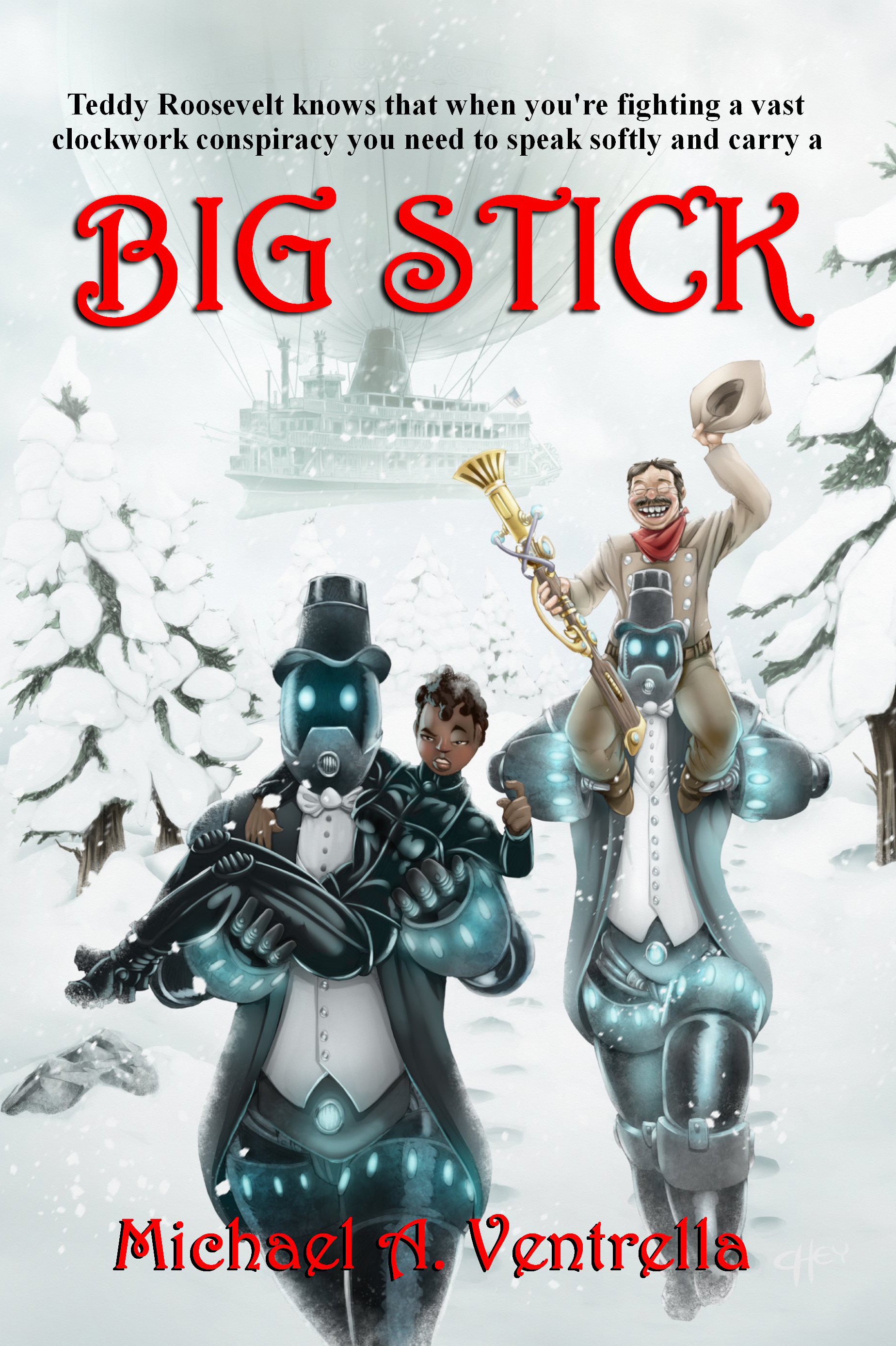
I am so pleased to announce that my second novel THE AXES OF EVIL is now available.

I’m quite proud of it and think it’s a great improvement over the first. Partially this is due to experience (the more you write the better you should get), a good editor (as discussed in a previous blog entry) and paying attention to good advice from professional writers.

Fantasy author Gregory Frost likens it to Christopher Stasheff’s work. I read THE WARLOCK IN SPITE OF HIMSELF about 30 years ago and remember only that it was a fun adventure about a reluctant hero, and I am pleased with the comparison! (I hope I don’t go to re-read it and find plot parallels, because then I’ll be quite upset.)

“Humor, danger and a twisted tangle of unlikely prophecies make for a page-turning adventure,” said Gail Z. Martin, author of THE CHRONICLES OF THE NECROMANCER series. Award winning author Jonathan Maberry (THE DRAGON FACTORY) said it’s “a taut nail-biter of a thriller. Edgy, funny and dark.”

Readers of THE AXES OF EVIL should have an exciting ride, with non-stop action, humor, and unexpected plot twists. (And no, you don’t have to have read ARCH ENEMIES to enjoy this one.)

Unlike many fantasy heroes, Terin is not “the chosen one” or someone with super powers or special skills. Instead, he constantly finds himself thrown into terrible situations and finds solutions by being brave, honest, and resourceful. I always found myself identifying with average people performing extraordinary feats — to me, those are the real heroes.

The purpose of this blog is not only to allow me to interview professionals and learn from them, but also to promote my own work. (Any similar writer who says otherwise is probably not being very honest with himself or herself.) If you’ve enjoyed this blog, you may enjoy THE AXES OF EVIL. As an aspiring writer, I very much appreciate (and need) your support. I hope you will give it a try and post your comments to Amazon and other booksellers. I am always anxious to receive constructive feedback, positive or negative — I can always improve, after all, so your comments are valuable.

You can order the paperback here.

You can download the ebook here.

You can download the kindle version here.

And you can join my Facebook fan group here.

Thanks for the indulgence. Next week, back to interviews!

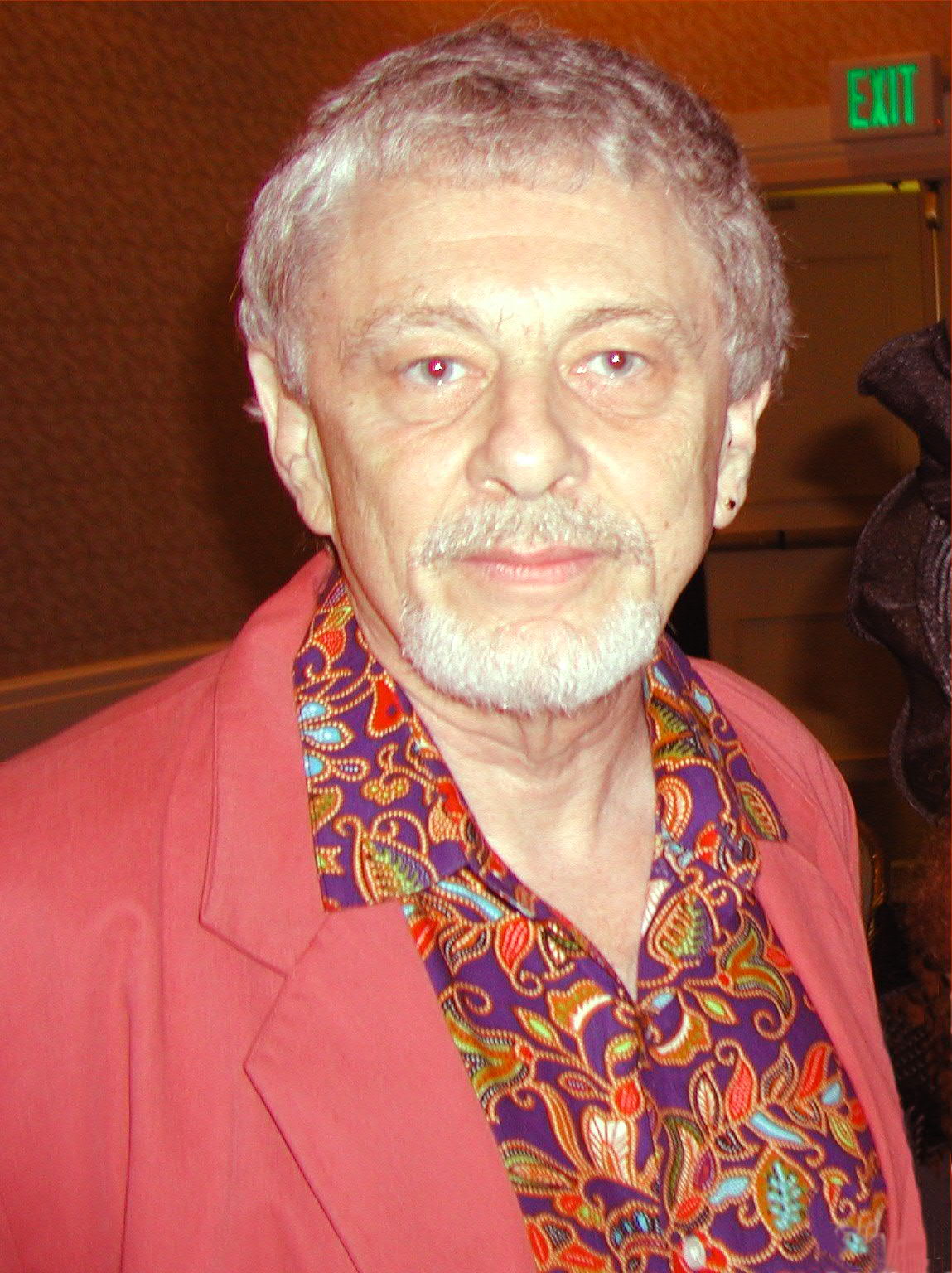
Interview with Hugo and Nebula Award Winning Author Norman Spinrad

MICHAEL A. VENTRELLA: I’m pleased to be interviewing Norman Spinrad, one of my favorite authors! Norman Spinrad is the author of some 20 or so novels, five or six dozen short stories, a classic “Star Trek” episode, a couple of flop movies, an album’s worth of songs, political columns, film criticism, literary criticicsm, mini-cookbooks, autobiography, and a bunch of assorted other stuff.

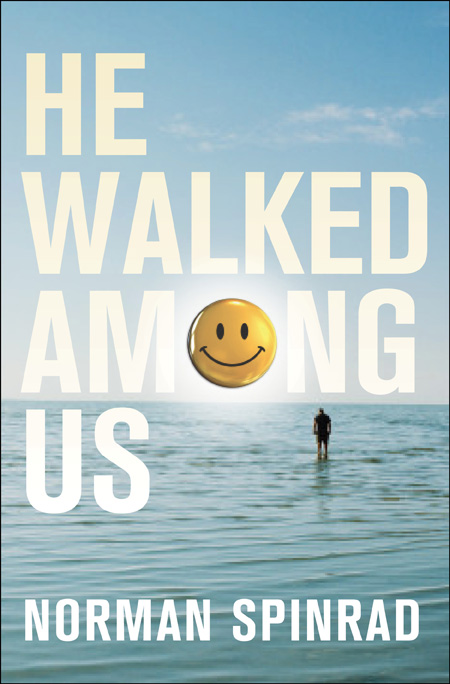
The latest novel to be written is a called WELCOME TO YOUR DREAMTIME, in which the reader is the viewpoint character. The latest novel to be published, in April 2010 by Tor, will be HE WALKED AMONG US.

His web page is here.

I can still recall when a friend and I both read BUG JACK BARRON within a short period of time, and spent months talking about it and saying what a good movie it would make. If you don’t mind, let’s start with that. You have written scripts before (most notably for the original “Star Trek”) and have produced one for BUG JACK BARRON, but somehow, due to Hollywood politics, it has never been made. What has stood in its way and is there the possibility that it might still happen?

NORMAN SPINRAD: This is always the wrong question. The right question is “How does any film get made?” I’ve had the experience of pitching a film project of THE BIG FLASH six times in one day, and what I was doing was walking into someone’s office and saying in effect “gimme $15 million.” Try it some time and see how it feels!

You can look at my YouTubes about this for gory details, but basically, the situation is that Universal had to pay the pick-up money when it looked like Costa Gavras was going to do it, Costa Gavras killed himself in Hollywood with HANNAH K, there were blown scripts, they didn’t like mine, never got made though any number of directors and producers have tried to get it away from Universal (in those days a “pick up” meant they owned the rights forever) because of a tax dodge in which studios keep phantom projects “alive” so they can use them to write-off annual deductions in the form of enhanced overhead for “development.” There are hundreds of such projects in the same situation in Hollywood for the same reason.

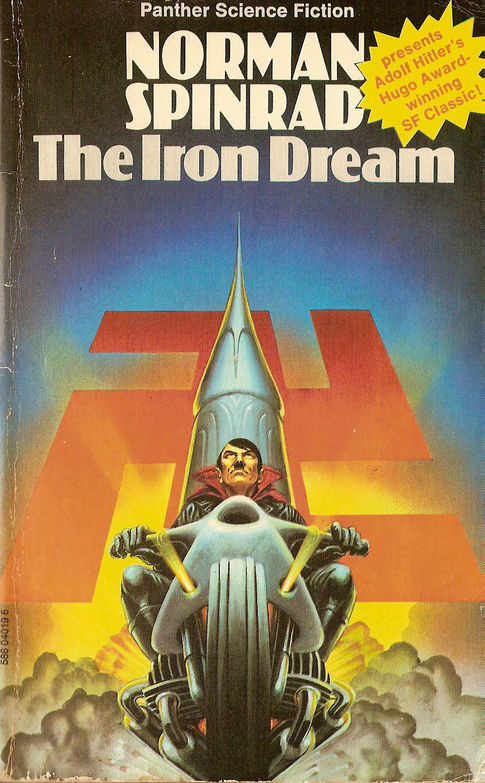
VENTRELLA: After the controversy over BUG JACK BARRON, did you make a conscious decision to push the limits even farther with your book THE IRON DREAM?

SPINRAD: No, I never do that, consciously seek to push limits, I just ignore limits.

VENTRELLA: How did you get the idea?

SPINRAD: I got the idea for THE IRON DREAM by asking Mike Moorcock how he wrote all his commercial fantasies. “Take a myth, or a story from history, run it through a lot of Freudian imagery, and there you have it,” he told me.

“You mean like for instance Nazi Germany…?”

VENTRELLA: Looking back, are you happy with the results?

SPINRAD: In retrospect, after THE IRON DREAM got all those good reviews in over a dozen countries, won an Apollo, was nominated for an American Book Award, I was finally convinced I had written a suigenerous classic. Before that I hated the novel; it took me a long time to figure out that what I hated was the unpleasant work of writing it, not the result.

VENTRELLA: Your novel HE WALKED AMONG US has gone through a most interesting publication history. Can you explain a bit about this? How much of this was by your design and how much of it was because of problems with publishers?

SPINRAD: All of it was problems with publishers, and I’m not going to go into it here. Suffice it to say that HE WALKED AMONG US was finally published by Fayard in French translation last year, a much more presitigous and serious publisher than any of those who rejected it, and will finally be published by Tor in April 2010.

VENTRELLA: You’ve dealt with language in the future in your novels. Where do you think we are heading? Is English taking over the world because of our culture?

SPINRAD: No. Our (pop, Hollywood, etc.) culture is taking over the world because of English, which is the most popular second language in the world as well as the first language of something like half a billion people. The Anglophone market is by far the biggest.

VENTRELLA: As a transplanted New Yorker, what is it about Paris that made you move?

SPINRAD: Nothing, if you mean back to NY, except financial and real estate complicatons. If you mean to Paris, I moved there for what I thought would be a year to write RUSSIAN SPRING, set primarily in Paris. But by the time I had finished, what was going on in Europe was much more interesting to me as a speculative writer, and personally I just enjoyed living in Europe, and particularly in France, much more than in the US. More diversity in the same area.

VENTRELLA: I read an interview you did with Woody Allen where you two discussed how much better artists are received in Europe. What is it about the culture that makes that possible there and not here?

SPINRAD: In part, it may be that it’s an individual thing, my work somehow resonates powerfully with the French as does Woody’s. But as a generality, I think it has a lot to do with American anti-intellectualism. If you’re living off an art, you’re less than macho, and if you are not employed, you’re a bum. How this evolved, I’m not sure, but I think it has to do with the extreme laisez faire capitalism of the US, and the idea that the bottom line is the bottom line. This is not true in France, for example, although the French are very keen on making money, where it is clearly “cultural patrimony” — literature, art, film, music, even comics, that trumps money psychologically and socially.

VENTRELLA: Do you consider yourself an optimist? Does the world today look like you imagined it when you began writing, and do you think it will improve?

SPINRAD: Neither an optimist nor a pessimist, but a realist. And I’ve imaged all sorts of contradictory futures, as have most serious writers of speculative fiction. The point is not prediction, the point is exploring possibilities, even very improbable ones.

VENTRELLA: What is your writing process?

SPINRAD: Story comes first, no story, no writing, and story, at least at novel length implies structure, at least knowing where you’re going before you start, and why you’e going there. So with novels, I don’t so much write “outlines” to begin with but treatments in the film manner, not just the events and the characters, but the voices and the styles.

With short stories, I guess I often do just start writing some stuff to see what happens.

VENTRELLA: Do you have any tricks you use for making sure that your characters are believable and consistent?

SPINRAD: Not really. Except mainly in fiction as in the real world, chez Emerson, “consistency is the hobgoglin of little minds,” meaning that fictional characters don’t have to be and probably shouldn’t be “consistent” if you want them to be “believable.”

VENTRELLA: Have you ever had to make changes you regret due to publisher/editor requests?

SPINRAD: Not really, except for some title changes.

VENTRELLA: Let’s discuss the publishing business a bit. With self-publishing and e-books becoming more prominent, how do you think this will change the demand and market for new writers?

SPINRAD: Not at all. I worked at the Scott Meredith fee reading service, which charged would-be writers for “editorial advice” and promised to try to sell what was marketable.. What was marketable was about 5% of amateur submissions. No technology will ever change this except maybe by increasing the size of editors’ slush piles.

VENTRELLA: The publishing industry still seems to be stuck in a “bricks and mortar” mentality, and is slow to embrace e-books and the like. Do you think that publishers will eventually be forced to reduce their prices on e-books?

SPINRAD: All this is in a creatively chaotic state of flux, and will be for a year or two. Publishers are not now slow to embrace ebooks, far from it, they’re almost desperately trying to figure out business models, pricing, power relationships with Amazon, Barnes and Noble, etc.

In my opinion, the devices to make ebooks take off are already here, more or less, what isn’t is realistic business models stripped of excessive greed. It seems clear to me that an ebook should be treated first like a trade paperback, later as a mass market paperback.

Meaning that when it’s a new title, it should sell for about $10 or $12, say, which is a 20% or so discount from the current standard price of a trade paperback, and this is the difference in numbers that Amazon and Macmillan were fight about, and it’s no big deal. But publishers, for titles that they want to launch in hardcover, should be able to delay ebooks for several months to protect hardcover prices, just as they now delay paperbacks a year to protect them. Once a book as been around over a year or so, the ebook price should be competative with that of a mass market paperback.

This, in general, is the just, workable model that will work, and therefore I believe it will enventually emerge. Think of it as evolution in action.

VENTRELLA: Finally, what is your favorite? For what would you like to be remembered?

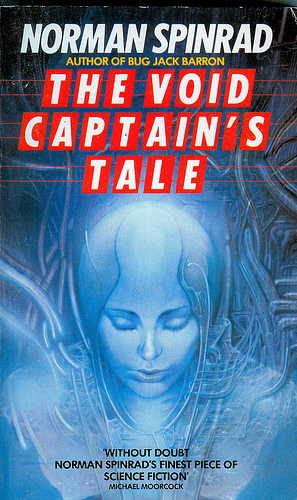
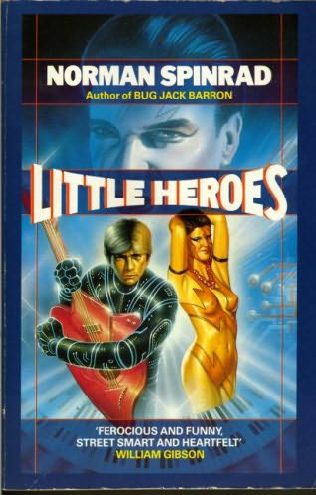
SPINRAD: Like asking someone with 20 kids which is his favorite. I suppose though, I have an A list: HE WALKED AMONG US, CHILD OF FORTUNE, THE VOID CAPTAIN’S TALE, LITTLE HEROES, BUG JACK BARRON…

As for what I would like to otherwise be remembered for:

He opened doors.

Many people walked through them.

Interview with Agent Lori Perkins

MICHAEL A. VENTRELLA: Lori Perkins is the Editorial Director of Ravenous Romance, a new publisher of romance ebooks and audiobooks. She has been a literary agent for 20 years, and is currently President of L. Perkins Agency, which has foreign agents in 11 countries and working relationships with Hollywood agents. She was the agent for HOW TO MAKE LOVE LIKE A PORN STAR: A CAUTIONARY TALE by Jenna Jameson, which made the New York Times best-seller list for 7 weeks. She was also the agent for J.K. ROWLING: THE WIZARD BEHIND HARRY POTTER by Marc Shapiro, which was on the N.Y. Times Children’s best-seller list.

As an author herself, she has produced four books: THE CHEAPSKATE’S GUIDE TO ENTERTAINMENT; THE INSIDER’S GUIDE TO GETTING A LITERARY AGENT and THE EVERYTHING FAMILY GUIDE TO WASHINGTON D.C. and THE EVERYTHING FAMILY GUIDE TO NEW YORK. She has also written numerous articles on publishing for Writer’s Digest and Publisher’s Weekly.

As an editor, she has edited thirteen erotica anthologies. when she is not teaching at N.Y.U.’s Center for Publishing. And somehow she found time to be interviewed by me.

Lori, how did you decide to start Ravenous Romance, and has it been as successful as you hoped?

LORI PERKINS: As an agent, I sell the stuff that other agents won’t handle — SF/Fantasy, pop culture and erotica. So after 9/11 I became the literary agent for the porn industry — I am Jenna Jameson and Vivid’s literary agent. But I also wondered what had happened in the erotica world that I had read as a younger woman, and I was surprised to find that the erotica market was becoming more and more female-centric. I took on Cecelia Tan — who writes SF/Fantasy erotica, as well as baseball books (another passion of mine) — and started selling erotica anthologies. I started reading all these wonderful writers with excellent writing chops who made their living writing short stories, and groomed a few of them into novelists for this burgeoning erotic romance and chick lit market.

At that time, I met Holly Schmidt and Allan Penn, who were nonfiction packagers doing a lot of sex books. They wanted to start a romance publisher, and I suggested that there were enough romance publishers out there, but erotic romance was young and growing. When they examined the market, they came back and said, yes, let’s do all ebooks, and that’s how Ravenousromance.com was born.

VENTRELLA: What is currently selling at Ravenousromance.com, and what are you looking for?

PERKINS: We’ve made a name for ourselves by crossing genres. Our most popular category is M/M romance, which means gay male romance. We’ve taken popular romance classics and rewritten them in contemporary settings — AN OFFICER AND HIS GENTLE MAN, PRETTY MAN, SLEEPLESS IN SAN FRANCISCO. We will be doing the same thing for lesbian F/F fiction now, so we are looking for someone to write THE PRINCESS’S BRIDE and MUST LOVE CATS. You get the idea.

Our paranormal romance is selling really well. We have seven vampire series, and the zombie fiction does well. HUNGRY FOR YOUR LOVE, our zombie romance anthology, is one of our best-sellers, as is our gay zombie romance, FOR LOVE OF THE DEAD by Hal Bodner. And our kinky stuff does well too, such as our THREESOMES anthology. We currently have a call out on the RR blog, ravenousromance.blogspot.com for stories for a paranormal threesomes anthology, THREE’S A CHARM, and an historical threesome anthology, ONCE UPON A THREESOME. We have two more big anthologies coming up soon — FANGBANGERS, which is romance with anything with fangs and claws, and APOCALYPSE TODAY: LOVE AMONG THE RUINS, which is end-of-the-world romance.

VENTRELLA: Do you see e-books being the wave of the future?

PERKINS: Ebooks is the future of the mass market. There will always be collectors and bibliophiles, but when it comes to books as entertainment, you can’t beat an ebook.

VENTRELLA: Do you think there is any stigma attached to books that are primarily sold as ebooks?

PERKINS: Only if they are self-published. We published 150 titles this year and sold reprint rights to a third of them to major houses.

VENTRELLA: Given that it is relatively inexpensive to produce ebooks, is there a worry that some will assume that the standards are lower for publication?

PERKINS: It is not much less expensive to “publish” an ebook. We pay an advance against royalties; we hire an editor, a copy editor, a cover designer; the book has to be converted into eformats from Word, and then it needs to be uploaded to the various Estores that sell it. Plus we need an office and an accounting department. I sell subrights. All Estores (Amazon, B&N, Fictionwise, Audible, etc.) take a huge portion of the sale price of the book (just like a bookstore and a distributor in print). The only part of the ebook system (with a real pubisher) that is less expensive is the cost of printing, shipping and storage, and that is returned to the author in the higher than print royalties — most epublishers pay between 25% and 35% royalties.

VENTRELLA: What will usually get a submission rejected for Ravenous Romance?

PERKINS: All erotic romance must have a happy ending or a happy-for-now ending. We might ask you to change it, and if you won’t, we won’t publish it. And then just plain bad writing will get you turned down — alternating perspectives, passive voice, etc.

VENTRELLA: Have you ever liked an author’s style and voice but rejected a story based on other grounds?

PERKINS: I am an editor who can fix things, so I can usually walk an author through a rewrite.

VENTRELLA: Audiobooks also seem to be growing tremendously. How are the ones with Ravenous Romance produced?

PERKINS: Erotic romance audiobooks do very well, because there aren’t many of them (they are still quite expensive to produce, since they must be done in a studio).

VENTRELLA: Do you think eventually the book publishers will change their pricing to accommodate a new economy model?

PERKINS: I think ebooks should be affordable, and that if they are too high they will encourage pirating. I think the print world needs to get rid of “reserve against returns”, which is an antiquated system that makes the publisher and the author a lender to the book seller. I think books are entertainment, and they must learn to complete with DVDs and games and music, all of which needs to be affordable. So a new blockbuster book should be $20, an ebook $10 and a mass market/backlist $5, IMHO.

VENTRELLA: What is your background? In other words, how did you get to become a literary agent?

PERKINS: I was journalist. I was the publisher of a neighborhood newspaper in Upper Manhattan with a degree in journalism from NYU. I became an agent becuse I wanted to sell both fiction and nonficiton, but I have always been an editorial agent (I fix the books before they go out and I often come up with ideas for my authors). I’ve also written four books and edited 15 anthologies. And I teach writing/editing at NYU.

VENTRELLA: As a literary agent, what do you see as the biggest mistake new authors make?

PERKINS: They are too eager to get published. They don’t work on their craft. They have fantasies about the marketplace that are no longer real.

VENTRELLA: How do you deal with receiving work that you think is well written but to which you don’t think the market wants?

PERKINS: I’ll tell them just that and tell them what’s selling, and if they want to rework something, fine. Otherwise put it in the trunk and get me something commercial.

VENTRELLA: What’s the best way for a new writer to find a literary agent who likes their genre and style of writing?

PERKINS: Get WRITER’S DIGEST’S GUIDE TO LITERARY AGENTS or Jeff Herman’s and go through the book with a marker, making a list of all the agents who sell what you’ve written. Then email the top five, wait a week, and go on to the next five, etc. You can also join Publisher’s Lunch and look up agent sales for the past three months to see who has sold something that sounds like what you are writing. Then send a query letter that starts: “I read on Publisher’s Lunch that you recently sold a….”

VENTRELLA: And finally, who are your favorite authors? Who do you like to read, and why?

PERKINS: My three favorite books are 1984, ALICE IN WONDERLAND and DRACULA, and I would say GONE WITH THE WIND is my fourth. I love Stephen King (am reading UNDER THE DOME now). I especially loved SALEM’S LOT because it was DRACULA set in America and he deftly portrayed the death of a small town. I think MISERY is his finest book — brilliantly crafted. I also love Peter Straub, who has mastered the art of telling a story like the peeling of an onion. He always amazes me.

Interview with Christopher Hoare

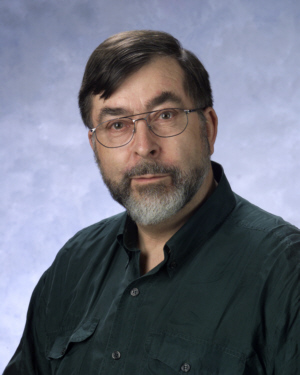
MICHAEL A. VENTRELLA: Today I am interviewing Christopher Hoare, whose books can be found with my publisher Double Dragon. Chris was born in London, England in 1939, immigrated to Canada in 1967, and became a Canadian Citizen in 1974 but we won’t hold that against him. He led an interesting life, studying around the world, serving in the Royal Artillery and then worked in oil exploration in Libya among other things. He now writes full time, living in Alberta at the eastern edge of the Rockies with his wife of almost 40 years, Shirley, and two shelter dogs.

Chris, there are so many new authors out there. What do you say to readers to get them to check out your books?

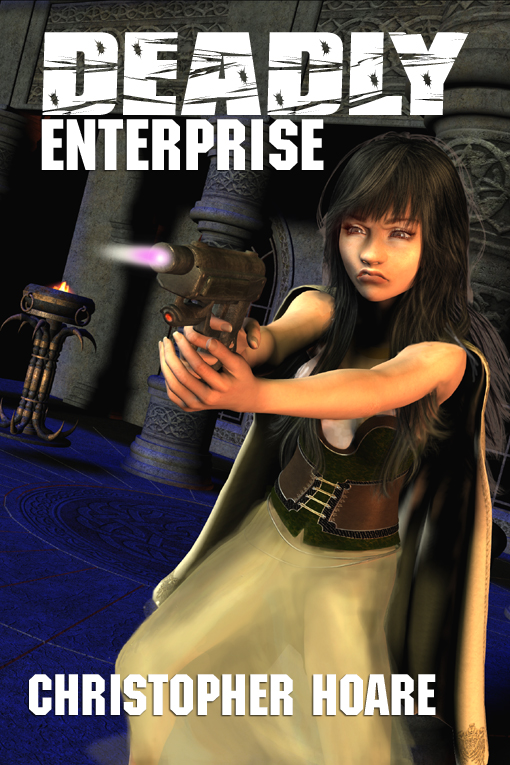
CHRISTOPHER HOARE: Gisel Matah, the protagonist of my Iskander series, is a woman who excels in a man’s world of action and danger, driving stories that women may find a refreshing change from being treated as sidekicks or helpless targets. She becomes the top security agent for her people when the small group of moderns are stranded in a 17th century world.

VENTRELLA: How did you decide to make the main protagonist a female?

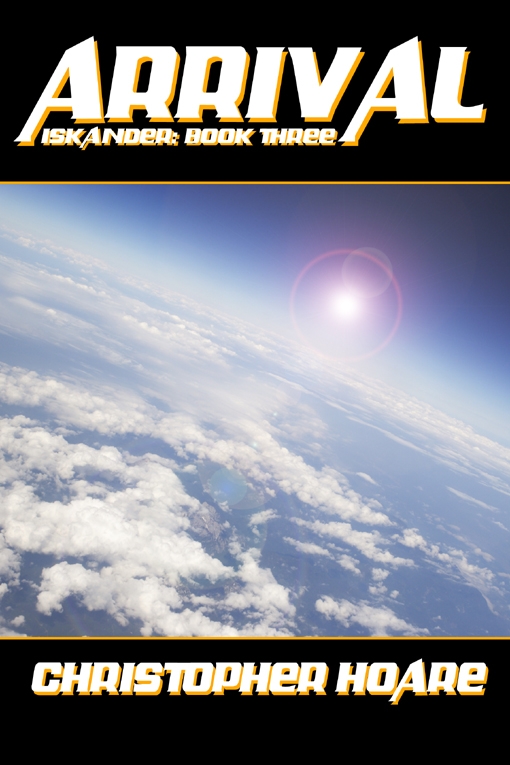
HOARE: I picked my strong and reckless female protagonist to oppose the relegating of women into accidental and amateur roles in action adventure fiction. I felt that women readers would enjoy one of their own who could stand with all the James Bonds and Rambos out there. I have heard skepticism about parts of the early stories where the young Gisel becomes the only person in the situation with the skills to take the lead, but partly because of her age. They query her action because they relate it to our society, that keeps the young in immaturity far longer than earlier societies did. I write such scenes with the age justification for her position carefully buttressed. For example, at 16 in ARRIVAL, she is picked to be Colonel M’Tov’s assistant in training a small group of parachutists because of her gymnastic experience; she then becomes the only person with the technical understanding to lead them on the operational jump when M’Tov breaks an ankle in a training exercise.

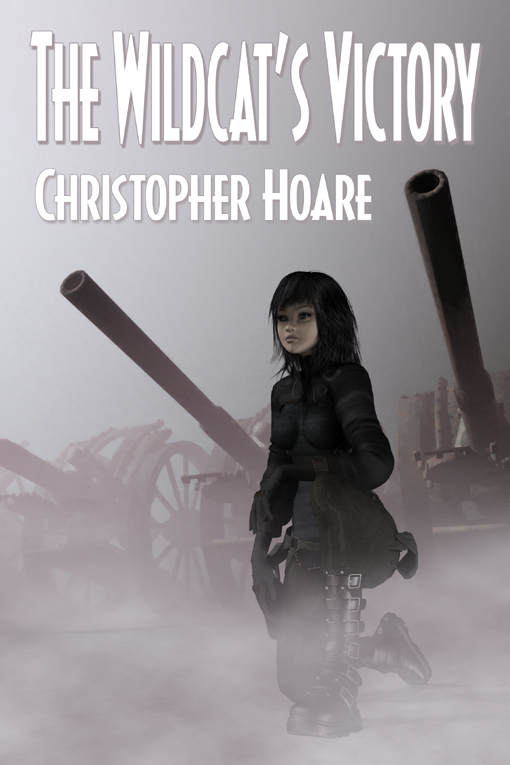
My next release is due to come out very shortly. THE WILDCAT’S BURDEN is a plunge into a dangerous writing minefield – I have Gisel both pregnant and moderately active as the governor of a rebellious city. The mothers in my writing group felt I’d mostly succeeded in depicting her in the conflicting roles, but also added their expert advice into the states of mind she should experience. The final crisis naturally takes place during her confinement and so the novel ends with attacks on her and on the city, while the plans she has prepared for the situation must unfold unattended. Another writer admitted she had a character in a fantasy give birth on a battlefield, but wouldn’t risk it again. We’ll see if readers accept this story.

VENTRELLA: What are you working on next?

HOARE: The novel I should be writing now instead of these answers. I have long wanted to write SF where the power of the mind is more important than the gadgetry. I think Lucas, in “Star Wars”, approaches this with the abilities of the Jedi, and I believe the ’50’s classics did as well in such stories as Alfred Bester’s jaunting in STARS MY DESTINATION (Tiger Tiger) and Asimov’s telepathic “Mule” in SECOND FOUNDATION.

The protagonist I introduce in MINDSTREAM is a retired professor of systems theory who has become abbot of a quasi-Buddhist monastery. He is able to access other beings – on this world, in deep space, and on other worlds – and, mentally, participate in or direct the action there. I blend a lot of the fascinating Tibetan Buddhist esotericism with String Theory in the background scenario. In the novel, Crumthorne and his assistant attend a NASA spaceflight convention to protect it against similar alien intrusion from adepts on other worlds, but it turns out that one of the Earth ‘attendees’ becomes a greater threat to all of them.

VENTRELLA: What’s the hardest part about writing?

HOARE: That’s easy – getting one’s work noticed among the cacophony of other media out there.

VENTRELLA: Have you had any formal writing training? Do you think that is necessary?

HOARE: You should have competence in the language you write in as a prerequisite. I’m appalled at the number of people who write although they have little knowledge of grammar and cannot spell; and even more appalled at those who self publish their writing without rectifying these inadequacies.

As to formal writing programs, I’m always skeptical about over-academicism because it can lead to rigidity and a failure to accept ideas that do not lend themselves to clever analysis. However, I attended a couple of university extensions that contributed greatly to my early development. A writers’ conference at NAU at Flagstaff in the late ’60s had an invited writer whose depth of analysis of fiction really opened my eyes.

VENTRELLA: How did you end up with your current publisher?

HOARE: I’m lucky to have landed with Double Dragon. Deron is supportive of ideas I sometimes spring on him, even when they turn out to be of less value than his own; he allows a writer to amass a growing body of available work without the fear of losing earlier writing to the deadly ‘shelf life’ demon of mainstream publication. Of course, that is also a function of e-publishing, where one is safe from being destroyed by the dreaded ‘returns’ policy.

I have been able to investigate the sales and distribution of POD vs e-books in my own way and learn from my mistakes (the only way I ever learn anything).

VENTRELLA: Do you have other long term goals to grab a more “mainstream” publisher?

HOARE: I would like to have a more mainstream publisher at some point, but I doubt I would find working with them (and they with me) completely successful. Really, the only thing they have that I covet is the greater exposure.”

VENTRELLA: Your short stories have also appeared in various collections, including TWISTED TALES. Do you find short story writing easier?

HOARE: Actually, I don’t like writing short fiction. The two stories accepted in TWISTED TALES II and III are the first short stories I produced since my early writing days. I doubt I will write more as I feel I was not able to get across the intentions I had in writing the stories. Possibly a fault of my lack of experience with the medium, but I really detest the literary genre that most short story writers write in.

VENTRELLA: Do you advise starting writers to concentrate first on short stories?

HOARE: Conventional wisdom when I started writing seriously said that one should always attempt to develop one’s idea first as a poem, then as a short story, and only later consider turning it into a novel. What rot. I do advise a developing writer that the shorter medium is a necessary foil when one is learning the essences of the craft of theme, tone, and plot. In a first novel one can easily lose all control over what one is writing – it certainly happened to my early attempts.

VENTRELLA: What’s your opinion on self-publishing?

HOARE: Would you recommend taking your first transatlantic flight in the captain’s seat rather than the passenger cabin? It requires an inordinate amount of hard work and luck for one’s self pub not to ditch in the ocean.

I do know a few good self published novels (other than Tolstoy’s and Dickens’) but they are exceptions. The writers were not first-time novelists and had some experience and craft knowledge to back their efforts. For a year or two I tried my hand at reviewing fiction and tried to give equal time to self-published works, but after receiving more than one that was actually painful to read I gave up on the exercise.

VENTRELLA: Do you tend to rely on outlines first or do you just plow right in?

HOARE: I much prefer to start with the characters and the opening question and write a first draft as an exploration. By the time the novel reaches the halfway point the ending should have made itself inevitable if one remains true to what has gone before.

There are times, when I’m not sure what should happen in a necessary scene or what comes next, that I will explore ahead with an outline or even an unorganized scattering of issues to determine the logical order which develops the story. I have never sat down and written a detailed outline of a story before starting to write as I feel that would destroy all the life – the illusion of real life happenings – that make the story flow.

VENTRELLA: Tell us about NovelPro.

HOARE: I learned almost all I know about writing during the five or six years I belonged. The partnership with some really brilliant authors and the hard work of extended whole novel critiques was more valuable than a conventional MFA. Not just my opinion, as I saw it expressed by other members who had MFAs.

If you can get in, I’d advise any writer to shelve their own writing ego long enough to submit to the group for awhile. Not everyone can do it. Some quit even before completing their very first novel crit – the be all, end all, of the NPro system – while others get kicked out because they become obstructive. I was cautioned a couple of times, and my posts put on ‘review’. I’m still in contact with some members and past members and have accepted that there will come a time when the writer has to accept that their own needs and the group’s no longer coincide. I still wish them all well, and wait for the time when a work from the group becomes a bigger success than THE DaVINCI CODE – as well as better written.”

In line with others in the NovelPro group I spent an inordinate length of time trying to perfect the query letter and the bit by bit perfection of the opening attention grabber to gain a top NY agent. Then I slowly began to realize that my writer profile ruled me out of their consideration. I’m a grouchy and opinionated senior who lives as far away from New York, and the New York mentality, as it’s possible to get without traveling through space. I tried to bend in the appropriate ways – I became a Toastmaster to hone my public speaking skills for those career building moments on camera, but by the time I became a CTM I realized I hated making speeches. I tried to convince myself that I could turn myself into a saleable ‘brand’ under the tutelage of a wise old literary agent, before I realized that I’m too much of a loner to fit the profile. I’ll go on writing my way and being me – and if that doesn’t fit with the NY concept – to Hell with them.

VENTRELLA: Do you have any specific advice you would give a writer trying to make it in the publishing business that they may not have heard before?

HOARE: I hope a few of the answers I’ve given above have pointed others to useful insights of their own. If there is anything I believe that I’d like to prove true it’s that in order to be a lasting writer – one who produces something that lasts – one has to be a contrarian. Not pretend to be one but to actually feel offended when life tries to squeeze you into a conventional slot.

My old physics prof at engineering college used to say, “If you want to have a brainwave, you have to have a brain, and you have to wave it.” I have absolutely no proof that these qualities will allow you to ‘make it’ in the conventional publishing business, but I assure you they will lead you to a more worthwhile life.

Interview with Nick Pollotta

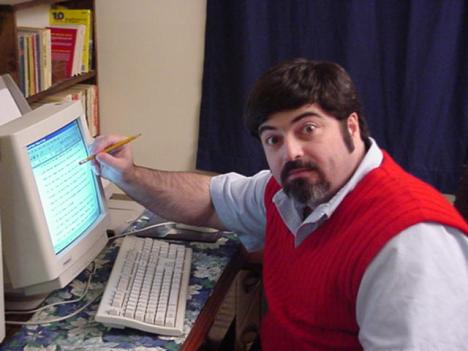
MICHAEL A. VENTRELLA: Nick Pollotta has 56 novels released under a wide assortment of pseudonyms. Specializing in Fantasy/Humor and Military/Thrillers, his books have sold in the millions, and been translated into a dozen foreign languages. A former stand-up comic, Nick still performs at SF cons just for fun, and occasionally teaches Creative Writing seminars at local colleges. He lives in northern Illinois with his wife Melissa, 14,000 books, and two cats who plan on conquering the world as soon as they figure out how to operate the can opener.nick2008

Nick, you’re one of the most prolific writers I know.

NICK POLLOTTA: Really? Try reading Alexander Dumas, he wrote six hundred novels. I’m a slug-a-bed compared to that dynamo!

VENTRELLA: But I don’t know him. Nick, I first heard of you when I read ILLEGAL ALIENS with Phil Foglio back in the 80s. How did that come about?

POLLOTTA: Funny story. I was living in Philadelphia at the time, and the local SF club, PSFS was trying to win the WorldCon for 1986. They wanted something different at their bid parties to make them stand out, so I offered to do some stand-up comedy. (I used to perform in NYC night clubs). That worked great – at first. But PSFS threw so many parties, I needed new material fast, and come up with the idea of performing a series of ‘radio plays’ live at the parties about the adventures of Phil A. Delphia, fannish secret agent 86 in his never-ending battle against The-Evil-Dr-Salvatore (one word) and his Agents of Chaos. They were an smash hit, and soon I had a cast of six, with a sound effects man, and we were playing to packed rooms. Standing room only. Phil Foglio caught a performance one night, we became friends, and soon were performing together. Naturally, we joked about turning the radio plays into a novel, and somewhere along the way that morphed into our SF/Comedy novel, ILLEGAL ALIENS.

VENTRELLA: Didn’t Phil also have a comedy troupe at the time? The Zanti Misfits? Were you involved in that? I think I still have one of their programs but I think that was at a Lunacon…

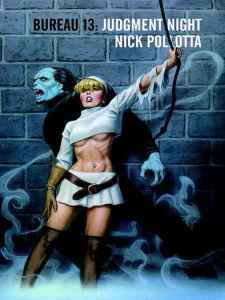
POLLOTTA: The Zanti Misfits was my comedy group, which Phil joined. After a couple of years I added radio plays (all new stuff) to the sketches, and renamed the group, The Gunderson Corporation (after our fake sponsor). “If it fits in the palm of your hand, is made is plastic, costs under five bucks, and breaks in a week – then its another fine product from.. The Gunderson Corporation!”Judgment-Night

The Gundersons had over two hundred performances at SF cons across the nation, (and for free, we did not charge for a show. This was our hobby) People came and went, including Phil when he moved away, but the group was still performing inl 2005 when our Sound Effects Master Kevin McLaughlin, a very good friend of mine, died in a tragic accident. We took a short hiatus, and it just kept getting longer. Four years later, I’m now way too busy to perform anymore, so I guess WTGC (all radio, all the time!) has finally gone off the air after 25 years.

VENTRELLA: You tend to write a lot of articles to help other aspiring writers; have you thought of producing a book of these essays?

POLLOTTA: I have considered it, but I simply do not have enough articles to make a whole book. However, they have been reprinted dozens of times, and now are posted for free on my Facebook page. What the Hell, somebody has to write books for me to read, eh?

VENTRELLA: What’s your writing process? Do you use extensive outlines? And do you plan out the series or just work one book at a time?

POLLOTTA: This depends entirely upon the project. But on average: I get an idea, flesh it out to two rough pages, then design my characters, and now do a full outline of about ten pages, or so. Next, I do chapter breakdowns, do whatever research is necessary (antique weapons, advanced physics, farming, ballet, high-explosives, whatever.) Then I book the time, sit down and charge. I am usually scheduled for a year in advance, sometimes even two or three.

VENTRELLA: I note that “nickpollotta.com” links to the “Fantastic Fiction” web page. Are you planning to have your own page or has this been just as good? Do you think a web page is important for a starting writer?

POLLOTTA: Once you have sold a book, a web page is vital to a new author. The ‘Fantastic Fiction’ web page is merely a place-holder while I change over from my old SFWA (Science Fiction Writers of America) web page to my new AG (Authors Guild) web page.

VENTRELLA: Of which book are you most proud? What would you like to be remembered for?

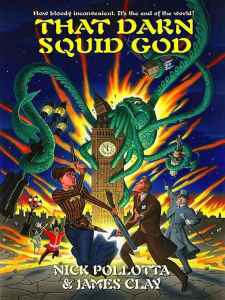
POLLOTTA: I am very proud of THAT DARN SQUID GOD and the Deathlands novel ZERO CITY. However, I would like to be remembered for my next novel – whatever it is. A writer lives in the future. We never stop trying to beat our last book.THAT DARN SQUID GOD

VENTRELLA: Your bio says you “almost” became a lawyer. As an attorney myself, I am curious as to how you escaped. Was it the lure of writing that drew you away?

POLLOTTA: Oddly enough, that was it exactly. I had gotten a scholarship, but turned it down to work as a video store clerk to have more time for my writing. Somebody very wise once said that if you do what you love, you’ll never work a day in your life. Sage advice, indeed. It took me many years to get here, but nowadays I start every morning with a smile, eager to get back to the computer, and start writing again.

VENTRELLA: What’s your opinion on e-books? Do you think they’re the wave of the future or a step down from traditional publishing? Should an author whose book is only available as an e-book be concerned?

POLLOTTA: According to every expert in the field, the sale of e-books have had no direct effect on the sale of traditional books. Bookies (slang for bibliophiles, AKA the readers) love to hold the actual book, to own it physically, and see it sitting on their shelf. E-book sales are gravy, but not the meat.

VENTRELLA: Here’s the question I’ve asked everyone so far: What’s the biggest mistake you have made?

POLLOTTA: Hmm, that’s a tough question. I’ve made quite a few, and suffered the consequences. However, I would say that my biggest goof was forgetting that writing is part of Show Business. Half of it is show (the art), but the rest is pure business. Learning how to write is merely half of the task. You must learn how to conduct yourself in a professional manner, never emotionally, or excitedly. Never promise something that you can not deliver. Never take anything personally. Never miss a deadline. Learn the tax laws. Save your money. Get printed business cards and letterhead stationary, not stuff you print at home on an ink jet. To be a pro, act like a pro.

It is also vital to remember that this is a small field, and you will constantly keep bumping into the same people over and over. Just because an editor is leaving a publisher, does not mean you will never see them again as, say a literary agent, as a fellow writer, or a chief editor at another publisher. The Dale Carnegie book, “How to Win Friends” is just as important to a writer as “Strunk & White: The Elements of Style”.

VENTRELLA: What is the best piece of advice you could give a starting writer?

POLLOTTA: To quote the movie, “Galaxy Quest”: Never give in, and never surrender! This is rough business, sometimes even cut-throat, and good writers who simply aren’t tough enough to withstand rejection often fall by the wayside, and disappear. You have to learn how to armor-plate your ego, and ignore the fools, yet remain open to intelligent advice, and constructive criticism. Plan for failure, but hope for success, and never stop writing!

Interview with Author Peter Prellwitz

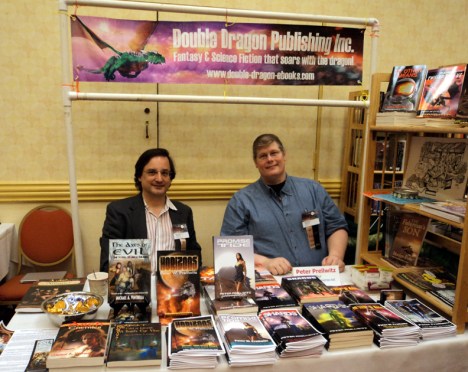
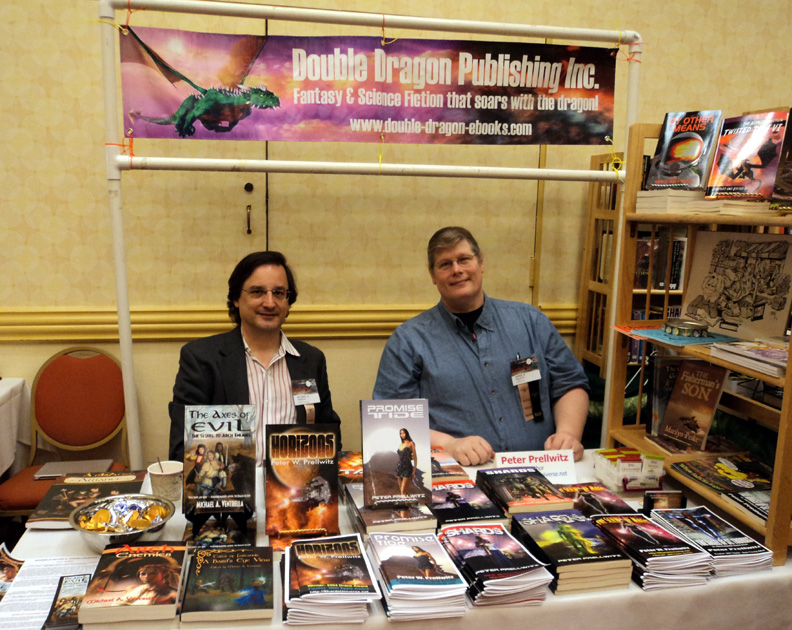
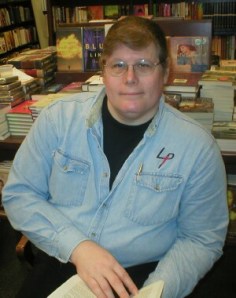
MICHAEL A. VENTRELLA: I’m pleased to be interviewing Peter Prellwitz, one of the most successful writers at my publishing house, Double Dragon. His web page is http://shardsuniverse.net/ . Peter, what made you sign up with Double Dragon, and do you regret going with a smaller press?

PETER PRELLWITZ: Double Dragon Publishing (DDP) was pointed out to me by a friend who was looking to start up his own publishing company. He’d read my novel Shards back when it first appeared in serial form on the CompuServe Writers Forum and became a supporter to see it published. (I’d originally written the novel just for my own enjoyment, with no intention of publishing it.) At the time, Double Dragon was conducting its first – and sadly, only – Draco Writing Contest, so I entered four of my finished novels, Horizons, Promise Tide, The Science of Magic, and The Angel of St. Thomas. I didn’t enter Shards because the four books making up the novel totalled three hundred thousand words and I knew better than to submit something of that size, having never been published. All four books fared well in the judging, with Horizons selected by finalist judge Mike Resnick as the Winner for Best Science Fiction.
prellwitzbiopic

I have never regretted going with a smaller press, primarily because that smaller press was Double Dragon Publishing. I have always been treated cheerfully, professionally and politely. This can be tempting to think, “Sure, they treat me that way because my sales are pretty good.” But the undisputed truth is the company treats all its contributors that way.

VENTRELLA: Given the cutbacks at the big publishing houses, would you advise other starting writers to “build a portfolio” by having success with a small publisher or is it better to keep holding off for that big potential deal?

PRELLWITZ: Having just crowed over the joy of being with Double Dragon doesn’t mean there aren’t challenges and downsides to being signed by an ebook publisher. One of the biggest is the “stigma” that comes with it. The sad truth is that there are a LOT of ebook/small publishing houses out there that have poor business practices, very low standards for accepting materials, and are about as real as faster-than-light travel. The mainstream publishers and associated agents, editors and such have maintained for years that ebook/small press publishing was no better than vanity press, and not to be taken seriously. Sadly, more often than not, they’re absolutely right. There’s an overabundance of – forgive me – poor quality writing that is being published by ebook/small press publishers that has little or no merit to it and is seeing print only because of their publishers’ inexperience, vanity or outright greed. That means that real publishers like DDP, who have high submission standards, a winnowing process, and sustainable business/publishing models, are unfairly lumped into the same group as so-called publishers. Because of this, while the idea of “building a portfolio” with a small publisher sounds good, it can actually hurt you in the respect of building a reputation among the larger, more conventional publishing companies. And literary agents won’t even look at work you’ve published with ebook/small press publishers.

But there a many positives to going with the right small publisher. One is the self-realization that you’re a serious writer; you’ve tried to get your work published. Another is that your chances of getting read and signed are greater with an ebook or small publisher. Just be sure you go with a reputable publisher. I do believe the time is coming when there will be a blending of some elements in the ebook publishing and mainstream publishers. The ebook and small publishing companies are far more efficient; not wasting paper but rather using print on demand (POD) or electrons to put out books, as opposed to the tried and true but increasingly expensive and wasteful mass publishing model that the larger houses use. Being a known, respected author with a known, respected publishing house, be it ebook, POD or mass, is a good thing.

VENTRELLA: What’s your writing process? Do you use extensive outlines? And do you plan out the series or just work one book at a time?

PRELLWITZ: I’m afraid I’m a nightmare of an example when it comes to the writing process. I’m what you would call a “seat of the pants” writer. I no idea how a novel is going to end, nor even what’s going to happen in the next chapter or even the next page. Oh, I’ve tried to do the outlines, plot summaries, character direction, and etc. For ten novels now, though, it hasn’t worked. I introduce my characters to the initial conflict that needs to be resolved, then just write down what happens. If I ever try to step in and direct things, they either smack me down for meddling in their lives or they stand around and go on strike like a bunch of prima donna actors. In one novel, TAU (which stands for Those Above Us), I set up one character to be the penultimate bad guy; then traitor everybody wants dead. I built this massive case of evidence against him and then, one chapter before the end of the book, he dies a noble death. He’s NOT the villain I was certain he was. Which left me completely in the dark as to who WAS the traitor. Took me a couple weeks to figure it out, and when I did, I couldn’t believe it. But when I read through the novel, there it was. I’d laid out – rather, recorded what I saw – everything that was needed to prove the guilt of the traitor and I’d missed it all.

As for planning out series, I do and I don’t. Oftentimes when I’m working on one novel I’ll write a reference to an event or person that has only tangent relevence at that moment but promises to have a good story on its own. Several novels and a couple dozen short stories have come about that way. I will start and work on more than one book at a time, however. Generally, I don’t recommend it. In my opinion, it’s far better to focus on one novel. Right now I’m writing a Shards Universe novel and a Martian Western novel and a fantasy novel. They’re all moving forward, but slowly. They’ll probably all be finished about the same time, which will be cool because I’ll have three completed novels. But until they’re finished, I don’t have anything to offer my readers. That’s okay before you get published, but once you establish a fan base, you owe them more than vague progress updates.

VENTRELLA: What’s your writing background? Did you begin with fiction?
horizons510
PRELLWITZ: I did. My first “published” work was a Thanksgiving play I wrote in 4th grade. My teacher was so impressed that I’d written completely on my own (it wasn’t an assignment or anything), that she produced it and it played to the entire school. It was an awful play. Elements of Gilligan’s Isle and F-Troop, poor dialogue, no logical progression to plot, and a cookie-cutter ending. My mom saved me a copy of the play, so I was able to refresh my memory about it. Yep, it was awful. But it was produced and it was my creation.

I was hooked.

I wrote another, much better Thanksgiving play in fifth grade, which was also produced, this time by my fifth grade teacher. After that I started writing short stories and started about six different novels that I never took more than a hundred pages. I co-wrote a melodrama in my senior year that was produced and played in nine libraries around Orange and Los Angeles counties in 1978. We got our fist official reviews from that; two thumbs up from both the Orange County Register and The Los Angeles Times. I continued writing fiction and non-fiction through the years, my break coming in 2003 with Horizons.

VENTRELLA: Is a web page important for a starting writer?

PRELLWITZ: Yes.

Hmm… let me rephrase that:

YES!!

One trap an author can fall into is that his or her “job” is to write and only write. Indeed, in the past – say, the 19th Century – a well-known author need only send his completed manuscript to his publisher, then sit back while other people did the rest of the work. Marketing, publicity, etc. The author had only to keep writing and occasionally show up at lecture.

Not only are those days gone, I wonder how much they really ever existed. If you look at Samuel Clemons’ life, you’ll see it was nothing like that. Today, however, the author must also be the main source of publicity. Also, simply writing a novel isn’t the only option. There are so many opportunities to add to the novel’s audience and reach, that NOT taking advantage – especially when so many other authors are using the chances – that an author is really short-changing the novel’s life.

Web sites are a critical opportunity that should not be passed up. And I don’t mean a typical “Buy My Book!” vanity web site. Having a living, breathing web site that you update regularily, store plenty of free stuff on, and just generally increase a readers involvement in your writing, can be the difference between your book just sitting on the shelf and your book gaining a following.

For the starting writer, I would recommend having a web site up and running at the same time you’re writing your first novel. When I was writing Shards back in 1996, I started the ShardsUniverse.net site mostly for myself. I kept my research, connecting short stories, maps, and everything else there. I didn’t let anyone really know about it. When I’d finished Horizons in 1998, I did more of the same. It wasn’t until 2003, when Horizons was first published, that I began pushing my web site. By then, however, it was a wealth of information on my universe, with a free library of short stories, novel excerpts, research, and current news on conventions and the like. Since the majority of my novels occur in the same universe, the web site helped tie everything together.

A tip… I put up my first web site all by meself. I wish I hadn’t. Even though I’m a professional IT person, I’ve never been big on web design. If you have a couple hundred bucks, PAY a professional to set up your site if you’re seriously going into the writing world. I’m doing that now, but it’s an ugly, slow process since I have a lot of content to move over.

VENTRELLA: How does writing for comics differ from writing standard fiction?

PRELLWITZ: As you know, I’m currently working with Steve Bennett, the anime artist, in turning my young adult novel, The Angel of St. Thomas, into a web comic of the same name. It’s been challenging. Since the medium is so very different, illustrated as opposed to written, rewriting is an absolute must. Where I could use the reader’s imagination to help me tell the story in the novel, as a web comic I’m more compelled to provide visual story-telling. While this forces me to provide more detail in the form of instruction to the artist, the result is a universal representation of what I’d envisioned when I first wrote the story, as opposed to my letting the readers’ imagination fill in the blanks.
ShardOne510

Pacing is also a huge challenge. The novel can be read in two or three hours. The web comic, which only posts one page twice a week, will need three years to tell the same story. Because of that, action scenes need to be enhanced while exposition and transition sequences need to be condensed. Taking three paragraphs of exposition in a novel is a one minute read, filled with useful information. But drawing three paragraphs of information might take four or five pages, which is two weeks worth of web comics in which nothing is happening. So adjustments are needed. Sometimes major adjustments. For instance, one chapter has the main character telling the origin of the “Angels” to another character over dinner. In the web comic, we’ll be having her showing the story; the reader will go back and watch things as they occurred from three centuries earlier.

The other primary difference is also the most exciting and, yes, at times challenging difference. The story is mine. The characters are mine. But the art is Steve’s, and he’s as much a creator of the web comic as I am. What I try to convey in a script isn’t necessarily what he’s going to draw. Not one single page has been exactly as I thought it would be. But at the same time, every page, while different, has been better. He’s the artist, after all. What he doodles in two minutes I couldn’t draw in two weeks; Steve is that good. So we always have an exciting and sometimes energetic exchange of ideas. That’s forced me to better see things as an artist does, which has helped me become a better writer when it comes to scripts. And being able to write scripts is always a useful skill.

VENTRELLA: You make regular appearances at science fiction conventions as a guest author; do you find these to be a useful process to promote yourself?

PRELLWITZ: Yes, and I think your question touched on the often overlooked main point. Conventions are a great place to promote MYSELF. Almost all other means of promotions, youtube, web sites, even book signings, are to promote the book. And my books are certainly the reason some people want to meet me. So when I’m at a convention, I’ll have a table in the Dealers Room and talk about/sell my books. But this is primarily the way my readers – and potential readers – get to meet the person behind the stories. To hear my opinions and my life experiences, as well as witness my reactions to and interactions with events as they occur at the convention.

Of course, it’s a two-way street. I also get to observe, interact, and learn from readers; those who’ve already read my novels as well as those who have not. Of all the genres that exist in fictional writing, science fiction is the fastest moving target. All other genres are limited by time, be it past or present. Even fantasy – which occurs in universes significantly different from ours – can’t go into the future, since it’s the future of a universe different from ours. But science fiction has no such limits. It can – and does – cover past, present and future. And it can cover multiple realities. And anyone who reads and enjoys science fiction is going to have a mind that has been stretched and exercised by a scope of endless possibilities. Those are people I want to know and with whom I want to interact

VENTRELLA: Here’s the question I’ve asked everyone so far: What’s the biggest mistake you have made?

PRELLWITZ: : In all honesty, I don’t think I’ve made it yet. I’ve had a very fortunate career as a writer to date. I continue to write, though not as much as I should, which is a common Biggest Mistake for authors. Though I do wish I hadn’t started playing World of Warcraft. That’s eaten up hundreds of hours I could have spent adding to my universe.

A lot of my readers often ask, “Why aren’t you in all the bookstores?” which is to say, “Why aren’t you with a mainstream publisher?” But I never for one moment think of my loyalty to Double Dragon as a mistake. Yes, I might have been able to get published with a big publishing house. But I DID get published with DDP. And now that I’ve proven myself to me and to a growing number of readers, I am trying to go mainstream with my next novel, Redeeming The Plumb. And I have DDP’s blessing and support. And if I have my way, DDP will always have my ebook contracts.

So, this is the only question I guess I’m dodging, because I really haven’t made my biggest mistake.

Yet.

VENTRELLA: What is the best piece of advice you could give a starting writer?

PRELLWITZ: My advice is three-fold.

1.) Buy, read and KNOW “The Elements of Style” by William Strunk and E.B. White. This slim book is a must for any writer.

2.) Constantly improve your skill with your tools; namely grammar, vocabulary and style (see above). If you have the greatest novel up in your head, but cannot communicate it, the story has value only to you. Don’t cripple your imagination because of poor writing skills. Mark Twain said it best: “Use the right word, not its second cousin.”

3.) Write crap. If the aspiring writer accepts that he or she will be a better writer in ten years, then the writer must also accept they are a POORER writer now. Don’t wait until the perfect inspiration comes along. Flowers can grow alone and by themselves, but a truly beautiful flower requires fertilizer to grow from, as well as less beautiful flowers nearby with which to be compared. The same is true for writing. Start writing and keep at it. You will write junk. But you’ll learn. And you’ll get better.