Interview with Kelly Jameson

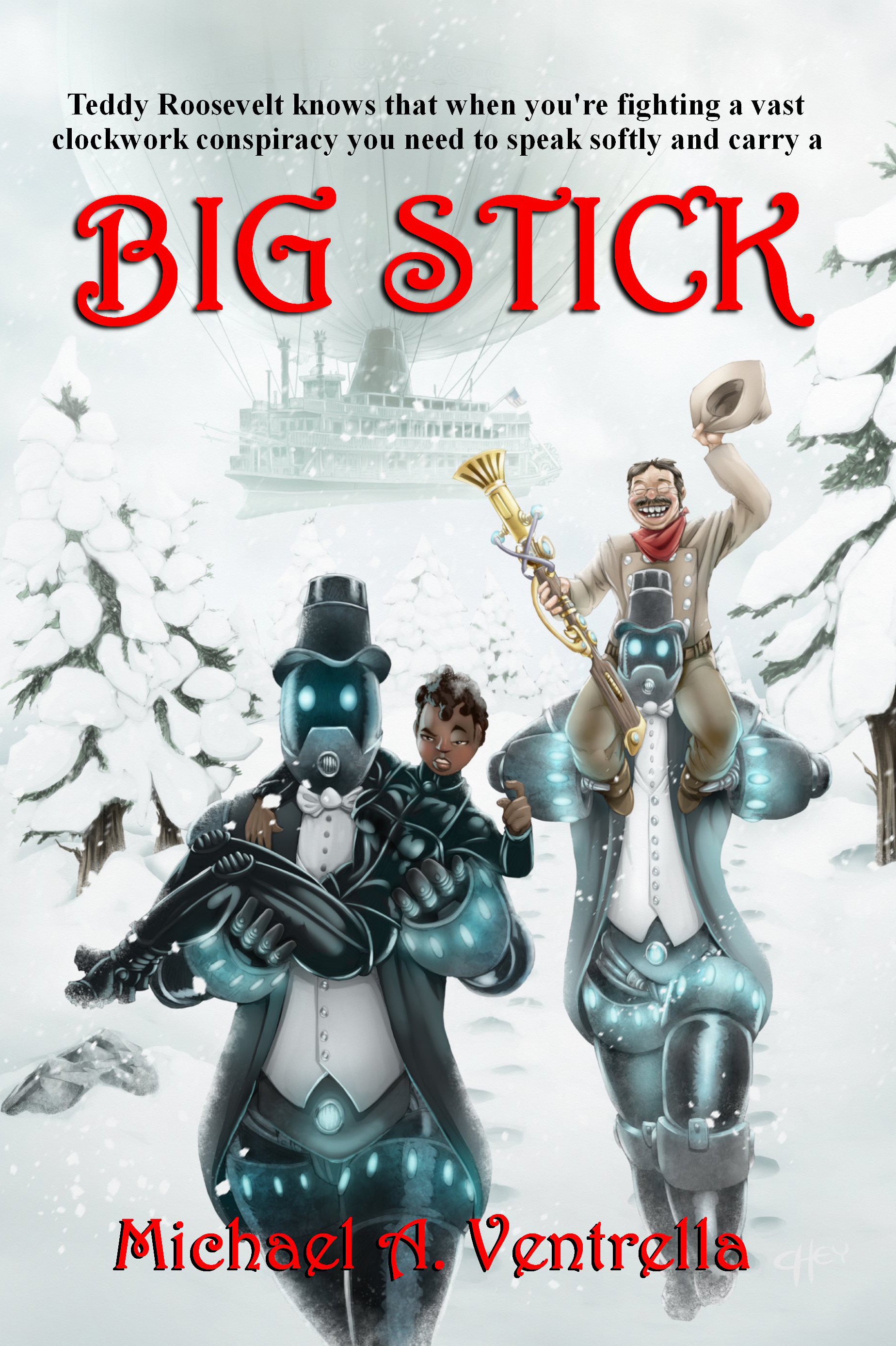
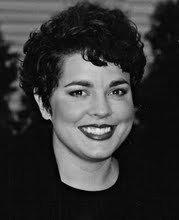
MICHAEL A. VENTRELLA: After last week’s blog about self-publishing, this week we have Kelly Jameson, a self-published author, to discuss her experiences. Kelly has two thrillers published, SHARDS OF SUMMER and DEAD ON.

Kelly, tell me about your books!

KELLY JAMESON: DEAD ON is the story of a medical examiner being stalked through different lifetimes by the same killer. History seems to be repeating itself. I set the story in Doylestown, PA because I grew up in the area. While the story is fictional, there are a lot of real-life places used in the book. I even put a body in the CB West football stadium. DEAD ON was film-optioned for two years by Gold Circle Films (they produced “White Noise” and “My Big Fat Greek Wedding”). It was also named Runner-Up in the 2006 DIY Los Angeles Book Festival. So I feel very fortunate and I think it shows that good things can happen with independently published books that you write and edit yourself. It is possible. In fact, when I was contacted by Gold Circle about movie rights via email, I almost fell out of my chair. The rights are back with me now and I’m working on a screenplay with another screenwriter on the script. We hope to have it completed by end of December and ready to pitch.
VENTRELLA: What’s your writing background?

JAMESON: I’ve wanted to be a writer since I was five years old. I used to write poetry all the time. Some of it was really bad. But that’s how you learn to be a writer—by writing. And reading.

I have a Journalism background. Got a degree from Bloomsburg University. I wanted to be a local sports reporter. Somehow I ended up a medical editor by day. Being an editor, editing my own books, has helped me to polish my indie novels and make them stand out.

VENTRELLA: How did you decide to write these books?

JAMESON: One of the characters in DEAD ON seemed to be tapping me on the shoulder and wanted to have her story told. That’s how it began. With a character and a “what if” situation. SHARDS OF SUMMER was really fun to write. I love the beach and Ocean City and wanted to write a story about lust, love, and obsession, about the wars going on inside each and every one of us every day. I like to write about flawed characters. The story starts with an elderly woman being arrested for the murder of a decorated WWII soldier on the beach 60 years ago. But of course, things aren’t as they seem … As a young woman, the main character was a dancer in a girlie show who got tangled up in an affair with a married homicide detective investigating murders in Ocean City.

VENTRELLA: How did you decide to self-publish?

JAMESON: I’m not very patient. The industry is a tough nut to crack and it seems to be changing on a daily basis. After a few positive rejections for DEAD ON, I followed my intuition and published it myself. I think that’s important in this biz—there’s more than one way to get your work out there and sometimes you just gotta take chances and do something.

VENTRELLA: Had you previously submitted your books to editors and publishers?

JAMESON: Yes. I even had an agent for eight months. However, when the recession hit, he pared his client list down and as a new writer, I was on my own again even though he thought my writing was excellent. I quickly became frustrated with the process. For my second novel, same thing. Got some positive rejections and some incoherent, nonsensical dismissals. It’s a very subjective biz. I decided to see if I could get it cookin’ myself … and fortunately I’ve had the support of established authors such as Ken Bruen (ONCE WERE COPS and GUARDS) who not only read SHARDS OF SUMMER but called it “THE GREAT GATSBY for the beach generation.” It’s so encouraging when a ‘new’ writer finds an established, best-selling author who is willing to read your material and blurb it. Jonathan Maberry says, “DEAD ON by Ann Kelly is a stunning first novel that blends ghostly happenings, romance, eroticism, time travel and intrigue into a genuine page-turner. The Ann Yang character (Bucks County, PA medical examiner) is particularly well-drawn, and the story builds nicely to a satisfying conclusion. I highly recommend it.” Kat Martin, NYT best-selling author says, “She’s a brilliant writer. No questions asked. She has a gift for the eerie. The words she chooses are absolutely brilliant. She has an incredible talent for stringing words together.”
If you like CSI meets the X-Files, you’ll probably like DEAD ON.

VENTRELLA: What do you see as the advantages of self-publishing?

JAMESON: You get to put the book out there pretty quickly and the way you want to. It’s fun to market it yourself, even on a limited budget. There are many local independent stores willing to help out. The Doylestown Bookshop sold 600 copies of DEAD ON so far! They’ve been really great. I think I’ve managed to sell about 2,000 copies of DEAD ON. I’ve read that a traditionally published first book has typical sales of 1,000. So I feel pretty good about my sales and I’d like to thank all my readers.

VENTRELLA: In my last blog, I made some comments about how there is a stigma against self-published books, even if they may be excellent. Do you agree?

JAMESON: I agree that a bias still exists against independently published novels but I think we are seeing some definite, and positive changes, in the publishing arena. I’ve had many positive experiences with my books. I don’t agree with the statement on your blog that “if you really want anyone else to consider you a real writer, avoid these things [self publishing companies] completely.” Of course most of us want to crack the traditional publishing nut and see our books at the front of bookstores everywhere.

Getting published traditionally is becoming more and more like winning the lottery. American publishing is basically averse to taking risks with new writers and tends to want to put everything in a box or a category. The ones who take a chance on multi-genre or slightly literary works still put out literary best sellers. It can happen. And I’m going to keep trying to crack the nut. I believe in my work 200% and I’m following my intuition in putting my books out there and marketing them. In fact, because of my first two novels, a small publisher who likes my style and storytelling approached me about writing a zombie novel and I just got the green light to write it based on my pitch! I’m also working on a new werewolf novel.

If you do publish yourself, investigate the companies. Some are vastly better than others and more fair. Ask other authors about their experiences. Look into the backgrounds of the companies…are there any complaints on the Internet about them? Are there glowing praises?

VENTRELLA:Did you hire an editor?

JAMESON: No … I’m an editor so I did it myself. But sometimes you don’t see things in your own work, so I also have fellow writers and family members who graciously read my work and comment.

VENTRELLA: Did your publisher provide the cover or was that your responsibility as well? Did you have any say in the decision?

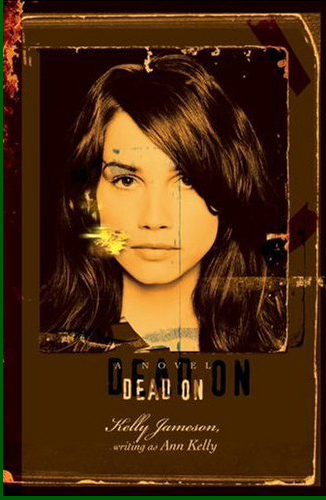
JAMESON: For DEAD ON, I gave iUniverse my idea and loved what they came back with. The front looks like sort of an old photograph that’s fading. The book goes back and forth in time between the present and the early 1900s and Ann Yang, the medical examiner, uses all her forensic skills as well as past life regression to solve the present-day crimes. I interviewed a past life regression specialist in Doylestown while writing the book and it was fascinating.
For SHARDS OF SUMMER, I did not go with the cover BookSurge provided because I felt it was too colorful and not right for the tone of the book. A designer from a small publisher helped me out and gave me a great cover, a dark mysterious cover that’s perfect for the book. I’m really pleased with it because I think it’s stunning. And covers are critical if you want readers to check out your book.

VENTRELLA: For those readers who would like to self-publish, what do you advise? How do you decide which company to go with and so on?

JAMESON: Do an Internet search. Keeping in mind your goals for the book, compare prices and services, percentage royalties paid, additional free services and distribution channels, and make a decision. Then go for it…and have fun with it. Don’t plan on making a whole lot of money. Plan on meeting lots of great people who are truly supportive of your work. Plan on making community connections. Plan on doing something that feeds your soul. Plan on your material maybe leading to other unexpected experiences, like trying your hand at screenwriting. Plan on meeting other authors and supporting each other. Set up your own local signings and write press releases and send to the local media.

I’ve also started writing short stories to practice things like dialogue and so far I’ve been published in The Summerset Review, The Mammoth Book of Best New Erotica 8 and 9, Dispatch Litareview, Amazon Shorts, Withersin Magazine, Barfing Frog Press, The Twisted Tongue, The Big Stupid Review, Ruthie’s Club, The American Drivel Review, sliptongue, ThugWorks and Ramble Underground. I have three shorts slated for publication in 2010 in Revenant magazine, TangledBank Press (Australian anthology) and Sex in the City (Paris edition).

VENTRELLA: What have you done to publicize the book?

JAMESON: For my first book, I did a lot of local signings, was interviewed by the Philadelphia Inquirer and other local newspapers, did some advertising myself (on a limited budget) and I’ve kept in touch with several hundred readers who ask for updates on my books and short stories, etc. I did co-op advertising with iUniverse and twelve authors were featured on a one page ad in the NY Times Book Review. That’s where Gold Circle saw my book and contacted iUniverse about the movie rights.

SHARDS OF SUMMER just went live on Amazon.com and so I will be setting up signings very soon. I hope to do some fun things and contests with beach glass because that’s a theme throughout the novel. I have a very limited budget so I’ll be peppering the media with news releases and hoping to do a few signings where the book is set, in Ocean City, New Jersey, too. I just set up a blog at http://kellyjameson.blogspot.com/. Hope you’ll keep in touch!

The Curse of Self-Publishing

These days many authors see an easy way to get published. Hook up with Lulu or Publish America and you too can have your own book! And look, it even gets listed on Amazon.com! It must be legit!

Well, if all you care about is having your novel available for your friends and family to buy, that’s a fine way to go. But if you really want anyone else to consider you a real writer, avoid these things completely.

Here’s a true example: Last year I went to a writer’s conference. It was the first I had ever attended and was not sure what to expect, but knew I could learn something. The conference had a number of guests who had published novels and more than a hundred participants who were, like me, there to learn and receive critiques. Quite a few of these people, I discovered, had already published their own books. One fellow was very proud of his Publish America novel.

On Sunday, they set up a question and answer period where the published authors would sit in front and discuss whatever the participants wished. I was honored when the organizers came to me and asked me to join in. The people with the Lulu books and the Publish America books were ignored completely. Even though my novel is with a relatively minor publishing house, the editors and writers who organized the conference considered it worthy.

After all, unlike these self-published books, mine had gone through the process and had been accepted. It had then been edited by a professional editor and I had worked with them to make changes. It showed a level of professionalism that the others did not.

And that’s the image you want, after all. Your work could be great, but if you publish it yourself, the message professionals get is that it was so bad that no one would publish it and that you were forced to put it out yourself.

Of course there are exceptions, which the self-publishing industry will point out as they try to get your business. There’s always that one-in-a-million time when a self-published book grabs the attention of the public and does well. Then there are the other 999,999 books that didn’t. You want to play the odds?

There are times when self-publishing works just fine. The books I edit for my live action role-playing game, for instance, are all self-published. However, I didn’t use a vanity press, because I wanted it to look more professional than that. I set up my own publishing company, paid for a bunch of ISBN numbers I could assign my books, and had them listed in Books in Print. Amazon sends me orders every now and then and Double Dragon (my publisher for the novels) has been distributing the e-book versions of them. But those are non-fiction rule books geared to a small but significant audience. They’re not the kind of thing you’d necessarily find in your local book store. If you’re pushing a novel, that’s not the way to go.

So don’t give up. There are publishers out there who might just love your book, but you may have to take a very long time to find them. And if you get absolutely nothing but rejection letters, maybe your book needs some more work. Maybe it shouldn’t be published yet.

Even by you.

My Turn to be Interviewed

The gaming web site Altern8 interviews me this week. Part one is mostly about my LARP game, and part two is primarily about the novels.

Part one

Part two

Philcon this weekend!

I’ll be one of the guests at the Philcon science fiction convention this weekend. I’ll be hosting a few panels and being a guest on others, so if you’re going to be there, please stop by and say hello.

The Philcon web page is here.

Other writer guests include (but are not limited to):

Catherine Asaro
Keith R.A. DeCandido
Genevieve Iseult Eldredge
Gregory Frost
Walter Hunt
Jonathan Maberry
Gail Z. Martin
Bernie Mojzes

Interview with Jay Lake

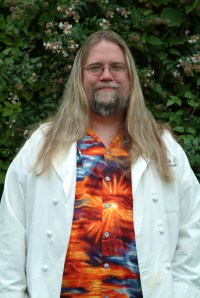
MICHAEL A. VENTRELLA: I’m pleased to be interviewing Jay Lake today. Jay is a winner of the John W. Campbell Award for Best New Writer in Science Fiction, and has been nominated for numerous Hugo awards and World Fantasy awards. His web page is here.

JAY LAKE: Michael, thank you for having me here. I’m very glad to be sharing my experiences with your readers.jay-lake_author-photo_Tor

VENTRELLA: Jay, how did you get started in the business?

LAKE: I began with short stories. Sold my first story in the spring of 2001, and two more that year. Sold about a dozen stories in 2002. Since then it’s been a big part of my writing practice. Did that for a while, all the way through earning the Campbell nod in 2004, before I got traction on novels.

That’s not to say that short fiction is the way everyone should enter the field. In some ways, novels are easier to sell. And if one wants to write novels, one certainly should. Don’t force short fiction because someone like me said it was the path.

VENTRELLA: You’ve placed a few short stories on your web page for free; do you advise this approach for new authors trying to establish themselves?

LAKE: In my case, the stories on my Web page are either Web reprints of older stories that have been in print already, or occasional one-shots of short pieces that for some reason I didn’t feel were what I wanted to market.

For a newer writer, the appeal of a “free sample” approach can be powerful, but I’m not certain of its value. You’re an unproven quantity until you’ve passed through the gateway of an editorial proxy. And most of us don’t have a good sense of the quality of our own writing. Posting something that you and the world would later see as sophomore work migh be iffy. On the other hand, I’m all about being proud of who you are.

VENTRELLA: What are the legal and contractual limitations of doing so?

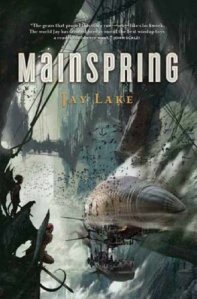
LAKE: Well, the primary issue is first rights. I’m not an attorney, and I don’t play one on the Internet, so this is not legal advice. But it is common sense advice. If you don’t already know how copyrights work, learn.books_mainspring

Basically, a copyright is a piece of property. You rent it out but you rarely if ever sell it. Each of those rentals is done by licensing a right. The rights are not explicitly defined in law. The rights themselves are defined on a case-by-case basis in each contract, and generally include such things as print rights, audio rights, electronic rights, ebook rights, gaming rights, film rights and so forth.

The first time a work is published is considered to be “First Rights”. While electronic publishing (e, appearing on a Web site) does not in fact expire the first print rights, most editors will view any prior publication as a first rights usage. So if you put someting on your Web site, you’re making it unlikely that anyone will be willing to buy it later for professional publication.

Note that aspiring writers are often concerned about protecting their ideas, or having their work stolen. While this can be an issue in Hollywood, it is rarely an issue in print fiction (defining “print” fairly loosely to include online, ebooks, and so forth). The reason that this is rarely an issue is that ideas are the easiest part of the process. Why would anyone need to steal your ideas when they can make their own?

Think about it. You write a fantasy about a quest through a magical kingdom by a mixed band of adventurers. Is that such an original idea that you’d be harmed by someone else writing such a book? There are already thousands of them in the market, an entire subgenre’s worth. Your fantasy includes a dwarf werewolf named Yoni who has a crippled foot from a sliver of moonsilver embedded in the sole when the wizard bar-Simon was assassinated by the Carmine Council. Is that such an original idea that you couldn’t make up another one just as good in the same ten seconds it took me to write that sentence? And probably better?

Short of outright plagiarism, which is quite rare for us, theft isn’t much of an issue. Where it does occur is in the area of unauthorized reprints, and ebook piracy, and those are largely concerns of established writers. To be blunt, if you have such problems it will be because you’re already succeeding.

VENTRELLA: All authors these days spend a large amount of time on self-promotion, from posting a regular blog to producing podcasts to appearing at conventions. What’s your opinion on the relative value of each?

LAKE: Writers write, first and foremost. The rest of it is just marketing, of little value if you have nothing to market, and of not much more value if you do it at the expense of further writing.

That being said, I’m a fan of doing anything to raise your profile and build your brand among readers, editors, reviewers and critics. But only if whatever you’re doing is fun for you, and more importantly, fun for the people who encounter you. In a professional sense, it’s not entertaining to read about your cat’s trip to the vet, or how many smoothies you made for breakfast this week. Likewise sitting around a convention bar griping about how your landlords keep screwing you on security deposits. But, if you can be relevant, or entertainingly tangential, in your blog or podcast or convention persona, you have a hook.

Plenty of people have done this. Mur Lafferty has made a niche for herself with her “I Should Be Writing” podcasts. I have my noisy-fat-guy-in-loud-shirt persona I wear around at cons. (And honestly, in real life, too.) Jim Van Pelt used to run a Campbell Awards Web site. Jeremiah Tolbert edited “Fortean Bureau”, and now “Escape Pod”. All of us did so while building our presence as writers. But we’re all having fun doing what we’re doing, and fun is contagious.

Doing something because you “should” is the kiss of death in this business. There are some exceptions: You “should” use standard manuscript format. You “should” enclose a SASE with postal submissions. You “should” read your contracts carefully before you sign them.

But in self-promotion, there really aren’t “shoulds”, there are only “coulds”.

Take me. I’m a demon blogger. I use my blog, across both LiveJournal and WordPress, with feeds to Twitter and Facebook, to talk about a number of things that interest me. I have regular content on a daily basis, special features several times a week, and continuing series about certain topics, such as my kid, writing processes and my journies through cancer. Some people read me for my strong leftie politics, some can’t stand that but read me for the daily round up of culture and science links. Some people follow me because they’re fans of my kid. Some people follow me for my fiction alone. I offer a range of content, all of which is interesting and engaging to me.

On the other hand, I’ve tried podcasting. It bores me. I don’t do podcasts much at all, because I can’t make them interesting enough, because they don’t interest me. If you like audio production, and expressing yourself through that medium, and have a lot to say, by all means, it’s a growing area. I’m probably missing out by not doing it myself. But it just doesn’t work for me.0765317095.02.LZZZZZZZ

As for conventions, I am of the first belief that one can have an entire highly successful career in this field and never set foot inside a convention. At the same time, writing is by its very nature a solitary act, and conventions are one of the few frameworks where we authors get to interact face-to-face with our peers, our editors and agents, and most importantly, our fans. If your social skills are on the outliers of the bell curve, this may not be the venue for you. Likewise if you are so introverted that groups of strangers are literally painful for you. (Both of those are true of many writers.) But if you can be personable and engaging and enjoy yourself, they’re a hell of an opportunity for networking.

VENTRELLA: How important is the social media (Facebook, Linked in, My Space and so on)?

LAKE: Ask me in five or ten years. Five or ten years ago, I couldn’t have given you a reasonable answer about how blogs would work out. I can tell you that far more people read my Twitter feed every day than read my blog directly, and that I have about as many Facebook friends as blog followers. I can also tell you that my Facebook feed gets more comments than my blog feed, at least most of the time. But the nuances of that? And the long-term value? No clue. Not yet. I do it becaus it’s fun, and because those are places where I can interact with people.

VENTRELLA: What trends in current genre literature do you hate? What vents your proverbial spleen these days?

LAKE: Enough with the vampires already. And I can rant for hours about how most magic systems violate Newton’s laws, as well as the basic rules of economics. But really? Not much hating going on. Taste, yes. I refuse to read TWILIGHT. But millions have read and loved that book and its sequels. I can’t hate on anything that gets people to look at print literature.

VENTRELLA: Who do you love to read? Who has inspired your work?

LAKE: Gene Wolfe. Ursula K. LeGuin. Jeff VanderMeer. Lois McMaster Bujold. Jeffrey Ford. K.J.Bishop. M. John Harrison. Terry Pratchett. Maureen McHugh. And so on and so on and so on. Our field is full of marvelous writers working from every direction, every theme, every plot.

VENTRELLA: Of what work are you most proud?

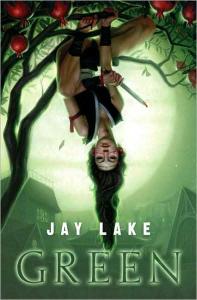
LAKE: That’s like asking me of which child I am the most proud. (Admittedly, I only have one child, so that question is not so hard to answer.) I suppose I’d point your readers to my latest Tor book, GREEN. It’s a coming of age story set in a secondary fantasy world, about a girl sold into slavery at a very young age who is trained to be a courtesan, while secretly being countertrained to assassinate the man she is intended for, a powerful Duke. green-jay-lake-largeShe rebels against both fates, tries to go back to the land of her birth, and makes a mess of a great many things before being forced to save a city, some lives, and even a god or two, in the course of repairing those messes. It’s courtly fantasy, with sex and violence and cityscapes, though not so much with the magic.
I wrote the book for and about my daughter, very much drawing from her character to build Green, the protagonist. Getting inside the head of a young girl of color with Green’s peculiar history was quite a stretch for me as a writer, but so far the readers have loved it. I hope you will, too.

VENTRELLA: What’s your opinion on self-publishing? Do you advise new authors to go this route, or is it better to not publish at all than to be self-published?

LAKE: I share the rather strong tic again self-publishing which can be found among the community of professional writers. Especially for aspiring or early career writers.

Here’s the simple reason. You don’t have any real idea how good your work is, or what its flaws are. Nobody does, especially not early on. That’s what editors are for.

I’ve been publishing professionally for almost a decade, and I’m only beginning to see it in my own work. That story of yours that is brilliant, better than anything you’ve seen in print this year? Maybe it is, maybe it isn’t. But you’re not likely to be able to judge that.

What the self-publishing route does is three things. It allows you to commit work to print that you will quite likely later come to question the wisdom of. If the work is as good as you believe, you’ve lost the ability to sell first rights by self-publishing. And it will reduce your standing in the eyes of professionals in the field, especially editors.

Note that for some purposes, self-publishing is a brilliant tool. Family histories, local interest cookbooks, private editions for a holiday gift, etc. But as a success path for commercial fiction? Not so much. And yes, there’s always a story about this author or that who got a huge contract after a self-published success, but no one ever tells you how many people didn’t.

Remember, editors and agents aren’t out to publish their friends, or suppress new talent, or any of the other things you hear people grumble about it. Quite the opposite. They want nothing more than to find hot new talent, and be the one to bring the work, and the author to market. And they do have an idea of how good work is, and what will succeed in the market.

Publishing is a meritocracy, but it’s not a just meritocracy. Nothing is ever quite fair or sensible. But if you want the credibility and impact of being commercially published, you need to follow the routes that work to enter commercial publication. And yes, it’s a game whose rules change all the time. So far, the rules haven’t changed to include self-publishing as a strongly valid option.

VENTRELLA: You’ve blogged about your fight with cancer. (As my wife is a cancer survivor, I certainly can relate in some small way.) How do you think this will affect your future writing?

LAKE: Cancer will indelibly affect my future writing. It already has. My voice, my themes, my view of myself and the world have been bent in a new direction. Not one I would ever wish on anyone, least of all myself, but there’s a lot of passion, power and pain in cancer. As I write this, I’m two weeks from surgery to remove a metastatic tumor from my lung. Second trip through the cancer mill. Believe me, I have learned new lessons in fear and terror, but I have also learned new lessons in hope, glory and blinding love.

That cannot help but change everything. Once again, I won’t know how til years down the road.

VENTRELLA: What advice do you wish someone had given you when you first began trying to break into the business?

LAKE: Really, I got plenty of good advice. I mostly wish I’d taken more of it.

I think most aspiring writers go through phases. One phase is “I’m an undiscovered genius”, and it’s characterized by a lot of hot pride. Another phase is “publishing is a conspiracy”, characterized by fear and resentment. Another phase is “I suck, and I’ll never make it”. You get the drift.

Each of those phases brings with it a certain wilful deafness. I wish, when I’d been in those phases, that some future me, or someone wise enough to speak in a way that got past my defenses, had simply said, “Shut up and write.”

Because “get back writing, then write more” is the only real advice.

In fact, it’s what I’m going to do right now. Thank you.

Interview with Chris Redding

MICHAEL A. VENTRELLA: Chris Redding primarily writes romance fiction. In 2004, Wings Press published her first romantic suspense book titled THE DRINKING GAME. ChrisRedding In 2007, Enspiren Press published her next book CORPSE WHISPERER, a paranormal romantic suspense book. Her third is soon to be published. She also teaches courses in writing and is active in the writers’ group “Liberty States Fiction Writers.” Her web page is here.
Chris, When writing romance, what are the key elements that you believe need to be present?

CHRIS REDDING: You must have a hero, a heroine and a happy ending. There must be some reason in the beginning that they cannot be together and both of them must overcome the obstacles by the end of the book for that happily ever after. Both can be flawed, but they can’t be unlikable. They can’t be mean or cruel. Lastly, the motivation for their actions must be clear.

VENTRELLA: Have you had any formal writing training? Do you think that is necessary?

REDDING: I have a BA in Journalism from Penn State though that should not have prepared me for writing fiction! And if it did my professors would be mortified. Other than that I’ve been to conferences and participated in workshops for ten years. Not sure if you’d consider that formal or not. I don’t think you need a degree in writing to write. You do need to be educated about the business of writing. You also need to know about the genre you write in. There are guidelines you must adhere to for each.

VENTRELLA: You have two books published so far, with two different publishers. How did that come about?

REDDING: With smaller publishers coming and going, I did not want to put all my books in the same place. One of my fellow writers in a group I was in at the time raved about Wings. She was so happy there that it was infectious. And they accepted my first book THE DRINKING GAME which came out in 2004. Then a few years later I heard a small Canadian publisher, Enspiren, was looking for submissions. They accepted my second book, CORPSE WHISPERER, which was released in 2007.corpse

VENTRELLA: How did you end up with your current publisher?

REDDING: My next book will be out with LBF books in the Spring of 2010. I pitched INCENDIARY to them in 2008 at a conference I attended. I feel each step has been a step up in terms of my career. That’s why I’ve chosen each publisher.

VENTRELLA: Would you advise beginning writers to contact them, or are they fairly specialized?

REDDING: Enspiren is more a boutique publisher. Wings and LBF Books accept more genres and publish more books each year. They would be more what a new author is looking for.

VENTRELLA: What’s your opinion on self-publishing?

REDDING: I think it has its place. I haven’t read many self-published books so I really can’t speak to their quality or lack of. It just never seemed the way to go for me. I think you must have already established outlets I which to sell your books. I don’t so I never saw it as a good fit.

VENTRELLA: What’s next? What are you working on now?

REDDING: I’m working on a novella about an angel who investigates crimes. It’s for a call for submission by a specific publisher. With my critique group I am working on a romantic comedy I hope to pitch at a conference in March. My edits for Incendiary will arrive at the end of November so all that will be on hold until they get done.

VENTRELLA: Have you ever considered writing in any other genre?

REDDING: I have been approached by a former co-worker to co-write a children’s picture book with her. I’ve also written a book geared towards the early elementary grades. It’s a chapter book about a pencil monster. I haven’t really done anything with it. If you want a short answer, yes, but I read mostly thrillers, mysteries and suspense so I’m most comfortable with those genres.

VENTRELLA: What is your writing style? Do you tend to rely on outlines first or do you just plow right in?

REDDING: I plow right in. A true pantser. The only things I need to start are the names of the characters, the title of the book, and maybe the conflict they have. I trust that the words will be there when I sit down. And they always are. drinkingThey aren’t always the best words, but that’s what revising is for.

VENTRELLA: What was your biggest mistake so far in trying to make it as an author?

REDDING: I listened to two people at the very beginning and they led me astray. Not on purpose. I think they had the best of intentions, but they didn’t know as much as I thought they did. Neither is published at this point so I was lucky to find some more knowledgeable writers to take advice from.

VENTRELLA: Do you have any specific advice you would give a writer trying to make it in the publishing business that they may not have heard before?

REDDING: Besides being wealthy so you can buy a publisher? Uh, no that won’t work. You need to have a realistic belief in yourself. What do I mean by realistic? I’m 5’ 2” tall. I’d never make it as a professional basketball player. That’s realistic. What I do know, is that any time I needed to write something to test out of a class in school, I succeeded, including freshman English in college. Does that mean I know everything? No, It means I have a good base to build on.

Thanks for having me on your blog, Michael!

Interview with Gail Z. Martin

MICHAEL A. VENTRELLA: I’m pleased to be interviewing Gail Z. Martin today. Gail is the author of The Chronicles of The Necromancer series. The books are available in your favorite bookstore, as ebooks from my publisher Double Dragon, and will be released as audiobooks by Audible.com soon. 0061-eWomenNetwork She is also host of the Ghost in the Machine Fantasy Podcast, and you can find her on MySpace, Facebook and Twitter. She enjoys attending science fiction/fantasy conventions, Renaissance fairs and living history sites. Her web page is here.

Gail, tell me about your fantasy series The Chronicles of the Necromancer.

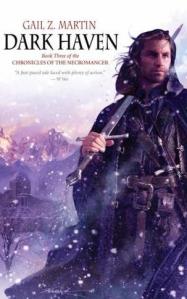
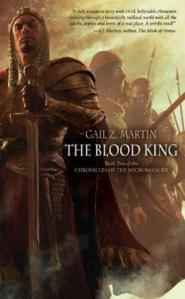
GAIL MARTIN: The Chronicles of the Necromancer series includes four books so far: THE SUMMONER, THE BLOOD KING, DARK HAVEN and DARK LADY’S CHOSEN. The story begins when a young man’s family is murdered, and he discovers that he is heir to a very rare type of magic, the ability to intercede between the living and the dead. He needs to learn to control that magic before it destroys him in order to avenge his family. I’ve really written two two-book sets. The Summoner and The Blood King are one story arc, and then a new story arc with the characters picks up in Dark Haven and Dark Lady’s Chosen.

VENTRELLA: Do you have a set number of books planned for this series?

MARTIN: Well, I’ve given my publisher abstracts for about 20 books I’d like to write, so we’ll see! There are two exciting pieces of news about the series. First, DARK LADY’S CHOSEN comes out December 29, and it will launch as a paperback, an ebook and an audiobook. And second, Orbit Books has picked up the next four books. The Fallen Kings Cycle is the name of the new series, and it will pick up after DARK LADY’S CHOSEN. I’m already working on Book One: THE SWORN.

VENTRELLA: Do you plan the entire series in detail or do you do one book at a time?

MARTIN: A little of both. I have a pretty clear idea of the full story arc and the arc for each major character. And I’ve given my publisher abstracts for quite a few other books set in the world of the Winter Kingdoms. And my publisher asks me to turn in a chapter-by-chapter outline before each book. That said, things do arise as I’m writing that often changes the way I saw things unfolding. Usually not a change to the ultimate outcome, but changes in how things go along the way. So the overview and outlines help, but the story develops on its own as we go along.

VENTRELLA: How did you become published? Did you obtain an agent first?

MARTIN: Yes, I did get an agent first. I really didn’t have time to work, write and shop my manuscript, and I knew that fewer and fewer large publishing houses accept unagented submissions. Having an agent has been very important, especially when it comes to negotiating contracts and understanding what options exist. A good agent is also valuable for negotiating translation sales and other contracts, such as ebooks and audiobooks.

VENTRELLA: Do you think you will ever write in another genre?

MARTIN: Well, I have the first book in a new nonfiction series for writers coming out in January, THE THRIFTY AUTHOR’S GUIDE TO LAUNCHING YOUR BOOK WITHOUT LOSING YOUR MIND. Dark HavenIt’s a book on book marketing for authors who want to make sure readers find out about their books! And as far as fiction goes, I do have some ideas I’m developing, but they’re not ready for prime time yet!

VENTRELLA: I keep hearing that publishers are not that interested any more in traditional high fantasy. As a writer in that genre myself, I am worried. Do you find this to be the case?

MARTIN: I think the more important question to ask is, “Are readers interested in traditional high fantasy?” From my experience, I would say yes. So long as there are readers who want a certain genre, there will either be publishers who will supply it or authors will meet the demand directly by self-publishing. My bet is that so long as publishers sense there is money to be made in a genre, they will keep publishing it.

VENTRELLA: What’s your opinion on self-publishing? Do you advise new authors to go this route, or is it better to not publish at all than to be self-published?

MARTIN: I think it’s easier to succeed with nonfiction in self-publishing than fiction because most nonfiction authors have the opportunity to sell from the “back of the room” at workshops, speaking engagements, etc. Also, if nonfiction meets a need and creates a benefit, people buy it, regardless of who publishes it. Fiction is a little harder, because it doesn’t have that clear need/benefit link. With fiction, distribution through bookstores and online booksellers is still crucial, and that can be more difficult if you’re self-published.

On the other hand, a good book will find a market. THE SHACK was a self-published book that couldn’t get a publisher until it sold a gazillion copies and then was picked up by a big publishing house. If you decide to self-publish, you’ll have to work twice as hard on distribution, personal appearances, being a vendor at conventions and basic selling. But if you believe in your book, then you do what you have to do to bring it to life. I would probably advise authors to exhaust their options for traditional publishing with large and small publishers before self-publishing fiction, but I’m sure there are other authors who feel differently and that’s OK. Even when you’re traditionally published, there is a lot of work that goes into promoting the book.

VENTRELLA: Gail, you are one of the most active authors when it comes to publicity and promotion, because of your background. While it is clear that published authors must promote themselves, do you think it is appropriate for unpublished authors to maintain a web presence and otherwise promote themselves, and if so, how can that be done tastefully and effectively?

MARTIN: I think part of that depends on your definition of “unpublished.” If you post your short stories on your web site, that is a form of publishing. If you release your book as a podiobook, that’s a form of publishing.

I think you always have to be clear about what it is you’re promoting. thesummonerSome authors, like J.C. Hutchins, started out by releasing free podiobook versions of their stories and gathered so many readers/listeners that they ended up getting a book contract with a traditional publisher. So think first about what your goal is in promotion yourself and what you have to promote. If you write an entertaining blog, host a good podcast or even create an online serial that gets good buzz, you may attract a publisher.
VENTRELLA: You and I run across each other at conventions often and you attend many more than I do. Please tell us why you think attending these is important, and whether you think they are important even for unpublished authors.

MARTIN: Cons are important because they’re a great way for authors to meet other authors and of course, to meet readers. Today’s readers like to meet the authors of the books they read, just like they enjoy connecting online and on social media. It’s also a great way to attract new readers who may decide to try your books because they liked what you said on a panel, had a good chat with you in the lounge or came to a reading and liked what they heard.

For unpublished authors, cons can be great places to meet published authors and get advice. Lots of cons have writing and publishing tracks where there are panels with editors, agents and publishers, or with authors talking about the business and mechanics of writing. It’s a great free education. I definitely think it’s worth it.

VENTRELLA: What advice do you wish someone had given you when you first began trying to break into the business?

MARTIN: Expect to spend twice as much effort promoting the book as it took to write it. blood_king_med_coverRealize that if you don’t promote the book and you don’t sell well, you don’t get invited to write a second book.
VENTRELLA: Can you think of a personal anecdote about the writing life you’d like to share?

MARTIN: Going on book tour really does require you to check your ego at the door. You spend a lot of time driving around, setting up table displays and schlepping your stuff from store to store. No matter how many big signs in the store have your photo on them, inevitably more than one person will ask you where the bathroom is or where somebody else’s book is shelved because they just assume you work there. Smile. It’s all part of being an author, and it’s worth every moment. But just to be safe, make sure you really can direct people to the bathrooms!

VENTRELLA: You’ve got audio and excerpts from DARK LADY’S CHOSEN online, plus there are other sites participating in your Days of the Dead blog tour. Where can we find all the goodies?

MARTIN: Check out my site at www.ChroniclesOfTheNecromancer.com, for all the downloads and more Days of the Dead stuff. Also, please find me on Twitter.com as GailZMartin and on Facebook and MySpace as well.

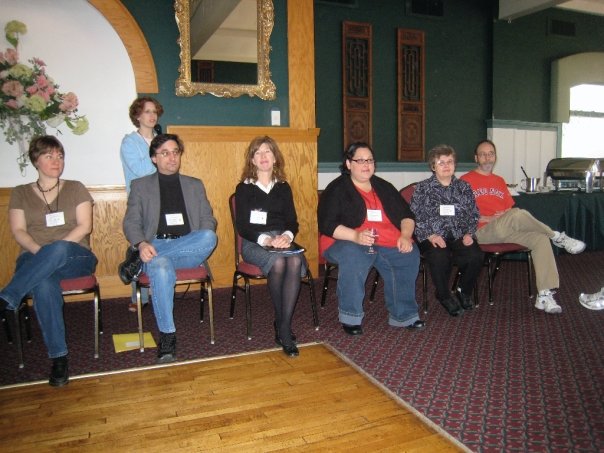
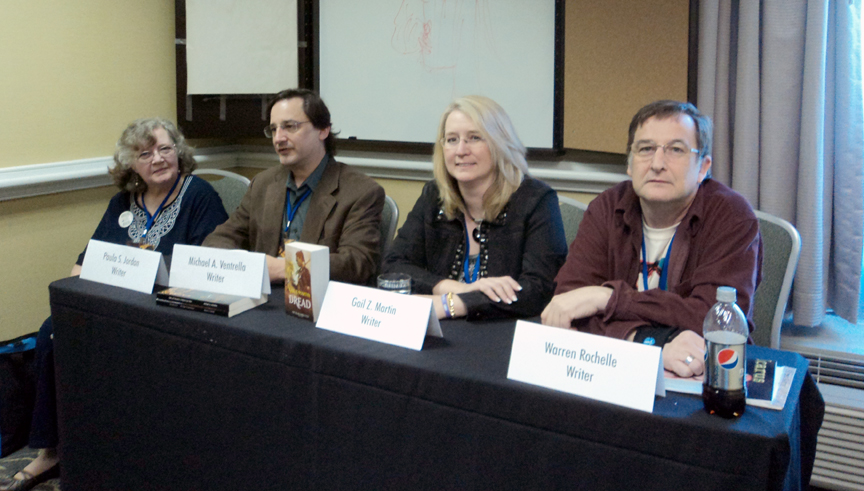
Me and Gail Z. Martin on a convention panel

Interview with Nebula Award Winning Author James Morrow

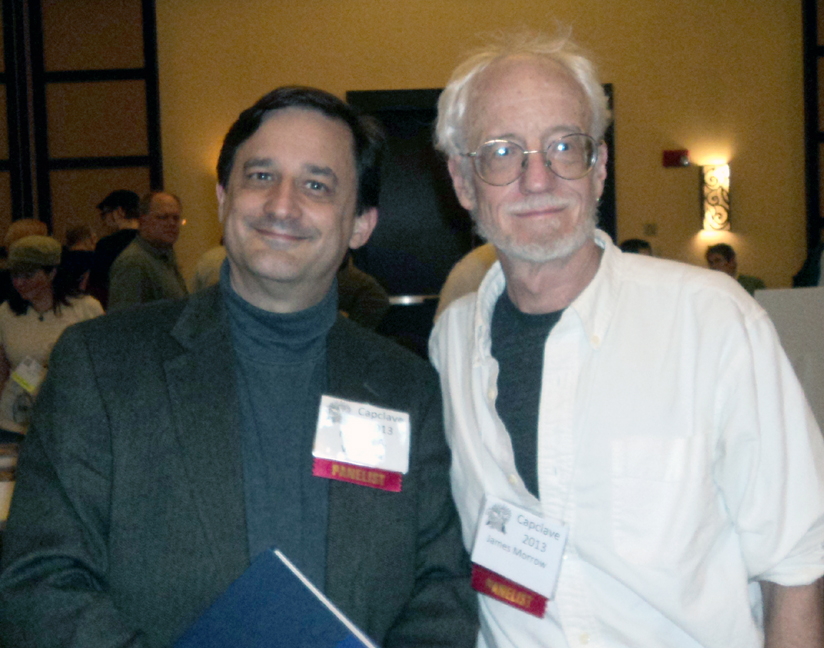
MICHAEL A. VENTRELLA: Years ago, a friend pushed the World Fantasy Award-winning novel TOWING JEHOVAH on me, and it sounded fascinating. Being a typical writer/reader, I always have dozens of books on my “Have to Read and Will Get Around to Some Day” pile. James Morrow_PhotoCredit Didier LeclercAtelier N89JEHOVAH jumped to the top of the list after I had the pleasure of meeting James Morrow at Worldcon in Montreal a few months ago as we both patiently waited in line for substandard Canadian coffee. It was as good as had been recommended (the book, not the coffee), and now I have the two sequels next in line on my “Have to Read” pile.

James Morrow is a graduate of Harvard and the University of Pennsylvania (not necessarily in that order) and has won acclaim for a variety of fantastic novels which weave together religion, politics, and philosophy. A Nebula-award winner, Morrow continues to challenge and entertain. His web page is here.

James, thanks for taking the time! It is obvious that much of your work concerns religion, from the Godhead Trilogy to ONLY BEGOTTEN DAUGHTER. What do you find in this subject that makes it so desirable?

JAMES MORROW: Every day, I wake up and I say to myself, “How extraordinary! Here I am, James Morrow, thrown into a world in which the vast majority of bipedal beings believe in benign supernatural intervention, and I don’t buy one bit of it! What’s going on here? Why am I totally at odds with most of my fellow thinking primates? How could such a large majority of humans, many of them brighter and better traveled than I, subscribe to a world-picture that is manifestly not the case? How can they imagine that the Bible enjoys a divine origin, when so much of it bespeaks our pettiest impulses? How can they not see the bankruptcy of the benevolent-God hypothesis? Why will they not face the probability that all deities are human inventions?

This paradoxical state of affairs variously confounds, amuses, saddens, frustrates, and infuriates me — but mostly it gives me the energy to create my stories and novels. I’ve been accused of writing primarily out of anger, but I believe I’m more bewildered than bitter. My bedrock perplexity seems to make for compelling fictive thought experiments, or so my more sympathetic readers tell me. towingEvidently God put me here to argue against His existence.

VENTRELLA: Have you faced any censorship or protests because of these works?

MORROW: No serious protests. Occasionally I’ll receive an e-mail from a Christian conservative who, having blundered into my website, is concerned about the status of my salvation. Normally this correspondent will prescribe a verse or two from Saint Paul, but sometimes he’ll glibly inform me that I’m going to Hell.

VENTRELLA: Are you disappointed?

You’ve actually struck a nerve here, Michael. Like all novelists, I’m a bit of a narcissist: I think my readership should be significantly larger. So, yes, I am indeed disappointed that Ralph Reed or the Vatican has not yet come gunning for me.

VENTRELLA: What was interesting to me after reading TOWING JEHOVAH was that the truth of the matter was just accepted; the novel does not disavow the Christian God nor does it satirize Him, but it certainly looks at Him in a new way. Had earlier versions and drafts taken a different approach?

MORROW: I’m glad you found that novel to be relatively nonpolemical. Preaching is the death of fiction. When I embarked on the thought experiment that became TOWING JEHOVAH, I wasn’t sure where I was going, and I was pleased to be surprised by many of the scenes that emerged from my pen. A literal pen: that particular novel was initially written in longhand.

At the start of the project, I didn’t realize TOWING JEHOVAH would give me a chance to satirize my own worldview in the form of the Central Park West Enlightenment League. Nor did I foresee the weirdly reverent tone of the inverse-Eucharist scene, in which the starving supertanker crew survives a famine by eating God’s deconsecrated flesh. And Neil Weisinger’s search for the En sof is also supposed to be taken at face value. I guess you could call TOWING JEHOVAH a novel by an atheist who’s trying to empathize — up to a point — with people of faith.

VENTRELLA: In TOWING JEHOVAH, a message is that “enlightenment” isn’t always truthful. The church wants to hide the truth in its own interest. The atheists, represented by the Central Park West Enlightenment League, also want to hide the truth for their own interest. Deceit is not something to be admired on either side, but in the sequels, the consequences of the truth are severe. Do you believe that it is sometimes better to not know the truth?

MORROW: As an equal opportunity satirist, I wanted to suggest that any group that would style itself the Central Park West Enlightenment League might very well — at the end of the day and faced with an apocalyptic challenge — decline to embrace a body of data that contradicted its worldview.18281941 When you’re in the business of fashioning sardonic comedies, nothing is sacred, not even atheism. My sympathies lie almost entirely with my secular brethren, but in a crisis I suspect that most of us would behave as mere feeble and fallible humans, not as courageous avatars of the truth.

Truth is a sticky commodity. The physical sciences long ago figured out that they can get by perfectly well without making grandiose truth claims (merely predictions based on theories), but philosophy and religion and the arts don’t have that option. Like the Ibsen of THE WILD DUCK and the O’Neill of THE ICEMAN COMETH, I can certainly imagine situations where the truth proved fundamentally destructive, and I was indeed playing with that idea in the Godhead Trilogy — though I ultimately come down on the side of truth-telling, as I also did in my novella CITY OF TRUTH.

Offhand, I can think of no greater sin than to consciously lie to a child, which is why I’m impatient with many conservative Christians, whose God is evidently so feeble that He can be sustained only through falsehoods systematically advanced on His behalf — falsehoods about the alleged evangelical foundations of the American republic, falsehoods about Darwin’s theory of natural selection, falsehoods about the blatant anti-Semitism of the Gospels, falsehoods about priestly sexual misconduct, and so on. As the saying goes, you can have your own opinions, but you can’t have your own facts.

VENTRELLA: Was the series planned in advance or did you decide to write the sequels after the first was completed?

MORROW: Based on some preliminary TOWING JEHOVAH chapters and an outline, I managed to convince Harcourt Brace to sign up for the whole trilogy. Needless to day, all three finished manuscripts departed radically from my original plan. BLAMELESS IN ABADDON was initially titled TERRA INCOGNITA, and the outline was more concerned with the trip through God’s brain, with the Trial of the Millennium functioning merely as a denouement. My first sketch for THE ETERNAL FOOTMAN had the characters searching for the Holy Grail. Eventually their quest leads them to a divine bedpan, an idea I rejected as sophomoric even by my standards.

VENTRELLA: What sort of research do you do for your novels, especially when discussing areas in which you may not be trained?

MORROW: For better or worse, the advent of Google has made the task of research 100 percent easier than in days gone by. I say “or worse” because I believe there was something vaguely romantic and even heroic about the novelist’s quest for the sort of quirky facts and period details that can bring a scene to life. But today these gritty particulars are available at the stroke of a key. It feels like cheating.

I like to say, “First I write the novel, then I do the research.” That remark is not entirely facetious. In the case of my novel-in-progress, an epic about the coming of the Darwinian worldview, I’ve already written scenes set at Darwin’s estate and on the Galapagos archipelago. I intend to visit both sites before putting the book to bed: in my experience such on-the-ground investigations can enrich a novel immeasurably — and yet the present drafts are not entirely lacking in credibility, and I could probably get away with simply claiming I’d done the primary research.

VENTRELLA: How did your education affect your writing? (As an aside, do you miss Boston? I went there for law school and loved it…)
apprentice-us
MORROW: Boston is a terrific city, commensurate in my affections with New York, Paris, and London. My days at the Harvard Graduate School of Education particularly paid off in my recent novel called THE PHILOSOPHER’S APPRENTICE, in which a philosophy student is hired to implant a conscience in an adolescent clone. When I was at Harvard, everyone was excited about Lawrence Kohlberg’s profile of children’s moral development. I ended up keying Londa Sabacthani’s education to the famous Kohlbergian dilemmas.

VENTRELLA: Do you tend to think of the story first, or a concept that will lead to a story? It seems that much of your work involves interesting questions of religion and philosophy that lead to a “what if?” scenario…

MORROW: Although most novelists, myself included, want to reach the reader at an emotional level, I believe that fiction writing is primarily an intellectual process. When a scene isn’t working, the problem is not that you’re failing to channel some cosmic Muse from a transcendent plane of reality — the problem is that you’re not thinking hard enough.

I couldn’t imagine beginning a novel or short story without an audacious premise in mind. Many writers evidently work in a completely different fashion. They’re happy to start with a memorable character, a vivid setting, a personal theme, or an intriguing initial situation, with the overarching concept emerging only during the composition process.

VENTRELLA: What do you know now about the publishing industry that you wish you had known when you first started out?

MORROW: My career was launched in a fashion that I took to be ideal: hardcover publication by a major New York house — to wit, the edition of THE WINE OF VIOLENCE that issued from Holt, Rinehart and Winston in 1981. I gradually came to realize that such an achievement, while not an occasion for sneezes, is by no means synonymous with having a career. I had not found the Holy Grail after all.

It took me awhile to figure this out, but unless the publisher is really behind you, with a fired-up sales force, a serious publicity budget, and a viable marketing strategy, any given novel is likely to die a dog’s death at the box office.hiroshima Not until TOWING JEHOVAH, my fifth book, did I actually enjoy the services of an in-house publicist.
VENTRELLA: What projects are you currently working on? Give us a teaser!

MORROW: I just finished a short story called “The Vampires of Paradox.” It will appear in IS ANYBODY OUT THERE?, a forthcoming anthology about the Fermi Paradox, edited by Nick Gevers and Marty Halpern. Now I’m free to return to the Darwin project, which I believe will be my best book yet — though I must admit I adopt that attitude towards all my novels: otherwise I would never finish them!

VENTRELLA: What sort of advice would you give an aspiring writer that you wish someone had given you?

MORROW: Try to figure out a way to make fiction writing its own reward. You can’t count on the marketplace or the publishing industry to validate your efforts — but you can learn to take satisfaction in a well-turned phrase, a witty description, a remarkable character, or a puissant idea.

VENTRELLA: What are you most proud of? What would you like to be remembered for?

MORROW: I hope that my posthumous biographer will pay particular attention to BLAMELESS IN ABADDON and THE LAST WITCHFINDER. In those two novels I believe I came fairly close to realizing my artistic ideal — that is, fiction in which the dance of ideas is at once complex and entertaining. Among my shorter efforts, I like to think that people will be reading SHAMBLING TOWARDS HIROSHIMA long after I’ve gone to live with Jesus.

46

Book signing this weekend

If you’re in the area of Phoenixville, Pennsylvania this weekend, be sure to stop by Wolfgang Books where I’ll be signing copies of ARCH ENEMIES on Saturday, October 24th. Joining me will be A.M.Boyle (TURN OF THE SENTRY).

Interview with author David Wellington

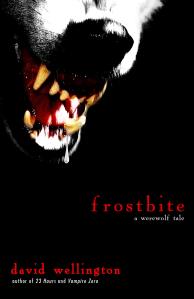
David Wellington is the author of seven novels. His zombie novels MONSTER ISLAND, MONSTER NATION and MONSTER PLANET form a complete trilogy. He has also written a series of vampire novels including (so far) THIRTEEN BULLETS, NINETY-NINE COFFINS, VAMPIRE ZERO and TWENTY THREE HOURS, and in October of 2009 began his new Werewolf series, starting with FROSTBITE. His web page is www.davidwellington.net.WellingtonAuthorPictureWeb

MICHAEL A. VENTRELLA: Welcome David! You’ve gathered quite an impressive array of degrees from prominent universities having to do with creative writing. How has your education influenced your writing?

DAVID WELLINGTON: Only indirectly, really. The main reason to pursue a graduate degree in Creative Writing is to be surrounded by other writers–you learn a lot more from your fellow students than from the instructors. The focus is on workshops, and I’ve found you can get that from an informal writing group. I suppose there may have been occasions when someone took me more seriously because I had an MFA, but really, the work needs to stand for itself.

VENTRELLA: Do you believe good writers are “born” or is education and training essential?

WELLINGTON: It’s all about hard work, unfortunately. It took me thirty years to get to the point where my work was worth being published. Exceptional talent might cut down on how long it takes–but the only way to improve as a writer is through trial and error. You need to write, a lot, and learn from your mistakes.

VENTRELLA: How did you get your “big break”? Aspiring writers want to know!MonsterIsland_LoRes

WELLINGTON: I tried everything, of course. I tried selling short stories to magazines. I tried submitting manuscripts to publishers, completely unsolicited. Nothing worked. I was actually ready to give up — when a friend of mine suggested that I publish a book on his website. The book happened to be MONSTER ISLAND. He set up a blog for me and I posted a short chapter three times a week. At first it was just for fun — I had no reason to believe it would lead to anything. Then people started reading it. A lot of people. By the time I had a couple of thousand people reading each new post, a publisher came to me with an offer. I used to say I got into publishing through the back door — but I’ve since come to realize there really isn’t a front door. If you want to be published today, you have to get creative. Luckily, if you’re a writer, you’ve already got a well-developed imagination!

VENTRELLA: How did you get involved in the Marvel Zombies series?

WELLINGTON: Marvel actively sought out the authors of zombie novels to come up with some new ideas for the franchise. They approached three of us to each write one issue of Marvel Zombies Return. I absolutely jumped at the chance — I’d been a fan of comics my whole life, and had always dreamed of writing one some day.

VENTRELLA: How does writing for comics differ from writing novels?

WELLINGTON: It’s much more like writing a screenplay. You’re writing something that will never be seen. Your script is going to be interpreted by an artist, so you give up a certain measure of control. You have to trust your artist to interpret your vision. Luckily for me I was matched with Andrea Mutti, whose art really brought my story to life. The guy’s a pro.

VENTRELLA: You have already tackled several classic horror monsters: werewolves, vampires and zombies. All of these takes were fairly unusual in their descrpition of the monsters’ qualites/appearances, yet retaining a lot of the classic elements at the same time. How did you come by that decision?

WELLINGTON: Whenever I start a project, I want to do it my own way. Otherwise where’s the fun? I start with the traditional version, and think about how I can play with it. That way I can add something new, and hopefully something fresh. My zombies don’t just eat brains — they eat anything organic. They peel gum off the street and eat it if there’s nothing else. They’re the ultimate consumers. My vampires were a direct reaction to the romantic vampires you see so often these days. I wanted my vampires to be scary — predators in a world where we would have a very hard time fighting back. And so on.hair ablowin

VENTRELLA: What’s next? Any plans to give us a fresh take on another horror creature?

WELLINGTON: There will be two books in my new werewolf series–FROSTBITE, out now, and OVERWINTER, which will come out next year. I’d like to do a fifth vampire book, to finish the series.

VENTRELLA: The protagonist of your vampire series, Laura Caxton, is lesbian which is quite unusual for mainstream horror. Anything specific that prompted you to that decision?

WELLINGTON: There wasn’t a lot of decision-making involved. When I created Laura, I knew I had a scene where she comes home after a very nasty day at work and gets into bed. I knew there would be someone in the bed waiting for her — when I got to that scene, the other person just happened to be another woman. The character was partly based on my sister, who is gay. Beyond that I gave it very little thought–and nobody ever gave me a hard time about it. My editors never blinked. My readers have accepted it without making a big deal out of it. I was pleasantly surprised by that.

VENTRELLA: What are your favorite books in the horror genre? Favorite horror movies?

WELLINGTON: My favorite books in horror are the classics — Lovecraft, Poe, Arthur Machen. As far as movies go, I like any horror movie that plays with the genre or expands a story in an interesting way. “Near Dark” is a great film, as is “Let the Right One In,” for this reason.

VENTRELLA: Have you ever considered writing in any other genre?

WELLINGTON: When I started publishing, it was with a horror novel. But I’ve never considered myself just a horror writer — I’ve actually written far more science fiction novels than horror novels, they just never got published. I write fantasy, mystery, even literary fiction — whatever idea comes along, I pounce on it.

VENTRELLA: What’s your favorite monster?

WELLINGTON: Frankenstein’s Monster, definitely. There’s something about that character — both in Mary Shelley’s book and in the Universal films — that really speaks to me, an existential loneliness that demands answers. What am I? Why was I created? What am I supposed to do now? The monster asks all these questions, and gets no answers. That’s how I feel every morning when I wake up. Then I eat my cereal and get to work and I feel a lot better.

VENTRELLA: Do you have any specific advice you would give a writer trying to make it in the publishing business that they may not have heard before?

WELLINGTON: Keep writing — it can seem pointless, but it’ll work eventually. Something will catch somebody’s eye. Or you’ll improve as a writer to the point where people can’t ignore you any more. Try to tell stories, rather than creating great art. Keep reading books — every book, good or bad, has something to teach you.frostbite

VENTRELLA: What are you most proud of? For What would you like to be remembered?

WELLINGTON: A book that hasn’t been published yet. One I haven’t written yet. Every book I write is better, in some way, than the last. I don’t want to be one of those writers who publishes one good book and then can never catch that fire again. I want to be the guy who’s best work is always his latest one, like Terry Pratchett.

VENTRELLA: What are you working on now that we can look forward to?

WELLINGTON: FROSTBITE, my werewolf book, is out right now–you can get it at Amazon or in any bookstore. There will be a sequel called OVERWINTER, out next year. I hope you’ll like them!