Interview with Author Tracy S. Morris

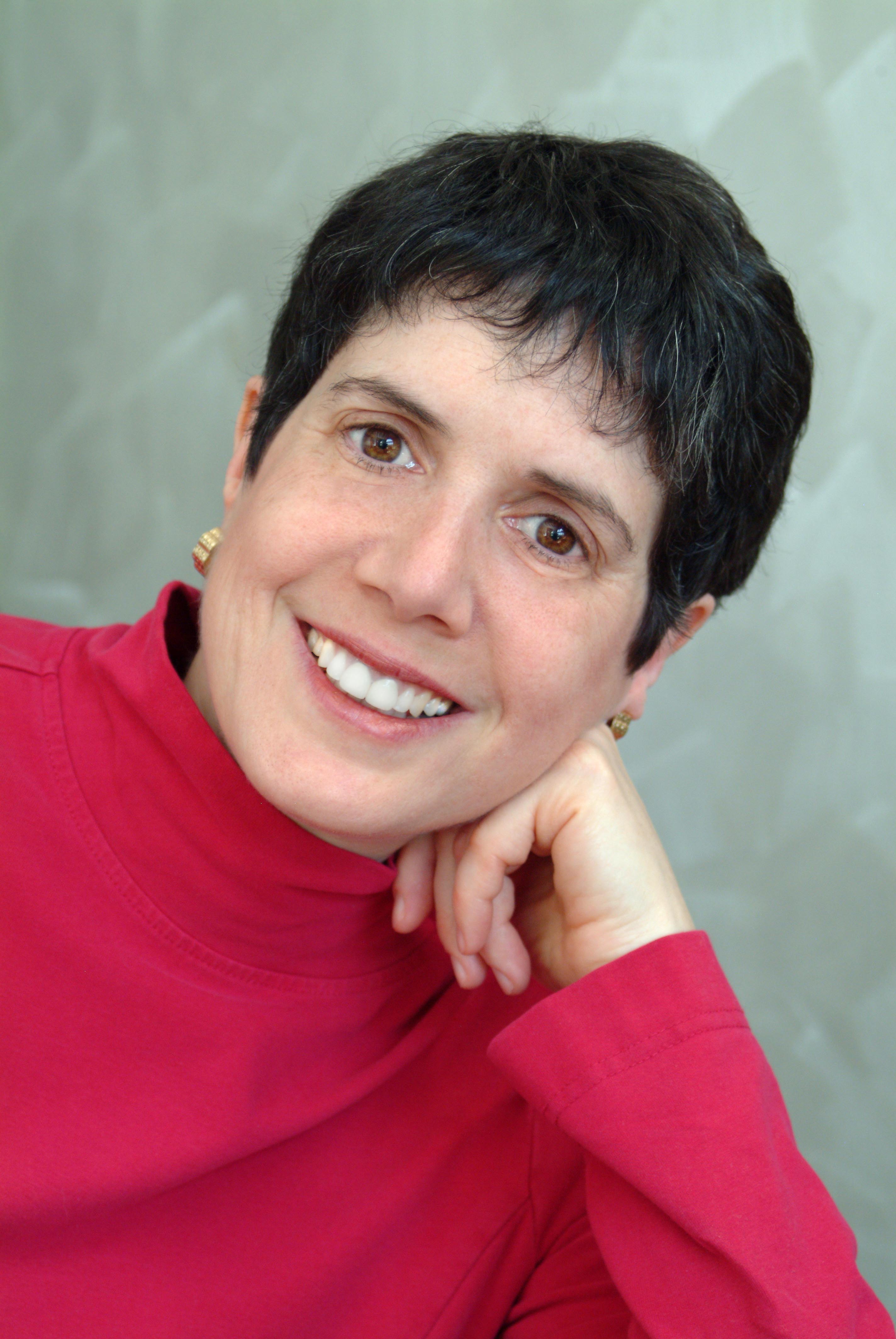
MICHAEL A. VENTRELLA: Today, I am pleased to be interviewing author Tracy S. Morris. She is the author of the Tranquility series of urban fantasy mysteries. The most recent, BRIDE OF TRANQUILITY, is a murder mystery set in a haunted hotel during a Renaissance wedding. She’s also published a number of short stories. Her web page is here.
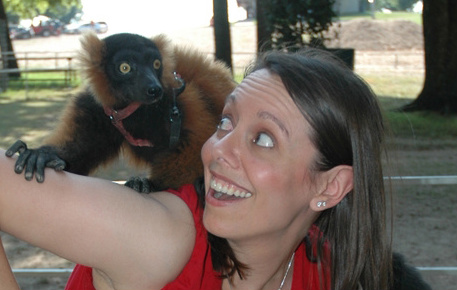
Hi Tracy! Tell me a little bit about yourself!

TRACY S. MORRIS: I’m a professional writer, so I spend most of my days in front of my home computer in my pajamas. My specialty is service journalism in the gardening industry. Which is a fancy way of saying that I write “how to” articles that deal with topics like compost, animal manure and growing the perfect tomato. I like to call that “living the dream.” Although it probably means that I’ve got no life.

I’m also a retired newspaper photographer/reporter. On my best day, I got to shoot the president (with a camera) which probably put me in the crosshairs of a secret service sniper. On my worst day, I was suspended off of the back of a speedboat in freezing weather and driving sleet to get a picture for a news story.

I got to do some very interesting things in that job. I had a ride in a hot air balloon. I had the best seats in the house for every major sporting event. But I also had no life, no predictable schedule. And after the day with the speedboat in the sleet, I realized that there has to be a better way to make a living. Which is why I now work at home in my bathrobe.

When I do leave the house, I’m a shooting enthusiast, a martial arts black belt and a former fencer. I’m a history buff and I’ve spent some time in the Society for Creative Anachronism, which is a group that recreates history from Roman times through the late-renaissance (the boundaries are nebulous and basically cover anything that other history groups don’t cover.)

VENTRELLA: What’s something unusual or different about you that your readers probably don’t know?

MORRIS: That’s a tough one to answer. I’m pretty transparent about my life, so there isn’t a lot that my readers don’t know about me.

I like to collect antique cameras. The collection is mostly thanks to my dad, who likes to go to garage sales. I asked him to be on the lookout for antique cameras for me. So he used to pick up any old camera he saw at an auction. I have several antique bellows cameras, a couple of twin lens reflex, some very nice medium format box cameras and two or three Brownie Hawkeye still in the box. He even bought me a couple of necklaces with camera charms. Eventually I hit a point where I had no more room for them and I had to ask him to stop buying them for me.

The one camera I want most that I don’t have yet is an old Speed Graphic press camera. One of these days I’m just going to cave in and buy one on E-Bay or something.

VENTRELLA: Your “Tranquility” series seems to combine a number of different genres. How did this come about?

MORRIS: Tranquility really grew out of something I was writing for fun. Because of that, I didn’t try to stick with a formula or say “I’m going to make this just a mystery. Or just an urban fantasy. Or just a horror. I was writing for me, so I made it about the things that interested me.
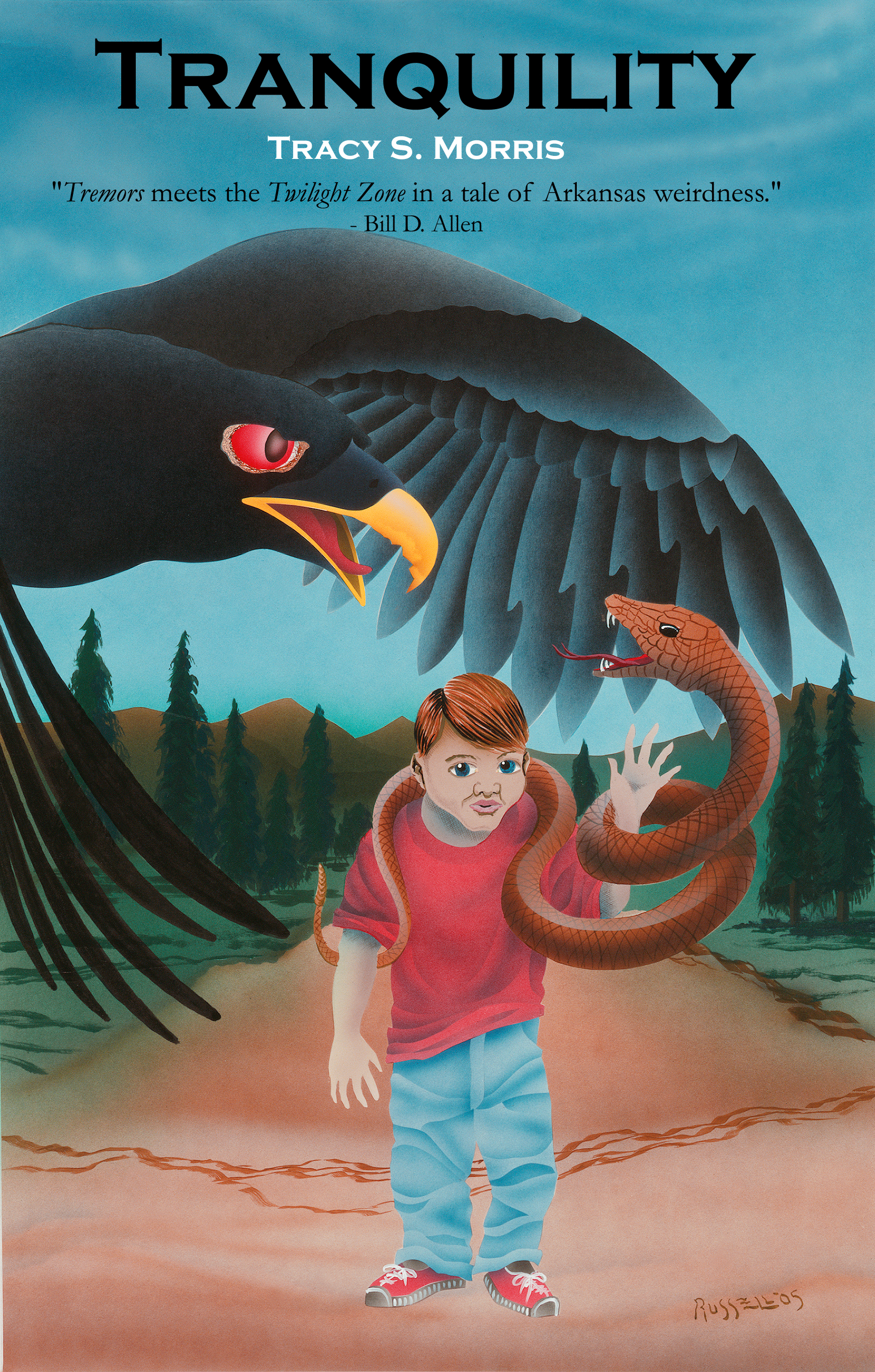
I grew up on a family farm out on the border of the Ozark mountains. My family lived in that region for four generations. When I was a kid, I read a few too many bigfoot stories. So the things that scared me weren’t the monster under the bed. It was whether there was something out in the dark woods out past the barn. That’s where the horror element from Tranquility came from.

I wanted to write the book as a pure horror, but I also have a skewed sense of humor which kept slithering in. One of the major themes that appeared in the book grew out of my reaction to moving home and really seeing the oddities in my small town for the first time. This made the book feel much more like the TV series Northern Exposure, or possibly the Disney Cartoon Cars with that ‘city slicker comes to the country and discovers that it’s a pretty great place’ theme.

By the time that I finished writing the book, I finally embraced the notion that my natural writing voice is humor instead of horror.

TRANQUILITY was nominated for a Darrell award, and placed runner up in 2006. At the awards ceremony my publisher asked when I was going to give her the second book. When I sat down to write it, I decided to make it as fun and absurd as possible. So I threw in everything but the kitchen sink.

The second book in the series, BRIDE OF TRANQUILITY, came after I had been through the process of helping to plan and put on four weddings (Two of them the same year.) I had dabbled in wedding photography by that point, and I had some sarcastic, slightly cynical views about the business side of the wedding industry.

So I thought ‘what’s the worst thing that can happen at a wedding? How about a murder? What’s the worst thing that can happen in a murder investigation? Why not a killer who can move around the hotel through secret passageways – phantom of the opera style? What about if all of the hotel guests mistrusted the investigator and wouldn’t talk to him? Why would they do that? What if they were conspiracy theorists?

VENTRELLA: Do you think that not fitting into one genre made it a harder sell to editors (and the public)?

MORRIS: I didn’t actually have to sell the series. Which is almost embarrassing to admit, since so many other authors have tales of sending a novel out to 45 agents and 20 publishers before gaining acceptance. I sold TRANQUILITY to Yard Dog Press because I was friends with the publisher. When I was outlining the novel, I told Selina Rosen, the editor about this new project that I was excited about. She asked me to send it to her when it was done.

BRIDE has been easier to sell to the fans, because I have a catchy summary that makes the book sound fun. Where else would you be able to read a murder mystery set in a haunted hotel during a Renaissance wedding?

VENTRELLA: I note that they are from Baen Books in e-format but Yard Dog in paper. How does that arrangement work?

MORRIS: Yard Dog Press does not deal in e-books, so they did not contract those rights. But the publisher has a working relationship with Baen. (Baen bought the e-rights to Selina Rosen’s Misha Merlin titles as well as the Sword Masters series from Dragon Moon Press.)

Additionally, Baen had just bought the E-Rights to another popular Yard Dog Press series, The Four Redheads of the Apocalypse.

Since I already had a working relationship with Baen, Selina suggested that I offer the E-rights to them. I could have put out the E-books myself through Amazon. Authors such as Jim Hines have done that with great success. Another Yard Dog author, Margaret Bonham has put her Yard Dog Press epic fantasy novel Prophecy of Swords out that way. Since then her title has reached the top 10 in epic fantasy e-book category for Kindle.

But Baen brings with them a new audience of readers that I might not reach otherwise. That is very exciting to me.
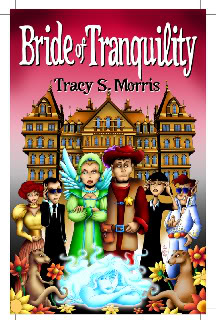
(By the way, through the month of December 2010, if you purchase either TRANQUILITY or BRIDE OF TRANQUILITY in trade paperback from Yard Dog Press (Direct from the publisher, not from Amazon), I’ll send you a free preview of the first two chapters of the next Tranquility book that is now in progress, which is tentatively titled IT CAME TO TRANQUILITY.

The links to these books on Yard Dog Press are: TRANQUILITY and BRIDE OF TRANQUILITY.

Baen is also running a special on the E-Books. Until January 1, 2011, you can order both TRANQUILITY and BRIDE OF TRANQUILITY along with the books in the “Four Redheads of the Apocalypse” series as a Yard Dog Press bundle for $20.

You can order the E-Books at: http://www.webscription.net/m-9-yard-dog-press.aspx)

VENTRELLA: How did you make your first sale? Did you have an agent?

MORRIS: I still don’t have an agent. Instead I’ve made every sale I have the old fashioned way — by researching markets and sending manuscripts out.

My first sale was to an anthology called OCTOBERLAND that was put out by Flesh and Blood Press. It was a story entitled “Frost King” that I had basically written and rewritten multiple times.

I sold the story exactly the wrong way. It had been the first short story that I ever wrote, I made revisions with the help of an English teacher and then put it in a drawer through my college years. Once I decided to pursue writing again I started sending it out. Every time It was rejected I rewrote it using suggestions that the rejecting editor provided me. Eventually after 12 rewrites over 4 years, I sold the story.

That same week I also sold “Attack of the Godless Undead Zombies” to Yard Dog Press for one of their “Bubbas of the Apocalypse” anthologies. That story was written in the space of two days. I turned it in to Selina Rosen after my husband gave it a single editing pass.

Today I try to get a story to the point that I am happy with it before I send it out instead of changing it with every rejection. I feel much happier with the end result.

VENTRELLA: I have a short story that I can’t seem to sell, as it hardly fits into any specific genre. What advice do you have for me (and other writers reading this) for finding the right editor?

MORRIS: Before you do anything, consider your goals. Do you want to sell a story you are unhappy with for the sake of having a sale? Or do you want to have the best body of representative work you can possibly produce?

If you just want the sale, then rewrite the story along a formula so that it fits into a single genre. But if you are happy with the story as it stands, put it aside until the right editor comes along.

My personal choice would be the second option. I have been writing and reading speculative fiction for 20 years and I have seen genre conventions change drastically over the years. I never thought I would see the day that Jane Austen and Zombies were used in the same genre. I have ‘trunked’ perfectly good stories because they didn’t have the right market, only to have the perfect market for the story come along two years later.

If you change your work into something that you dislike just to make a sale, you may end up with a ‘representative body of work’ that you are unhappy with.

Also bear in mind that compared to novels, short stories are very quick to produce. You can have a short story written within a few days. So if you can’t find a home for one, you can set it aside and devote your attentions to creating and selling a new story.

VENTRELLA: You have two short stories in Baen’s online magazine “The Grantville Gazette”: “Still Life with Wolves and Canvasses” and “A Study in Redheads.” Do you think that online publications are the wave of the future?

MORRIS: Don’t forget about my co-writer for those stories, Brad Sinor.

A few months back Amazon began selling more electronic books than print books. This has a huge impact on magazines. Particularly since the publication business model is not the same as the book business model.

Most print publications don’t get their revenue from selling copies of their magazines. Instead they get revenue from ad sales. So a magazine like Fantasy Magazine once could leverage their sales numbers to attract advertisers. Fewer people are going into stores where these magazines used to sell. Instead, readership is online now.
You are already seeing more magazines online. There are several business models out there. Daily Science Fiction is delivering a story a day directly into my in box. The Grantville Gazettes require a subscription to access their online content. Fantasy Magazine has complete stories up for free with ads in the margins. Clarkesworld offers free content online, but sells their magazine with additional content through Kindle and has occasional donation drives.

When the dust settles, I think the most profitable business model will be the one we see copied.

The thing I admire about what Grantville Gazette is doing is that they are building a community around their 1632 franchise. There are the novels with the bigger name writers. But there are also message boards where fans can interact and have an impact on the storylines. Baen has an entire section devoted to the tech of the 1632 universe where experts (and there are plenty of qualified experts) can hammer out the science of the universe.

If someone wants to submit a story to the Grantville Gazettes, the story is put up on a closed message board where the Grantville fans can pick it over for conflicts with the universe timeline or the science. The author can make the changes and if the story is accepted, the same fans will buy the content.

Eventually, the ‘best of’ stories are the ones that get released in the print anthologies. Which also are bought by the community members.

Business-wise, this is smart. This is what made Dr. Horrible’s Singalong Blog such a success: Joss Whedon has an intensely loyal community that is willing to follow whatever he does.

This is also why celebrities such as Wil Wheaton, and internet celebrity Author Cleolinda Jones do so well with self publication. They’ve built a community of readers who are willing to follow what they do.

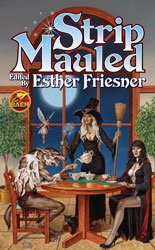
VENTRELLA: “Fish Story” is a short story you wrote which appeared in STRIP MAULED, an anthology edited by Esther Friesner. Tell me about that!

MORRIS: “Fish Story” involves a couple of characters that have been living in my mind for a while. Back when Laurel K. Hamilton and Jim Butcher first began publishing urban fantasy, I had a thought that it might be fun to write someone who would live in an urban fantasy world but eschewed magic. How would that person survive if they lived as a sort of magic conscientious objector?

The adventures I wrote were another example of a hard-to-sell genre mashup. I write funny third person. The urban fantasy of that type seems to take itself very seriously, and usually follows the noir detective novel conventions of first person point of view.

The characters are a good example of an idea that was trunked because of a lack of market, only to have the market return. I had an early story with the characters published in a magazine (now defunct) entitled “Whispers from the Shattered Forum”. After that, the Noir Detective novel in the Urban Fantasy market seemed to be dying.

Then TWILIGHT revived the interest in Urban Fantasy Vampires, which always seem to pull readers into the Noir Detective Urban Fantasy novels. And then along came a couple of great TV shows like “Supernatural.”

Prior to selling Fish Story, I sold a short story with these characters entitled Homo “Homini Lupis” to an anthology entitled WOLF SONGS, which was put out by Wolfsinger press. I recently finished a novel with the characters that is based on the plot to this short story.
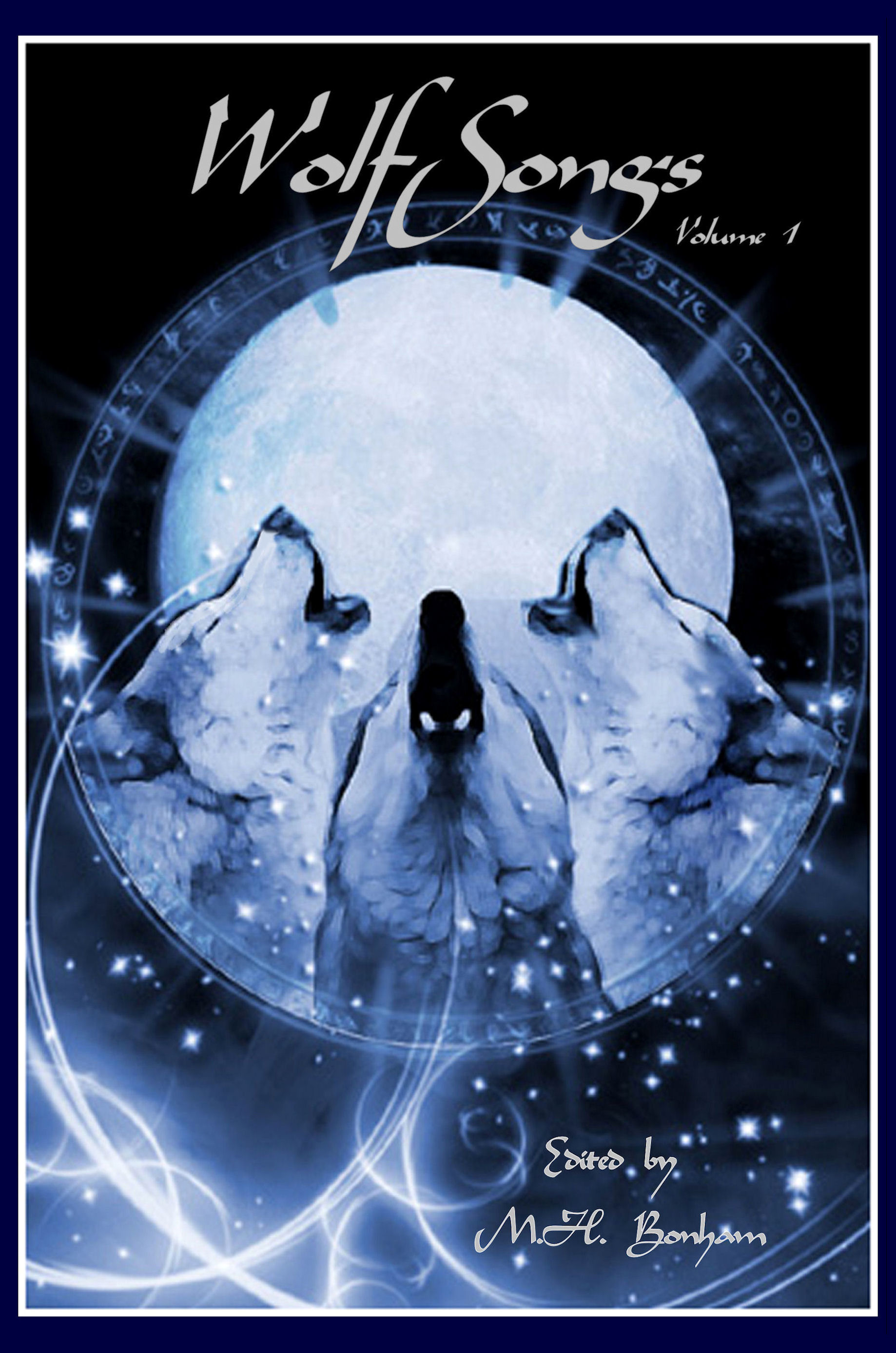
Then Esther Friesner launched her monsters in suburbia series. The anthologies are open by invitation only. But through a mutual friend I was able to ask her if I could submit a story for consideration for her werewolf-themed anthology. I was very surprised when the story not only made it into the anthology, but was put up on Baen’s website as one of the free preview stories.

I also submitted a story to her for the vampire-themed anthology. But the competition for inclusion in that anthology was a bit stiffer, and I didn’t end up being selected.

VENTRELLA: Would you advise beginning authors to concentrate on getting short stories published first?

MORRIS: There is a huge difference between publishing a short story and publishing a novel. About 15 years ago the accepted career path was to build name recognition through short stories and leverage that to secure a novel contract. Today that wisdom doesn’t hold true. You can get a contract with an agent, or sell a manuscript to Tor or Baen if the novel is good regardless of what your name is. Conversely, you can have a big name in short stories and if your novel isn’t good enough, you won’t be able to sell it.

My advice is to concentrate on honing your craft in the medium that you want to be published in. If you want to write short stories, that’s the area you should focus in. If you want to write novels, start there.

VENTRELLA: What is your opinion on e-book publishers and Print On Demand?

MORRIS: Each publisher is different. Do your homework and contract with a respectable publisher. One good resource is SFWA’s Predators and Editors website.

VENTRELLA: How about self-publishing?

MORRIS: Rule #1 of Self-Publishing: Thou Shall Not Fooleth Thyselfeth.

First thing you must understand is that publishing a book yourself does not put you into the same league as Stephen King, J.K. Rowling or Danielle Steele. You won’t be rolling in piles of money. Nor will you spend your days poolside with a laptop, eating bon bons while you compose deathless prose.

Writing is a business. Publishing is doubly so. You will be responsible for selling the books yourself, handling the details of distributorship and all promotional marketing (these things that publishers normally do).

Additionally, you must overcome the stigma attached to self publishing. Self publishing (from what I’ve observed) is like swimming upstream against a tide of professional ostracism. In the eyes of many professionals (authors, editors, publishers, book sellers) your book lacks the quality editing work that books published with an established house have.

Promotion will be more difficult because many reviewers will give your book less priority than a book sent by a professional house. Science fiction conventions will give preferential treatment to writers who have books with professional houses. If you do manage to get paneling, you may be treated with hostility or veiled contempt by authors with credits through traditional publishers.

There are a number of authors who have been successful with self publishing. Most of them know to treat the business of writing and publishing like a business. Many of them establish a fan following through other means, and dabble in self publishing. Others have an established fan following through traditional publishing that follows them into the self publishing realm.

VENTRELLA: I assume you have cats. (Don’t all writers?) Am I wrong?

MORRIS: No cats. I am owned by two very lazy dogs. When I’m not writing, my job is to cater to their every whim.

Interview with Janice Gable Bashman

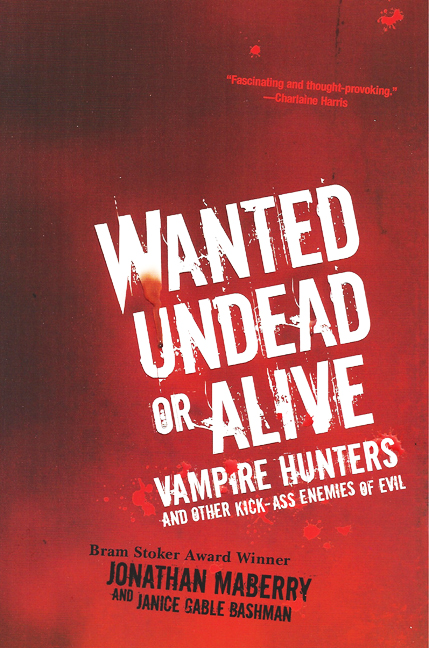
MICHAEL A. VENTRELLA: I’m pleased to be interviewing Janice Gable Bashman today. Janice is co-author (with Jonathan Maberry) of WANTED UNDEAD OR ALIVE: VAMPIRE HUNTERS AND OTHER KICK-ASS ENEMIES OF EVIL (Citadel Press, August 2010). She has written for many leading publications, including NOVEL & SHORT STORY WRITER’S MARKET, WILD RIVER REVIEW, THE WRITER, INDUSTRY TODAY, and FOOD & DRINK QUARTERLY. Janice is a member of the ITW (International Thriller Writers) and the Horror Writer’s Association, as well as a contributing editor of the ITW’s newsletter the BIG THRILL. Her writing won multiple awards at the 2007 Philadelphia Writer’s Conference.

Your book WANTED UNDEAD OR ALIVE is due out shortly. Tell us about the book!

JANICE GABLE BASHMAN: WANTED UNDEAD OR ALIVE deals with monsters of all kinds (supernatural, fictional, or real) and the people/beings/forces that fight them. It’s a pop culture book for fans of the genre. We interviewed tons of people for the book — FBI profilers, authors, screenwriters, comic writers, actors, directors, producers, criminal experts, psychologists, and others — as well as luminaries like film-maker John Carpenter, author Peter Straub, and the legendary Stan Lee. The book also has over forty illustrations from fantastic artists.

Here’s what some of the experts have to say about the book:

“WANTED UNDEAD OR ALIVE is a fascinating, far-ranging analysis of the nature of evil and those who rise to fight it … in real life, in pop culture, in literature and in legend. A must read for those who want to dive deep into the reasons for why we are fascinated by monsters … and love those who make it their business to take them down.” — Rachel Caine, New York Times and USA Today bestselling author of the Morganville Vampires series, Weather Warden series, and Outcast Season series

“WANTED UNDEAD OR ALIVE is a riveting chronicle of all things that drop fangs in the dead of night. All aficionados MUST have this in their library!” — LA Banks, New York Times best-selling author of the Vampire Huntress Legend series

“Jonathan Maberry and Janice Gable Bashman probe into pop culture’s Heart of Darkness, and what they find is both fascinating and thought-provoking.” — Charlaine Harris, creator of TRUE BLOOD and the Sookie Stackhouse novels

VENTRELLA: How did your writing styles work together?

BASHMAN: Jonathan Maberry and I each wrote individual chapters and reviewed and edited the other’s work. Other chapters were a collaborative effort. Prior to writing anything, we had to decide who was best to write each chapter. Although writing the book was research and interview intensive, we each brought our own skill sets and knowledge of the subject matter to the project; therefore, some chapters were better suited for one of us than the other.

When writing or co-writing a book, voice is important. The challenge with two authors is finding one voice that both authors can write and that fits the tone of the book. At first it takes a bit of trial and error (and writing and rewriting) to get there, but the end result is, if you do your job right, a voice from two writers that sounds like it’s from one.

VENTRELLA: Do you have any similar books planned?

BASHMAN: WANTED UNDEAD OR ALIVE is a companion to VAMPIRE UNIVERSE by Jonathan Maberry (2006) and THEY BITE by Jonathan Maberry and David F. Kramer (2009). I’m finishing up a proposal for my next non-fiction book; it’s still under wraps so I can’t share the details at this time. I can say that dozens of key players are already on board for the project and it’s sure to be a fun one.

VENTRELLA: You primarily have written nonfiction. How does that differ from writing fiction?

BASHMAN: Writing fiction and non-fiction differ and yet are the same. By that I mean that both forms of writing have a story to tell. In fiction, the story comes from your imagination (and research); in non-fiction, the story is derived from fact. Whether I’m interviewing an author for the NOVEL & SHORT STORY WRITER’S MARKET or THE BIG THRILL or interviewing a CEO of a major corporation for a trade magazine, the process is the same. I gather my facts and tell a story — the story of the person or organization I’m interviewing.

I’ve received many e-mails from authors and others I’ve interviewed thanking me for giving them such an interesting interview, one where the questions differ from those they’ve been asked so many times before. I make it my business to thoroughly research my subject before I construct an interview and find a way to take that interview to a deeper and more personal level, to get to the heart of the person and talk to them about what really matters.

But, in the end, it’s all about story. Finding the story and crafting it in a way that’s exciting for the reader. That’s my job as a writer whether I’m writing fiction or non-fiction.

VENTRELLA: How did you get started in the business?

BASHMAN: About four years ago, I decided to take a swing at publishing some articles after I became involved with a writing group. I learned to craft a query, sent out a few ideas to some local publications, and sold my first article. In the years prior, I had published my master’s thesis and a few book reviews, so I did have some, albeit minimal, publishing credentials. Once that first article was published, I began sending out more queries to both local and national markets, and the sales began rolling in. I’ve written dozens of interviews and profiles for numerous publications, but I’ve also written features, book reviews, and now a non-fiction book.

VENTRELLA: How do you pitch a nonfiction book or article?

BASHMAN: Pitching a non-fiction book is different than pitching an article, so let’s tackle a book first. To pitch a non-fiction book, the writer must write a non-fiction book proposal. The book proposal contains detailed information about the editorial format, the book contents, the author’s marketing and promotion intentions, who will buy the book, media contacts, and more. A sample chapter or two is also submitted with the book proposal. The author must then pitch the book to an agent, via a query letter, in order to find an agent to represent him in selling the book. Some publishers may accept proposals directly from an author, but most do not. So, unlike fiction, the entire book does not have to be completed before pitching to an agent or editor.

The process of writing a non-fiction book proposal is helpful beyond obtaining a sale. It helps the author flesh out and refine his ideas and really get a good handle on the book. And when it comes time to write, the author is ready to go.

Pitching an article is a different beast. To pitch a non-fiction article the writer must send a query to an editor telling that editor about the proposed article and why it’s a good fit for his publication. This is done prior to writing the article. It does help sometimes, depending on the type of article you wish to write, to have one or two quotes from “experts” in your pitch to support your proposal. For an interview or profile I have not found this necessary, but I would recommend using expert quotes for a feature article. It shows the editor that you not only have the knowledge to write the article but that you also have access to the experts who can support the material.

My experience has shown that once I’ve worked successfully with an editor, it is easier to pitch new ideas to him and have them accepted for publication, as long as the ideas are good, obviously, and fit the publication’s needs. I’ve also had editors contact me on numerous occasions asking if I would be interested in writing a particular piece for their publications. When that happens, it certainly makes life easier because I bypass the query process. If and when that happens, it’s important to remember that it’s okay to turn down an assignment if your schedule will not allow you to complete the piece on time to meet the editor’s deadline. Always, always, always meet your deadlines.

VENTRELLA: Giving a pitch to a fiction editor or agent is a skill few have. How do you manage it? What advice do you have?

BASHMAN: The hook is all important. A query letter must hook the agent or editor in the first sentence just like the first sentence of a book must hook the reader. The writer must give the agent a reason to continue reading the query letter and to request sample chapters. It may seem like a simple thing, especially after writing and editing a manuscript, but it’s not. Crafting a good query letter takes time, but it’s important for the writer to take the time to do it right. How awful would it be for a great manuscript to sit forever in a drawer because an author didn’t take the time to learn how to write a good query and therefore couldn’t get an agent or editor to read the manuscript?

My advice is simple. It takes practice. Write and rewrite your query until it sounds like something that would make you request pages if you were an agent. Run your query past a few colleagues, post it on a writer’s critique board such as Backspace or Absolute Write Water Cooler, or if you’re really brave post it online for either the Query Shark or Evil Editor to critique. But before you even get that far, read through Miss Snark’s blog achieves where you’ll find hundreds of query critiques to study as examples. Publishers Marketplace is also a good resource. Take a look at the deals page and you can easily see how authors/agents have summed-up a book’s hook in one sentence. Find books in your genre and read the back cover copy, see how the wording hooks the readers and find a way to do the same for your book.

The more a writer studies and writes queries the easier it gets, but it takes time and practice. Don’t expect perfection right out of the gate. Work on the query, study your sentence structure, word choices, etc. until you get it right. Put the same hard work into the query that you put into your book. And if you query and don’t receive requests for pages, you either need to rethink/rewrite your query letter or ensure you queried the agents/editors who are interested in your type of book. One or the other wasn’t on target.

VENTRELLA: What advice can you give an aspiring writer?

BASHMAN: Remember that you’re writing because you love to write, because you have something to say that is meaningful. Be persistent. Push through the tough times; they will come. Relish the rewards of your work. And remember that publishing is a business, so try not to take rejection too personally. A rejection may not be a reflection on your work but may simply show that what you wrote is not the right piece for the marketplace at that particular time.

VENTRELLA: What’s the worst thing you have seen writers do that ruin their potential careers?

BASHMAN: I cringe every time I see a writer bash an agent or an editor in a social media setting such as Twitter or Facebook because the agent or editor rejected that writer’s work. Agents and editors receive and respond to hundreds of queries a week and often read them on their own time outside of business hours. They are searching for that next great book to represent, the book they love, and the book they believe readers will love too. They’re in the publishing business because they love books, and believe me, they want to find the next great book just as much as the writer wants to write it.

Rejection is part of the business, and a writer’s response to that rejection should be kept private or shared with a few select friends. It’s okay to feel disappointed, hurt or upset, but publically airing those feelings and lashing out at agent or editor either online or via e-mail is awful. First of all, it’s cruel. It’s done out of anger and feelings of rejection — that the writer’s work isn’t good enough, which may or may not be true. Second, agents and editors know one another, so when a writer bashes an agent or editor, that writer is labeled as trouble based on their online or e-mail rant. The writer may have written a great manuscript, but who wants to work with a difficult author, especially one just starting out in the business?

VENTRELLA: How do you manage promotion for your work? What things do you have planned?

BASHMAN: Promotion takes a lot of time, but it’s a necessary part of business. Today, authors are expected to do most, if not all, of their own promotion. It’s important to have a game plan and follow-through with it. A writer can write a great book, but if no one buys it the book is considered a failure.

For WANTED UNDEAD OR ALIVE, we’ll be posting expanded interviews on our websites with some of the people we interviewed for the book, we’ll reach out to readers through social media, we’ll attend upcoming comic, horror, and other events, we’ll participate in speaking engagements at local libraries and other organizations, we’ll attend book fairs, hold book signings, and a whole slew of other things to get our book out there and to bring it to the attention of readers.

VENTRELLA: How important is it for a writer to post on Twitter and Facebook and keep a blog? And what can a writer do to make his or her blog different and noticeable?

BASHMAN: It’s extremely important for a writer to connect with as many potential readers as possible. The internet has given authors a powerful arsenal of tools to connect with readers through social media, blogs, Yahoo! groups, websites, etc., and authors need to recognize those opportunities and use them. I recently spoke about building your buzz to drive up sales at the Backspace Writers Conference, and I’ll be speaking about it again to the Brandywine Valley Writers Group in September. I embrace these social media and online opportunities and have found them instrumental in helping propel my writing career forward. I’m on Twitter , Facebook, LibraryThing, Shelfari, LinkedIn, and a bunch of Yahoo! groups. I also follow and comment on numerous blogs and post to my own blog, usually about the writing business.

In order for a writer to make his blog noticeable, the writer must provide content that is engaging and relevant to the blog readers. In order to achieve that, the writer must identify his blog audience—who are they and why they are there. Also, what does the writer want to talk about? How can the writer make that interesting for his readers? If the writer’s target audience is other writers, for example, how can a blog post on writing draw in potential readers, agents, editors, etc.? Find ways to target new audiences while maintaining the readers you already have? Study those blogs you admire and see what they are doing and how they are doing it. Learn by example. Then try your twist on it and see if it works. If it doesn’t draw the response you desire, tweak your approach and try again. There’s no sure-fire formula for success. Just do what you do and do your best.

VENTRELLA: What projects do you have upcoming?

BASHMAN: In addition to the upcoming non-fiction book project I mentioned earlier, I continue to write for various publications. I’ll also be shopping a young adult novel shortly.

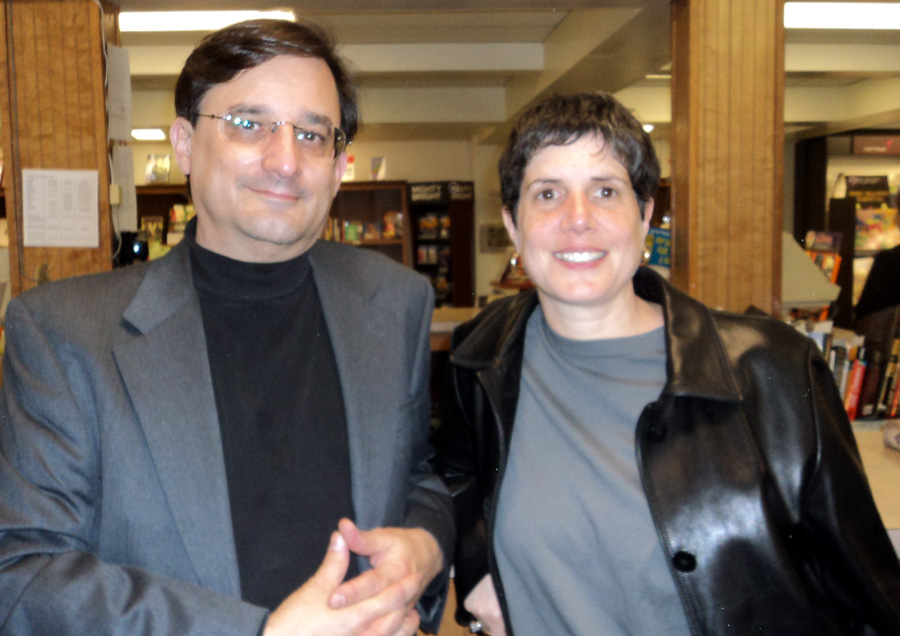
Me and Janice

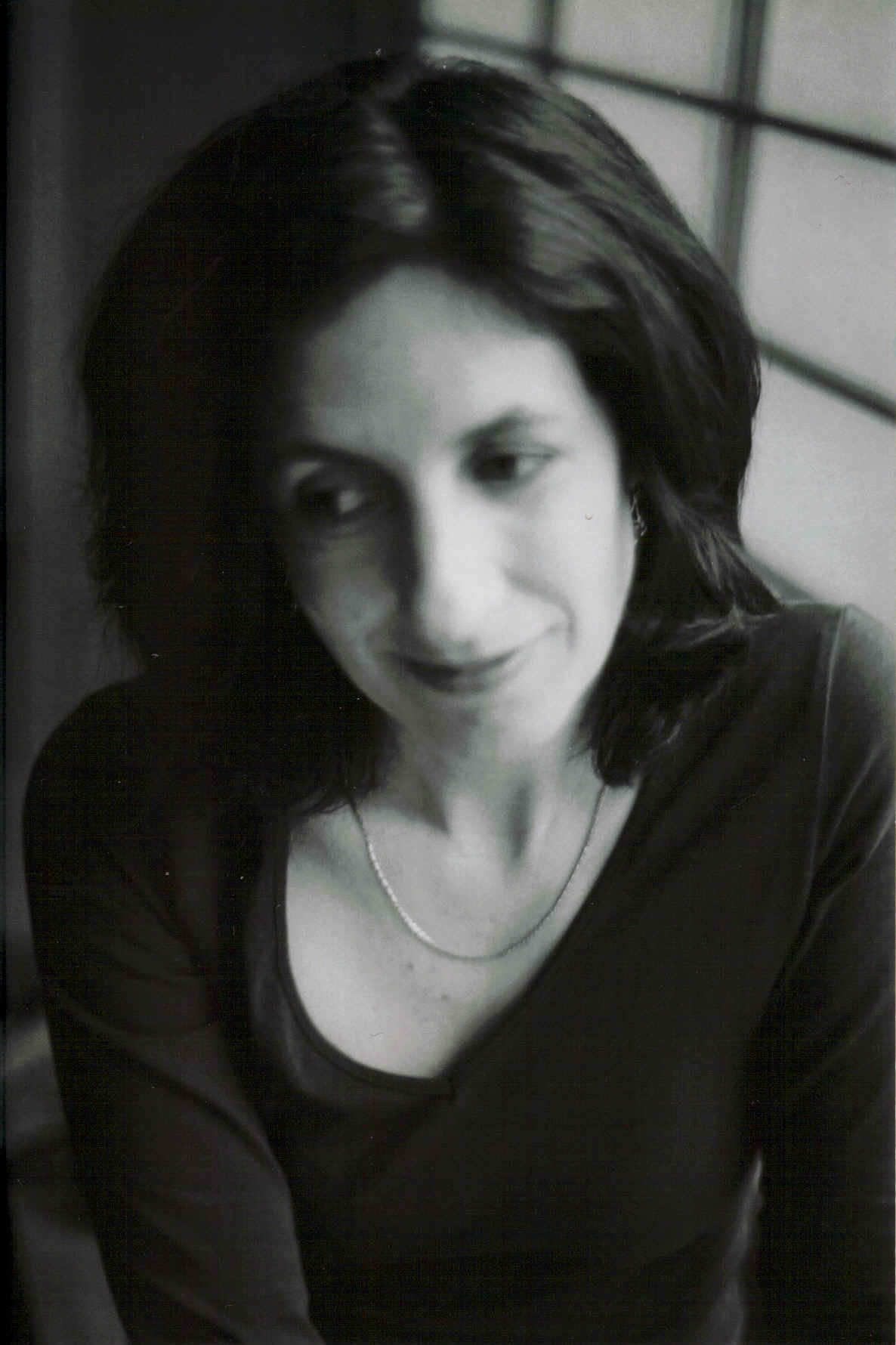
Interview with Author and Editor Cecilia Tan

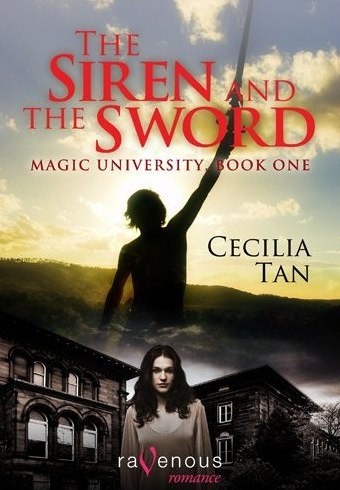
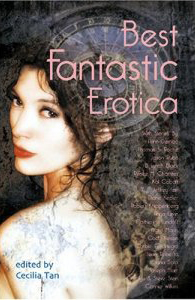
MICHAEL A. VENTRELLA: I’m pleased to be interviewing Cecilia Tan today. Cecilia has been writing and editing professionally for the better part of two decades, both independently and for the small press she founded in 1992, Circlet Press, who specialize in material that mixes the erotic with the fantastic. She has written numerous erotic romances for Ravenous Romance, has edited anthologies for Alyson Books, Thunder’s Mouth Press, Carroll & Graf, Masquerade Books, Blue Moon Books, and others, and collections of her short stories have been published by HarperCollins and Running Press. On top of all that, she also writes and edits publications on baseball.

Cecilia, What brought about the founding of Circlet Press?

CECILIA TAN: I had written a story called “Telepaths Don’t Need Safewords” and just knew at the time I finished it that it was the best story I had written to date. It mixed explicitly kinky erotic action with a science fiction plot. Then I looked around for somewhere to submit it. There was nowhere. Science fiction magazines had explicit rules against sexual content. Porn magazines had explicit rules against both science fiction and any plot beyond “two people meet, then have sex.” The BDSM magazines of the time were either exclusively lesbian or exclusively gay, and my characters were neither. I had been working in book publishing for a few years at that point so I knew the business and I thought “this is nuts. Someone has to do this!” And of course that someone ended up being me.

VENTRELLA: Has it met your expectations?

TAN: Circlet Press has met all my hopes and dreams except for the financial one. We grew by leaps and bounds, garnered fabulous critical acclaim, excellent notice, a great reputation, helped to blow the doors off the old restrictions and show how good mixing the genres could be, jumpstarted the careers of a whole generation of writers … but once the Returns Crisis hit the book publishing industry in the late 1990s, it’s been a financial uphill battle ever since. I’m too stubborn to quit, though, and the ebook has suddenly allowed us to start reaching the readership that mainstream bookstores abandoned. So all of a sudden, there’s some cash flow! Who knows? Maybe someday we’ll turn a profit. What’s most important to me is that we’re still able to connect authors to readers, and then put money back in the pocket of the authors. That part of the business is the same as always … in fact, it’s better.

VENTRELLA: There are many examples of small press these days; do you think this is good for the publishing industry or does it tend to water down the field?

TAN: Oh no. It’s the mainstream presses, not the small presses, who are the most watered down. That’s where you’ll find the most mediocre, recycled pap being packaged and put on the shelf. Granted, it’s not 100% the fault of the big publishers — it’s also the fault of the buyers at Borders and Barnes & Noble, who just want the same thing over and over again, in the hopes that what sold before will sell again. They are all chasing the book equivalent of the Top 40 radio hit and making a lot of boring noise in the process. The small presses are more directly connected with the readership and what they actually want. The small presses occupy the specialty niches.

Another way to look at it is with a comparison to restaurants. The big presses are the chain restaurants. They’re Applebee’s and the Olive Garden and Budweiser. The small presses are that great little gourmet Italian restaurant in your neighborhood, and handcrafted microbrews.

Small presses are also the minor leagues, but for the most part the authors being published in the small press aren’t any less talented than the ones in the mainstream press. They are sometimes less experienced, or less marketable, or just less lucky.

VENTRELLA: As a small press author, I thank you for that!

Has the rise of self-publishing been good for the business?

TAN: Absolutely.

VENTRELLA: When acting as an editor, what is it you look for? What will immediately get a story chucked in the trash?

TAN: The first thing I tell my assistant editors when its time to read the slush pile is DO NOT read the cover letter until after you read the story. Far too many authors think that the job of a short story cover letter is to build you up into a froth of excitement about how great the story is going to be, thus ensuring that a) you’ll be let down, and b) any suspense or joy of discovery in the story has been killed for the reader. I think many amateur writers are confused about the difference between submitting a short story and pitching a novel proposal to an agent or editor, and some just can’t imagine that all they should introduce in the letter is THEMSELVES and let the short story speak for itself.

We get a lot less utter garbage than we used to, though, honestly, and I think the reason why is that thanks to the Internet, writers are actually better informed about how to go about submitting, and they are much more likely to have practiced their grammar and spelling skills on a daily basis. It’s that or the Internet has somehow
swallowed up the attention of most of the crackpots who used to send us wacky submissions in red crayon and the like.

VENTRELLA: What sorts of things do you want in a query letter?

TAN: Since most of what we read is short stories, we don’t read queries. We just want a professional introduction of the author, with whatever credentials they have, but if none, just a firm, no-nonsense hello. It’s professional courtesy to include a cover letter. Sticking a post-it note shaped like a heart on the story is not professional.

Actually, these days, we only accept manuscripts by email, so whenever anything arrives in the mail, I know it’s likely to be from the land of psychoceramics.

VENTRELLA: As a writer of erotic and romantic fiction, what would you advise to someone wanting to enter this field?

TAN: Both romance and erotica have a lot of cliches. The whole trick to writing something that will thrill the pants (sometimes literally) off your readers is to satisfy their expectations while at the same time exceeding them. Be aware of the boundaries of any genre that you write in, and then find out how you can play with and cross those boundaries.

That is, unless thinking about that sort of thing paralyzes you and saps your will to write. In that case, forget everything I said and JUST WRITE. That’s probably the best advice. Step one, start writing. Step two, finish what you started. You’ll get better every time.

VENTRELLA: What trends do you see in the publishing industry that excite you? Which ones worry you?

TAN: I’m very excited at how social networking is allowing authors and readers to connect directly. But the problem is how do you find out about new authors you might like if you’re a reader, when now there isn’t just a publisher-wholesaler-retail chain delivering you a limited selection to choose from? A lot of things are changing now because of that.

It worries me a little that the newer system rewards authors more based on their marketing savvy than on their writing ability … but then I look at a lot of the junk that was published that still hit the New York Times best-seller list over the past 20 years and I realize that’s ALWAYS been true. There have always been populist and popular writers who weren’t particularly great artists.

VENTRELLA: Writing a short story is much different from writing a novel. What are the difficulties you have found? Why do you think some authors specialize in one or the other?

TAN: I’ve written a fair number of both and I really think they are different arts, just like painting and sculpture are different arts. A short story writer has to have guts and brio; a novelist has to have stamina and vision. For me short stories have always come pretty easily. I grab an idea and just pound it until it’s done. A novel takes a bit more planning. The one time I just grabbed hold of a novel with minimal planning, it took six years to finish and came out three times too long to be a commercial novel. (That’s DARON’S GUITAR CHRONCILES, which I’m serializing now on the web.) The next time I plotted out 12 chapters of 5,000 words each and bam, I hit my target right on the nose.

The secret to writing outlines for me is realizing that in the second half I’m going to deviate quite significantly from the outline I wrote, but that some kind of internal logic is at work in my subconscious, so if I forge on, it will all work out. I still have to write the outline, which to me is like sketching out the map of the mountain I’m going to climb. But when I get to the top, exactly halfway through the journey, and am at the turning point, I look down the other side of the mountain… and discover it always looks totally different from the top than it did from where you started at the bottom. Some of the landmarks are the same, but how you get to them changes.

VENTRELLA: Are you sick of vampire stories yet? Is there any plot you have seen too often?

TAN: I love vampires! But even sixteen years ago when I edited my very first anthology of vampire stories, called BLOOD KISS, there were some cliches I didn’t ever need to see. Like setting your vampire story in a goth nightclub … cliche cliche cliche! It really isn’t very imaginative to think “what if those spooky kids who look like vampires actually WERE?” Not exactly an original idea. I actually had to turn down a lot of stories where the “surprise” ending was that one of the two people who met in the bar turns out at the end to be… A VAMPIRE!

I had to write rejections that said things like “It’s a vampire anthology. Every readers KNOWS at least one of them is a vampire.” Then there were the millions who tried the surprise twist: they’re BOTH vampires! Argh. Or surprise twist two: the other one is a vampire hunter! I saw literally hundreds of stories with these plots even after I explicitly banned them in my submission guidelines.

Then there are some ideas that go through fads. I kid you not. One year I received no fewer than four stories all with this exact same plot: an artist falls in love with a model in a painting (usually a Renaissance painting) and gets artistically blocked, can’t paint, is wasting away… until the day the model shows up at the door to have
fantastic sex, looking just like the painting, because s/he is a vampire. Somewhere, once upon a time, that was an original plot. Now, it’s a cliche.

VENTRELLA: How do you think your education has helped your writing?

TAN: Well aside from the actual writing courses I took, it was important to me as someone who writes science fiction to learn some high level science. In college I went right for what was cutting edge at the time, cognitive science (artificial intelligence, neurology, etc) and genetics. Anything you learn that stimulates your brain is going to help your writing. I took a fair amount of psychology in that mix, as well as literature, music, etc. … Long live the liberal arts.

VENTRELLA: Besides “keep writing” what specific advice would you give an aspiring author that you wish someone had given you when you began?

TAN: I think I must have started out with some pretty good advice, because I can’t think of anything. I suppose the advice I would give is this.

You need your reader to trust you to lead them on a rollercoaster ride. For them to trust you, you have to trust yourself. To trust yourself, you have to know your craft and be constantly improving it, constantly learning about yourself and the way your writing affects your readers. So don’t write in a vacuum because you’re afraid people won’t like it. Find the ones who do like it, and write more for them!

Interview with author Marie Lamba

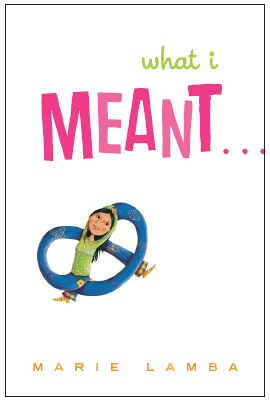
MICHAEL A. VENTRELLA: I’m pleased to be interviewing Young Adult author Marie Lamba today. Marie is the author of the humorous young adult novel WHAT I MEANT…, which Publisher’s Weekly has dubbed “an impressive debut.” She has two more novels which will be coming out soon. In addition to her fiction writing, Marie has written and published more than 100 articles, including features in national magazines such as Garden Design, Your Home, and Sports International. Her most recent piece, “Plotting a Novel Group,” appears in the February 2008 issue of Writer’s Digest. Her web page is www.marielamba.com.

MARIE LAMBA: Hi Michael. Thank you for having me on your blog.

VENTRELLA: Marie, what is it that makes a novel a Young Adult novel?

LAMBA: To me, a young adult novel is categorized primarily by the age of the main character. Since readers read about characters older than themselves, if you have a 13-year-old protagonist, you’ve just written a middle reader (not a YA), and will have mostly elementary school aged readers. Also, content figures in. Sometimes the content is not right for the YA market. But these days, almost anything goes for YA readers. The edgier the better, though you may just be banned by schools…which usually reaps great press and even better sales, interestingly enough.

VENTRELLA: You keep a pretty active blog. Do you think this is necessary to help promote your work?

LAMBA: My site helps me promote my work every single day. I’ve heard people say that if you don’t update your blog at least 3 times a week, then don’t bother having one. I heartily disagree. Sometimes it’s not about getting a huge number of subscribers, but about having a presence, and being able to be found in various ways.

While my blog may seem really active, I sometimes post as rarely as once a month. I just don’t think there’s a point in posting unless I really have something to say. Yet the site is dynamic and gets a fair number of hits everyday because I’ve got a lot going on there. In addition to offering updates about my work, essays on writing, and book reviews, I’ve made it function as my website, www.marielamba.com. So folks are going there to find out about my appearances, to read my bio, to read excerpts from my books, etc. And with links to my Twitter feed, there is always something new to see.

By combining my website with my blog, people stumble onto it while doing the weirdest searches. Like when looking for the menu of Nat’s Pizza. And then they see that my novel has a scene set there. Then they click on my link to buy my Doylestown-based novel. All because of a blog post that tagged Nat’s Pizza in it, if that makes sense?

VENTRELLA: Should unpublished authors have a blog?

LAMBA: Absolutely. It’s a great way to start establishing yourself and your voice. Everything from the color scheme you use to the tone of your bio can help create a feel for who you are. Have a page on your blog with short excerpts of your work, but don’t give away too much material there. Just enough for a taste.

If you really want to be savvy, then you could use your site for things such as book reviews and editor and publisher interviews, which would make your name familiar to the “powers that be.”

VENTRELLA: What can an author do to make their blog stand out among the many out there?

LAMBA: I think it goes back to your voice. Who you are should come through in the tone of your writing, and what you choose to highlight. Then, of course, you need to connect with your audience. That’s where bringing your site to the attention of an organization can help. For example, after I wrote a post about plotting, I saw on a children’s writing message board that I belong to that there was some recent discussion about plotting. I immediately commented there, providing my link to my post.

VENTRELLA: You also make extensive use of Twitter. How can you make your tweets stand out when there are so many people on Twitter? And do you think this is an efficient use of your time?

LAMBA: You know, Twitter is so quick that it isn’t the time suck that sites like Facebook seem to be. At least not for me. Here’s the trick though: when you post there, make it under 40 characters so that you can easily be retweeted to others. Also, try to always provide a link, whether it is to a relevant blog post or a Facebook invite to an event. Links are always too long, so go to www.bitly.com, paste the link there, and you’ll get a shorter link that you can use. And don’t always make your tweets about you. Highlight the accomplishments of others. It’s fun to do, plus I think it’s just good karma.

As for making your tweets stand out, I definitely avoid the whole “I’m getting a cup of coffee now” variety of posts. Again, I only go on there when I have something to say or I really want to respond to someone. I think then people will pay more attention to you. You aren’t the annoying talker everyone wishes would go away. And I try not to follow just anyone or anything. My list is made up of people I know, and of publishers, editors, librarians, media, authors. In short (in the spirit of Twitter), folks who might actually care to hear what I have to say.

VENTRELLA: What is your writing process? (Do you outline heavily, create character backgrounds first, come up with the basic concept and run with it, etc.?)

LAMBA: Good question. It’s evolving. For my past few novels, I knew my final scene. I had my opening dialogue. And then I was off! Kind of like knowing I’m driving to California, and therefore start heading west, but without a map. I do get to the end eventually. The fun thing about this method is the unexpected twists and turns. The not-so-fun thing is cleaning up the mess that I’ve created, trying to make it more direct and cohesive. It can take a long time.

With my current novel, I’m trying to be more organized. I’ve plotted it out, and now I’m in the outlining stage. Then I’ll start writing. I’m hoping that this will help me write faster. My last novel DRAWN (which is now out on submission), took over a year and a half to write. I want to be much more productive than that.

VENTRELLA: What are you doing in your fiction that no one else is doing? What makes your book different and exciting?

LAMBA: I think, again, it comes down to voice. I’m the only person with my point of view and my humor, and that flavors the plot and the characters. With WHAT I MEANT… (Random House YA), the book’s cast of bi-racial characters mirrors my own family’s blend of Italian-American and Asian-Indian personalities. Because WHAT I MEANT… has a mixed race protagonist, yet it is a mainstream story not focused on race, it became a standout in the field.

VENTRELLA: Have you received any surprising results from your writing?

LAMBA: It is always touching to have readers contact me saying that they identified with the characters and that WHAT I MEANT… is their favorite book. One girl even said that she never cries at anything, yet she found herself bawling at the end of my novel because it touched her. That was humbling.

On a funny note, an ex-boyfriend from high school assumed that one of the guy characters in the novel was named after him. He wasn’t.

VENTRELLA: You do a lot of personal appearances to promote your books. What are the advantages and disadvantages of doing these? How do you organize them?

LAMBA: The main advantage is making a personal connection with a reader. If someone meets you and enjoys talking with you, they’ll also remember you and feel a connection to your writing. This is really how books are sold: one reader at a time. I love meeting people, and appearances take me away from my isolated little writing spot and out into the real world. All good. The disadvantage? I can’t think of a single one. I’m careful to pick and choose where and when I go so it doesn’t take away from my writing time.

Events happen many ways. Sometimes booksellers or conferences or teachers contact me. Sometimes I get in touch with them if I have a specific event idea. And I have done presentations to hundreds and hundreds of scouts. I also have to mention that I’m a proud member of the Philly Liars Club, a collection of 13 authors who basically lie for a living. Together we stage a slew of oddball events, and have a blast.

VENTRELLA: Let’s discuss the publishing business a bit. With self-publishing and e-books becoming more prominent, how do you think this will change the demand and market for new writers?

LAMBA: I really think that self-publishing and e-books represent a revolution in publishing, the likes of which we haven’t seen since the 1460’s when old Guttenberg came onto the scene with his printing press, displacing those hard-working monks and their illuminated manuscripts. Documents at that time show that people didn’t realize the magnitude or ramifications of what was going on. Quite simply, the change was so huge that they couldn’t envision the implications.

And so it goes with us. We speculate, but we can barely foresee what all these huge changes mean. I say look to the music industry, to prevalent iPods and the dearly departed record stores. And be cautious. Will books on paper no longer exist? Will bookstores and libraries disappear? Will publishers become obsolete? The only thing I know for sure is that no matter what form content will take, someone will have to write it.

Cling to that, writers and future writers. We are not replaceable.

VENTRELLA: Do you think the stigma of being self-published will continue? Do you think it’s deserved?

LAMBA: Some self-published books are brilliant. Others are painful and shouldn’t see the light of day. Books that are horribly written and barely edited definitely ruin the reputation of others out there, sadly.

I do think that as distribution of self-published novels improves, and more established authors step into this arena, that this stigma will fade. I mean, what does an author like Stephen King really need a publisher for? Couldn’t someone of that stature just put books out into the stratosphere by himself by self-publishing? J.A. Konrath has started to do it with some success, though he still also goes the traditional route.

VENTRELLA: Who are your favorite authors? Why?

LAMBA: Anne Tyler for her beautiful imagery and quirky characters. T.H. White for his epic storytelling, sense of grandeur, and sense of humor. Audrey Niffeneger for her amazing plotting abilities. Sarah Dessen for her touching and real YA voice.

VENTRELLA: What’s the biggest mistake you see aspiring writers make?

LAMBA: Not taking the time to polish their work, and really learn their craft. Writers need to work so hard to improve everything they do. Established authors are always struggling to polish, to edit. They value pointed criticism, and vigorously revise. When I see someone with talent refusing to do this type of work to polish their manuscript, or not absorbing decent criticism, I know that they are limiting themselves, and that’s a shame.

VENTRELLA: What advice can you offer that you wish someone had offered you?

LAMBA: Writing is not only an art, it’s a business. And sometimes in this business really nasty crap will happen to you. In fact, expect it. Your novel, no matter how important it is to you, is just a commodity in the business world. Be as businesslike as you can, while protecting the sensitive artist within. And write another book. And another. And another.

VENTRELLA: And what’s next? What can we look forward to seeing from you?

LAMBA: My YA paranormal DRAWN (excerpt on my blog/website) is under consideration right now. It’s about a teen artist who moves to England in search of a normal life. But then she starts channeling one very hot ghost through her drawings. Not normal at all.

And right now I’m working on a novel for adults: When an Italian grandmother shares old fashioned recipes for sauces and for a happy life, her three granddaughters test the ingredients in fresh ways, cooking up a surprising blend of spice, passion, trouble and true love.

That pretty much sums it up! Thanks, again, for having me here.

7.28.13g

The Axes of Evil

One barbarian prophecy says the legendary hero Bishortu will unite the three warring tribes. Another tribe has a prophecy that directly contradicts this, and they want Bishortu dead. And a third tribe, which may or may not be comprised of werewolves, refuses to let anyone know what their prophecy says. Meanwhile, the Duke on whose land the barbarians sit wants them all gone.

In the middle of all of this is squire Terin Ostler, who has been mistakenly identified as the great Bishortu. Under the Duke’s orders to get rid of the barbarians, he heads to their lands without the slightest idea of what to do.

Along the way, he has to avoid assassins, werewolves, lovesick barbarian princesses, and confused goblins while attempting to figure out the meaning of the magical and mysterious Wretched Axes. Nobody said being a hero would be easy.

I am so pleased to announce that my second novel THE AXES OF EVIL is now available.

I’m quite proud of it and think it’s a great improvement over the first. Partially this is due to experience (the more you write the better you should get), a good editor (as discussed in a previous blog entry) and paying attention to good advice from professional writers.

Fantasy author Gregory Frost likens it to Christopher Stasheff’s work. I read THE WARLOCK IN SPITE OF HIMSELF about 30 years ago and remember only that it was a fun adventure about a reluctant hero, and I am pleased with the comparison! (I hope I don’t go to re-read it and find plot parallels, because then I’ll be quite upset.)

“Humor, danger and a twisted tangle of unlikely prophecies make for a page-turning adventure,” said Gail Z. Martin, author of THE CHRONICLES OF THE NECROMANCER series. Award winning author Jonathan Maberry (THE DRAGON FACTORY) said it’s “a taut nail-biter of a thriller. Edgy, funny and dark.”

Readers of THE AXES OF EVIL should have an exciting ride, with non-stop action, humor, and unexpected plot twists. (And no, you don’t have to have read ARCH ENEMIES to enjoy this one.)

Unlike many fantasy heroes, Terin is not “the chosen one” or someone with super powers or special skills. Instead, he constantly finds himself thrown into terrible situations and finds solutions by being brave, honest, and resourceful. I always found myself identifying with average people performing extraordinary feats — to me, those are the real heroes.

The purpose of this blog is not only to allow me to interview professionals and learn from them, but also to promote my own work. (Any similar writer who says otherwise is probably not being very honest with himself or herself.) If you’ve enjoyed this blog, you may enjoy THE AXES OF EVIL. As an aspiring writer, I very much appreciate (and need) your support. I hope you will give it a try and post your comments to Amazon and other booksellers. I am always anxious to receive constructive feedback, positive or negative — I can always improve, after all, so your comments are valuable.

You can order the paperback here.

You can download the ebook here.

You can download the kindle version here.

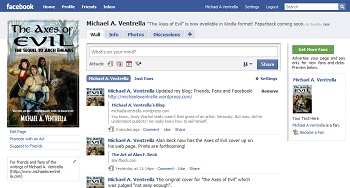
And you can join my Facebook fan group here.

Thanks for the indulgence. Next week, back to interviews!

Friends, Fans and Facebook

You know, Andy Warhol really wasn’t that great of an artist. Seriously. But man, did he understand publicity! He really knew how to sell himself.

And sadly, that’s the hard truth in today’s world. Why is it that great bands with loads of talent never seem to make it while Lady Gaga gets to perform at the Grammy awards? And why do some authors sell so much more than others who may be better?

It’s all about the publicity.

Now, before you start giving me exceptions and arguments, realize that there is still a minimum that must be met. All the promotional push in the world won’t help you if your work really sucks. But assuming you are at least talented enough to be in the running, you face the hard reality of letting people know about you.

Even published authors with book contracts know this, as you can see from the various interviews I’ve done here on this blog. You need to keep yourself in the Public Eye.

But, like all advertising, you should target your audience appropriately. Buying an ad in Doll Collector Magazine probably won’t help you sell your steampunk novel.

In the last few years, Facebook has become the place for meeting with potential readers directly. (It’s not the only place, but it certainly is the largest and the subject of this post.) Besides being a great way to meet old friends and keep in touch with them, it’s a wonderful tool for promotion. I love it! I’ve been able to keep up with my favorite authors — who actually comment back! — in a way that would have been impossible just three years ago. And they love being able to interact directly with their fans and let them know what they can look forward to.

I’ve placed links on my web page to my Facebook page, mentioned it in interviews and biographies at science fiction conventions I attend as a guest, and included it in my “About the Author” note in the back of my latest novel. I’ve befriended many people who I don’t actually know because of this, and that’s exactly what I want!

This comes with risks, though, because you want to balance the line between reasonable self-promotion and acting like a constant advertisement. Further, you have to not get too controversial and anger people over things that have nothing to do with your writing.

I’ve had this problem a few times, indeed. My political views might be just fine with friends, but people who only care about my books may not like reading my views on Republicans or gay marriage. And I’ve seen a big problem with a few other people I’ve been friends with — one woman seemed to only post about her job with Amway, and it was clear that the only purpose she had on Facebook was in making sales. I’ve put her on “ignore.”

Anyway, recently I was advised that the thing to do is to start a Facebook “fan” page where I would only post about writing, leaving all the other stuff for my personal page. I had hesitated doing so previously because of two things: First, it seemed kind of egotistical. Creating a “fan” page for yourself? Geez! Second, I was worried that I’d get only a dozen people joining and then I’d look really foolish.

“Pretend that instead of it being called a ‘fan’ page that it’s a ‘professional’ page,” I was told. “Besides, when you’re shopping your next book to agents and editors, they’ll look for things like this.” Well, that did it.

So I started one a few days ago, and fortunately I already have over 100 members. I’m only posting information about my books, personal appearances, and what I’m working on, and trying to not post too often so as not to appear to be spamming.

But still I feel slightly uncomfortable about the whole thing. I’m not some big name author; I have a few books with a small publishing house. But apparently, if I want to ever be more than just that, I need to think bigger and I need to constantly promote myself.

So please come join! I look forward to seeing you there.

Networking

Does it seem like a lot of the advice I have been posting here is about promoting yourself as a writer? Have you noticed that a lot of the authors who have been interviewed talk about web pages and Facebook and conventions and such?

That’s not by coincidence.

For years, I wrote … and sent query letters and wrote … and read books about writing and wrote … and while I did get better at the writing part, I wasn’t getting anywhere professionally.

The sad fact is that talent will only get you so far. You need a certain drive and promotional zeal to take it to the next step. You need to make connections and use every avenue at your disposal. And this applies to even published authors.

One way is to attend conventions, which I blogged about previously. You also need to take advantage of all the social networks available to you, such as Facebook, My Space, Twitter, Good Reads, and so on. (Note that my web page has links to all of these.) And of course, you need a professional web page of your own.

I’ll discuss those in more detail in a future blog post, but for now, let’s talk about actual writing groups, where you can meet people face to face.

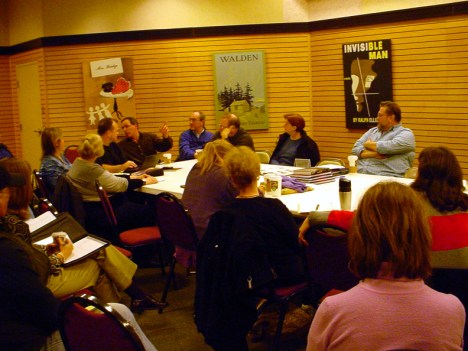
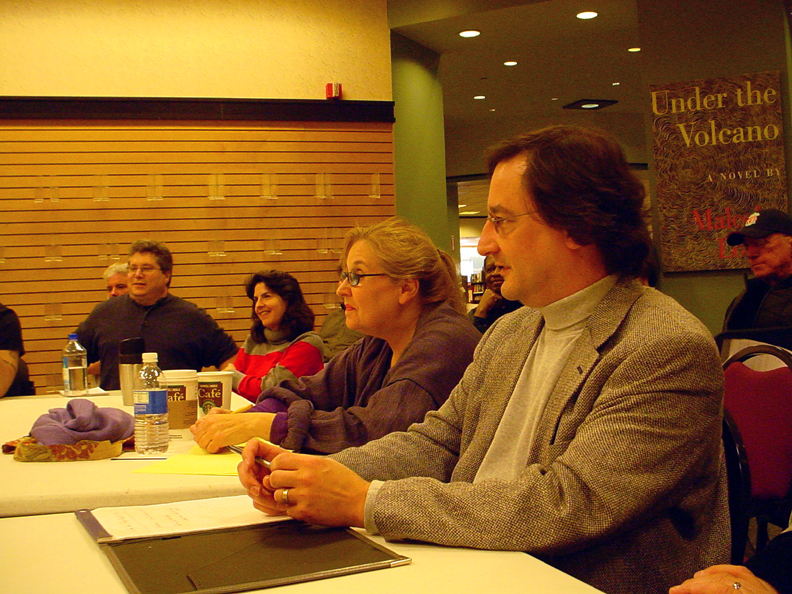
Jonathan Maberry and his friends in the Philly Liar’s Club (including Gregory Frost, Dennis Tafoya, Marie Lamba and others) set up one such group, called the Writer’s Coffeehouse. I first attended about a year ago and have tried my best to never miss one since. I drive over 75 miles one way to go there once a month. It’s invaluable for many reasons.

First, you get to meet professional writers who have experience in the business. They can tell you what has worked for them and what hasn’t. They can help you draft the query letter and maybe even introduce you to agents and editors. They can answer your questions and help steer you away from the rip-offs and traps that plague many starting writers.

Second, other unpublished writers like yourself will have useful connections and relationships. They might know of other groups in your area, for instance. They also want to network just like you. (A quick aside: In case you don’t realize it, you are not in competition with other writers. This is not a zero-sum game. Someone else’s success does not mean your failure.)

Third, you can also learn some writing skills. At the last Writer’s Coffeehouse, there was a nice discussion about voices — how important it is to make sure that each of your characters speaks in a unique way. Ideas were thrown about as to how to best achieve this, with the understanding that what works for one person may not be universal.

Fourth, you can get valuable networking advice. This blog came about because of the Coffeehouse. Jonathan mentioned keeping a public presence and said that interviewing other authors was a fun and fairly easy way to make a weekly post. I decided to gear this blog for aspiring authors and toned my interviews accordingly, starting with Jonathan. It’s been great! I’ve been able to meet many of my favorite authors (albeit mostly through emails), and every time I post another interview, these authors mention it in their Twitter posts and Facebook status updates, and the blog gets visited. Every visitor reads my name over and over again, and quite a few have started following me on Twitter and Facebook as well. It’s a win/win. And it’s an idea I would not have come up with on my own.

Finally, you can promote yourself. It goes without saying that writers are also readers, and maybe they might take an interest in your work, give you valuable comments, and maybe even buy your book once it’s published. Writers I have met at the Coffeehouse have invited me to participate in book signings, interviewed me on their blogs, and otherwise helped expose me to a broader audience.

The Coffeehouse is a great resource, and I am very happy that Jonathan has organized it. He is a tremendously busy writer who has many projects on his agenda. So why does he take the time to meet every month with other writers and writer wannabes?

Haven’t you been paying attention? Networking! Even successful professional writers want to meet others to share ideas, discuss the craft, and see what others may have learned about the trade since the last meeting. Plus they want to promote themselves. I mean, look, I’m writing about Jonathan Maberry, aren’t I? You’re reading it, right? Aha! It worked!

Finally, an obvious disclaimer: All the promotion and networking in the world won’t help you if you are a terrible writer. Work on your craft! You need something to promote, after all.

Interview with Kelly Jameson

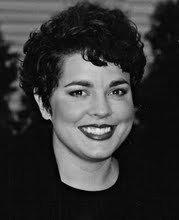
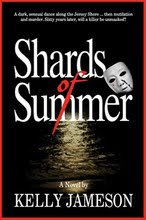
MICHAEL A. VENTRELLA: After last week’s blog about self-publishing, this week we have Kelly Jameson, a self-published author, to discuss her experiences. Kelly has two thrillers published, SHARDS OF SUMMER and DEAD ON.

Kelly, tell me about your books!

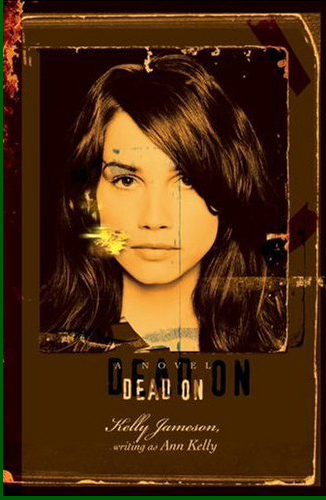
KELLY JAMESON: DEAD ON is the story of a medical examiner being stalked through different lifetimes by the same killer. History seems to be repeating itself. I set the story in Doylestown, PA because I grew up in the area. While the story is fictional, there are a lot of real-life places used in the book. I even put a body in the CB West football stadium. DEAD ON was film-optioned for two years by Gold Circle Films (they produced “White Noise” and “My Big Fat Greek Wedding”). It was also named Runner-Up in the 2006 DIY Los Angeles Book Festival. So I feel very fortunate and I think it shows that good things can happen with independently published books that you write and edit yourself. It is possible. In fact, when I was contacted by Gold Circle about movie rights via email, I almost fell out of my chair. The rights are back with me now and I’m working on a screenplay with another screenwriter on the script. We hope to have it completed by end of December and ready to pitch.

VENTRELLA: What’s your writing background?

JAMESON: I’ve wanted to be a writer since I was five years old. I used to write poetry all the time. Some of it was really bad. But that’s how you learn to be a writer—by writing. And reading.

I have a Journalism background. Got a degree from Bloomsburg University. I wanted to be a local sports reporter. Somehow I ended up a medical editor by day. Being an editor, editing my own books, has helped me to polish my indie novels and make them stand out.

VENTRELLA: How did you decide to write these books?

JAMESON: One of the characters in DEAD ON seemed to be tapping me on the shoulder and wanted to have her story told. That’s how it began. With a character and a “what if” situation. SHARDS OF SUMMER was really fun to write. I love the beach and Ocean City and wanted to write a story about lust, love, and obsession, about the wars going on inside each and every one of us every day. I like to write about flawed characters. The story starts with an elderly woman being arrested for the murder of a decorated WWII soldier on the beach 60 years ago. But of course, things aren’t as they seem … As a young woman, the main character was a dancer in a girlie show who got tangled up in an affair with a married homicide detective investigating murders in Ocean City.

VENTRELLA: How did you decide to self-publish?

JAMESON: I’m not very patient. The industry is a tough nut to crack and it seems to be changing on a daily basis. After a few positive rejections for DEAD ON, I followed my intuition and published it myself. I think that’s important in this biz—there’s more than one way to get your work out there and sometimes you just gotta take chances and do something.

VENTRELLA: Had you previously submitted your books to editors and publishers?

JAMESON: Yes. I even had an agent for eight months. However, when the recession hit, he pared his client list down and as a new writer, I was on my own again even though he thought my writing was excellent. I quickly became frustrated with the process. For my second novel, same thing. Got some positive rejections and some incoherent, nonsensical dismissals. It’s a very subjective biz. I decided to see if I could get it cookin’ myself … and fortunately I’ve had the support of established authors such as Ken Bruen (ONCE WERE COPS and GUARDS) who not only read SHARDS OF SUMMER but called it “THE GREAT GATSBY for the beach generation.” It’s so encouraging when a ‘new’ writer finds an established, best-selling author who is willing to read your material and blurb it. Jonathan Maberry says, “DEAD ON by Ann Kelly is a stunning first novel that blends ghostly happenings, romance, eroticism, time travel and intrigue into a genuine page-turner. The Ann Yang character (Bucks County, PA medical examiner) is particularly well-drawn, and the story builds nicely to a satisfying conclusion. I highly recommend it.” Kat Martin, NYT best-selling author says, “She’s a brilliant writer. No questions asked. She has a gift for the eerie. The words she chooses are absolutely brilliant. She has an incredible talent for stringing words together.”

If you like CSI meets the X-Files, you’ll probably like DEAD ON.

VENTRELLA: What do you see as the advantages of self-publishing?

JAMESON: You get to put the book out there pretty quickly and the way you want to. It’s fun to market it yourself, even on a limited budget. There are many local independent stores willing to help out. The Doylestown Bookshop sold 600 copies of DEAD ON so far! They’ve been really great. I think I’ve managed to sell about 2,000 copies of DEAD ON. I’ve read that a traditionally published first book has typical sales of 1,000. So I feel pretty good about my sales and I’d like to thank all my readers.

VENTRELLA: In my last blog, I made some comments about how there is a stigma against self-published books, even if they may be excellent. Do you agree?

JAMESON: I agree that a bias still exists against independently published novels but I think we are seeing some definite, and positive changes, in the publishing arena. I’ve had many positive experiences with my books. I don’t agree with the statement on your blog that “if you really want anyone else to consider you a real writer, avoid these things [self publishing companies] completely.” Of course most of us want to crack the traditional publishing nut and see our books at the front of bookstores everywhere.

Getting published traditionally is becoming more and more like winning the lottery. American publishing is basically averse to taking risks with new writers and tends to want to put everything in a box or a category. The ones who take a chance on multi-genre or slightly literary works still put out literary best sellers. It can happen. And I’m going to keep trying to crack the nut. I believe in my work 200% and I’m following my intuition in putting my books out there and marketing them. In fact, because of my first two novels, a small publisher who likes my style and storytelling approached me about writing a zombie novel and I just got the green light to write it based on my pitch! I’m also working on a new werewolf novel.

If you do publish yourself, investigate the companies. Some are vastly better than others and more fair. Ask other authors about their experiences. Look into the backgrounds of the companies…are there any complaints on the Internet about them? Are there glowing praises?

VENTRELLA:Did you hire an editor?

JAMESON: No … I’m an editor so I did it myself. But sometimes you don’t see things in your own work, so I also have fellow writers and family members who graciously read my work and comment.

VENTRELLA: Did your publisher provide the cover or was that your responsibility as well? Did you have any say in the decision?

JAMESON: For DEAD ON, I gave iUniverse my idea and loved what they came back with. The front looks like sort of an old photograph that’s fading. The book goes back and forth in time between the present and the early 1900s and Ann Yang, the medical examiner, uses all her forensic skills as well as past life regression to solve the present-day crimes. I interviewed a past life regression specialist in Doylestown while writing the book and it was fascinating.

For SHARDS OF SUMMER, I did not go with the cover BookSurge provided because I felt it was too colorful and not right for the tone of the book. A designer from a small publisher helped me out and gave me a great cover, a dark mysterious cover that’s perfect for the book. I’m really pleased with it because I think it’s stunning. And covers are critical if you want readers to check out your book.

VENTRELLA: For those readers who would like to self-publish, what do you advise? How do you decide which company to go with and so on?

JAMESON: Do an Internet search. Keeping in mind your goals for the book, compare prices and services, percentage royalties paid, additional free services and distribution channels, and make a decision. Then go for it…and have fun with it. Don’t plan on making a whole lot of money. Plan on meeting lots of great people who are truly supportive of your work. Plan on making community connections. Plan on doing something that feeds your soul. Plan on your material maybe leading to other unexpected experiences, like trying your hand at screenwriting. Plan on meeting other authors and supporting each other. Set up your own local signings and write press releases and send to the local media.

I’ve also started writing short stories to practice things like dialogue and so far I’ve been published in The Summerset Review, The Mammoth Book of Best New Erotica 8 and 9, Dispatch Litareview, Amazon Shorts, Withersin Magazine, Barfing Frog Press, The Twisted Tongue, The Big Stupid Review, Ruthie’s Club, The American Drivel Review, sliptongue, ThugWorks and Ramble Underground. I have three shorts slated for publication in 2010 in Revenant magazine, TangledBank Press (Australian anthology) and Sex in the City (Paris edition).

VENTRELLA: What have you done to publicize the book?

JAMESON: For my first book, I did a lot of local signings, was interviewed by the Philadelphia Inquirer and other local newspapers, did some advertising myself (on a limited budget) and I’ve kept in touch with several hundred readers who ask for updates on my books and short stories, etc. I did co-op advertising with iUniverse and twelve authors were featured on a one page ad in the NY Times Book Review. That’s where Gold Circle saw my book and contacted iUniverse about the movie rights.

SHARDS OF SUMMER just went live on Amazon.com and so I will be setting up signings very soon. I hope to do some fun things and contests with beach glass because that’s a theme throughout the novel. I have a very limited budget so I’ll be peppering the media with news releases and hoping to do a few signings where the book is set, in Ocean City, New Jersey, too. I just set up a blog at http://kellyjameson.blogspot.com/. Hope you’ll keep in touch!

Interview with Jay Lake

MICHAEL A. VENTRELLA: I’m pleased to be interviewing Jay Lake today. Jay is a winner of the John W. Campbell Award for Best New Writer in Science Fiction, and has been nominated for numerous Hugo awards and World Fantasy awards. His web page is here.

JAY LAKE: Michael, thank you for having me here. I’m very glad to be sharing my experiences with your readers.jay-lake_author-photo_Tor

VENTRELLA: Jay, how did you get started in the business?

LAKE: I began with short stories. Sold my first story in the spring of 2001, and two more that year. Sold about a dozen stories in 2002. Since then it’s been a big part of my writing practice. Did that for a while, all the way through earning the Campbell nod in 2004, before I got traction on novels.

That’s not to say that short fiction is the way everyone should enter the field. In some ways, novels are easier to sell. And if one wants to write novels, one certainly should. Don’t force short fiction because someone like me said it was the path.

VENTRELLA: You’ve placed a few short stories on your web page for free; do you advise this approach for new authors trying to establish themselves?

LAKE: In my case, the stories on my Web page are either Web reprints of older stories that have been in print already, or occasional one-shots of short pieces that for some reason I didn’t feel were what I wanted to market.

For a newer writer, the appeal of a “free sample” approach can be powerful, but I’m not certain of its value. You’re an unproven quantity until you’ve passed through the gateway of an editorial proxy. And most of us don’t have a good sense of the quality of our own writing. Posting something that you and the world would later see as sophomore work migh be iffy. On the other hand, I’m all about being proud of who you are.

VENTRELLA: What are the legal and contractual limitations of doing so?

LAKE: Well, the primary issue is first rights. I’m not an attorney, and I don’t play one on the Internet, so this is not legal advice. But it is common sense advice. If you don’t already know how copyrights work, learn.books_mainspring

Basically, a copyright is a piece of property. You rent it out but you rarely if ever sell it. Each of those rentals is done by licensing a right. The rights are not explicitly defined in law. The rights themselves are defined on a case-by-case basis in each contract, and generally include such things as print rights, audio rights, electronic rights, ebook rights, gaming rights, film rights and so forth.

The first time a work is published is considered to be “First Rights”. While electronic publishing (e, appearing on a Web site) does not in fact expire the first print rights, most editors will view any prior publication as a first rights usage. So if you put someting on your Web site, you’re making it unlikely that anyone will be willing to buy it later for professional publication.

Note that aspiring writers are often concerned about protecting their ideas, or having their work stolen. While this can be an issue in Hollywood, it is rarely an issue in print fiction (defining “print” fairly loosely to include online, ebooks, and so forth). The reason that this is rarely an issue is that ideas are the easiest part of the process. Why would anyone need to steal your ideas when they can make their own?

Think about it. You write a fantasy about a quest through a magical kingdom by a mixed band of adventurers. Is that such an original idea that you’d be harmed by someone else writing such a book? There are already thousands of them in the market, an entire subgenre’s worth. Your fantasy includes a dwarf werewolf named Yoni who has a crippled foot from a sliver of moonsilver embedded in the sole when the wizard bar-Simon was assassinated by the Carmine Council. Is that such an original idea that you couldn’t make up another one just as good in the same ten seconds it took me to write that sentence? And probably better?

Short of outright plagiarism, which is quite rare for us, theft isn’t much of an issue. Where it does occur is in the area of unauthorized reprints, and ebook piracy, and those are largely concerns of established writers. To be blunt, if you have such problems it will be because you’re already succeeding.

VENTRELLA: All authors these days spend a large amount of time on self-promotion, from posting a regular blog to producing podcasts to appearing at conventions. What’s your opinion on the relative value of each?

LAKE: Writers write, first and foremost. The rest of it is just marketing, of little value if you have nothing to market, and of not much more value if you do it at the expense of further writing.

That being said, I’m a fan of doing anything to raise your profile and build your brand among readers, editors, reviewers and critics. But only if whatever you’re doing is fun for you, and more importantly, fun for the people who encounter you. In a professional sense, it’s not entertaining to read about your cat’s trip to the vet, or how many smoothies you made for breakfast this week. Likewise sitting around a convention bar griping about how your landlords keep screwing you on security deposits. But, if you can be relevant, or entertainingly tangential, in your blog or podcast or convention persona, you have a hook.

Plenty of people have done this. Mur Lafferty has made a niche for herself with her “I Should Be Writing” podcasts. I have my noisy-fat-guy-in-loud-shirt persona I wear around at cons. (And honestly, in real life, too.) Jim Van Pelt used to run a Campbell Awards Web site. Jeremiah Tolbert edited “Fortean Bureau”, and now “Escape Pod”. All of us did so while building our presence as writers. But we’re all having fun doing what we’re doing, and fun is contagious.

Doing something because you “should” is the kiss of death in this business. There are some exceptions: You “should” use standard manuscript format. You “should” enclose a SASE with postal submissions. You “should” read your contracts carefully before you sign them.

But in self-promotion, there really aren’t “shoulds”, there are only “coulds”.

Take me. I’m a demon blogger. I use my blog, across both LiveJournal and WordPress, with feeds to Twitter and Facebook, to talk about a number of things that interest me. I have regular content on a daily basis, special features several times a week, and continuing series about certain topics, such as my kid, writing processes and my journies through cancer. Some people read me for my strong leftie politics, some can’t stand that but read me for the daily round up of culture and science links. Some people follow me because they’re fans of my kid. Some people follow me for my fiction alone. I offer a range of content, all of which is interesting and engaging to me.

On the other hand, I’ve tried podcasting. It bores me. I don’t do podcasts much at all, because I can’t make them interesting enough, because they don’t interest me. If you like audio production, and expressing yourself through that medium, and have a lot to say, by all means, it’s a growing area. I’m probably missing out by not doing it myself. But it just doesn’t work for me.0765317095.02.LZZZZZZZ

As for conventions, I am of the first belief that one can have an entire highly successful career in this field and never set foot inside a convention. At the same time, writing is by its very nature a solitary act, and conventions are one of the few frameworks where we authors get to interact face-to-face with our peers, our editors and agents, and most importantly, our fans. If your social skills are on the outliers of the bell curve, this may not be the venue for you. Likewise if you are so introverted that groups of strangers are literally painful for you. (Both of those are true of many writers.) But if you can be personable and engaging and enjoy yourself, they’re a hell of an opportunity for networking.

VENTRELLA: How important is the social media (Facebook, Linked in, My Space and so on)?

LAKE: Ask me in five or ten years. Five or ten years ago, I couldn’t have given you a reasonable answer about how blogs would work out. I can tell you that far more people read my Twitter feed every day than read my blog directly, and that I have about as many Facebook friends as blog followers. I can also tell you that my Facebook feed gets more comments than my blog feed, at least most of the time. But the nuances of that? And the long-term value? No clue. Not yet. I do it becaus it’s fun, and because those are places where I can interact with people.

VENTRELLA: What trends in current genre literature do you hate? What vents your proverbial spleen these days?

LAKE: Enough with the vampires already. And I can rant for hours about how most magic systems violate Newton’s laws, as well as the basic rules of economics. But really? Not much hating going on. Taste, yes. I refuse to read TWILIGHT. But millions have read and loved that book and its sequels. I can’t hate on anything that gets people to look at print literature.

VENTRELLA: Who do you love to read? Who has inspired your work?

LAKE: Gene Wolfe. Ursula K. LeGuin. Jeff VanderMeer. Lois McMaster Bujold. Jeffrey Ford. K.J.Bishop. M. John Harrison. Terry Pratchett. Maureen McHugh. And so on and so on and so on. Our field is full of marvelous writers working from every direction, every theme, every plot.

VENTRELLA: Of what work are you most proud?

LAKE: That’s like asking me of which child I am the most proud. (Admittedly, I only have one child, so that question is not so hard to answer.) I suppose I’d point your readers to my latest Tor book, GREEN. It’s a coming of age story set in a secondary fantasy world, about a girl sold into slavery at a very young age who is trained to be a courtesan, while secretly being countertrained to assassinate the man she is intended for, a powerful Duke. green-jay-lake-largeShe rebels against both fates, tries to go back to the land of her birth, and makes a mess of a great many things before being forced to save a city, some lives, and even a god or two, in the course of repairing those messes. It’s courtly fantasy, with sex and violence and cityscapes, though not so much with the magic.
I wrote the book for and about my daughter, very much drawing from her character to build Green, the protagonist. Getting inside the head of a young girl of color with Green’s peculiar history was quite a stretch for me as a writer, but so far the readers have loved it. I hope you will, too.

VENTRELLA: What’s your opinion on self-publishing? Do you advise new authors to go this route, or is it better to not publish at all than to be self-published?

LAKE: I share the rather strong tic again self-publishing which can be found among the community of professional writers. Especially for aspiring or early career writers.

Here’s the simple reason. You don’t have any real idea how good your work is, or what its flaws are. Nobody does, especially not early on. That’s what editors are for.

I’ve been publishing professionally for almost a decade, and I’m only beginning to see it in my own work. That story of yours that is brilliant, better than anything you’ve seen in print this year? Maybe it is, maybe it isn’t. But you’re not likely to be able to judge that.

What the self-publishing route does is three things. It allows you to commit work to print that you will quite likely later come to question the wisdom of. If the work is as good as you believe, you’ve lost the ability to sell first rights by self-publishing. And it will reduce your standing in the eyes of professionals in the field, especially editors.

Note that for some purposes, self-publishing is a brilliant tool. Family histories, local interest cookbooks, private editions for a holiday gift, etc. But as a success path for commercial fiction? Not so much. And yes, there’s always a story about this author or that who got a huge contract after a self-published success, but no one ever tells you how many people didn’t.

Remember, editors and agents aren’t out to publish their friends, or suppress new talent, or any of the other things you hear people grumble about it. Quite the opposite. They want nothing more than to find hot new talent, and be the one to bring the work, and the author to market. And they do have an idea of how good work is, and what will succeed in the market.

Publishing is a meritocracy, but it’s not a just meritocracy. Nothing is ever quite fair or sensible. But if you want the credibility and impact of being commercially published, you need to follow the routes that work to enter commercial publication. And yes, it’s a game whose rules change all the time. So far, the rules haven’t changed to include self-publishing as a strongly valid option.

VENTRELLA: You’ve blogged about your fight with cancer. (As my wife is a cancer survivor, I certainly can relate in some small way.) How do you think this will affect your future writing?

LAKE: Cancer will indelibly affect my future writing. It already has. My voice, my themes, my view of myself and the world have been bent in a new direction. Not one I would ever wish on anyone, least of all myself, but there’s a lot of passion, power and pain in cancer. As I write this, I’m two weeks from surgery to remove a metastatic tumor from my lung. Second trip through the cancer mill. Believe me, I have learned new lessons in fear and terror, but I have also learned new lessons in hope, glory and blinding love.

That cannot help but change everything. Once again, I won’t know how til years down the road.

VENTRELLA: What advice do you wish someone had given you when you first began trying to break into the business?

LAKE: Really, I got plenty of good advice. I mostly wish I’d taken more of it.

I think most aspiring writers go through phases. One phase is “I’m an undiscovered genius”, and it’s characterized by a lot of hot pride. Another phase is “publishing is a conspiracy”, characterized by fear and resentment. Another phase is “I suck, and I’ll never make it”. You get the drift.

Each of those phases brings with it a certain wilful deafness. I wish, when I’d been in those phases, that some future me, or someone wise enough to speak in a way that got past my defenses, had simply said, “Shut up and write.”

Because “get back writing, then write more” is the only real advice.

In fact, it’s what I’m going to do right now. Thank you.

Interview with Chris Redding

MICHAEL A. VENTRELLA: Chris Redding primarily writes romance fiction. In 2004, Wings Press published her first romantic suspense book titled THE DRINKING GAME. ChrisRedding In 2007, Enspiren Press published her next book CORPSE WHISPERER, a paranormal romantic suspense book. Her third is soon to be published. She also teaches courses in writing and is active in the writers’ group “Liberty States Fiction Writers.” Her web page is here.
Chris, When writing romance, what are the key elements that you believe need to be present?

CHRIS REDDING: You must have a hero, a heroine and a happy ending. There must be some reason in the beginning that they cannot be together and both of them must overcome the obstacles by the end of the book for that happily ever after. Both can be flawed, but they can’t be unlikable. They can’t be mean or cruel. Lastly, the motivation for their actions must be clear.

VENTRELLA: Have you had any formal writing training? Do you think that is necessary?

REDDING: I have a BA in Journalism from Penn State though that should not have prepared me for writing fiction! And if it did my professors would be mortified. Other than that I’ve been to conferences and participated in workshops for ten years. Not sure if you’d consider that formal or not. I don’t think you need a degree in writing to write. You do need to be educated about the business of writing. You also need to know about the genre you write in. There are guidelines you must adhere to for each.

VENTRELLA: You have two books published so far, with two different publishers. How did that come about?

REDDING: With smaller publishers coming and going, I did not want to put all my books in the same place. One of my fellow writers in a group I was in at the time raved about Wings. She was so happy there that it was infectious. And they accepted my first book THE DRINKING GAME which came out in 2004. Then a few years later I heard a small Canadian publisher, Enspiren, was looking for submissions. They accepted my second book, CORPSE WHISPERER, which was released in 2007.corpse

VENTRELLA: How did you end up with your current publisher?

REDDING: My next book will be out with LBF books in the Spring of 2010. I pitched INCENDIARY to them in 2008 at a conference I attended. I feel each step has been a step up in terms of my career. That’s why I’ve chosen each publisher.

VENTRELLA: Would you advise beginning writers to contact them, or are they fairly specialized?

REDDING: Enspiren is more a boutique publisher. Wings and LBF Books accept more genres and publish more books each year. They would be more what a new author is looking for.

VENTRELLA: What’s your opinion on self-publishing?

REDDING: I think it has its place. I haven’t read many self-published books so I really can’t speak to their quality or lack of. It just never seemed the way to go for me. I think you must have already established outlets I which to sell your books. I don’t so I never saw it as a good fit.

VENTRELLA: What’s next? What are you working on now?

REDDING: I’m working on a novella about an angel who investigates crimes. It’s for a call for submission by a specific publisher. With my critique group I am working on a romantic comedy I hope to pitch at a conference in March. My edits for Incendiary will arrive at the end of November so all that will be on hold until they get done.

VENTRELLA: Have you ever considered writing in any other genre?

REDDING: I have been approached by a former co-worker to co-write a children’s picture book with her. I’ve also written a book geared towards the early elementary grades. It’s a chapter book about a pencil monster. I haven’t really done anything with it. If you want a short answer, yes, but I read mostly thrillers, mysteries and suspense so I’m most comfortable with those genres.

VENTRELLA: What is your writing style? Do you tend to rely on outlines first or do you just plow right in?

REDDING: I plow right in. A true pantser. The only things I need to start are the names of the characters, the title of the book, and maybe the conflict they have. I trust that the words will be there when I sit down. And they always are. drinkingThey aren’t always the best words, but that’s what revising is for.
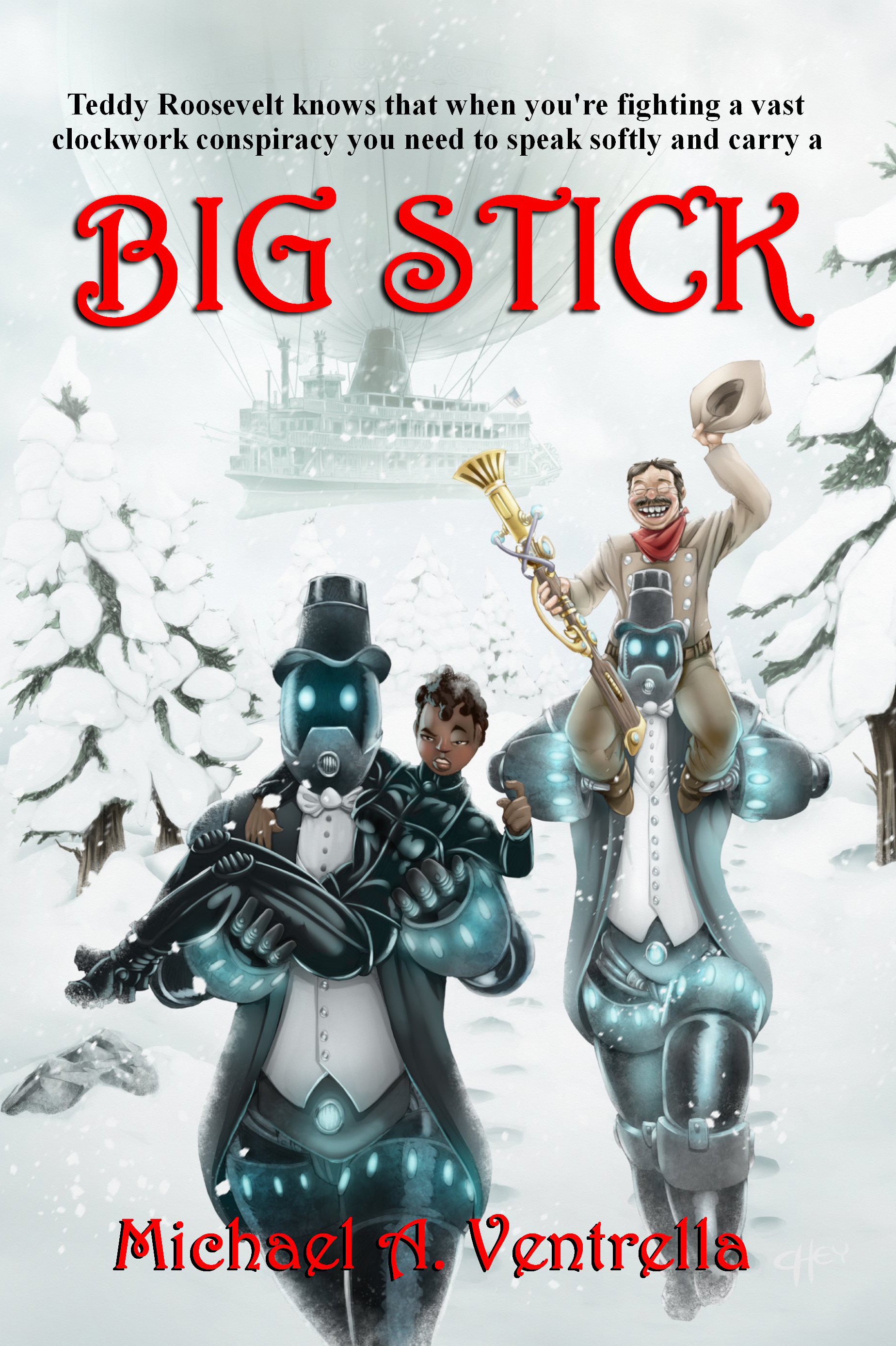
VENTRELLA: What was your biggest mistake so far in trying to make it as an author?

REDDING: I listened to two people at the very beginning and they led me astray. Not on purpose. I think they had the best of intentions, but they didn’t know as much as I thought they did. Neither is published at this point so I was lucky to find some more knowledgeable writers to take advice from.

VENTRELLA: Do you have any specific advice you would give a writer trying to make it in the publishing business that they may not have heard before?

REDDING: Besides being wealthy so you can buy a publisher? Uh, no that won’t work. You need to have a realistic belief in yourself. What do I mean by realistic? I’m 5’ 2” tall. I’d never make it as a professional basketball player. That’s realistic. What I do know, is that any time I needed to write something to test out of a class in school, I succeeded, including freshman English in college. Does that mean I know everything? No, It means I have a good base to build on.

Thanks for having me on your blog, Michael!