Interview with Hugo nominated author Michael Flynn

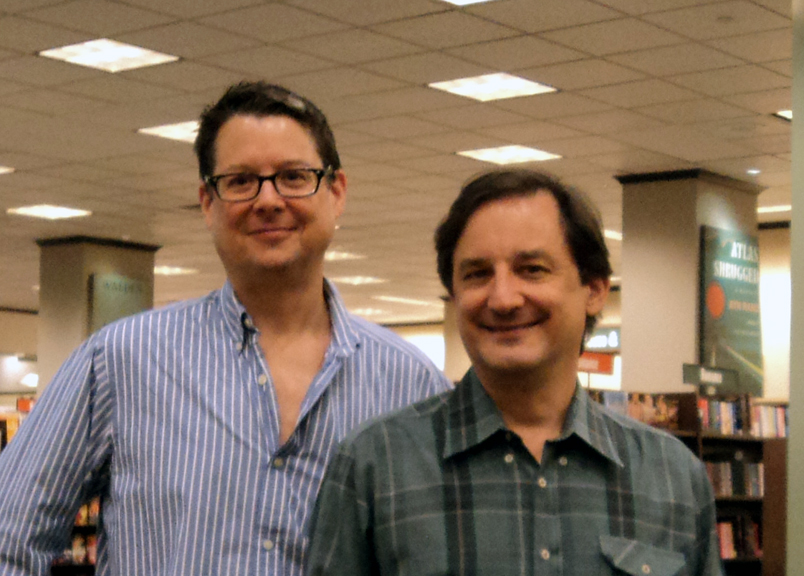
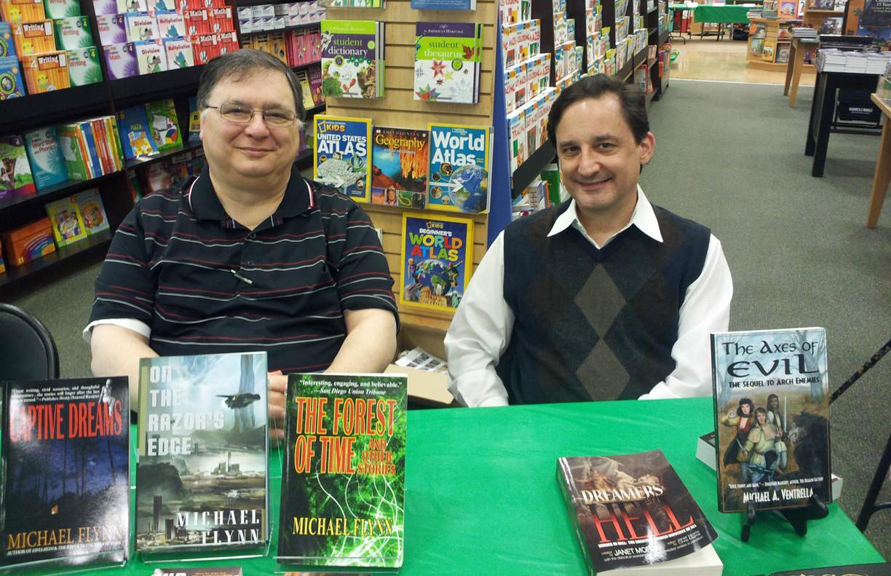
MICHAEL A. VENTRELLA: Today I am pleased to be interviewing Hugo-nominated author Michael Flynn. Mike and I met at the Greater Lehigh Valley Writer’s Group and have run across each other at Philcon and other conventions before, but we’ve never really had a conversation together, so this should resolve that.

Mike, what was your first big break into the business?

MICHAEL FLYNN: I entered a contest by Charlie Ryan, who was editor at the old Galileo magazine. It was for never-before published writers. So I wrote a story “Slan Libh,” about a fellow who has invented a time machine and decides to use it to feed his ancestors during the Irish Potato Famine. Charlie decided to buy it for the magazine instead, which was a larger payment. However, the payment was “due on publication,” and that never happened. Galileo went belly-up. My brothers, ever willing to offer encouragement, suggested the magazine folded because they had been reduced to the desperation of buying my story. For a while, Charlie tried to shop an anthology, but nothing came of it. So, I took the rights back and tried it at Analog, where Stan Schmidt bought it. It appeared in the November 1984 issue.

Two of my first four stories made it onto the Hugo ballot, which certainly did not hurt. This led another writer, the late Charles Sheffield, to urge his own agent to take me on as a client. Charles became a very dear friend, and not least because I only found out years later that he had done that.

VENTRELLA: Did you have any formal writing training before submitting your first work?

FLYNN: Nope. Just the usual English classes in HS and college. Never did workshops, either. OTOH, I did read voraciously.

VENTRELLA: You’ve done quite a few short stories. Do you find them more difficult than longer works?

FLYNN: Stories are less forgiving than novels, in that there is no space for self-indulgence. A novel can meander a bit and still keep the plot going, and has more room in it for scenes devoted to character-building, scene-setting, and the like. But shorter fiction must do all that with a greater economy of words. I find that they take longer to write relative to their length and from an economic perspective not at all cost effective. But I still write them because there are some stories that don’t need a novel to rattle around in. Take a story idea and put it in a novel, and you lose density. The whole seems fluffy. But put an idea in the right length of story and it is more dense and powerful. At least, that’s the way I think of it.

VENTRELLA: Your work is usually classified as “hard science fiction.” Do you agree with that classification?

FLYNN: Well, I’ve often considered them to be “high viscosity” science fiction, a term I coined in a moment of whimsy, but which seems appropriate. Some reviewers have made such comments as “…unlike most hard SF…” without seeming to notice that they were undermining their own idea of what hard SF means. There is an unexamined assumption that hard SF gives insufficient attention to character. But that may have been more a matter of decade than of genre. A story stands on four legs – idea, plot, setting, and character – and can remain upright on any three of them. I don’t insist that all stories have the same strengths. A captivating idea executed in a page-turner plot in a vivid setting can tolerate characters from central casting.

To this we can add the actual wordsmithing, or style. The rumor is that hard SF is less “literary” in style. I’m not entirely sure what that means, except that it leads reviewers to write things like “…unlike most hard SF…” when they notice stylistic acuteness.

VENTRELLA: How do you define “hard science fiction”?

FLYNN: As “science fiction.” Emphasis on both words. It should be a story in which some element of speculative science or technology plays a vital role, and does not serve as simple stage props. And the author takes some pains to “get the science right.” So “Flowers for Algernon” is hard SF, but “Star Wars” is not.

Of course, no one gets everything right, and sometimes the speculative science turns out to be wrong; so it’s more a matter of intent and thrust than it is of successful calculations and prognostications.

VENTRELLA: Science fiction is being outsold by fantasy these days. Why do you think that is?

FLYNN: The Modern Ages, which were among other things the Age of Science, have ended and we have moved on and/or back.

VENTRELLA: Do you find that there is less respect for science these days?

FLYNN: Yes. Partly, this is due to scientific hubris by which (mostly) fanboys of science set Science-with-a-capital-S as the colonial power of the intellectual world, invading other domains of human thought and disparaging philosophy, humanism, religion, and other endeavors. Partly, it is due to feminism, environmentalism, and government funding. Modern Science differed from Medieval Science in an important respect. The natural philosophers of old were in it to comprehend and appreciate the beauty of nature; modern science was redefined by Bacon, Descartes, and others to be subordinated to the production of useful products “to increase Man’s dominion over the universe.” They meant Man in a very masculine sense, and the exploitation of nature as completely open-ended. Hence, the feminist and environmentalist critiques in the Postmodern Age were not without some merit. Thirdly, as Eisenhower warned in his Farewell Address, the government-science funding complex meant that eventually science would be subordinated to political goals. All these strands contributed to undermining regard for science in the Late Modern Ages. When the American Chemical Society funded an exhibit on the contributions of science to modern life, they were astonished when the Smithsonian came up with an exhibit that presented American science as a series of moral debacles and environmental catastrophes: Hiroshima and Nagasaki, Silent Spring, Love Canal, Three Mile Island, and the explosion of the space shuttle.

VENTRELLA: Let’s discuss FALLEN ANGEL, your collaboration with Larry Niven and Jerry Pournelle. How did that occur?

FLYNN: Niven and Pournelle had promised FALLEN ANGELS to Jim Baen, but were under contract to deliver a book to another publisher. But there was no bar to writing a Niven-Pournelle-Third Author collaboration, so they invited a friend to do the rough draft while they worked on the other book. But time went by and the other writer did nothing, so they invited him out. Then they went to Jim Baen and asked him to pick a collaborator. Jim had just published my first novel, IN THE COUNTRY OF THE BLIND, and was about to do a story collection, THE NANOTECH CHRONICLES. Larry and Jerry liked what they read, and so Jim Baen contacted my agent who passed it on to me.

VENTRELLA: How did you handle collaboration?

FLYNN: Superbly.

OK, seriously. (The three of us were on a con panel the year FALLEN ANGELS came out, we were asked that question, and gave that answer in unison.)

It befell thusly. I was given rough drafts of the first two chapters, and outline of the remainder that became sketchier as it went along, and character sketches for a bunch of characters, both fictional and real fans who would be Tuckerized. I was a speaker at a quality control convention in San Francisco and Larry came up and we talked story and batted plot ideas around.

I rewrote the first two chapters, added two more; visited East Coast conventions to harvest more characters, and showed the results to Larry and Jerry. They liked what they saw, made some suggestions, and gave me the green light.

“Showed” doesn’t cut it. This may have been the first novel written by modem. There were problems. I had a Mac, they used DOS boxes. We wound up sending files — dial up modems! Forsooth! — to Jim Baen, who was able to figure out the proper modem settings and translate from one to the other. So “showed” electronically.

Eventually, they made a breakthrough on the main book, then started doing rewrite behind me. There was two of them and only one of me, and I could write only part-time; so they began to catch up fast.

Funny thing was that I met Larry only twice — as aforesaid and at a Norwescon — and Jerry not at all until after the book was finished and I found myself on a client assignment in LA, where we all got together.

VENTRELLA: When creating worlds (either science fiction or fantasy), too often writers ignore politics. You have not done so. How do you make sure you are creating a realistic political world?

FLYNN: I used to be a filthy politician. Not the kind that runs for office — They asked once and I declined — but the kind that runs caucuses and so on. I was precinct committeeman, district captain, and eventually House District Leader. So I’ve seen politicking from backstage. Then, too, as a consultant, I have encountered all sorts of corporate-regulatory interactions. As for other settings, I read a lot of history.

VENTRELLA: When you create a story, do you begin with the characters or do you have some basic plot idea?

FLYNN: Yes.

Typically, its one thing or another. Setting, Idea, Plot, Character. Any of them can be the stimulus. For example, “Melodies of the Heart” started with an idea. In his book, THE MAN WHO MISTOOK HIS WIFE FOR A HAT, Oliver Sacks tells of cases of “incontinent nostalgia,” in which the patient re-hears music from her childhood and sometimes re-sees scenes of her childhood. That is, they don’t remember hearing or seeing in the past as such, but are hearing and seeing these things in the present time. So the notion occurred to me of a woman who as time goes by re-hears tunes from further and further in the past until one day the doctor realizes that the tunes are now “too early” and begins to wonder how old the woman is.

Okay, so what was the story? Doctor listens to old woman hum tunes is not a story. Even doctor discovers old woman’s age is not a story. Who is the doctor? Who is the woman? Why would it matter, to either one of them, how old she is? From this I developed the characters of Mae Holloway and Dr. Wilkes and why it mattered very much to them both. So this was a case of Idea then Character then Plot.

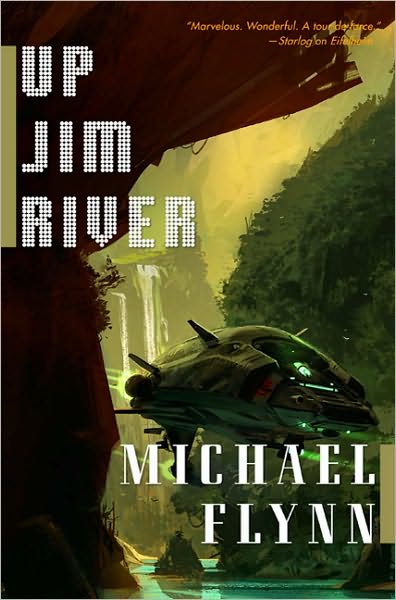
OTOH, I recently sold a novelette, “The Journeyman: On the Short-Grass Prairie,” to Analog. In this story, the Character came first: Teodorq sunna Nagarajan, the Wildman bodyguard in UP JIM RIVER. I got a kick out of his character, and the idea of writing his backstory appealed to me. Likewise, “Elmira, 1895,” started with the characters of Sam Clemens and Rudyard Kipling; while “Places Where the Roads Don’t Go” started with an abstract idea suggested by Searle’s Chinese Room and Lucas’ Goedelian Proof. It may the first hard SF where the S is not physics but metaphysics. “The Iron Shirts,” recently selected for Gardner Dozois’ annual anthology, was suggested by plot elements, as will usually be the case with alternate histories.

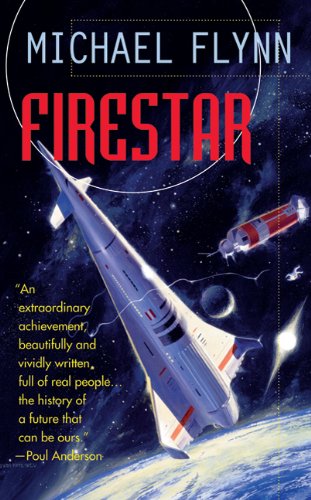
VENTRELLA: Tell us about the FIRESTAR cycle.

FLYNN: I was at a con once with Charles Sheffield. I forget which. And we were at the Tor party. Tom Doherty was holding forth on what Science Fiction needed, which he told me was “near future, high tech, and optimistic.” I pondered on that for a while, since I had been playing with an image of someone listening outside a high school classroom and not hearing learning taking place. The listener became an industrialist, for industry was already hurting for educated workers. But it was a very vague idea. Listening to Tom Doherty started to make it percolate. Setting up a school system to deliberately produce technologically literate students.

Then David Hartwell, an editor at Tor, called and asked if I had ever thought of writing a book for Tor and I said yes and he said what kind of book and I said, “near future, high tech, and optimistic.” Well, you know that had to be a good fit.

The original concept was of a single book covering the maturation of a cohort of students at one of these schools as they grow into the middle managers who save the world. (I had also read Strauss and Howe’s book GENERATIONS.) It was to cover a thirty-year arc; but after 200 pp. it was clearly not going to fit into a single book.

Interestingly, although the near future of FIRESTAR is now the recent past — it’s set during 1999-2007 — Tor has recently issued a second edition without any updating, making it a sort of alternate history.

VENTRELLA: What other works are you most proud?

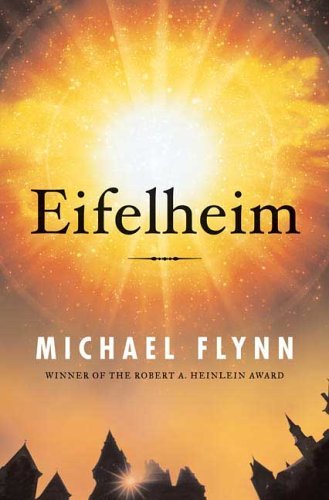
FLYNN: I would have to say EIFELHEIM, since it was a Hugo finalist for best SF novel of the year. It did win the Seiun Award for the Japanese translation and the Prix Julie Verlanger for the French translation. The SPIRAL ARM series is shaping up nicely. THE JANUARY DANCER made #6 for SF paperbacks in October, which is not bad considering that #1-#4 was George R.R. Martin’s GAME OF THRONES books. And both UP JIM RIVER and IN THE LION’S MOUTH have gotten good reviews.

There is also THE WRECK OF THE RIVER OF STARS, which did not sell as well as it should have. It is a bit darker.

On the short fiction front, I have always been fond of “Dawn, and Sunset, and the Colours of the Earth,” of “Melodies of the Heart,” “House of Dreams,” “The Clapping Hands of God.” The forthcoming “Places Where the Roads Don’t Go” may also pass the test of time. I think. There is also a story series set in the Irish Pub, of which I think “Where the Winds Are All Asleep” is probably the best.

VENTRELLA: What would you advise a reader to go to first if they wanted to check out your fiction?

FLYNN: EIFELHEIM, because it stands alone. THE JANUARY DANCER, because it is first in the series. For short fiction, a collection THE FOREST OF TIME AND OTHER STORIES is available in ebook format, and a new collection CAPTIVE DREAMS is forthcoming. The latter overlaps one story with FOREST OF TIME, but contains three stories written specifically for the ebook.

VENTRELLA: What are you working on now?

FLYNN: Answering these questions.

Oh, wait. Books and stories…. I just sent a short, “Elmira, 1895,” to Analog, fate unknown. A fourth SPIRAL ARM book, ON THE RAZOR’S EDGE, is in the can. For the moment I am working without contract on two possible novels:

1. THE SHIPWRECK OF TIME, about tantalizing hints found in Old Books, Old Film, and Old Bones, in a story that runs from a scholar in 14th century Freiburg-im-Breisgau to historical researchers in 1960s Milwaukee, a documentary film maker in 1980s Denver, and a police detective in contemporary small town Pennsylvania.

2. THE CHIEFTAIN, an historical fantasy (yes, fantasy) revolving around David O Flynn, chieftain of the Sil Maelruain in 1224. The magical element will be not the wizard and warlock kind, but prayer and saints, a bit of a change in pace.

VENTRELLA: How have the changes in the publishing industry affected you and what do you see for the future in publishing?

FLYNN: The only effect is another channel for books, the electronic one. However, going forward I think Mike Resnik and Barry Malzberg are right, and the whole print industry will be turned upside down. Self-publishing is becoming easier; but may become too easy, flooding the market with so much self-indulgent publishing that one may have a hard time separating wheat from chaff.

VENTRELLA: What piece of advice would you give an author wanting to write science fiction?

FLYNN: 1. Learn science.

2. Learn fiction.

At least in third-party publishing, the sort of writing that got by in the 30s and 40s will no longer do, and a certain stylistic mastery will be expected. Editors will often work with promising newbies, but editors may pass away if electronic self-publishing drives third-party publishing out of the pool. The same is true of agents. You may need one to convince Tor or Ace to publish your book; but you do not need one to convince yourself. (And that is the big trap.)

It is also more difficult to write good SF about the science of the 40s or 50s or 60s. Much of what was once speculative science is now mainstream. There was a time, and not too long ago, when a story about a kid using a home computer to garner the information needed to solve a problem wold have been high SF. Now, it’s your son or daughter doing a homework problem. So learn where the cutting edge is today; and if you must use the tropes of yesteryear, give them a new spin that makes them fresh.

Writing fanfic is okay for practice and for beginners; but fanfic will always be derivative and imitative. Whatever you write had got to be genuine and genuinely yours.

flynn

Interview with author Mike McPhail

MICHAEL VENTRELLA: Today I am pleased to interview author Mike McPhail. Author and artist Mike McPhail is best known as the editor of the award-winning Defending the Future (DTF) series of military science fiction anthologies. Currently he is the administrator for the Dark Quest Books’ imprints DTF Publications (MilSciFi) and Starsong Press (SciFi).

He is the creator of the science fiction universe the Alliance Archives (All’Arc), which serves as the backdrop to his (and other authors’) stories. Its related role-playing game is part of the dC percentile family of game mechanics, as used in the Martial Role-Playing Game (MRPG) series.

As a member of the Military Writers Society of America, he is dedicated to helping his fellow service members (and deserving civilians) in their efforts to become authors, as well as supporting related organizations in their efforts to help those “who have given their all for us.”

Mike – you began, like me, developing plots and worlds for games. How did you decide to start writing fiction?

MIKE McPHAIL: It was an accident, no really it was. My wife (the award-winning Danielle Ackley-McPhail), had long been after me to let her write a story set within my gaming universe — The Alliance Archives (All’Arc) — but I was worried that she didn’t have enough experience playing the game to get the finer points right. So I wrote a back story (a little more advanced than you would for a game scenario), which was heavily laden with techno-babble, terminology, and in-game historical reference, in order to help her along.

Well she read it and said, “I don’t need to write the story, you can do it yourself.” and thus I was proclaimed to a writer.

VENTRELLA: Were your first attempts successful?

McPHAIL: Yes, but I had the advantage of working with people that already “had been there,” to advise me on how to pick and work for a specific project, rather than just sending work out, and hoping someone would buy it. Plus not having any “dreams of grandeur” helped; I hadn’t planned to be an author, so whatever came my way, I looked at as a blessing.

VENTRELLA: Let’s talk about the problems inherent in using games as a foundation for your fiction. I have advised those who have asked that they should begin by throwing out all the game rules. Have you found that to be the case?

McPHAIL: Not in my case. The All’Arc game mechanics were developed during my Academy days to allow the Marines in the group to have a more realistic portrayal of combat (a.k.a. what they learned and did in real life). But generally I would agree with that statement, since most gaming systems don’t have a real-world application, it could very easily get in the way of making your story seem plausible.

VENTRELLA: The goal in my fantasy fiction has been to make sure it doesn’t read like it was based on a game. Do you agree, and if so, what techniques do you use to accomplish this goal?

McPHAIL: Overall I would agree, that is unless your writing a tie-in book for a game, then I think the readers are hoping for some form of homage to the original work. The most realistic way is just to have a character make a game reference, just as I’ve seen them do in real life combat. “Well that bad-guy didn’t make his luck roll.”

VENTRELLA: What advice would you give to someone wanting to write a story in a game world?

McPHAIL: Don’t take it verbatim from a game you have played. What works when a group of friends are sitting around a table enjoying themselves almost never translates. So use the game only as inspiration, taking from it the key facts, and relating some of the more interesting events. Above all, have people outside your gaming group read your work, since your players are going to be too close to be objective about how good, or bad it is, or what needs to be done to advance it.

VENTRELLA: Tell us about your novels.

McPHAIL: I don’t have an “inner need” to write novels. I’m much happier doing short stories. But having said that, my publisher is looking to have me write some game tie-in novellas to go along with the re-release (or should I say, his release) of the All’Arc, now to be known as the Martial Role-Playing Game (MRPG) Core Manual.

VENTRELLA: Do the short story collections you edit take place in the world of your novels?

McPHAIL: I haven’t done an Archives collection yet, but my stories in the DTF anthology series are set within the realm of the All’Arc. In Dani’s case, she writes in the “universe” using the technology/terminology, but her stories aren’t part of the game’s original timeline.

VENTRELLA: What are the biggest difficulties you have faced when editing a collection?

McPHAIL: Keeping all the contributing authors “happy.” We’ve be fortunate enough to have in the DTF series some of the biggest names in science fiction, and their participation is purely due to them knowing us. As the saying goes, “small-press, small-pay,” so they are not in it for the money. Over time we have had problems with the books’ publishers, and naturally the authors come to us when they have issues. Then I would chase down the publisher for answers. Now-a-days, that chain of command is shorter. Dark Quest Books (the current publisher of the series), made me an administrator for one of their imprints, so now I’m in charge of publishing the series. And yes I yell at myself all the time over it.

VENTRELLA: What is your military background?

McPHAIL: I enlisted in the Air National Guard; originally I was hoping for ordinance, but the only opening was in Air Cargo, so by the family standards, I’m a slacker. Dad joined the Army Air Corp in WWII, and served until Vietnam; my father-in-law was a Navy attack pilot in Vietnam; and my wayward-son is an Army Lieutenant, winner of the Bronze Star.

VENTRELLA: Do you believe it is important to “write what you know”?

McPHAIL: Yes, but that doesn’t mean you can’t learn new things to write about. Typically I spend a third of my time writing, the rest either looking things up on the internet (or in my reference library, yes I’m talking about books), or calling someone I know that is in that related field.

The more of your own life experiences you can introduce in to your characters, the more believable and relatable they will become to your readers.

VENTRELLA: What projects are you working on now?

McPHAIL: For 2012, besides the re-release of the Dark Quest version of the MRPG, we have started working on DTF5 Best Laid Plans; producing Phoebe Wray’s Jemma 7729 and J2; updating James Daniel Ross’ Radiation Angels series; David Sherman also has something in the pipeline. With 2013’s projects already forming up in the queue.

VENTRELLA: Have you found that publishing short stories has helped you gather new readers?

McPHAIL: Name association from the DTF anthologies is priceless. For example if you did an Amazon search for say Jack Campbell (LOST FLEET), well he’s been in several of the books I’m in, so my work show up as a related title.

VENTRELLA: How did you find your publisher?

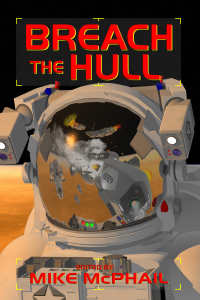
McPHAIL: We met at a gaming convention, things where slow, so we sat and talked. I told him about the game I came up with at the Academy, and how I put it on the shelf and only used it as reference for my writing. Well, the small press that had published my first DTF book (BREACH THE HULL) gave us the go-a-head to do the second one (SO IT BEGINS), but, when the time came for us to transfer the finished file so he could send it off to press, all of a sudden, his publishing empire was no more.

Then we remembered that game publisher we had met at the convention, he had said something about wanting to do books as well as games, and the rest his history.

VENTRELLA: What are the advantages of a small press?

McPHAIL: Accessibly. The big-houses are pretty much out of reach for a new writer, all they seem to want these days are top seller author, and even at that you only have a few months to prove your worth or you’re out.

VENTRELLA: What’s your opinion on self-publishing? Do you advise starting writers to consider that?

McPHAIL: Generally I would not advice self-publishing if you’re looking to become a “main-stream” author; writing the story is only part of the process. There are a lot of different skills needed to produce a professional-looking book, everything from editing and layout, to cover art and back cover copy, and yes, you will be judged by the cover of your book.

My wife and I have been out on the frontline as authors, books sellers and promoters for over a decade now. In our case, we had the advantage having worked in the printing / publishing industry.

Mike’s Websites: www.mcp-concepts.com
www.milscifi.com
www.allianceacrchives.net
www.defendingthefuture.com

4

Attending Conventions

One of my favorite conventions is Philcon, run by the Philadelphia Science Fiction Society in New Jersey. (Look, just run with it.)

Philcon is the oldest science fiction convention still in operation, although it’s still one of the smaller conventions, apparently by design. It’s next weekend (as I write this) — November 18 – 20, and the main guests are Cory Doctorow and Boris Vallejo.

Many of my writer and artist friends attend and it’s great to see them all again. There’s this sub-group of convention goers — fans, writers, artists — who attend a lot of these things, most of which occur during the winter. For many of us, Philcon is the first time we’ve seen each other in many months. Then there’s Arisia (Boston) in January, Mysticon (Roanoak) in February, Lunacon (New York) in March, Ravencon (Richmond) in April, and Balticon (Baltimore) in May. There are even more, but they’re either too far away for me to attend or too small.

And these are just the literary cons that specialize in books. You see, when people think of science fiction conventions, they usually think of Comic Con and the like, where it seems that the vast majority of attendees are there in a costume from their favorite TV show or comic book and all they want to do is buy toys and stuff. A literary convention is very different. Or sure, some people do show up in costume, but the main point is to discuss books.

Yes, these conventions are for people who actually still read!

Which is why, if you are an aspiring writer, you should be attending these. Not only can you go to panels where authors discuss their writing processes, but you will make all sorts of connections. Agents and editors attend these too, you know.

Usually I post my panel schedule on the blog before each convention, but for some reason Philcon hasn’t sent out their schedule yet; but here are some examples from previous conventions so you can see what they’re like: Ravencon; Lunacon; Arisia.

Anyway, please say hi if you attend. I’ll be spending some time at my publisher’s table in the Dealer’s Room with fellow author Peter Prellwitz. Look for the “Double Dragon” banner!

Leggo My Ego

I’ve found that the writers I’ve met fall into two categories:

First, there are the brooders who think they’re no good. “I can’t stand what I’ve written! I refuse to look at it again. No one will buy this book, because I’m such a terrible writer!”

Then there are the egotists who think they can do no wrong. “This is a masterpiece! It’s the best book ever written! It’s sure to be a best seller and be made into a movie!”

You know where I’m going with this, right? That the truth is that there are some absolutely terrible and amazingly talented writers in each group?

Still, the problem comes in recognizing yourself if you fall into one of these categories, and then learning to take a step back and trying to view your own work objectively. That’s not easy.8

It’s always difficult for any creative person to look at their own work and analyze it fairly. And that’s understandable. Your children are smarter, prettier, and more talented than everyone else’s children, right?

I, unfortunately, tend to fall into the second category too often. I finish a story and go “Wow! This is great! I can’t see any way to improve upon what I have just written!” I get all excited — and then I’m crushed when I receive rejection letters.

What has helped me is a good editor who can knock some sense into me from time to time and bring me back to earth. Usually the changes she suggests make me go “Now why didn’t I see that the first time?” (I’ve discussed how and why an editor is important before, by the way.)

It is important to have a healthy ego and be proud of your work. It’s what keeps you striving and happy, in my mind. I think many authors in that first group never get very far because they are not confident in their own work to promote it properly.

But at the same time, you have to know your limitations. I am perfectly aware that I am not a great writer — but I am very proud that I am a good writer! I can be proud of my characters and my plot twists and the way I keep my story moving while acknowledging that I am still learning the techniques to make it read even better.

Interview with Author and Publisher Karen Syed

MICHAEL A. VENTRELLA: Today, I am pleased to be interviewing Karen Syed, bookseller, author, publisher, and all around awesome gal. There are so many things floating around about Karen, but the only truth is that she is really cool. She recently (four days before the date of her doing this interview) moved to Orlando. Having been raised in Florida (and swearing she would never move back), she spent ten years in Texas, two years in Tennessee, and then five years in Maryland, she headed back to the sunshine state with her totally awesome husband. When asked why she decided to move back to Florida, she will simply tell you it is to be closer to Mickey, Pooh, and Tinkerbell. Her favorite food is dill pickles (especially Kosher deli dills) and fried chicken, which her husband won’t let her eat very often since she got the Pacemaker/defibrillator. Heart failure and an enlarged heart sucks. (Disclaimer: Karen might have written this intro herself … but who really knows…)

You come from an interesting background in that you expanded your bookstore into a publishing company. This sounds like a fascinating story; please share it with us!

KAREN SYED: I knew at a very early age that I would be a writer. I would write on anything. I also knew I loved books. I have been reading (well) since I was four. I read everything from shampoo bottles and air freshener cans to books. So when I met my (now husband of 15 years) and he offered to buy me a bookstore, I knew I had hit the motherload of love … books and a great man. Boy howdy!

At the end of my first year as a bookseller, I was nominated for the Publishers Weekly Bookseller of the Year. I still have no idea who nominated me, but some store in Indiana won. Oh well. So after about four years in the store, a friend and I started Echelon Press. Within eighteen months, I knew I wanted to do the publishing full time. So, I sold the store and forged ahead. During my bookstore days I managed to get a couple books published very badly.

I was so desperate to be a published author that I signed my rights away to my work for seventy years past my natural life … not once, but twice — two different companies. Oy!

So the reason for Echelon Press was to give new writers a place to break into the business. Ten years later, we’ve done okay.

VENTRELLA: How does your fiction writing fit in?

SYED: I’ve been writing for so long I don’t even know when it actually started. It wasn’t until 1987 that I considered writing as a career. My grandmother and mother were great at encouraging me and my Gramma event bought me a brand new Brother electric typewriter. It was such a vote of confidence, I knew I couldn’t let her down.

I wrote a lot for several years and even after I had the store. But once the publishing house started to take off, I had to make the tough choice; my own writing or discovering potential bestsellers. Finding awesome writers to publish is way cooler than revising my own work. But I do miss the writing. So much in fact that I did NaNoWriMo in 2010 and write a Steampunk novel that I have yet to revise. But I loved it, and I am a winner.

VENTRELLA: The future of publishing certainly is heading in the direction of e-books; however, there is still a stigma attached to books that are either not available in a hard copy or only available as a POD. Do you see that changing in the future?

SYED: Oooh, I just wanna smack people who feel the need to feed the distinction. A book is a book is a book. I say this in almost every interview I have done for the last ten years. There doesn’t need to be one or the other. I love my Kindle, but I also love my paperbacks. I just moved and cursed all twenty or so boxes of books I had to lug on and off the moving truck.

The sooner people realize it is a personal choice, the happier we will all be. I don’t see print becoming obsolete until we run out of trees, which means that it is perfectly safe for people to stop beating a dead horse and give eBooks the credit they have earned.

VENTRELLA: There seems to be a (relatively) easy path for printing these days in that just about anyone can claim to be a “publisher” by getting software for distributing e-books and using someone else to do some PODs. Is this a good or a bad thing?

SYED: I admit to being torn on this issue. Educating people on the value of POD printing has been a tough road, but the growth of the self-publishing industry has helped with that. Of course, with one solution comes another problem. Sadly, anyone can become a publisher or an author, but not many actually become “good” publishers or authors. There is a lot of laziness in the self-publishing industry. Ugly covers, lack of effective editing, and low quality materials. This does not have to be the case. It all boils down to pride in product.

This is kinda like “Made in the USA” merchandise. A lot of times we buy stuff from other countries because the quality is better. Same thing with books. Most of us (readers) will try anything, but if you screw us once, we will move on. I read very few NYT best-selling authors because their work simply isn’t as good as most of the midlist authors I like. Why? Because the big authors know their books will sell whether they are good or not. Okay, this is not the case with all and that was a very general statement, but I think everyone knows what I mean.

Just because someone says he is a publisher doesn’t mean he is any good at it. Good publishing is not easy and if anyone says it is, he is lying like an old Oriental rug.

VENTRELLA: How can readers and writers know they are dealing with a publisher that is legitimate — where there is a standard for acceptance and books are edited before they are published?

SYED: Do your homework. Don’t assume that because they have a website they are good at what they do. As you said, anyone can say it. Talk to authors who have been with them, current and previous. If you only get awesome answers and high praise, dig a little deeper. We all have some issues and if it sounds too good to be true, then it probably is.

I’ll be honest; there are people out there who will tell you I am a horrible publisher. They lie! No, honestly, there are a few cases where authors previously with Echelon have legitimate gripes, but pay careful attention to what is fact and what are sour grapes. I’d like to think that our successes far exceed our failures and we can’t be everything to everyone. But I will probably die trying.

Make sure that when you are considering a publisher that they share your vision. If you are not on the same page, neither the author, nor the publisher will be happy.

VENTRELLA: We met at a writer’s conference earlier this year. Have you found these to be a successful way for authors to find publishers?

SYED: Conferences have been outstanding for Echelon. I have literally found 50% of our authors at conferences, conventions, festivals, and even one at a craft sale. I need to connect with people and the only way to do that is to be out in the industry. I am a people person and I need that interaction. I also need to see a person’s face when they tell me what they are willing to do. I have learned (the hard way) who the liars are, and they are out there.

VENTRELLA: I still remember your expression when I mentioned I had written a vampire book; admittedly, it improved when you discovered the plot was not just another typical copycat. So here’s my question: What types of stories are you tired of receiving?

SYED: Pretty much vampire stuff. Heehee! Just kidding … sorta. I am truly sick to death of terrorist stories. I am of the mind that if the media and the entertainment industry continues to glamorize the horrific nature of terrorism, it will only continue to feed the fear and misunderstanding. I love thrillers as much as the next guy/gal, but there needs to be a limit and I simply don’t want to be the one to publish it. Reality sucks, why keep that fire burning so brightly.

VENTRELLA: How much of a story do you need to read before you can tell you’re going to reject it?

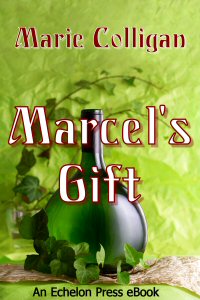
SYED: Totally depends on the story. I have read as few as two pages and knew I would rather gouge my eyes out than read any more, but I have also made it all the way to the end of some books and still couldn’t justify publishing it. It’s sad really when I find a book that I love, but I know I can’t make it sell. For example. I recently experienced the opposite. I got a submission (MARCEL’S GIFT) from an author named Marie Colligan. Her book is women’s fiction and involves a marriage, a tryst, a priest, the Pope, and a lot of love, understanding, and acceptance. I was shocked at the concept, but intrigued enough to keep reading. I kept telling my husband I didn’t have any idea how I could sell this book, but by the time I got to the end, I was so swept away, I am confident people will either love this book or hate it, but I know it will sell.

VENTRELLA: Have you rejected a book because you didn’t think you could work with an author, or thought the author wouldn’t promote their own material sufficiently? (Looking for anecdotes here but not names!)

SYED: Hey, I’ll give you names. This was not an immediate rejection, but … I contracted an author named Martin Bartloff. He wrote a book called TORN FROM NORMAL. It is a YA story that is very dark and very emotional. It deals with teen suicide. I was intrigued with the idea, but it was the recommendation of one of my editors that led me to contract it. We got to work and I soon discovered that Martin’s personality was far too powerful for me to tolerate in a working relationship. I know that sounds horrible, but I just couldn’t do it. I didn’t doubt his enthusiasm, or his desire to sell; it was specifically our personalities. I reverted his rights and suggested he self-publish. Martin needed to be in the driver’s seat. He did what I suggested.

Now, I admit that I have been a bit of a mentor to him through it all, but it was on his terms and I knew I could walk away any time. Martin is doing very well with his book and we have become very good friends. I enjoy him as a person so much more than I did as an author — don’t get me wrong, he is a great author — I just knew that if I had not made that decision, a very hard one, things would have ended very badly. As it were, things went better than either of us could have considered.

VENTRELLA: What’s the best piece of advice you could give a starting author that isn’t obvious and hasn’t been stated many times before?

SYED: Don’t be stupid and don’t be conceited. You are not all that and a bag of chips. We are all just people and we all need help and guidance in all that we do. We are not born brilliant; it’s very hard work. In order to find great success, you must be willing to admit when you are wrong. Know when to ask for help. More than anything, do not assume you know more than everyone else just because you wrote the book. I don’t care what anyone says, writing the book is the easy part. I can say that I’ve done it all. I know.

If you think you can be a successful author just by writing book after book, think again. You can write a hundred books, but if you don’t get anyone to read them, you are just a writer, not an author. Whether you go with a traditional publisher or self-publish, you better be willing to learn how to market and sell or you better be satisfied with selling a few dozen books to your family.

VENTRELLA: We discussed some of your success stories concerning authors who submitted short stories for download. I’ve had short stories published in anthologies, but have never gone to the “download just the story” route. Do you think that is the way of the future, given that anthology sales keep dropping?

SYED: I am not a fan of anthologies. I sincerely hope that more writers will learn the value of electronically publishing short stories. eBooks could seriously revive the short story industry.

VENTRELLA: What are the advantages and disadvantages of that?

SYED: Think about it. A writer who has spent years writing shorts, but never finding the “right” anthology to accept them. How sad is that? Short stories are a great way to develop your writing skills and to increase you readership. There is no downside to eBook shorts.

VENTRELLA: How important are agents for publishers like yourself?

SYED: Disclaimer: I have met quite a few agents that I personally liked. However, I have only found one agent that has been worth anything with regard to working with me. More times than not, agents turn out to be more trouble for me than good. Being a smaller (or boutique) publisher, we don’t have the perks to offer than a NY house does. We often don’t pay as much as a larger house (for obvious reasons) so why would an author want to give 15% to an agent when there is little to nothing an agent can do to help them with me?

The few times I have tried to work with agents, it has meant me giving up every bit of legal protection for my company so the author could have every little thing they wanted, with no compromise.

VENTRELLA: Let’s talk about your books. You originally started out writing primarily romance. Tell us about those!

SYED: They are brilliant. No, really. Okay, they are damn good. I have a tendency to write what I want and that made it impossible for me to find a traditional publisher. I wrote between the cracks as a very nice editor at Mills & Boon told me one Christmas Eve as she was rejecting me. Nice, huh? I worked in daycare for fifteen years so almost all my books have some strong young characters to compliment the lead couples.

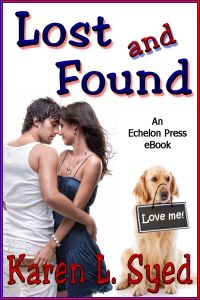
I also tend to write flawed characters. DARK SHINES MY LOVE has a blind hero. LOST AND FOUND has an orphaned teen with an emotionally devastated uncle as her guardian. THE WINGS OF LOVE deals with a man’s issues with his family and his belief in himself and things in general.

I have always been a fixer, so I write people who I can fix. Romance is about happily ever after and redemption. I do both pretty well. If I do say so myself.

I am currently toying with a mystery and a Steampunk novel. I met an author named Nick Valentino at a conference in San Diego and he introduced me to the Steampunk genre. His novel, THOMAS RILEY, was our first Steampunk novel and has been one of our most successful to date. It totally rocks. I-was-blown-away! Have become a wee bit obsessed with it — both reading and writing it.

VENTRELLA: You’ve also written under a pseudonym. Why did you decide to do that?

SYED: Well, in the beginning I felt like I needed to keep my writing separate from the bookstore/bookseller. How goofy was I? (Rhetorical) It was nearly impossible to explain my resonating to people and now that I just wanna be me, it is a huge pain in the butt trying to switch things back over. If you decide to write under a pseudonym, please know that it is NOT as easy as Nora Roberts makes it look.

VENTRELLA: Tell us about your new Steampunk books.

SYED: Dude, Steampunk is just the coolest thing ever, almost as cool as faeries. I knew after meeting Nick that I was hooked. So when NaNoWriMo came up last year, it was my chance to do a couple things. I spent a solid month writing, and it was bliss. I also got to delve into this totally awesome and explosive genre. My series (I never come up with book ideas, I always come up with series ideas) is called Petticoat Junction and is about four girls from very different lifestyles who join together to make a very formidable band of vigilantes. Each one has a special trait and together they are incredible. Toss in the automatons, alchemy, and big flying things, and it is bliss. Isn’t that a cool word? Bliss .. ahh.

VENTRELLA: Who do you enjoy reading?

SYED: Oy, good thing you are okay with long answers. I have three favorites, oh hey, stories.

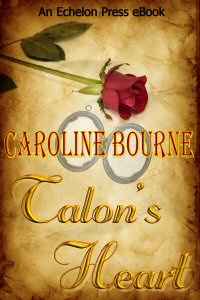
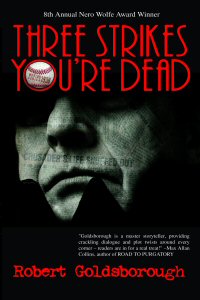
My favorite is Caroline Bourne who writes the most incredible historical romances (the best being RIVERBOAT SEDUCTION). Many years ago, I belonged to the Prodigy Romance Writers Group and I ran across a very nice lady named Carol. She became a friend and a mentor of sorts. She was incredibly supportive of me and my writing. After a bit of time, I found out she was actually Caroline Bourne (I had been reading her books for some years and she was already my favorite.) It was like fate had brought her into my life and we have been friends since. We did lose touch for a while, but thanks to Facebook, she found me and I am so freaking pleased to say that within the next couple months we will begin a new journey together. Echelon will be reissuing her previously published romances, as well as new stories (Talon’s Heart) from her. This is as cool as when Robert Goldsborough (who wrote several Nero Wolfe books after the passing of Rex Stout) called me and said he wanted to submit his mystery to Echelon. We published THREE STRIKES YOU’RE DEAD which turned out to be the first in his original Snap Malek mystery series. We have published five in the series so far, along with a couple shorts.

I also adore Jill Barnett. Her paranormal romance, BEWITCHING, was a light in the darkness for me when my first marriage was falling apart. I have never read a book by her that I did not love. And she is a wonderfully nice lady.

Julia Spencer Fleming opened a new genre for me with her IN THE BLEAK MIDWINTER (A Claire Fergguson Novel). Her writing is some of the best I have ever read and her characters are just so real, you really feel like you know them.

I mentioned thrillers up a bit and once of my favorite thriller writers is James Rollins. I discovered his Sigma books a few years back and wow! I have been going back to his earlier books and love them just as much. I highly recommend THE DEVIL COLONY, his latest. Mesmerizing.

And this is not the end of the list, but I cannot ignore James Lee Burke. Have been rading his Dave Robicheaux series for years and it is one of the best.

I did recently read my first books from Jacquelyn Winspear and Seanan McGuire and they may just get added to my favorite list.

Prologues: The Devil’s Work

Prologues: Do editors really hate them?

Recently, at a writer’s discussion, an aspiring author discussed his fantasy novel. It started with a prologue that explained something important that happened fifty years prior to the action that begins the first chapter.

I advised him to cut it and work that information into the book in other ways. I dislike prologues.

Too often, especially in science fiction and fantasy books, authors use a prologue to explain the world and set the scene. Instead of jumping into the story, we get a long history lesson, full of names and places we’ll instantly forget, many of which never appear again in the book.

Bor – ring.

Let us find out about that background when it’s needed. Introduce it through dialogue instead of in some “info dump.” Trust your readers.

You’ll probably find that most of the information you created isn’t really needed for the story.

Writing a background history is important — I encourage all authors writing to develop their worlds fully. It will aid you greatly in developing your characters’ personalities. However, your reader doesn’t need all that information.

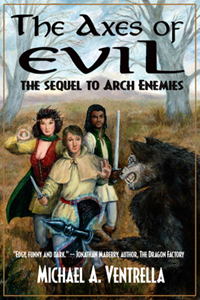
ARCH ENEMIES and THE AXES OF EVIL take place in a fantasy world with a detailed history. The magic in this world works in a specific way. Terin, the teenager who gets pulled into the adventure against his will, learns what history and magic he needs to know as he progresses through the story. Amazingly enough, that’s exactly the amount the reader needs in order to follow the story and get excited about its plot.

None of the rest of that grand world history is in the book other than through passing comments. It’s not needed to tell the story.

Not all prologues are evil. Just unnecessary ones. For instance, in a tale about a haunted house, a short prologue describing the murder that took place there a hundred years ago might work just fine. There’s absolutely nothing wrong with a prologue that sets the story. But then, why not just name that “Chapter One”?

Here’s my entire first chapter for my upcoming novel BLOODSUCKERS, about a vampire who runs for President (disclaimer: This could change by the time of publication):

Norman Mark was a politician with skeletons in his closet.

Literally.

I could have called that the prologue, because it sets up the feel of the book in a concise way while not actually starting the plot at all. In fact, Norman Mark is not even the main character.

I have no problem with an introductory opening like that — and neither do editors. There are plenty of examples of books that begin this way.

Really, what I hate (and what editors hate) are info dumps — where the author needs the reader to understand certain things and gives a lesson instead of tells a story.

I’m against those at any point in the book, but especially in the beginning. Your opening words need to grab the reader, and a history lesson doesn’t do it.

Interview with writer and artist Darrin Bell

MICHAEL A. VENTRELLA: I admit; when I was younger I wanted to be a cartoonist and draw a daily comic strip. I drew comics for my school newspapers and doodled all over my schoolbooks. Even though that idea was dropped as I started college, I still have a huge collection of comic strip books.

What people do not always understand about comics are that the best ones are written. The artist thinks about characterization and plotting just like novelists do, but with huge limitations.

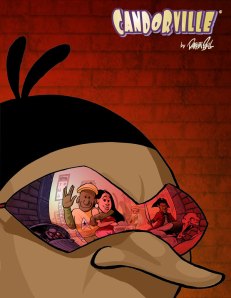
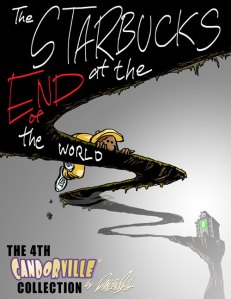
Anyway, today I’m pleased to be interviewing Darrin Bell, who writes one of my favorite current strips, Candorville. (Come on, this is my blog, I can interview whoever I want!) There are four books collecting the daily strips, one of which features an afterword by yours truly. Check out his web page for more information!
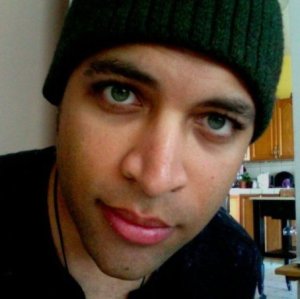
Darrin, you approach your strip differently than most comic strip authors do. While you still strive for that punch line every day, you also are working on a long-term plot that evolves over the years. What made you decide to go this route?

DARRIN BELL: Two words: Babylon Five.

I grew up on TV, like most kids of the Eighties. I was used to B.A. Barrachus getting shot at the end of the episode, and then being absolutely fine the next one. I was used to Spock shouting one episode, and then saying Vulcans don’t have any need to raise their voice in the next one. I was used to episodic TV, and in my mind, serialized equalled “soap opera.”

It also equalled bullshit. Because the soaps my mom watched completely ignored their own continuities. Most famously, Dallas. The Bobby Ewing-in-the-shower thing defined serialized storytelling for me. Authors would paint themselves into corners and then have to pull ridiculous stunts to get out of them.

But then Babylon 5 came along.

And Straczynski seemed to paint himself into corners, and I’d wonder how he’d get out of them, but he didn’t. He just knocked down the wall and kept going. Change became a constant.

Suddenly episodic TV seemed stale and formulaic to me. When Star Trek: Voyager came around, and the ship was nearly destroyed one episode, and new and shiny the next… and shuttles that were destroyed seemed to spontaneously reappear the next week, it was false to me.

VENTRELLA: Impressive to me was how he would plant a plot and then leave it alone for two years or more to come back to it and suddenly everything that happened earlier makes sense. (I’m thinking of the episodes where they visit Babylon 4)…

BELL: Definitely, that was my favorite aspect of the series. I’d read that he described it as a “novel for television.”

VENTRELLA: So did you decide to be a comic artist first or a storyteller first?

BELL: Storyteller.

I was lucky enough to grow up at the height of Chris Claremont’s run on X-Men, and Marv Wolfman’s run on Teen Titans, and these guys were epic storytellers. I knew that’s what I wanted to do. I also knew that the pictures John Byrne drew were equally responsible for the endless nights I spent huddled under my blanket with a flashlight and the comics I’d stolen from my brother. So to me, graphic storytelling went hand in hand with the written word. I wanted to draw comic books.
VENTRELLA: But you went to school for political science…

BELL: I did.

I actually thought about law school. For a minute or two.

The thing is, I have an older brother who practically raised me. And for the first half of my life I followed in his footsteps. Including his interest in history and politics.

But we’re different creatures. While he paid attention in class, I let my mind wander. I’d draw cartoons about whatever the teachers were talking about, and pass them around the class. I thought I was ignoring them, but oddly enough I did very well because I wasn’t just listening to them, I was letting them inspire mockery.

VENTRELLA: How did that get you into doing comics as a career?

BELL: In a roundabout way…

I was in gifted and talented programs in Jr. High and High School, and I realized my interest in history and civics was outpacing my interest in art (I’d been drawing since the age of three). That’s when the man who sparked my interest in politics (Pat Buchanan) became the same man who sparked my interest in journalism. In 1988, a Pat Buchanan ad where he portrayed a Gay Pride parade as proof we were going to hell, pissed me off. I had barely noticed politics before this, but I sure as hell paid attention to it afterward. It just seemed so monstrously unfair, and the prospect of someone like him leading the country scared the shit out of me.

Anyhow, four years later, I was flipping through channels looking for coverage of the Clinton-Bush campaign, when I saw that same guy on TV. Pat Buchanan. He was so smug and full of his own opinion, but I noticed he looked really, really happy. And it occurred to me, I’d be happy too if millions of people were listening to my bullshit ideas and taking me seriously.

So I asked a guidance counselor, how do I become a talking head on TV? She said I’d have to be a journalist first.

So I joined the school paper, and quickly became the Opinion page editor, then editor in chief.

VENTRELLA: Here’s my headline: “Bell Inspired by Pat Buchanan”

BELL: hahaha

One week, a few of my reporters didn’t turn in their work (must’ve been a party the night before that they didn’t invite me to…) So I had an hour to fill all those holes. I drew a bunch of cartoons and pasted them in (that sounds so prehistoric now). People loved them.

In college, I tried writing for the Daily Californian (at UC Berkeley). Interviewed a senator, a governor, and a congressman. I wrote a couple hard hitting articles that I barely remember now. Nobody paid attention. But at the same time, I started drawing cartoons for the paper, and again… people loved them. That’s when I knew that’s what I should be doing.

VENTRELLA: How did you end up with Matt Richtel?

BELL: While I was still a freshman, I started faxing my editorial cartoons to the LA Times, San Francisco Chronicle, and the Oakland Tribune. The LA Times was the first paper to pick them up. The editor there told me I was the youngest regular contributor to their opinion page in the paper’s history (I was 20). The Times paid well. The Chronicle and the Tribune, not so much. About $20-$30 per cartoon.

One day, I faxed a cartoon to the Tribune, and got a call. I was hoping it was the opinion editor telling me I’d be getting another $20. But it was some guy named “Matt Richtel,” who said he was the paper’s business reporter. He had started developing a comic strip called “Rudy Park,” and had a development deal with Universal Press. But Universal didn’t like the art. Matt had been walking past the Tribune’s fax machine when my cartoon came in, picked it up, and called me to ask if I thought I could adapt my style to a four panel strip.
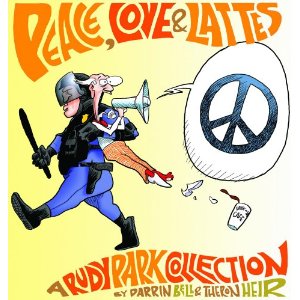
The Daily Cal had, for a couple years, been running “Lemont Brown,” the precursor to Candorville. And I’d just built a website. So I sent him to the site. A few minutes later we were working together. The development deal fell through. I’m pretty sure we lost out to The Boondocks, which was also in development.

VENTRELLA: I assume you created Candorville because you wanted to do the writing.

BELL: I created Candorville in 1993 as a class project, and kept doing it through college for the college paper (only back then it was called “Lemont Brown”). Not doing the writing was never even a consideration for me. It was more like I was doing Rudy Park because I wanted the experience of collaborating with another living person; since the rest of the time I was holed up in my apartment writing and drawing three “Lemont Browns” and four editorial cartoons per week. I finally decided to get Candorville syndicated because the editorial cartooning market was drying up.

VENTRELLA: Which one has wider circulation?

BELL: Candorville, Ironically.

VENTRELLA: Let’s talk about writing, since that’s the theme of my blog … It’s clear that you’ve planned out a long-term plot for your strip; how detailed has that been?

BELL: It’s not very detailed, it’s more of a skeleton. An outline. I know where I want my characters to be by a certain year, but I don’t exactly know how to get them there.

And I know how it’s going to end.

VENTRELLA: End? You plan on ending the strip?

BELL: That’s where I was going with the Babylon 5 reference. The reason Straczynski never painted himself into a corner, the reason he was able to blast through the wall instead, was because he didn’t have to come back. Characters could change and not have to be redeemed, because people wouldn’t have to still like them enough to keep watching for ten or twenty years.

Candorville has a beginning, a middle, and an end. Just like B5. Only the time frame is ten times longer. The story’s gonna take fifty years to tell. Stories without ends aren’t really worth reading.

VENTRELLA: Impressive. I admire it when comic strip writers end their strips instead of carrying them on zombie-like.

BELL: Me too. I’ll never forget 1995.
VENTRELLA: When Calvin and Hobbes ended?

BELL: Not just Calvin and Hobbes. Bloom County and The Far Side too. It was a traumatic year for a comics fan like myself.

VENTRELLA: I didn’t realize those all ended the same year, although I recall it all being close.

One of the major plotlines you established early was Lemont’s fling and subsequent child … that started in the first year if I recall.

BELL: I think it was the first year. That’s something that took on a life of its own. It wasn’t in the outline at all.

VENTRELLA: Well, that’s interesting. It’s been going on strong since then… but I’d like to ask about that, especially given something you said earlier in this interview. Although your characters deal with the supernatural from time to time, they never break the 4th wall … we’re supposed to take it pretty literally. And lately, with that plotline, there are all sorts of questions about reality — is this really happening or is Lemont imagining everything?

So here’s my question…

You’re not going to pull a Dallas on us, are you?

BELL: I always ask myself, at nearly every turn, WWJMSD?

VENTRELLA: Don’t disappoint us.

BELL: What would J. Michael Straczynski do?

VENTRELLA: Yes, I know! We nerds get that stuff.

BELL: Haha! I forgot who I was talking to. I know what happened in the story. But I reserve the right to leave it open to interpretation.

VENTRELLA: Let’s talk about Lemont. First of all, did you give him the last name “Brown” as a tribute to Charlie Brown?

BELL: I did. And I gave him the first name “Lemont” in tribute to Sanford and Son.

VENTRELLA: And I assume it is no coincidence that he wants to be a writer.

BELL: No coincidence at all. Part of the outline, from the outset, has been my main character’s grasp – or lack thereof – on reality. And I had two choices if I wanted to sustain that and still explain how he feeds himself: I could make him a perpetual inmate at a psychiatric hospital, or I could make him a writer. So the time travel and all the supernatural stuff can be easily explained (by readers who just aren’t into that stuff) as being part of this writer’s imagination.

Stephen King touched on that in a Candorville storyline last year. Well…

VENTRELLA: Yes, I remember that — King admired Lemont’s imagination. Did you hear from King after that ran?
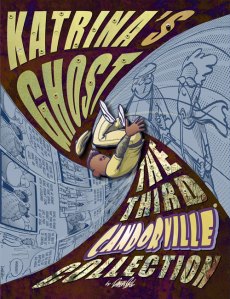
BELL: No, I doubt he’s heard of Candorville, much less that he’d take the time to write to me about it. I thought of sending the sequence to him, but never did.

VENTRELLA: Given Lemont’s love of science fiction, it’s not hard to assume he has much in common with you. How much of your family life is in his?

BELL: Bits and pieces here and there. It’s inspired by my personal life, but it’s not autobiographical.

Roxanne becoming a vampire was 100% inspired by my breakup with my ex wife. For two reasons. (1) The obvious, and (2) Where I WAS going to go with the story turned out to be way too close to home for me. Suddenly it wasn’t funny anymore and I wanted to deal with it more metaphorically.

VENTRELLA: Being funny can be a big limitation for storytelling, especially if you have to be funny every single day and with only a few panels in which to do it…. so how do you do it? I mean, you must have to be very economical with your words…

BELL: I don’t worry about it. When Candorville got syndicated, I sat down and tried to figure out exactly what it was I liked about my favorite comics as a kid. And what they all had in common was, ironically, that they often weren’t funny. I often laughed at them because of some truth they delivered to me, not because of a punchline. Calvin and Hobbes, for instance… I’ve almost never laughed at that, but it’s one of my favorites. So I don’t try to be funny, I just try to speak my truth and hope other people relate to it.

I do have to be very economical. Sometimes I wish Candorville were a TV show, where I’d have dozens of pages to set up and explore a humorous or tense situation. But I only have a couple panels in which to do that, and then a couple in which it has to pay off.

It’s actually relaxing, though, whittling my complex ideas down. It’s like trimming a bonzai tree.

VENTRELLA: Speaking of themes, you have not shied away from politics — which is one of the reasons I enjoy the strip so much. Have you found that to be something that has helped the strip’s popularity or hurt it (at least with editors)?

BELL: I used to wonder about that, but I’ve come to think it’s impossible to know. Some editors have dropped it because of the politics, but others have bought it because of the politics. And still others subscribe to it despite the politics.

VENTRELLA: Well, it wouldn’t be Candorville without the politics.

BELL: It wouldn’t.

I wouldn’t do it without the politics.

Candorville has an underlying structure, an outline. But on its surface it’s pretty stream of consciousness. And if I had to censor myself every time I was concerned with politics, it wouldn’t be fun for me.

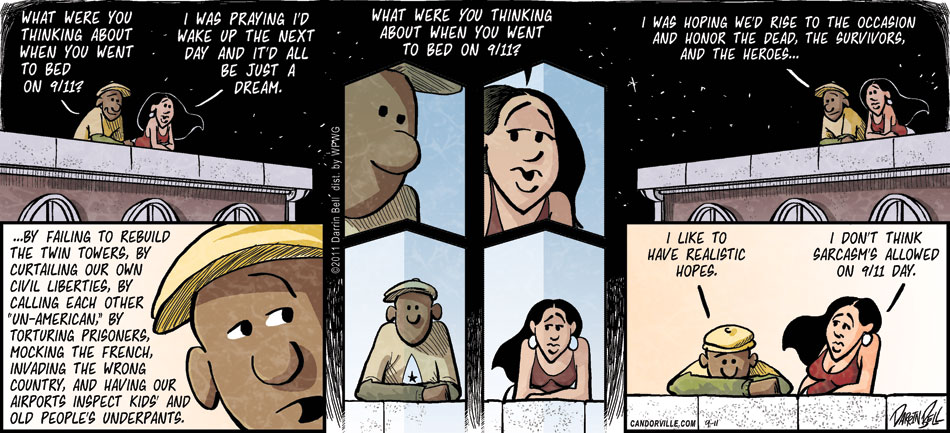
VENTRELLA: You recently posted a pretty political 9/11 strip when every other cartoonist was doing a traditional tribute. How was that received?

BELL: A lot better than I’d expected. There was some grumbling online, but it was vastly, vastly outnumbered by people expressing relief that someone was in an introspective mood instead of joining in on the 9/11 somberpalooza and jingoism fest.
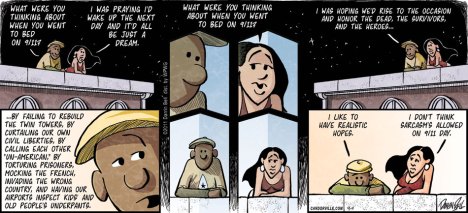
VENTRELLA: And it’s not like you hadn’t said the same things before in earlier strips.

BELL: I knew pretty much everyone else was going to focus on who we lost on 9/11, and I thought it was more useful, more productive, for me to do what I’m good at, which is speaking my mind even when others think it’s inappropriate. Especially when others think it’s inappropriate. I said a similar thing a month ago, to foreshadow this one.

VENTRELLA: But you did discuss what we lost on 9/11 — other things we lost.

BELL: Let me rephrase: Others were going to focus on who we lost. I focused on what we lost.

We lost our collective mind. We lost our soul. We lost our identity, which led to us losing our credibility.

We lost our way.

VENTRELLA: You’ve tried to remain topical… most cartoonists have to get their strips done months in advance, but you actually drew all new strips when binLaden was killed and had the syndicate put them out before anyone else.

BELL: I did, I have a one week lead time.

I went out of my way early on to establish devices I could use whenever I have a chance. One reason I made Lemont a journalist – and made it clear he’s got a wild imagination (which may or may not be reality) was so I could have him give famous people their exit interviews when they die.

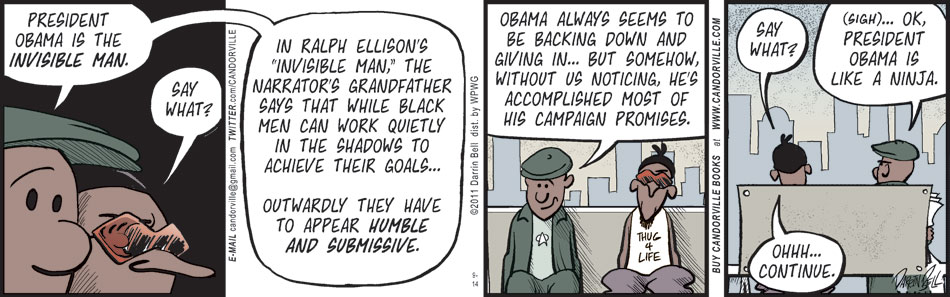
VENTRELLA: Your strip today discusses Obama as Ellison’s INVISIBLE MAN – is this something to be admired, in that it’s a way to accomplish your goals behind the scenes?

BELL: I’m hoping people will read INVISIBLE MAN and that might help answer whether it’s something to be admired.

The same person who says that’s how black men have to behave, was ashamed for having done so. It’s up to readers to decide whether it’s something to be admired, or whether it’s even really necessary in 2011.
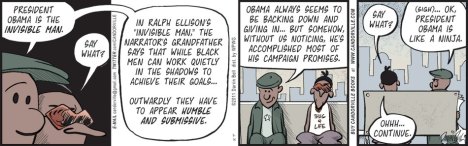
VENTRELLA: The worry is that if Obama were to be as aggressive as many of us Democrats would like, he’d be attacked as being the “angry black man”?

BELL: Not only that, but he might get assassinated. When black men in Ellison’s day didn’t act invisible, they were often persecuted, shunned, and sometimes lynched. America hasn’t come far enough that it’s willing to tolerate a black leader who isn’t humble and demure. That’s one reason why Americans respect Colin Powell, and dismiss Jesse Jackson. America may have moved past that. But we won’t know until somebody tests the waters.

VENTRELLA: Someone always has to be the first.

BELL: There’s a school of thought that the first black anything has to be humble and submissive, and quietly excel. He has to be Jesse Owens, or Jackie Robinson, or Nat King Cole. Then the next generation can be brash. The first has to be Nat King Cole. The second can be James Brown.

VENTRELLA: Let’s talk about publishing. You’ve self published your last few books.

BELL: …and am selling them exclusively online and at conventions.

VENTRELLA: Which conventions do you attend?

BELL: Last year, none. Too much personal drama (which I worked into the strip). The year before, only Wondercon in SF. I sold all the books I brought with me. I want to attend more in 2012, but only in cities where the paper runs my strip.

VENTRELLA: Ever plan on coming here to the East Coast?

BELL: I’m not planning on it, but it’s a possibility. If I ever break into an NYC paper, or if there are any conventions around Virginia or Georgia (where the strip runs in some big papers), sure. Otherwise I’m not sure it makes financial sense.

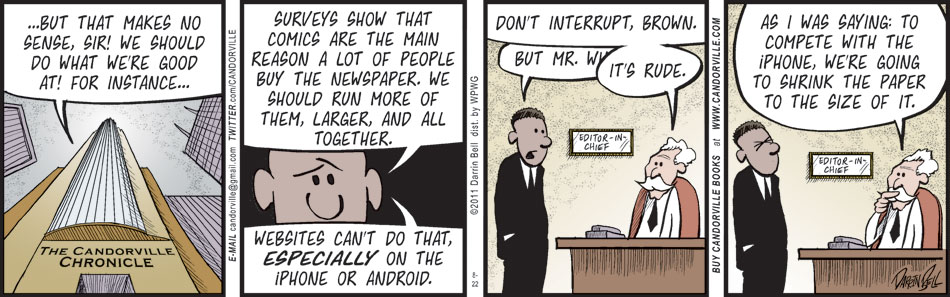
VENTRELLA: The NY Daily News just stupidly cut an entire page of comics, and I stopped buying it every day.
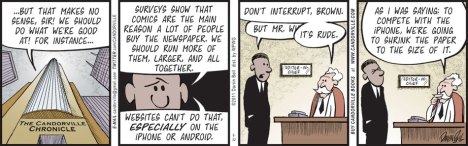
BELL: Papers everywhere are doing that, and they’re shooting themselves in the foot. Most people cite the comics as the #1 reason they buy the paper.

VENTRELLA: Why isn’t there a convention for comic strip fans? They could have it right before the Reuben Awards when everyone is in town…

BELL: I don’t know. Comic strips are sort of an appendage to comic book conventions.

VENTRELLA: Let’s talk about character development … what efforts do you make to keep your characters from being one dimensional?

BELL: Motivation and backstory. Every character has a backstory that I’ve never spelled out, but that I can draw on from time to time. For instance, Sasha Mitchell is a Jamaican immigrant. I never mentioned it until recently (when it became germane to the plot) but it’s always informed how she relates to men, and it is a basis for her fears and hopes. And I approach every scene the way a screenwriter would: Each character enters the scene with his/her own goal, a goal that is based on that character’s backstory. And the goals usually conflict, sometimes causing the character to become introspective.

So… motivation, backstory, and goal.

VENTRELLA: Have you taken creative writing courses or otherwise studied writing techniques?

BELL: No, everything I know about writing I learned from reading comic books and watching TV. (Oh, and reading novels)

VENTRELLA: In fact, I have a blog post about that issue, in that the best way to learn is to read others and see how they do it, so I agree with you there. But also it’s making sure your characters do not always act predictably — because people are not always predictable. And that is something I have seen you do in your strip.

BELL: Thanks for noticing.

The problem I have with most comics is, they bore the hell out of me. People never change, they always react the same way, and feel about each other the same way they did last month and last year. In real life, people can change from moment to moment, let alone from year to year.

VENTRELLA: Well, most aren’t interested in telling a story — they are joke-a-day strips.

BELL: True.

VENTRELLA: Which story comics do you like? (Don’t say Funky Winkerbean, Don’t say Funky Winkerbean…)

BELL: I won’t read that strip until I have health insurance and can afford the Prozac.

VENTRELLA: Heh!

BELL: But you may not like my answer any better: the last story strip I liked was For Better or For Worse.

VENTRELLA: No, I agree with you — I have quite a few of those collections. Good characters.

BELL: I loved how she would juggle several different storylines, and how characters would grow apart, and come back into each others lives in unpredictable ways. And the characters weren’t predictable. They made mistakes, learned lessons (sometimes the wrong ones), etc.
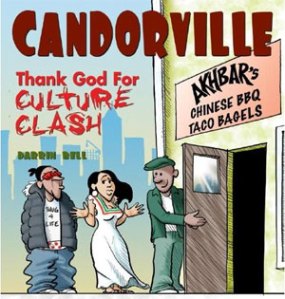
VENTRELLA: That is what makes us go back again and again — because we like the characters, they are real to us, and we want to know what happens to them. It’s true with TV shows and movies and all storytelling. The jokes and the special effects don’t matter if we don’t care about the characters

BELL: Neither does the artwork.

VENTRELLA: Exactly.

How about political strips? Any you really like?

BELL: I like Non Sequitur, and I liked Bloom County.

VENTRELLA: Have you been able to meet many of the artists who do strips you like?

BELL: Wiley’s a friend, and I met Berke Breathed. I signed books next to Lynn Johnston, hung out a little with Jim Borgman and Jerry Scott … Lalo Alcaraz and Keith Knight too. It’s all been very surreal.

VENTRELLA: It’s a world I’m not privvy to…

BELL: Oh, and Stephan Pastis almost killed me once.

VENTRELLA: Sounds like him. Care to share that story?

BELL: I’d driven up to Santa Rosa to help judge the comic strip category for the Reubens. Afterward, we all went out to lunch. But Stephan didn’t have any money. So I went with him while he drove to find an ATM. He was in the middle of telling me some sort of story, and talking with both hands (don’t ask me how he was steering) when a big white van pulled out into the street in front of us, to make a left. Stephan seemed to see it, but also seemed not to think anything of it. He didn’t even slow down. I have no idea what would’ve happened if that van hadn’t moved just a second before we got to it. He just continued on with his story while I filed the experience under “things to talk about years from now in interviews.”

VENTRELLA: Perfect.

BELL: Years later, he and I were on a successful panel discussion in Walnut Creek (the video’s on my site somewhere). I turned that discussion into a Candorville storyline the next year (the Stephen King story)

VENTRELLA: What’s your thoughts on the 2012 election? I came out of the 2008 one so enthusiastic for the future of our country, and now…

BELL: I feel like I’m part of the rebel alliance and this is the Battle of Hoth, and I’m just praying a Tonton will amble by so I can gut it and climb inside for warmth…while the republic crumbles.
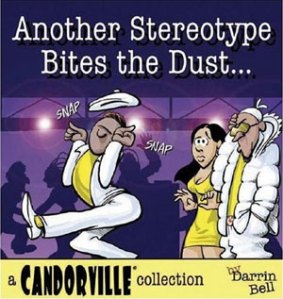
VENTRELLA: And you thought the tea party smelled bad on the outside!

BELL: Hahaha!

I think we’re witnessing the death of the republic. Republics end when the citizenry loses respect for both their intellectuals and their government. Mitt Romney doesn’t scare me. Michelle Bachmann doesn’t scare me. Perry doesn’t keep me up at night. What scares me is how pervasive the hatred toward specialists, intellectuals, and teachers has become.

It’s hard for me to imagine anything good could come from that, or that we can pull ourselves out of that death spiral. And it is a death spiral.

VENTRELLA: The anti-science crowd and the pro-death crowd scares me. They cheered someone dying because he didn’t have health insurance at the debate recently! They’ve become the Death Panels.

BELL: They have. But I saw this coming. They’re the Orwellian party that was perfectly ok with “free speech zones” and who supported a man who said “to have peace, you have to have war.” Whatever they accuse others of doing, is pretty much what they’re going to do.

VENTRELLA: Do you think Obama will be any different if he wins re-election? Will he be more aggressive?

BELL: I think he’ll be a lame duck, with no successor for Congress to fear (Biden’s not gonna run, Hillary probably won’t run). I think he may believe he’ll be more aggressive – and he’s regularly hinted to his base that he’ll be more attentive to them later – but if he believes that, he isn’t paying attention to history. Presidents rarely exceed the achievements of their first terms. Even Clinton’s excellent second term was entirely based on what happened at the end of his first.

I think Obama’s squandered the biggest opportunity a Democrat has had since FDR’s day to shape the narrative and transform the debate and the country, and it’s too late for him to fix that. The perception of him as a weak leader has taken root among his base, and that is usually the death knell.

VENTRELLA: I’m afraid you’re right.

BELL: I would so love to be proven wrong. But even after his latest big speech, he immediately backtracked and said he’d sign whatever part of it Congress sends him, which we all know is going to be only the tax cuts. That’s not going to create jobs, it’ll just make the problem worse.

VENTRELLA: His low ranking in the polls isn’t from conservatives; they already didn’t like him. It’s from liberals and moderates who are abandoning him. So why he keeps trying to appeal to those who will never support him while ignoring his base is beyond me.

BELL: It’s not beyond me.

I come from a similar background. I’m mixed, so I’ve always felt a little like an outsider. My dad left when I was a kid, and I spent years dealing with abandonment issues. All of that leads me to want approval from people who don’t want to give it to me. It’s a constant battle, and I think creating Candorville and being so forthright with my opinions is my way of conquering that tendency. I see the same trait in Obama that I have in me, the same irrational urge to win the approval of those who will never give it to him. The same urge to reach out an open hand to people who are going to respond with a fist.

VENTRELLA: Wow, that’s a great way to end the interview. Good conclusion, and unexpected.

BELL: That’s what I do!

The Secret of Success

I recently read an article that spoke of the three elements needed for success in any field, and it struck me as a wonderful summation. You need all three of these in varying degrees if you want to get anywhere.

The three things are talent, hard work, and — here’s the one people don’t always realize — meeting the right people and impressing them.1366571_com_success_ke

Talent is obvious, right? But that alone will get you nowhere. People who are less talented than you have become successful, and people more talented than you are still waiting tables and wondering why no one has discovered them yet.

Talent is a mixture of what you are born with and the skills you acquire. You need both. You may have a great ear for music but it won’t get you anywhere until you practice your instrument to the point where you can produce the music you hear in your head. Having great story ideas won’t get you far if you lack the basic writing skills to express them.

Which leads us to the next element: Hard work.

Almost every single person who has made themselves successful has been obsessive about their work. It’s practically all they do. They spend every day working on their craft and, of course, the more they do, the better they get.

Here’s the key: You have to love your work for this to happen. If you love it, it doesn’t seem like work.

This one has kind of been my downfall — I love a lot of things and over the years, I tried to do them all instead of concentrating on one.

When I was in college, for instance, my band meant the world to me. I loved playing, practicing, writing songs, and performing. And we got pretty good, too. We played all the big clubs in Richmond, Virginia and had a bit of a following. But we never made it. We were talented and we worked hard, but we lacked that final element.

We didn’t meet the right people and impress them. It didn’t even occur to us that we should be working on that. (Hey, we were young.)

Part of the problem was that we were in Richmond. You can only go so far in Richmond, which lacks major record labels, agents, and the connections we needed. No one was going to “discover” us there.

You have to go to the places where people who can make a difference to you live. If you want to be a successful actor, get yourself to New York or Los Angeles. Want a career in politics? Move to Washington. Computers? Perhaps Seattle.

Things are different these days than when I was in college. With the internet, it’s a lot easier to meet the right people and impress them. But even so, it is much better to be in a major city that can give you the personal touch needed to make the final sale.

In my writing career, I’ve learned how important this third point is. I’ve attended writer’s conferences, networked with other authors and agents, spoken at conventions, and have tried my best to keep myself in the loop. And it has helped me tremendously. I’ve learned things from these people I would not have discovered on my own, and my writing has improved. And the people I have met in person are much more likely to help me than those I have only talked to online.

More importantly, these people have introduced me to others who have helped my career. I’ve built relationships that will serve me when I try to sell my next novel. I’ve met the right people, and (hopefully) have impressed them.

Oh, I may not have impressed them with my writing skills (yet!) but I hopefully have given them the image of me as a professional with whom they can work; that I am someone who is reliable, meets deadlines, and completes tasks given.

You want the people you meet to know that you have something to offer them in exchange; that you can help their career, too.

These three elements need to be present if you want success. They do not have to be equal — if you meet the right people, for instance, you don’t need as much talent, which is the only way to explain Paris Hilton or the cast of the Jersey Shore. And if you are so talented that you cannot be ignored, the right people may come looking for you.

But don’t ignore any one of these elements, because if you do, you’re never going anywhere.

Interview with author Peter Orullian

MICHAEL A. VENTRELLA: Today, I am pleased to be interviewing Peter Orullian. In 2006, Peter sold his first short story to a Denise Little anthology, and has since sold numerous stories to both Denise and Marty Greenberg, as well as Orson Scott Card’s “Intergalactic Medicine Show.” Then, in early 2009, Tor purchased the first three books in an epic fantasy series Peter is writing. His web page is here.

How did you get your first “big break” in publishing? Did you have an agent first?

PETER ORULLIAN: I think my story here is pretty traditional, and maybe a tad boring. I did get an agent first, and he then sold my fantasy series, The Vault of Heaven, to Tor. The funny thing is that in today’s publishing world, the path to publication is happening in so many ways. But my “big break” was that I landed a new agent—-I’d had one prior-—who took a deep interest in my work and almost immediately sold my books. There’s much to be said for having someone who really gets behind you.

VENTRELLA: Aspiring authors often seem to think that writing a book is easy and your first one is sure to be a huge hit. What writing experience did you have prior to publication?

ORULLIAN: Well, I’d sold a dozen or so short stories. But more than this, I’d spent several years working on my craft and understanding the business side of writing and publishing by attending workshops and following the industry. That isn’t to say that I’ve got it all figured out, but if a writer is serious, he needs to commit these kinds of things.

On instant success, I get how aspiring writers start to think this way. They’re close to their own work, and they yearn to be writing full time, doing something they love. And unfortunately, the success stories of writers who have this happen to them are oft repeated in writing circles. The thing a writer needs to do is keep writing, put his heart into each book, and then move on to the next one. With that approach, things will generally continue to get better on all fronts.

VENTRELLA: What resources did you use in creating your fantasy world?

ORULLIAN: Lots of imagination. That sounds cavalier, but it’s kinda true. I’m sure that all my years of reading, and my college days, and all my wide interests have found their way into the work. And often you’ll start down a path, and realize you need to know a bit more about a particular thing, and so you’ll do some research. But I like to extol the value of invention. Plus, therein lies the fun!

VENTRELLA: What distinguishes your fantasy world and story from all the others?

ORULLIAN: At the end of the day, stories are about the characters. And I’ve got a unique bunch. Oh, there are things like magic systems, one based on music that is pretty unique —- I’m a musician, you should know. Then, of course, the cosmology is my own, and like that. But I tend to believe that we mostly read for characters, and I’ve put mine through the grinder, as they say. They’re forced to make very hard choices, and to try to reconcile doing the right thing for the wrong reason and vice versa. Those moments of intense personal conflict, I like to think, are one of the hallmarks of my series.

VENTRELLA: THE UNREMEMBERED is the first in a new series. Have you planned them all out in advance or are you taking them one at a time?

ORULLIAN: I’ve got the first three pretty well defined. And I know the ending with a great deal of clarity. Then, the space between the end of book three and the end of the series, I have in broad strokes. So, there’s still some planning to do late in the series.

VENTRELLA: Tell us about the plot for THE UNREMEMBERED.

ORULLIAN: Oh, man. I’m not good at summarizing my own work. And mostly, I don’t think it can be done well in short bits of text for any book. Suffice to say that nations and realms are on the brink of war; social upheaval is putting ideologies at odds; ancient threats and enemies are stirring; and there are some who see the coming storm who are working desperately to avoid it.

See, that’s not real awesome when you boil it down. But I’ve had readers who like George R.R. Martin, Robert Jordan, Brandon Sanderson, Patrick Rothfuss and others email me and tell me liken my work in many respects to these epic fantasists. So, that’s both humbling, and perhaps an indication of the type of books I’m writing.

VENTRELLA: Do you tend to outline heavily or just jump right in? What is your writing style?

ORULLIAN: I’m somewhere in between. I have a rough outline, that I deviate from quite a bit. But having the outline is a nice set of guideposts to get me moving. And I do a great deal of story thinking in my outline phase, which I find helpful when I sit to write. That said, a lot of discovery takes place in the writing itself.

VENTRELLA: When creating believable characters, what techniques do you use?

ORULLIAN: Think first: What matters most to my character? Then, give them conflict and real motivation.

VENTRELLA: What was the biggest mistake you made in your career?

ORULLIAN: I stuck with my first agent for longer than I should have, since he didn’t seem to have an active interest in my career.

VENTRELLA: Tell me about the book trailer. Did you produce this or hire someone to do so, or did your publisher take care of it?

ORULLIAN: I produced it with the help of some friends. I’m lucky to have folks around me with crazy amounts of talent. So, between the set of us, we’ve done some pretty cool things, I think.

VENTRELLA: Do you feel that book trailers help sales at all?

ORULLIAN: Good question. I’m not sure. I don’t have any analytics on my own stuff, so I can’t speak with any kind of authority on it. Mostly, these kinds of things are there to help create awareness of your work. So, doing at least some of these kinds of things seems right. You simply have to take a balanced approach—don’t over-index on marketing stuff. The best sales tool for your work is the work itself.

VENTRELLA: You’ve also placed a map and other information about your world on your web page. Have you found this to help sales at all or is it more for those who have already read your book and want more information?

ORULLIAN: I believe it’s both. Hopefully, readers who haven’t read my work yet might find this information and consider getting the book. But it’s also there to provide some depth for those who have already read it. Whether it helps sales or not really wasn’t my motivation though. I’m a bit of a geek for this kind of stuff, as I love finding it on the websites of authors I read. So, I went ahead and did some of it from a reader’s point of view.

VENTRELLA: Do you find short stories to be easier to write in any way?

ORULLIAN: Well, they take less time. But if you’re asking from a craft standpoint, no. It’s a bit of a different form, for sure. But each has its own unique considerations. I enjoy writing short fiction, as well as novels.

VENTRELLA: Do you advise authors to write short stories to help promote their other work?

ORULLIAN: No, I don’t advise it, as such. The main reason I do it is because I have this idea that some of the stories are too much like a data-dump, were I to drop it into one of the novels. But I like the backstory, and think others might appreciate some of the depth. So, I write the short stories for those who want to have a deeper look into my world. They’re not necessary by any means, but readers who read both the short and long stuff will have a some of those “aha” moments when they’re reading.

VENTRELLA: Many authors are now making short stories set in their world available for free online. Do you think this is a good way to grab new readers? Has it worked for you?

ORULLIAN: Again, I have to say I’m not sure if it’s a good way to grab readers or if it has worked for me. I have no way to track such a thing. For my part, I don’t do it so much as a marketing tactic, as much as I do it because I like the notion of transmedia, where using the strengths of various artistic media to tell a broader story is the goal. What that means is that you can read my book and not read my short fiction (or watch my webisodes, or explore my online map, or spend time looking through the art, etc), and you’d be just fine. But if you read and explore some of these other things, there’s a kind of larger “story experience” available to you. I really dig that possibility. That’s why you see me doing these kinds of things. I love the resonance and enlarging opportunities transmedia affords me as a storyteller. Oh, gosh, I could go on and on . . .

VENTRELLA: How do you prefer to make your short stories available – anthologies, magazines, download? What is better, in your opinion?

ORULLIAN: There’s no science to this yet, in my opinion.

VENTRELLA: Couldn’t help but notice that you’re a musician (as am I). I used music to help explain the magic in my world – has music played a part in your fiction as well?

ORULLIAN: Absolutely! As I mentioned, there’s a music magic system. And it factors heavily in several aspects of my series. Plus, I’m writing a concept album as part of the transmedia approach I mentioned above. It won’t be a retelling of the novel. It’ll be additive story, going into the early life of one of the characters, a old war, and some explanation of what I call “The Song of Suffering,” which is a song of power in my world.

On another level, I think it helps me approach a sense of lyricism in my writing. So, yeah, this is a great big question that we simply don’t have enough space to go into here . . .

VENTRELLA: Why do so many authors also tend to be musicians?

ORULLIAN: I’m not sure that’s true. Thinking now of all the writers I know, most aren’t. But yes, of course, some are, too. Rather, I’d say, “Why do so many authors also tend to engage in other artist pursuits?” Because I know writers who are painters, poets, photographers, etc. I think writers are creative types, and most creatives have more than one creative outlet, or so I’ve noticed.

Interview with Author Cat Grant

MICHAEL A. VENTRELLA: Usually on this blog, I concentrate on fantasy and science fiction since that’s primarily what I read (and write). This means I am missing out on a large portion of the market, and not necessarily providing information for authors who are interested in other genres.

So today I am pleased to be interviewing Cat Grant, writer of what has become to be called “erotic fiction.”

Cat, thanks for answering my questions. What’s the difference between “erotic fiction” and “romance”?

CAT GRANT: People sometimes get the two confused, but they’re really very different. Erotica is about one character’s (or two, or three!) sexual journey. The emotional component, and even the plot, is downplayed in favor of sex scenes – the hotter, the better. Romance is all about characters connecting emotionally. The plot centers around the protagonists and their relationship.

The biggest difference between erotica and romance is that erotica doesn’t require a happy ending. Romance does.

VENTRELLA: Is there a bias against same sex romances that limits your options?

GRANT: Not in e-publishing – in fact, quite the opposite. There are a number of e-presses devoted to same-sex romance, and more are jumping into the pool all the time. There’s no shortage of places to sell my work!

VENTRELLA: Who do you find to be your primary audience?

GRANT: Women, mostly, with gay men a close second.

VENTRELLA: What are the advantages of a small press?

GRANT: In e-publishing, I would say the biggest advantage is that once your manuscript is accepted, it usually doesn’t take very long before it’s published – unlike traditional New York publishing, where it can be a year or more before an accepted manuscript sees print. And also, you get paid a lot faster. Most of the publishers I’ve worked with pay on a monthly basis.

VENTRELLA: Please tell me about how you found your publisher(s) or how they found you.

GRANT: I found my first publisher, Lyrical Press, the usual way – I checked out their website and submitted my first book, THE ARRANGEMENT, to them. They liked it so much, they offered a contract the same day. I ended up publishing five books with them. Then I got an invitation to submit to Amber Quill. Later that year (2010), I went to the Romantic Times convention and met Kelli Collins, the Editor in Chief at Ellora’s Cave, and she invited me to submit to EC. For my latest book, ONCE A MARINE, (due out this November) I’ve decided to go with this amazing new start-up, Riptide Publishing, the brainchild of my good friends Aleksandr Voinov and Rachel Haimowitz. They’re a class act, and I’m very excited to join them.

They will also be republishing my Courtland Chronicles series – re-edited, and in proper reading order – starting in 2012.

VENTRELLA: Of the few romance authors I’ve known, the constant problem they all have is that people tend to think they are writing from experience and have participated in all sorts of sexual situations – have you had this problem and if so, how do you deal with it?

GRANT: Yeah, it can be a bit of a problem, especially with men I’ve met lately. It’s gotten to the point where I don’t tell them what I write until I decide if they’re “keepers” or not! LOL!

VENTRELLA: Do the romance writers have conventions where they can meet readers like the science fiction writers do?

GRANT: Ohh, yes! In fact, I’m attending three of them fairly soon: Authors After Dark in Philadelphia from August 10th through the 14th, Ellora’s Cave’s RomantiCon at the end of September, and the Gay Rom Lit retreat in New Orleans this October.

VENTRELLA: Of what are you most proud?

GRANT: I’m proud of all my work. Getting published is a hard slog, and you won’t make it if you’re not constantly upping your game. However, I do have what I call “books of my heart.” THE ARRANGEMENT was my first published book, so it will always hold a special place for me. Then there’s ALLEGRO VIVACE, which marked a quantum leap forward in my writing ability. ONCE A MARINE is also a favorite. I love Marc and Cole, my two protagonists. And I’m getting some amazing editing from Aleks and Rachel on this one. I can see the book improving with every page I revise. It may very well be my best work yet.

VENTRELLA: What piece of advice would you give an author wanting to write erotic fiction?

GRANT: The same advice I’d give any writer – don’t give up. People will diss you and try to knock you down at every turn, but if this is really, really what you want to do, ignore the naysayers and listen to your instincts. They won’t steer you wrong.