


The Blog “Rambling Roses, Purple Prose and other Asinine Alliteration” has a very nice interview with me today! Please check it out. http://writertracy.livejournal.com/197182.html
Filed under: writing | Leave a comment »

The Blog “Rambling Roses, Purple Prose and other Asinine Alliteration” has a very nice interview with me today! Please check it out. http://writertracy.livejournal.com/197182.html
Filed under: writing | Leave a comment »
MICHAEL A. VENTRELLA: Today I welcome author William Freedman. His debut novel, LAND THAT I LOVE, was published this year by Rebel and he is currently finishing his second, MIGHTY MIGHTY. His novelette “Forever and Ever, Amen” appeared in the 2006 Spirit House chapbook and his short story “Intentions” is scheduled to be published this year in Ash-Tree Press’s HOLY HORRORS anthology. He is a founding member of the Long Island-based LISciFi critique group and has been a panelist at I-Con, Balticon, Albacon, Capclave and Arisia.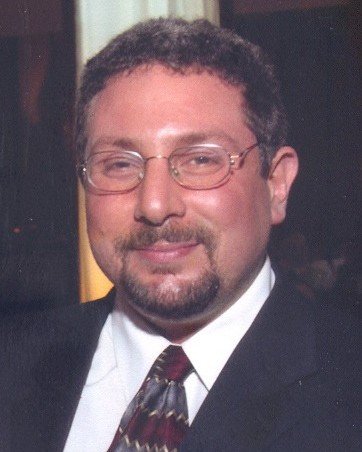 He holds degrees in journalism and international business and his non-fiction work has appeared in Investor’s Business Daily, Euromoney Books, Global Finance magazine, Treasury & Risk Management magazine, and many other business and financial news outlets both in print and online.
William, what is it in your background that made you want to write LAND THAT I LOVE? Was there some specific political event that triggered the idea?
WILLIAM FREEDMAN: When I began writing LAND THAT I LOVE, George W. Bush had just won the 2004 presidential race. (I hesitate to use the term “re-elected” because that presumes he was elected the first time.) Considering all the changes in American politics in the brief time since then, some might not recall the mood of the nation back then. The Republican Party controlled both chambers of Congress as well as the White House, and the Supreme Court was getting more conservative all the time. We were effectively a one-party nation. From Election Day until Katrina, dissent was rarely heard in public. I remember telling a co-worker at the time, “I’m married and raising three kids in a Republican-majority suburb, so I’m a lifestyle conservative. I’m an MBA, so I’m by definition a fiscal conservative. As someone who was in harm’s way during the Gulf War, I’m in favor of military intervention in Iraq, even if I don’t buy the reasons the White House is giving for that intervention. With a few codicils, I’m pro-life. But I don’t believe in rescinding habeus corpus. I don’t believe in warrantless wiretaps. I don’t believe in torture for torture’s sake. But what exactly am I allowed to disagree with the President about and still be considered a good American?” He didn’t have an answer to that.
By the way, it didn’t take me five years to finish writing a 55,000-word book. It took me one. But it then took three years to find a publisher and the better part of another to get through the contractual, editing and launch processes. On my blog site, LandThatILoveNovel.WordPress.com, I have a page with excerpts from some of the rejections I got from publishers and agents. At first, nobody wanted to touch the political controversy. Then, after it became fashionable again to criticize Bush, the rejections tended to say that the material was too dated — that by the time they’d be able to get it on the shelves, the war would be over. Of course, the book has been out for the better part of a year now, and we still have a hundred thousand American troops spread between Iraq and Afghanistan. I suppose I get the last laugh, but I’d give it up if it meant bringing them all home.
Incidentally, I don’t consider this book anti-war. It’s anti-arrogance. I don’t consider it anti-conservative, as its Amazon reviews would indicate. It’s anti-seeing-the-whole-world-through-only-one-lens.
VENTRELLA: Who were you inspired or influenced by? (Am I remiss in seeing the ILLUMINATI trilogy in here somewhere? fnord)
FREEMAN: I never read it. Maybe I should. I’m not really into the whole conspiracy-theory thing. Although there is an element of deception, there are no conspiracies in LAND THAT I LOVE. Everyone’s motivations are pretty clear and nobody’s manipulating anyone. It’s the naked power of a remote overlord versus the scrappy resistance of the proud locals. This plot goes back at least to the Maccabees and almost certainly before that.
I do steal the plot straight out of H.G. Wells’s THE WAR OF THE WORLDS with one exception: There are no aliens. In the corner of the Milky Way in which LAND THAT I LOVE takes place, there are no extant, high-functioning non-human civilizations. Humanity has spread throughout the sourthern spiral but hasn’t encountered much in the way of competition. And I think that will continue to be the case. It’s unlikely that we’ll ever encounter anything out there more dangerous than ourselves.
VENTRELLA: Given the good reviews you have received, how are you capitalizing on that?
FREEMAN: I get a little more respect from my local librarians. And now that I have a book in print and those kind words on Amazon and on the back cover, I feel like I have quite a decent calling card when it comes time to get serious about floating MIGHTY MIGHT, my superhero spoof/social satire, to the agenting and publishing worlds.
VENTRELLA: I met you at Albacon, a science fiction convention. Why did you decide to target that audience?
FREEMAN: Satire is my canvas, but science fiction and fantasy are my palette. These are the tropes I use. But I belong to a sci-fi/fantasy crit group, not a comedy crit group. Just as I want my writing to work on the gag level and on the message level, it absolutely has to function on the adventure level. Don Adams won the Best Actor Emmy three years in a row because Maxwell Smart, as Adams inhabited him, might spend most the show making faces, delivering a litany of trademark gag lines and stepping on rakes, but in the last five minutes he’d be swinging from chandeliers, winning sword fights, expertly manipulating some world-saving gizmo and outwitting the villains as surely as James Bond or Napoleon Solo or Matt Helm would have. 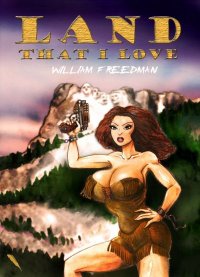 And you wanted him to get together with 99, and you wanted him to impress the Chief. Get Smart worked as a parody precisely because it also worked as character-driven romantic comedy and as the kind of secret agent story that it was sending up. Of course, sci-fi and fantasy auteurs in 2010 take their genre far more seriously than the spy writers of the 1960s did. I’d probably have ruffled fewer feathers in that milieu.
Even so, I remain resolute in identifying with sci-fi (which I insist on calling “sci-fi” despite protests from people who are trying to jettison the term in some have-baked, poorly conceived and wrong-headed attempt at gaining respectability) and fantasy. My favorite author these days is Paolo Bacigalupi, whom I’ve been following like a deranged fanboy since “Pop Squad” first appeared in 2006. Over the past couple years, he’s won all kinds of awards and critical acclaim. No less august an outlet as Time magazine showed him love for THE WINDUP GIRL. In a convention green room a few months ago, he was chatting with some other writers and talking about how mainstream publishing pros are telling him to keep doing what he does, but stop calling what he writes “science fiction”. He just laughs it off. I like to think I would too. Not that I’m in any position or am ever likely to be.
VENTRELLA: Have you received any negative comments based on the political nature of the book? Or do we just assume that the targets of your book don’t read anyway?
FREEMAN: I think history has come down on my side on this one. As unpopular as President Obama is today, he’s still twice as popular as President Bush was in his final year. Even the new wave of Republicans have little good to say about Bush’s policies.
A quick word about my own politics. Like I said, I’m an independent. I tend to vote for Democrats at the national level, but I’m just as likely to vote for Republicans in local and state contests. I got my liberal arts degree from a conservative school and my business degree from a liberal school. I’m used to disgreeing, pointedly but respectfully, with my friends, then going out drinking with them afterwards. If you think I’m an extremist, it might be because you’re the extremist and believe that everyone who doesn’t agree with you on every issue is stupid, misinformed or evil. That goes for liberals, who might identify more with my broader beliefs, as well as conservatives. My non-absolutist views on the abortion debate don’t set too well with the left.
Abortion doesn’t figure in LAND THAT I LOVE’s plot. I just cite this to call out some increasingly shrill voices who expect their favorite writers to tow a party line. I refer to the former fans of Elizabeth Moon, who vilified her for expressing what I agree is a reprehensible position on how the American mainstream ought to treat the Muslim-American community. I don’t defend her stance, just her right to disagree with the rest of us. Am I supposed to burn my signed copy of ENDER’S GAME just because I’m uncomfortable with Orson Scott Card’s anti-gay rhetoric? Is it inappropriate for me to read Nietszche or listen to Wagner because I’m a Jew and they were anti-Semites? Guess I should’ve never bought that Ford then. I mean, how would those of us who are left-of-center react if Glenn Beck went on the air and told all his viewers to boycott Alec Baldwin movies? If we’re artists, aren’t we expected to draw a reaction — a strong reaction? Can we do that if we’re concerned that we’ll lose our audience if we say something they might disagree with? We won’t ever have to worry about government or corporate sponsorship if we allow others to cow us into censoring ourselves. Yeah, good luck saying something brilliant if you’re always on the defensive against saying something stupid. And good luck getting through the rest of your life without saying something stupid.
VENTRELLA: Do you think today’s political landscape is in need of more satire, or is the news itself satire enough? (Since my next book is about a liberal vampire who runs for President, I certainly hope there is a market out there still for political satire!)
FREEMAN: No, Mike. Sorry. I tapped that well dry. There’s nothing left. I feel bad for you after all that work. Tell you what: I’ll buy a copy.
VENTRELLA: What are you working on next?
MIGHTY MIGHTY takes place in a world very similar to ours but with one exception: it has roughly the same proportion of superpowered individuals as the Marvel or DC universes seem to have. As one character puts it, “There are as many people with powers as there are people with herpes.”
The reason that world is otherwise indistinguishable from ours is that we ourselves have abilities and talents we don’t use. We all have excuses: lack of ambition, lack of social graces, family responsibilities, better things to do. But we could all be making more of a difference in the world. That’s why so many of MIGHTY MIGHTY’s most powerful characters work as airport screeners or mall cops. Until Fate, i.e., me, steps in to provide them with one last chance at redemption.
VENTRELLA: Who do you like to read for pleasure?
FREEMAN: Bruce Stirling, Neil Gaiman, Terry Pratchett, Iain M. Banks. I mentioned Paolo already.
VENTRELLA: What advice would you give to a starting author that you wish someone had given you? What is the biggest mistake you see aspiring authors make?
FREEMAN: You can’t copy-edit enough. Ultimately, you have final signoff. Your name goes on the cover and any mistakes that can creep in during the editing process, you own forever. Don’t assume that leaving the editing to skilled professionals is like leaving it to infallible gods. Don’t make that final cut on a screen. Print out all hundreds of pages and read them fresh. In LAND THAT I LOVE, I had what my editor considered an unclear antecedent to the pronoun “his”. There were two possible individuals that could have been referenced, although I can only see the logic in one. She picked the other and replaced “his” with the wrong character’s name. The mistake takes me out of the story every time I read it for an audience — and it’s right there in the first chapter. Maybe I’m being overly sensitive, though, because nobody else has told me they caught the error yet.
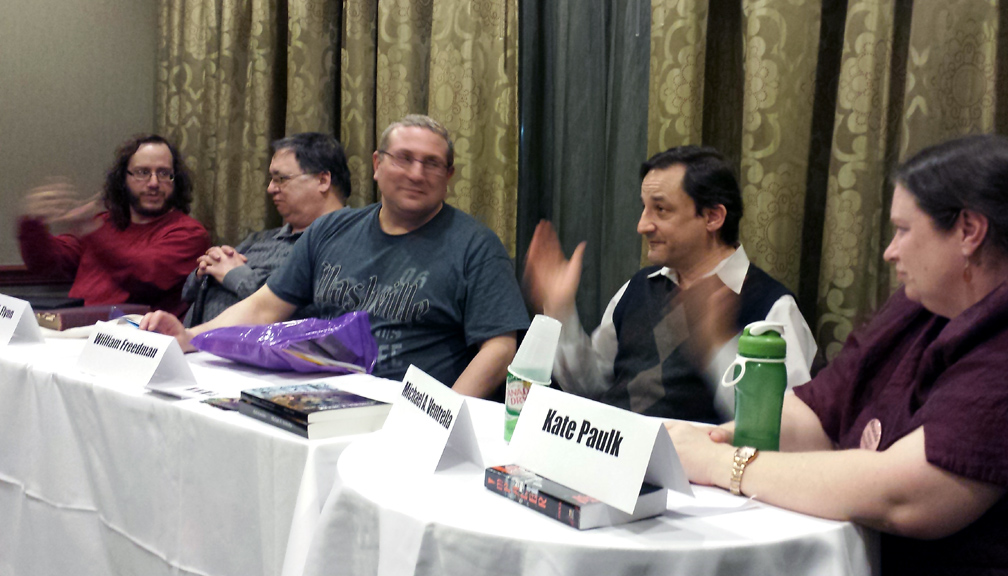
From a Lunacon panel in 2014
Filed under: writing | Tagged: editors, ideas, science fiction, writing advice | Leave a comment »
I’ll be a guest at the Philadelphia science fiction convention Philcon this weekend (along with Peter Beagle, whose interview is just below this post in case you’re looking for it!). I hope to see some of you there!
Here’s the schedule of panels I will be on:
Fri 7:00 PM: INTO THE PENSIEVE: THE HARRY POTTER FILMS [Panelists: Gail Z. Martin, Susan Casper, Michael A. Ventrella, Susan Toker] Now that the first half of “Deathly Hallows” is coming out of film (the same weekend as Philcon!), maybe it’s time to take a look back at the movie series about The Boy Who Lived, and remember some of the highlights (and lowlights) of the series until now… as well as what we’re looking forward to from the last two films.
Fri 8:00 PM: HOW DO YOUNG ADULT WRITERS KEEP UP [Panelists: Christine Norris, Jonathan Maberry, Michael A. Ventrella, Anna Kashina] How do you keep it real with the YA audience?
Fri 11:59 PM: EYE OF ARGON READING [Panelists: Oz Fontecchio, Keith R.A. DeCandido, Victoria Janssen, Gregory Frost, Hildy Silverman, Michael A. Ventrella] Science fiction professionals and members of the audience compete in a live reading contest of what may well be the genre’s worst story ever. Last year’s contest played to an audience that spilled half way down the hall and to peals of laughter. Come see what all the guffawing is about!
Sat 8:00 PM: COPYRIGHTS AND WRONGS: IP, FAIR USE, AND DERIVATIVE WORK FOR THE REST OF US. [Panelists: Jim Stratton, Rob Balder, Michael A. Ventrella, John Gregory Betancourt] Is it OK to use characters and settings from my favorite book or movie in my fanfiction? Can I make a music video using footage from that TV show? Can I put them up on the internet, as long as I don’t make any money off of them? There are a lot of questions about copyright, intellectual property, and using someone else’s creations as the basis for your own. With this panel, we hope to provide some answers.
Sun 1:00 PM: VAMPIRES THICK AS FLEAS [Panelists: Victoria Janssen, Jonathan Maberry, Genevieve Iseult Eldredge, Michael A. Ventrella] Has this trend crested? Is it going to take over the field or has it become a ghetto unto itself?
Sun 2:00 PM: IT’S ALL A PLOT! [Panelists: Dina Leacock, Michael A. Ventrella, Jim Stratton, Andrew Breslin] The fine boundary between fiction about conspiracies and fiction that people are supposed to believe. Examples are The Illuminatus Trilogy, the Shaver Mystery and the Da Vinci Code
Filed under: writing | 1 Comment »
MICHAEL A. VENTRELLA: Today, I am honored to be interviewing Hugo award winning author Peter Beagle.  I emailed some questions to him and was thrilled when he took some time from his busy schedule to send me back a voice recording of his answers!
Peter Beagle is probably best known for his novel and screenplay of THE LAST UNICORN. His other acclaimed novels include A FINE AND PRIVATE PLACE, TAMSIN, and THE INNKEEPER’S SONG. He also has a number of short story collections and nonfiction works to his name.
Besides THE LAST UNICORN screenplay, he has also written the screenplays for Ralph Bakshi’s animated The Lord of the Rings and the episode “Sarek” for Star Trek: The Next Generation.
The transcript follows:
Mr. Beagle, THE LAST UNICORN was made into an animated film back in the days when maybe we’d get two animated features a year. How did that arrangement come about?
PETER BEAGLE: It came about because a red-headed rascal named Michael Chase Walker not only optioned the book from me but eventually — and this doesn’t often happen with options — eventually paid the purchase price to buy the rights to the book and then turned around desperately looking for a deal to make believing that somebody would want to make this book into a movie. He ran through a lot of people back then before he finally got Rankin and Bass to fall in love with it.
VENTRELLA: Were you happy with the results artistically?
BEAGLE: I’m as happy with it as their budget would allow them to be themselves. They did some wonderful work in it. There’s nothing that appalls me; nothing that makes me want to leave the country. At its best, it’s marvelous. It rarely has a ‘worst’ to it. I found myself saying, when watching it a year or so ago, “Oh my god, the damn thing’s a classic.”
VENTRELLA: How did the “lost” version of that book come about?
BEAGLE: Well, I started the book when I was twenty three. That summer I was sharing a cabin in the Berkshires in Massachusetts with my closest friend from childhood who was a painter, and still is. 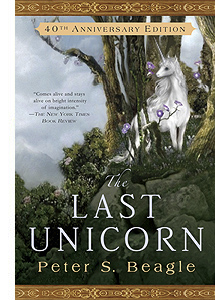 I began writing a story — just a story about a unicorn going somewhere with a companion who I couldn’t see, because he was out all day working on an enormous landscape. He’d make his lunch and then pack the landscape on the back of his motor scooter and I wouldn’t see him all day, and I wanted to show him that I had been working on something all day and not just fooling around in the warm sun or playing with the guitar. So I tried several stories that summer, and none of them seemed to work.
And then I found myself writing this story about a unicorn traveling somewhere in search of her people. It was almost completely different from THE LAST UNICORN that people know. I got about 85 pages done that summer and then simply hit the wall. I didn’t know what I was doing — well, I didn’t know what I was doing writing the whole book anyway — but I really didn’t know where this should go and I just dropped it. I put it aside, about 85 pages in, and wrote another book, nonfiction, about crossing the country with the same friend on a couple of motorscooters.
And then the mother of my children gently nagged me to get back to it. She’d read the original version and wanted to know what comes next. And I threw out — or thought I had thrown out (my mother kept everything, thank goodness) — I threw out everything but the first couple of pages from the earlier version and started over. What is out as the “lost version” was printed and will be republished is basically that first 85 pages. A reader would recognize certain things at the beginning and be absolutely baffled by a whole lot else.
VENTRELLA: Do you prefer screenplays to novels?
BEAGLE: Fiction is more fun — writing books in general is more fun — but screenplays pay better.
VENTRELLA: You are the Guest of Honor at Philcon this year. (I’m just a regular guest, but I’m hoping to maybe be on at least one panel with you!). Do you enjoy conventions and do you advise authors to attend them?
BEAGLE: When I pull into a convention, I always imagine myself and my business manager as a couple of peddlers coming to town with their cart and their mule, setting up shop by the roadside, and selling out of the wagon. 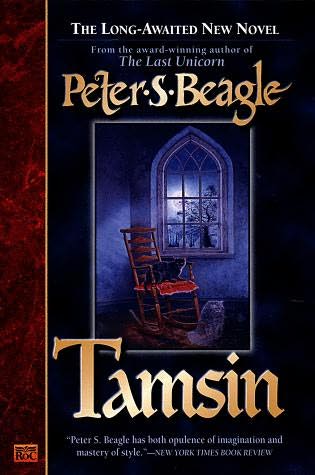 There are extra elements to a convention. There are people I only meet there — there are friends I make at conventions that I never see during the rest of the year — and generally, I’ve had very good experiences. Some have touched me very deeply. And there are people I look forward to seeing when I know I am going to be in that town and I know they’ll be coming. But I never advise a writer to do too much of it. I didn’t do conventions at all for years, and I’m trying to cut down, because one is supposed to be home working and it’s not simply the time, it’s the energy. You only have so much and it usually takes me a couple of days to get charged up again after a convention. At a convention, you’re running on adrenaline, and that’s not the same thing.
VENTRELLA: What themes do you find yourself revisiting in your work that may pop up without planning?
BEAGLE: I’m trying seriously to at least cut down on the elder goddesses, cats, and music, as well as shapeshifters. Gotta watch it with the shapeshifters, they’ll turn up in my work. I’m doing pretty well with most of them but you have to watch the cats. Every time you take your eye off a cat, it shows up in your story.
VENTRELLA: Who do you like to read for pleasure?
BEAGLE: Well, I read far less fantasy and science fiction than you might think. I read a lot of history because my father was a history teacher and I have a taste for it. I’m getting back to reading poetry — I got scared off in college, which happens to a lot of people. And I have favorite writers whose books I’ll pounce on. Right now, I’m reading a novel I missed by John le Carre. I like mysteries very much and le Carre has an extra dimension, an extra depth that most mystery writers don’t have.
In fantasy, I look for books by old friends like Patricia McKillip and Robin McKinley and Patrick Rothfuss — I’m still waiting for his second book to come out. And I re-read a lot. I re-read books I haven’t read in years that I just want to see again, like visiting an old friend. I re-read George McDonald Fraser’s FLASHMAN novels. Flashman is an absolute scoundrel. There is nothing to be said for Flashman. It’s a rat’s eye view of 19th century English European history. There’s something just inspiring about Flashman’s badness because at least he never pretends he is anything other than what he really is! You can’t ask more from a character.
VENTRELLA: What advice would you give to a starting author that you wish someone had given you? What is the biggest mistake you see aspiring authors make?
BEAGLE: The biggest mistake — it’s not even a mistake, but something I wish an author had told me: Don’t get too mad at yourself when you do it wrong. Just do it again. Because that’s most of it, just doing it again, learning by doing it wrong.
The thing I always tell people who want to write is that you have to show up for work. Most people haven’t got the patience. The talent doesn’t have anything to do with it. I know a lot of people with as much or more talent than I have … But I will sit there, even when nothing is coming. 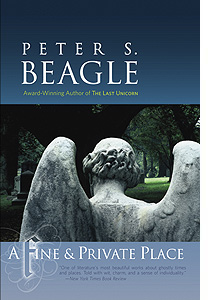 Anybody can write when the stuff is flowing. But I’ll sit there until, as Red Smith, the great sportswriter said, “I’ll stare at the blank screen or page until little drops of blood start to come out of my forehead.” That’s how you know you’re writing.
When I was fifteen or sixteen, I met a writer through friends named Charles Jackson who I’m sure isn’t remembered these days except for the movie that was made out of his novel THE LAST UNICORN. [laughs] I’m sorry, THE LOST WEEKEND, which was about an alcoholic. It was made into a movie, and was very successful. But when I met him, he wasn’t writing fiction. He was working for one of the early television soap operas. And being the age I was, I was immensely snobbish. How can somebody who wrote THE LOST WEEKEND lower himself to write for a TV soap? We rode in on the train together from Connecticut to New York, and he told me, among other things, “I can only really write about something that’s a part of me. I am an alcoholic, so THE LOST WEEKEND came out of what I know. And there hasn’t really been anything like that since.” I remember him telling me this: “I can probably get a hundred thousand dollar advance on my name for a new book of any sort, but you can’t do that. It’s not honorable. What I’m doing may not seem like much to you, writing for this soap opera, but it’s honorable work, and it’s professional. And when something erupts in my life that wants me to write about it, then I will. Meanwhile, I’ll do this.”
He wasn’t scolding me. He wasn’t coming down on me or anything like that; he was very gentle. But he taught me a thing about what is professional and honorable. What you can do and what you can’t, even if you need the money.
Charles Jackson had principles. I make jokes about having no principles of my own because I can’t afford them, but when I do come up against a principle, I know what it is. I’ve usually got ten seconds to make a decision. I hate it, but I think of Charles Jackson. He was gay, by the way, which he didn’t go into, and he did write a novel after that — again, this was in the 1950s — from the point of view of a gay man. He’s long dead. If anyone reads anything of his, it’s probably for a film class that included THE LOST WEEKEND. But he was a good guy and I’ve never forgotten him.
The biggest mistake an aspiring author makes is thinking either that nothing you write is any good or that everything you write is good, and neither one is true. The biggest mistake is listening to too many people and also — and this I talk about a lot — confusing writing with publishing. It’s not the same thing at all. Publishing is a business. Publishing involves making someone else some money and maybe a little bit for yourself. Writing, storytelling, art — that’s another matter. I’m not being romantic about it; there’s just not a lot of connection between the two.
There’s a saying that an artist is someone who can’t not be an artist, and that’s really what matters. If you can’t do without being an artist, then it really doesn’t matter if it doesn’t sell. You don’t burn the manuscript, for heaven’s sake, you find a place for it … The only publication that would touch my story “Lila the Werewolf” back in the 1960s was a college magazine at UC Santa Cruz. Later on, it got picked up, but I just wanted it published.
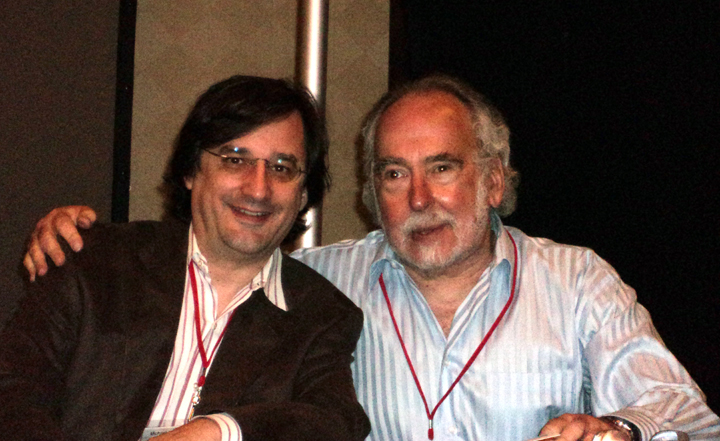
Me and Peter Beagle
Filed under: writing | Tagged: convention, fantasy world creation, Peter Beagle, science fiction, short stories, Star Trek | Leave a comment »
MICHAEL A. VENTRELLA: Walter H. Hunt is a science fiction writer known primarily for his “Dark Wing” series, a “military space opera.” His most recent work, A SONG IN STONE, deals with the Knights Templar. He lives near my old stomping grounds (Boston area) with his wife and daughter. His web page is here. 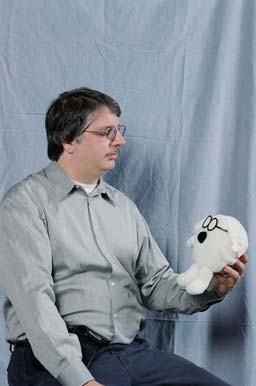
Walter, you began writing scenarios for games. (As a person who has done the same — albeit for LARPs — I know what that’s like!) How did you get published that way? In other words, how did you turn your hobby into a business?
WALTER H. HUNT: I had the good fortune to encounter Rich Meyer and Kerry Lloyd of Gamelords in 1981 and was pulled into the company as a writer. Between 1981 and 1984 I worked on a number of projects for them. When they stopped publishing Richard and I (along with others, including my wife) began Adventure Architects to write free-lance in the game industry. We worked for Mayfair, Iron Crown, FASA, and several other companies.
VENTRELLA: Is there still much of a market out there for writing for games?
HUNT: It seems so, though I haven’t done any of it for quite some time.
VENTRELLA: When did you decide to start writing fiction, and what were your first attempts like?
HUNT: When I was in elementary school. And it was predictably awful, though it meant that I wrote lots and lots of words and learned how to set scenes and compose dialog. I wrote six novels in middle and high school. They will never be seen, I hope.
VENTRELLA: How did you get your first big break?
HUNT: I’d shown a manuscript to a friendly editor at a convention in 1987, and when he began working for Tor Books in 2000 he contacted me through a mutual friend to see if I still had it available. The mutual friend lined up the agent, so I got the agent and the publisher at the same time. Lucky break – though it took almost 14 years for me to get so lucky.
VENTRELLA: Lately it seems that fantasy of all varieties has taken the place of science fiction on the bookshelves. To what do you attribute this change?
HUNT: Haven’t a clue. There is a lot of bad fantasy, but there is a lot of bad science fiction too – especially on television. Sturgeon’s Law, I suppose.
VENTRELLA: Your most recent work is about the Knights Templar and the Rosslyn Chapel, something most people had never heard of before Dan Brown. How did you decide to tackle that subject?
HUNT: The Order of the Temple is an interesting subject, with plenty of scope for writing. I’d heard of Rosslyn before reading the Brown book – it’s common pseudohistorical fodder in Masonic circles, and I’ve been a Freemason since 1988. 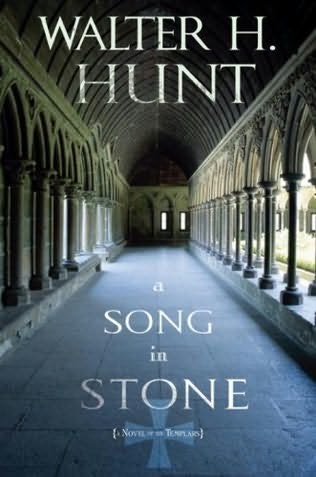 When we went to Scotland for Worldcon in 2005 I put it on my itinerary, and was fortunate to receive a tour from a fellow Mason. He pointed to the ceiling of the lady-chapel and said, “that’s the Rosslyn music.” As the lead character in “Despicable Me” is fond of saying, “light bulb.” By the time I came back from Scotland the book was plotted and partially written.
VENTRELLA: You are a regular at science fiction conventions (and indeed, we have been on panels together!). Why do you attend them?
HUNT: Why, to meet fascinating colleagues. Seriously, the opportunity to meet readers and fellow writers is something not to be passed up. For professionals (or aspiring professionals), there are editors and publishers as well. I arranged my most recent book deal at NASFiC this summer by having the right conversation with the right person. And I’m still a fan: I’ve gotten to sit next to people like Robert Sheckley and Frederik Pohl and Connie Willis and David Brin and a dozen others – and talk to them (and listen to them. More listen than talk, I hope.)
VENTRELLA: What advice would you have for an aspiring genre writer for attending these things, even if they haven’t been published yet?
HUNT: Finish the book. No one buys an idea from an aspiring writer – only a manuscript. But by all means believe in your own work; I have seen too many occasions when an unpublished writer lets his/her work be folded, spindled and mutilated by people who want to make it into something else because it might be more “publishable.” Write what you understand, trust your creative instinct, and finish it.
VENTRELLA: What’s your pet peeve about the industry?
HUNT: I’ve heard it said that the criteria and market studies for genre fiction are thirty-plus years out of date. I think that some editors base decisions on what to buy and what to promote based on inaccurate perceptions of the composition and demographics of the buying public. 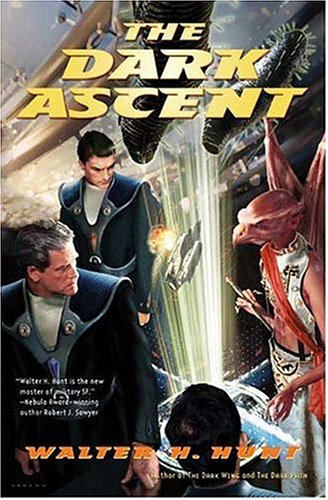 But, again, I have no idea if this is true.
VENTRELLA: What is the biggest mistake you see aspiring authors make?
HUNT: To assume that there’s any money in this business. I’m married; as the old joke goes, “what do you call a full-time writer who’s single?” The answer is, of course, “homeless.”
VENTRELLA: What’s your opinion on small press and self-publishing?
HUNT: Small press deserves better respect, and I think the internet is helping with that. My Rosslyn book A SONG IN STONE is currently published by a small press. Self-publishing is a mistake: it says, essentially, “no one professional will buy my work, but maybe the reader will. I hope so, my garage is full of these things I paid to print.” So I’d wait to have someone buy my work.
VENTRELLA: I see you are a historian or sorts, having studied that in college. With a time machine and a universal translator, who would you invite to your ultimate dinner party?
HUNT: Top of the list would be Benjamin Franklin – polymath, wit, diplomat, Freemason. Erasmus of Rotterdam. Stanley Weinbaum and Cyril Kornbluth, two great science fiction writers. My parents, whom I miss terribly (they’ve been gone for twenty years and never saw me succeed as an author. My mom would enjoy meeting Franklin, I suspect.)
You know that Hendrik van Loon did this little thought experiment, right?
VENTRELLA: Um, no. Hendrik van Loon? Did you make that name up?
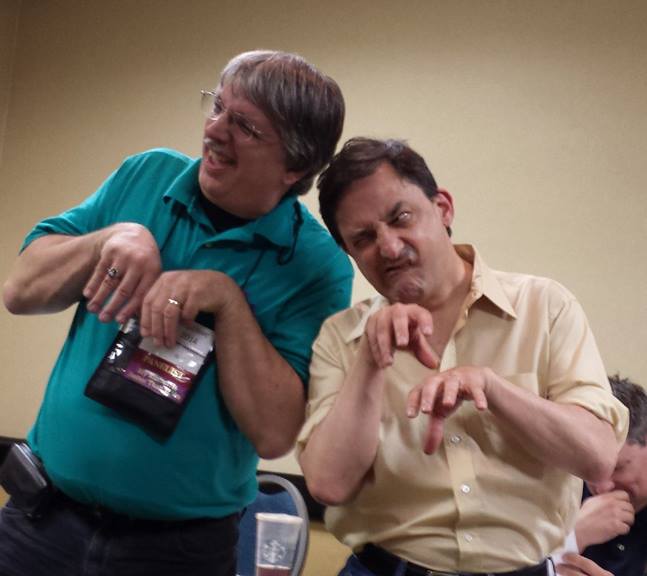
Goofing off at Capclave 2014
Filed under: writing | Tagged: agents, convention, ideas, science fiction, self-publishing, Walter H. Hunt | Leave a comment »
MICHAEL A. VENTRELLA: Today, I am honored to be interviewing author P.N. Elrod, best known for The Vampire Files series featuring undead private eye Jack Fleming. She’s edited award-winning anthologies, warns new writers away from scams, and is open and honest about her incurable addiction to chocolate. 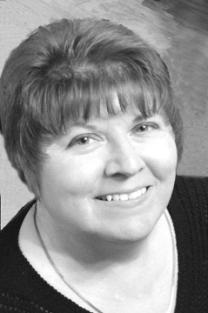 More about her toothy titles may be found at www.vampwriter.com.
What is it about vampires that so attracts the public?
P. N. ELROD: They’re easy on the eye, have money (if they’re doing things right), and get to kick butt—at least that’s true for the ones in my books!
VENTRELLA: Why did you decide to become the “vampire specialist” with your series?
ELROD: I didn’t decide. I like writing about the characters. You write about what interests you and that passion comes through in the words. If you’re lucky your words will touch others.
VENTRELLA: What’s your opinion on the many variances we’re seeing in vampire stories?
ELROD: I don’t have any. To each his own, let’s all have fun.
VENTRELLA: Do they bother you?
ELROD: Not even a little. I have other things on my event horizon.
VENTRELLA: Do you think this trend will die down eventually?
ELROD: I was told in the 1960s that vamps were dead. Apparently someone got that wrong and others will continue to get it wrong. I don’t pay attention to trends. If I did, then there would be no Vampire Files or any of my other books. I write the kind of stories I want to read and hope others agree with my take on things.
VENTRELLA: The concept of a vampire private eye solving his own murder must have helped sell your first novel in that series.
ELROD: The concept resulted in 20+ rejections from publishers who didn’t know what to do with a cross-genre book back then. It wasn’t a mystery or a horror and no one knew how to sell it—especially agents looking for a quick placement. 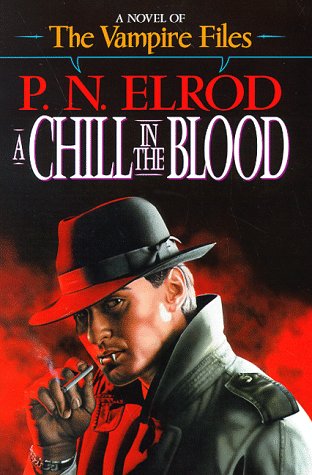 It finally sold off the slushpile to Ace Science Fiction. It only took two years of shopping around—and about 20+ rewrites to get it up to a professional level. I’m glad it too so long—it resulted in a much better book!
VENTRELLA: You’ve written a sequel of sorts to Dracula. How did that come about, and what constraints did you discover?
ELROD: It is a sequel to Dracula. I’ve always thought that Quincey Morris got a bum rap at the end, and wondered how it was that he knew more about vampires than all the others except for Van Helsing. I also wondered—after V.H. again and again harped about using a wooden stake—that they bumped off Dracula with a big metal knife. Well, my hero, Fred Saberhagen deftly and cleverly dealt with the latter problem in his classic The Dracula Tapes. When I was ready to do my own take on things, Quincey Morris, Vampire was the logical result!
No constraints. I wrote the kind of story I wanted to read. I love the Victorian period, the research was a joy and still is. I’m doing another Quincey book, but it will have to be scheduled after I turn in my new steampunk series.
VENTRELLA: In my next novel, a vampire runs for President (but of course, no one believes that vampires really exist). Do you think there’s a market out there for a political vampire novel?
ELROD: I wouldn’t know. Get some feedback, polish, shop it around, and find out.
VENTRELLA: When editing, what do you look for in a story?
ELROD: As little work for me to do as possible. I expect a clean, polished manuscript from writers who bothered to proofread and use the spell check.
After that, I want a beginning, middle, and satisfying ending with characters I can relate to whether they’re good guys or bad apples, and good solid writing.
I expect an enthusiastic, cheerful, professional attitude. My goal is the same as the writer’s: producing the best story possible so readers fall in love with their words.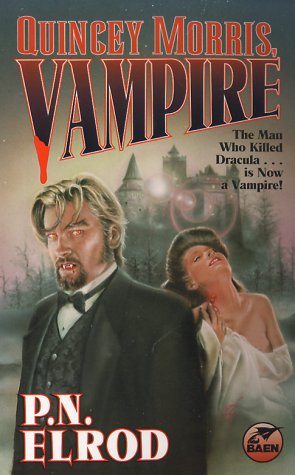 If you’re a paranoid diva whose deathless prose that must be preserved like the Dead Sea Scrolls, move on. Neither of us will enjoy the experience.
VENTRELLA: Do you generally invite others to join your short story collections or do you have open submissions? Which do you prefer?
ELROD: These days I’ve room for only nine stories in a collection. I call on a core handful of writers on my A-list choosing about four of the nine, depending on who is available. A-list writers are busy! The publisher—who is footing the bill—naturally wants to promote the writers who have books with them, and pick the other names. It’s only fair, and they are being more than generous about it.
In past projects I could handpick all the writers, inviting ones I knew would deliver good stories. I’ve asked only 2-3 otherwise unpublished writers for work, and they did not disappoint.
Those projects were not open submission, but I got stories from other writers with more cohones than sense. I let in one based on his letter and story. The letter, I later found out (this was before Google), was a gross exaggeration of his supposed “sales”. His story required extensive and repeated line edits. After that, I put him on my “do not invite” list. I don’t deal with liars.
Here’s a clue, new writers: tell the truth. You’re only as good as your reputation for honesty. If you’ve not sold anything, it’s perfectly okay. But don’t tell an editor that you’ve sold 20 stories to various publications when you really mean you just submitted stories and are waiting to hear back. These days it’s too easy to check up on you.
After speaking with other editors who have done open submission collections, I know I’d not want to work on such a project. I don’t have the time or patience.
VENTRELLA: What bugs you most about the publishing industry and what would you change about it if you could?
ELROD: They’re not cracking down on e-piracy. It’s not about freedom of information, it’s about theft of property. It’s one thing to resell a used book, but used bookstores don’t sell Xerox copies.
Contrary to popular myth, most writers don’t get paid much, and piracy cuts into the pittance they do manage to get from their hard work. Pirates are not promoting anything. If writers could make more money by giving away free e-copies of their works, they’d be doing it. Some of the more successful ones have chosen to do so, but the pirates have taken that choice away from the rest of us.
Publishers are losing millions in revenue through e-theft. If the music industry can crack down on it, so can the publishing industry. I want them to get off their duffs and shut down on these so-called “share” sites. Slap fines on the pirates and those who download from them. If anyone wants a free copy to read, go to the library. Each time a book is checked out, the librarians note that and order more from those writers. It’s good for everyone.
I believe most people want to do the right thing, so please, support your local library and the writers you love.
VENTRELLA: You’ve self published a novel, even though surely you could have sold it to a traditional established publishing house. Why did you decide to do this?
ELROD: Let’s call it commercial publishing. “Traditional” is a term used to excess by a notorious reverse vanity printer to make their customers think they’re in safe hands. In true “traditional” publishing it was the writers who paid the costs. Writers call that “the bad old days!”
I could not have sold THE DEVIL YOU KNOW to a commercial publisher, since it was always meant to be a signed, numbered, limited-edition written specifically for my fans. My publisher for that series prefers stand-alone titles—at least from me.
Commercial publishing is glacially slow. It takes time to put books through editing, copy-editing, design cover art, arrange distribution, etc. I wanted to get the book out quickly.
So I did my research of various printers, pricing, delivery times, shipping costs, got the best deal from a local company whose people I know. I did the cover myself, got a professional edit, and a lot of proofreading. The printer very kindly tweaked my interior design to cut down on the page count and thus the cost. I had some good breaks and learned a lot.
For future non-commercial venue works I’ll go through a POD service, again, doing my research so I get the lowest cost per copy, but with a professional company that can deliver the goods to the readers. While it won’t be a signed edition on acid-free paper, it will be available through my website links at a low price and won’t ever go out of print.
I see many new writers opting to self-publish—usually long before they’re ready.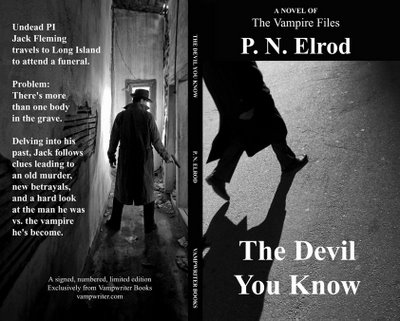
Some neos think having a book finished is good enough, and that the story is so great that people will forgive any “little” errors. It’s a nasty reality check when they get bad sales and worse reviews as a result. I don’t recommend self-publishing for the new kids. I was able to get away with it, based on my experience, an obsessive attention to detail, and a sizable fan base built up over the last 20 years.
VENTRELLA: Has it been a success?
ELROD: It’s sold out the 500 copies I had printed. In self-publishing terms it was a runaway bestseller. In commercial terms it tanked.
It took a year to sell that many copies. Had it been a commercial release it would have sold that many in one day.
I was only able to do because I have a solid platform of readers. Even so, only a tiny fraction of them chose to buy. I had hoped to sell out in the first month. So despite my experience and fan base, I overestimated my sales figures. It was instructive!
If a new writer with no platform decides to self-publish, they can expect to sell 5-10 copies to family and friends, perhaps 50 if they bust their bottoms with promotion. But they can also expect the standard “If your book is so good, why couldn’t you sell it?” Unfair, but that’s how it is.
I know some writers are promoting their backlists with much success as e-books and POD copies, racking up thousands of sales. But THEY had a plenty of commercial sales that built up a good audience. At this point, writers who have pro sales, who have books in the stores, and who self-promote like mad have the edge.
A new writer with no professional sales is delusional if he/she thinks similar success will happen to them. It’s all the difference between holding a garage sale, and having a store at the mall. It’s just better business sense to try for professional publication from the get-go.
VENTRELLA: What advice would you give to a starting author that you wish someone had given you?
ELROD: Get feedback, rewrite as often as it takes, and expect rejection. No one escapes.
Send your work to venues that actually publish it. Don’t send a fantasy to a mystery house or a western to a cookbook house.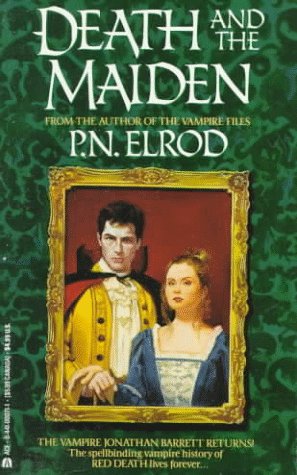
Just because you worked really, really hard on a book, don’t expect anyone to give you extra credit for the effort. Publishing is a business. Your words have to be worth buying and selling. If they aren’t you get a rejection. That’s when you ask for more feedback, rewrite, and try, try again.
VENTRELLA: What is the biggest mistake you see aspiring authors make?
ELROD: Sending unpolished work out before they’ve gotten feedback from other writers, not just friends and family. They love you and want you to feel good.
Other writers will tell you the truth.
An amateur wants to be told how good their book is. A pro wants to know what’s wrong with it so they can fix the problems. Get the problems fixed first, then start shopping. Write the next book while you shop the first.
Don’t give up. Ever read a terrible book that still somehow got professionally published? That writer didn’t give up.
Obey Yog’s Law: “Money flows toward the writer.” Never pay to publish. It’s hard to believe, but many writers still think you have to pay to play. It’s scary how many will ask me “How much did it cost to get your book published?” I’m talking about my commercial titles, not the ones I self-pub. I’m very clear that there is a huge difference between the two! (Usually the money they make. Commercial wins out every time.)
Don’t look for a publisher online, get Writer’s Market. You cut out 99% of time/money-wasting vanity and scam operations. If you google “book publisher” most of the names on the first page are scams wanting to turn you into an ATM for them.
Go into a bookstore, find books similar to what you write, then follow submission guidelines to the letter. Scams and vanity houses cannot get books into stores.
Ask other writers to recommend reputable agents in your genre. It worked for me.
Did I say to obey Yog’s Law? It’s worth repeating. Writers get paid, they don’t pay!
VENTRELLA: With a time machine and a universal translator, who would you invite to your ultimate dinner party?
I don’t give dinner parties. My cooking is lethal. Ask the few survivors.
If we ate out, I’d hang with my friends in the here and now. I’ve learned it’s often a good idea to keep some distance between oneself and one’s heroes. You might catch them on a bad day and be disappointed.
“When the legend becomes fact, print the legend.” – The Man Who Shot Liberty Valance.
Filed under: writing | Tagged: Dracula, e-piracy, new writers, P.N. Elrod, POD, print on demand, publishing house, rejection letters, self-publishing, short stories, vampire, Vampire Files, writing advice | Leave a comment »
Writers don’t like rules. Actually, most creative people don’t like rules.
But the fact is that you must follow certain basic rules in order to tell good stories. And this is nothing new — it hasn’t changed since the ancient Greeks.
All good storytelling has three acts. And no, this isn’t just “the beginning, the middle, and the end.” There is a structure that should be followed in order for your story to have the greatest impact.
Now, some of this is common sense that a good writer knows instinctively. However, I’ve never taken any writing classes and never really thought about it much until recently, as I’ve been trying to educate myself. (Hence the purpose of this blog).
Act one is the introduction of the main character and the conflict he or she faces. (This doesn’t mean you shouldn’t start in the middle of the action — you want it to be gripping and exciting, of course.) Here is where the reader gets an impression of your character and decides whether the character is likeable or at least interesting enough to follow.
Act one can theoretically be quite short, but it’s the foundation upon which the rest of the book rests.
Act two is where the main character is pulled into the conflict in some way that he or she cannot avoid.
Understand that the conflict mentioned here doesn’t mean action. It could be a moral conflict, or a lover’s disagreement. It must however be something that requires the character to do something to resolve it. The character can’t just wait around talking about it, and the character should not have someone else solve the problem for them.
Act two ends at the lowest point in the character’s attempt to resolve this problem. He or she looks defeated; there seems to be no way out.
Act three then is the character’s redemption and salvation. This is the resolution, and like act one, it may be very short in comparison.
You can see this very clearly in good movies. Well, actually, you can also see it in bad movies that don’t follow this formula. Usually it’s because the writer hasn’t paid enough attention to act two — the conflict is not serious enough or the character can easily avoid it.
Now for the disclaimer.
This does not mean that you should think of your story as existing in three equal acts. You can see a three-act play and the “second act” of the story can take place ten minutes into the first act of the play. Even one-act plays have three “story acts.” Hour-long TV show scripts have seven “acts” (to allow for commercials).
That’s why I think it’s much better to think of your story as having three unequal parts. If you think of three “acts” you invariably begin structuring your story too much. Give your character a conflict; make it unavoidable; and then resolve it.
Filed under: writing | Tagged: three acts, writing advice | Leave a comment »
MICHAEL A. VENTRELLA: I’m pleased to be interviewing Joel Rosenberg today. His first published fiction, “Like the Gentle Rains”, appeared in Isaac Asimov’s Science Fiction Magazine in 1982.  The following year, he published his first novel, THE SLEEPING DRAGON which was the first in his long-running Guardians of the Flame series. The “Keepers of the Hidden Ways” trilogy similarly places people from the real world into a fantasy setting, making heavy use of Norse mythology. He’s also written in a number of other genres.
I remember reading THE SLEEPING DRAGON when it was first released, and thinking “Oh, this is interesting; a group of gamers who get sucked into another world where they must actually play their characters for real.” A few years later, I helped to found one of the first major fantasy LARPs in America. Coincidence? I think not.
JOEL ROSENBERG: 🙂
VENTRELLA: Anyway, my question is this: It became clear very soon in THE SLEEPING DRAGON that this was no cute little adventure when (spoiler alert) one of the main characters dies fairly quickly. Further books in the Guardian of the Flame series also had no problem handing death to characters we have followed and loved for years. Was there anything specific you were trying to say by doing this?
ROSENBERG: Yup. What I was trying to say, explicitly, is that innocence is no shield, and that I wasn’t using any Plot Armor on my characters. Two reasons: 1. I think that makes a story more entertaining, and 2. I think it’s an important truth, for real life.
At the moment, we’re wrapping up a horrible experience — in mid-August, my wife, Felicia Herman, was falsely arrested and maliciously charged with domestic abuse of our sixteen-year-old daughter, Rachel, and it wasn’t her utter innocence — and I want to be clear: she didn’t do anything wrong, or unlawful — that caused the charges to be dropped just over a week ago, but damn good lawyering by our attorney, David Gross.
It could, absent David, easily have gone the other way.
VENTRELLA: In retrospect, do you think this willingness to kill your characters off has strengthened the popularity of your books or hurt it?
ROSENBERG: I dunno. If I had to guess, I think it’s probably hurt the popularity, but there’s so many other factors in publishing that it’s hard to say what causes any success … or failure, for that matter.
VENTRELLA: Do you have any interest in ever publishing another book in the Guardian of the Flames series?
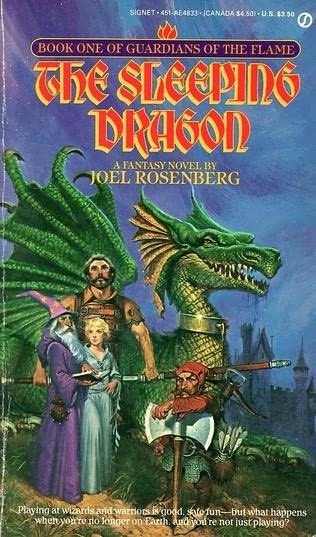
ROSENBERG: I have to write one; that’s part of my deal with Walter Slovotsky for his collaboration on the nonfiction book in progress, FAMILY MATTERS II: GREENER’S LAW. (see http://familymattersii.com/.) Whether or not somebody publishes it isn’t my call, but I expect that the next Guardians book will find a publisher. First, though, I’ve got to finish FMII.
VENTRELLA: How were you able to sell your first book?
ROSENBERG: It was pretty straightforward. I got an agent; the agent submitted it all around; Sheila Gilbert (then at NAL) made an offer.
VENTRELLA: It has been a long time since your last published work. What happened? What have you been doing?
ROSENBERG: Firearms instruction, tech writing, political activism — you’ll find a lot about it in fmii. It’s been . . . interesting, in a Chinese Curse sense. Never thought I’d walk into Streichers — a local cop shop — and say, “Wayne, I need you to fit me out with body armor. Now.” But I did. Some of the stuff that’s been happening lately is kind of, well, close to the edge.
VENTRELLA: What clichés do you see in the fantasy genre that you hate? How do you avoid them?
ROSENBERG: I try, really hard, not to see cliches. That said, the society that seems to consist solely of muscular warriors, voluptuous barmaids/peasant girls, and evil minor nobility bugs me, so I try to avoid it.
VENTRELLA: You’ve also written science fiction and mysteries. Is there a genre you enjoy above all others?
ROSENBERG: Nah. There’s books I’ve enjoyed writing more than others — writing HOME FRONT was an utter joy, and both of the Guardians Road books had their moments, although I think they cut too close to the bone, personally.
VENTRELLA: What techniques do you use to make sure your characters are realistic and believable?
ROSENBERG: Let me give you two honest answers: 1. All of them. 2. Damned if I know. I don’t mean to be flip, although I don’t mind, but I don’t care if my characters are realistic; I care, to the point of pain, that they’re believable.
VENTRELLA: How do you prepare? Do you outline heavily?
ROSENBERG: Nah. From my POV, an outline is something an agent uses to sell a book that hasn’t been written. 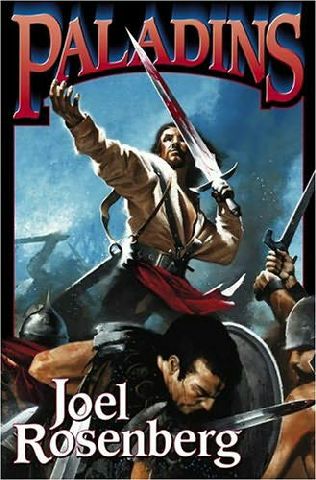 That’s a noble endeavor, honest, but it has nothing to do with how I write. (Dave Drake, a writer who I respect tremendously, outlines extensively; I’m not knocking the practice at all. So do Pournelle and Niven, when they collaborate.) Feist and I wrote an outline, kinda, for MURDER IN LaMUT, and then when I took my crack at the first draft, I avoided it. Well, no, that’s not true; I more bent it over a table and violated it.
VENTRELLA: A common theme in your work has to do with freedom, and the consequences (good and bad) that can come from it. What is in your background that makes you interested in this theme?
ROSENBERG: Child abuse. Receiving end. Not that that’s a secret to anybody who has read my books and noticed some similarities to, and some obvious attempts to rewrite, my own family history. (When my sister Dale read D’Shai, she wrote me: “I love it. I didn’t even mind the part where I died.”) Truth is, I’m the dog who has been beat too much, and have been, for more than forty years; writing is one of the ways I deal with it. So, for that matter, is the political activism.
Sorry about the answer, but, hey, you asked. 🙂
VENTRELLA: I always liked the idea in the Guardians series that despite the fact the main characters were the “heroes” they still had problems being elected the leaders. Do you find this a fault or a strength of democracy?
ROSENBERG: All in all, I think that a public who elects heroes is looking for trouble, and will find it. Heroes work best as dictators — temporary ones; see Cincinnatus, or, for that matter, Churchill, or Rudy G. — and then it’s best to put them back behind the glass, with the big sign that says, “In case of emergency, break glass”, and make sure that they can’t break the glass from inside.
VENTRELLA: Do you think that being a successful author has more to do with skills that can be taught, or is it more something more intangible?
ROSENBERG: Neither. I think it has to do with skills that can be learned, as opposed to being taught. On the FMII site, I’ve got partial list of my teachers, and I’ve learned a tremendous amount from all of them.
Filed under: writing | Tagged: agents, character development, heroes, outlines, writing advice | Leave a comment »
MICHAEL A. VENTRELLA: I am pleased to be interviewing two-time Hugo award winning author Allen Steele today! Allen has won numerous awards and nominations for his science fiction stories, novels, and novellas. 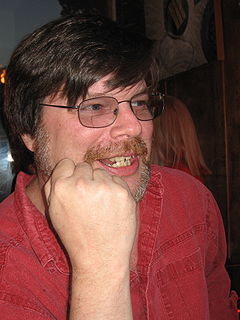 His novels include ORBITAL DECAY, LUNAR DESCENT, THE JERICHO ITERATION, OCEANSPACE, and the “Coyote” series. His web page is here.
Allen is the Guest of Honor at the 2010 Albacon SF convention (which is next weekend as of this posting). I’ll be there too (but only as a regular ordinary guest)!
Allen,You’re one of the few authors who has been published on another planet. How did that come about?
ALLEN STEELE: A couple of years ago, NASA’s Phoenix lander made it to Mars, and aboard it is a DVD containing a library of science fiction stories and artwork about Mars that was compiled by the Planetary Society. Among them is ‘Live From The Mars Hotel”, my first published story, which was published in Asimov’s Science Fiction in 1988. The DVD is intended to be a repository for future Mars colonists, and also a tribute to SF writers and artists who’ve portrayed Mars since the 1700’s. It’s a huge honor to have my work represented in this way. In fact, I wrote a story about this that appeared in Asimov’s earlier this year: “The Emperor of Mars”, in the June 2010 issue.
VENTRELLA: You’ve been with small publishers and large. Which do you honestly prefer?
STEELE: Both have their benefits. Large publishers like Ace or HarperCollins pay better and have greater distribution; small publishers like Subterranean and Old Earth give me the advantage of more creative control and also the ability to publish individual novellas and short fiction collections, something which large publishers tend to avoid these days. So I split the difference by having my novels put out by large publishers and my short fiction by small publishers. Any preferences I may have are predicated by what I’m publishing, really.
VENTRELLA: What’s your opinion on self-publishing? Should a starting author consider such a thing?
STEELE: Only if they don’t mind not making any money from your work or not having it seen by very many people. Yes, I know there are exceptions, and that online publishing is offering yet another option, but the success stories are few and far between. Nearly every time I go to a SF convention, I see people hawking self-published novels from tables they’ve rented in the dealer’s room, and at best they sell only a handful. Bookstores won’t carry them, and reviewers simply won’t touch `em.  There’s literally thousands of self-published novels and stories online, and I’d be amazed if any of them were downloaded more than a few dozen times. And once a book or story has seen print in any form, professional editors are not inclined to reprint them (again, yes, I know there’s exceptions. I can only name one or two, though). So it’s a dead end, and one that a new author should avoid.
VENTRELLA: Hard science fiction seems to be taking a back seat to high fantasy, steampunk, urban fantasy, and other genres. Why do you think that is?
STEELE: This last decade, yes, SF has been less visible. Personally, I think the principal reason is that the other genres you mention are almost entirely escapist in nature, and tend to look backward instead of forward, while SF is usually a forward-looking genre, with the best work grappling with the effects of the present while confronting plausible futures. We’re living in scary and uncertain times, so it’s little wonder that many readers are searching for that sort of literature that avoids reality, whether it be ersatz-Tolkien fantasy worlds, sexy vampires, or pseudo-Victorian settings that bear little or no resemblance to history as it actually happened.
But when you look at the history of the SF genre as a whole, you see that SF is something that periodically waxes and wanes in popularity. When my first novel was published in 1989, it was during one of those waning periods. Shortly after that was the SF boom of 90’s when a lot of new writers like myself who write this sort of thing entered the genre, but this followed by the gradual decline of the last decade. Eventually SF will make another comeback. Until then, writers like myself will continue to satisfy that solid, hard-core SF audience that has never gone away, while several hundred fantasy, horror, and steampunk writers struggle to distinguish themselves from the pack.
VENTRELLA: I can think of many SF novels that aren’t that old that didn’t predict cell phones or email, for instance, which makes them a bit quaint. How does one avoid those things?
STEELE: The purpose of science fiction isn’t the prediction of the future. When that happens, it’s by accident (and incidentally, there is an older SF novel that depicts a cell phone: TUNNEL IN THE SKY by Robert A. Heinlein, published in 1955). So claiming that a given SF novel is “quaint” because it didn’t predict the future that it depicted means you’re holding it to a double-standard that’s impossible for a writer to keep. When a SF writer comes up with a futuristic scenario, he or she is simply devising a world that doesn’t presently exist and may never; because he or she is extrapolating from our current condition, they should try to create a certain verisimilitude by keeping a close eye on what may be possible. But his or her job isn’t to predict the future, but rather to tell a good, believable story.
VENTRELLA: In a similar vein, LABYRINTH OF NIGHT made use of the “Face on Mars” – is this something you regret or try to avoid now?
STEELE: When I wrote “Red Planet Blues”, the 1989 novella which I later expanded to become LABYRINTH OF NIGHT, the “Face on Mars” was an astronomical oddity that relatively few people knew about. 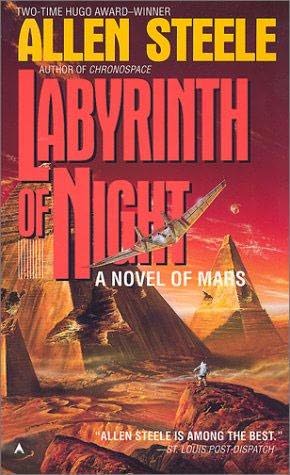 Aside from that single grainy image photographed by the Viking orbiter in 1976, it was a curiosity and nothing more. Our lack of knowledge about it gave me the liberty to use the Face as a springboard for a first-contact story. By the time the novel was published in 1992, though, the Face had become the subject of tabloid journalism and pseudo-science books, and not long after that the Cydonia region of Mars was revisited by subsequent NASA probes, during which the Face disappeared. I don’t regret the novel I wrote — it’s a good adventure story that sold many copies in both the U.S. and in Europe — but it’s now obsolete and I don’t mind that it’s gone out of print.
VENTRELLA: What is it about alternate history novels that appeals to writers and readers?
STEELE: The appeal of alternative history is obvious: depicting what might have happened if certain events had happened in a different way. It’s like futuristic SF, only in reverse. And just as it’s unwise to read a futuristic SF novel as a means of predicting the future, I think that it’s similarly unwise to read an alt-history story as a means of understanding the past. It’s just another form of storytelling, really.
VENTRELLA: What did you do to prepare for your alternate history novels?
STEELE: When I’ve researched the alt-history stories I’ve written, I’ve started by reading every reliable account I can find that depict the particular historical events upon which I’ve basing that particular story or novel. If possible, I visit actual locations; museums are another major resource. I take loads of notes, and during this period I’m fine-tuning the story and characters as well. It’s hard work, but I think it pays off in the sort of verisimilitude that you need to achieve if the reader is going to buy into the variation on history that I’m depicting.
VENTRELLA: What is the biggest mistake made by authors who write SF?
STEELE: The common mistake by novice SF writers is two-fold: not doing enough research, and then letting the research they have done get in the way of their story.  Science fiction is hard to write, mainly because of the homework involved — which is a principal reason, I think, why so many new writers have taken to fantasy or horror instead; they’re easier to do — and there’s a great temptation to take shortcuts, but it’s just those sorts of shortcuts that undermine the story you’re creating. The other side of the coin is to do boatloads of research, then front-load everything you’ve learned into the story you’re writing; this can bog things down and cause the reader to lose interest. So you have to walk a line here: do your homework, but don’t bore the class by telling them every little thing that you learned.
VENTRELLA: Is writing a skill that can be learned or are the best writers born, not made?
STEELE: I think fiction writing is something that can be learned, yes … but it takes a long time to develop the skills necessary to tell a good story, and it’s a task that shouldn’t be undertaken lightly. Not every kid who joins a Little League team is going to grow up to be a pitcher for the Red Sox; not every guy who plays guitar in a garage band is cut out to tour with the Rolling Stones. Somehow, though, there’s a belief that if you know how to spell correctly and can compose a coherent paragraph, you’ve got the chops to publish a novel. Writing is hard work; it’s not something you learn overnight. And, yeah, it helps if you have a certain innate talent for this sort of thing. I once tried to learn how to play guitar, but gave up after two months of weekly classes after my instructor and I came to the realization that I have no musical talent whatsoever. So if you don’t really think you’re a writer … well, you should be honest with yourself and admit that you probably aren’t.
VENTRELLA: What’s the most interesting light bulb moment you’ve had, where you suddenly have an idea that makes the entire story?
STEELE: I had one of those moments just a couple of weeks ago. You’ll forgive me, though, if I don’t describe it in detail; I haven’t written the story yet. 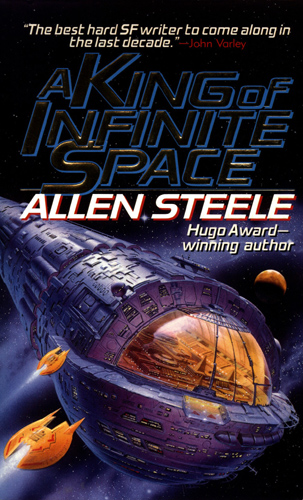 It involves an interesting little item I found at my next-door neighbor’s tag sale. Within five minutes of picking it up, I had an entire short story in my head. It’ll be fun … once I get around to writing it.
VENTRELLA: Amazon is reporting that e-books are now outselling traditional publications. What effect will this have on the publishing industry? For beginning authors is this a good thing or a bad thing?
STEELE: No one is really sure how ebooks are going to shape the publishing industry. There’s a lot of projections that they may eventually replace hardcovers or mass-market paperbacks. On the other hand, most readers I know tell me that they still prefer print novels. But I think ebooks are not only here to stay, but also have the potential to completely reshape how — and even what — people read. The take-off point will occur when the price of a good, reliable ebook device drops to about $50. If and when that occurs, you’ll see them all over the place.
Beginning novelists will probably have an easier time adapting to whatever changes there may be, simply because they’ll be able to take advantage of them from the get-go. It’s guys like me, who’ve had long careers writing exclusively for the print medium, who are going to have a tougher time adapting to the new environment. But we’re trying, we’re trying…
VENTRELLA: You’ll be the guest of honor at Albacon this year. What is it about attending conventions appeals to you?
STEELE: I don’t attend as many SF conventions as I used to, mainly because I’d rather spend my time writing. But when I do go to conventions — like MadCon in Madison, Wisconsin, last week, or Albacon in Albany, New York, next week — I generally have a lot of fun in a lot of different ways. I like meeting readers I haven’t met before, or seeing again those whom I’ve already met, or catching up with old friends and colleagues. I’m also a book collector, so you’ll usually find me prowling the dealer’s room in search of items to fill out my collection. And it sometimes gives me a chance to see a town I haven’t visited before, as I did in Madison.
VENTRELLA: What are you working on now? Come on, give us a peek!
STEELE: I won’t tell you what I’m currently writing except that to say that it’s a young-adult SF novel, my first of this kind. The next novel to be published is HEX, which is set in the Coyote universe and is my take on the Dyson sphere concept; it’ll be out next June from Ace. As for what I’m going to do after that … I don’t know, I’m making this up as I go along.
Filed under: writing | Tagged: e-book, ideas, new writers, science fiction, self-publishing, Young Adult fiction | 1 Comment »
MICHAEL A. VENTRELLA: I’m pleased to be interviewing Allen Wold today. Allen Wold has published nine novels, several short stories (mostly for the Elf Quest anthologies), five non-fiction books on computers, and a number of articles, columns, reviews, and so forth, also concerning computers. He is a member of SFWA and teaches writing.
ALLEN WOLD: Many people have complimented me by assuming that I teach writing classes, at NC State or somewhere. 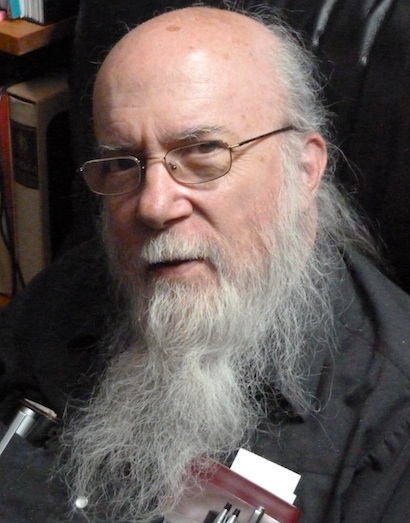 I am not associated with any college, or university, or even a high school. The only “classes” I teach are my writing workshops, which I do at science fiction conventions. Because of people’s comments, I have begun to think of myself as a teacher, and I am quite flattered that people think of me as one. I do have some ideas about how writing can be “taught,” and about college courses in “creative writing” (Manley Wade Wellman said that “creative writing” is redundant, all writing is creative), but some of these are best saved for private conversation. There are, and have been, some excellent writing teachers in various colleges and universities, teachers who’s stories you can read in magazines, or who’s books you can buy in bookstores. But I am not one of them.
VENTRELLA: How did you first get published? Did you have an agent?
WOLD: I did have an agent. I no longer remember the exact details, I was sending my first novel THE PLANET MASTERS around over the transom. Sharon Jarvis, then fiction editor at Playboy if I remember correctly, suggested two agents to me. I picked one, Lea Braff, and she agreed to represent it. At this time, I had no knowledge of submission protocols, and it probably showed. Lea sold my book to St. Martin’s Press, and after some fluffling around in the editorial department, it finally came out in 1972.
VENTRELLA: How has the publishing industry changed since you entered it?
It has changed a lot, but I’m not really qualified to talk about that. I do not study the industry, and what I have seen, has been seen by many. So many imprints now being owned buy umbrella companies (pun intended); restriction or elimination of non-agented submissions; agents themselves taking new clients only by introduction; and, fortunately, the rise of the small independent publisher.
I felt many years ago, that the small press would, or should, or could become more important, to the average fiction writer, than the large houses, and nothing I have seen so far changes my mind about that. 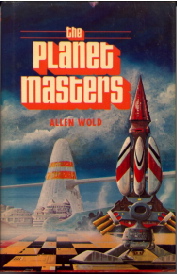 Some small presses lack editing skills, distribution, or money, but some have all of that and more. Big publishing is dominated by the marketing departments of the various houses, rather than by the editors. Sol Stein, one of the founders of Stein and Day, complains about that in his own company. But small presses are usually not subject to their accountants. Baen is probably the largest “small press” in the business, and the publisher, Toni Weisskopf, and her editor in chief, Hank Davis, make their own decisions. At least, that’s how I understand it, I’m sure Toni will correct me if I’m wrong.
My point here being that big publishing, it seems to me, is less concerned with books than with moving product — books or fried chicken, whatver, let’s just sell a lot. I’m not the first to think that.
VENTRELLA: How much should a writer consider the market when deciding what to write?
WOLD: Being aware of the market is essential. If you know, for example, that nobody is publishing paranormal erotica (they are, oh yes they are), and that’s what you want to write, then you have to be prepared to struggle to find a publisher, or perhaps make your story seem more like a similar genre which is being published. I don’t like that idea. Not too long ago, cross-genre work just couldn’t make it. Now it hardly matters. I suppose Lovcraftian Romance (in the sense of a story of love, as opposed to the original idea of a work of fiction) might be a hard sell, and I don’t know if anybody has tried it. Or would even want to. I could be wrong. Anime hentai tentacles…?
But if you devote too much energy to trying to figure out what is going to be popular two to three years down the line, you’ll always be wrong, and you’ll be wasting your time. Right now, paranormal romance is, in fact, doing quite well. And if you write one, just because it is doing well, by the time the book is written, and submitted, and rejected and resubmitted, it may no longer be so popular. Or it might be. But you’re worrying about anticipating a market, rather than about writing your story. If your story is good enough, somebody will take it, even if it is a bit difficult to find its place on a bookstore’s shelves.
So yes, be aware of the market, but don’t write for the market. Write what you have to write. Write a book that you’d like to read. You may start a trend. More likely you won’t, but hey, there are no guarantees in this business. None.
VENTRELLA: Do you think the emphasis on e-books is going to help the individual author?
WOLD: How can it hurt? Every sale is a sale. The more readers a writer has, the better. Several publishers, Baen for example, offer e-book versions of their hard-copy books, usually at a discount. 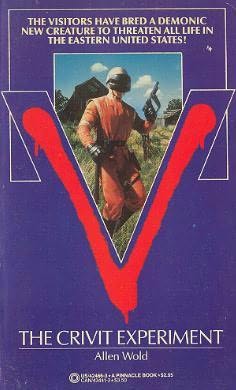 Their cost is minimal, their profit margin is high, distribution costs them only download expenses, which is nothing compared to paper, ink, printing, trimming, binding, and so on. I’m not talking about reading books on line, but buying e-copies which you can read on your computer or your Kindle or Nook or iPad or whatever. These are actual sales, you own the book. It’s just not on paper. And the more people who read you —
Well, you have to have a good story to tell, and you have to tell a good story (not the same thing), or it doesn’t matter what format you’re in. Bad fiction goes nowhere (though some of it does get published, see Pel Toro for example). Good fiction gets found out, and is read. E-publication is something I’m keeping in mind for some of my projects, but not all. As is going with a small independent press. But never vanity, that’s a waste. If you have to pay for it, become your own press. It’s a lot cheaper.
VENTRELLA: What techniques do you use to make sure your characters are realistic and believable?
WOLD: I don’t use techniques. I use my ever increasing understanding of human nature and behavior. I watch people constantly, not deliberately most of the time, but automatically. Everybody I meet becomes a part of that compost heap in the back of my head, from which characterization (not characters) is drawn. Everything my characters do is what I have observed real people do (though I couldn’t tell you who is the model, or how many models there are), it’s the way real people behave.
Once a character begins to reveal himself, or herself, or itself to me, my task is to make sure that that behavior is consistent. One of my main gripes with the second version of Star Trek was that developed characters frequently acted out of character. Also true of the TV series V (the original, not the remake). That destroys a story for me.
I discover my characters, or at least, those that work. I discovered Larson McCade, Morgan Scott, Rikard Braeth, Freefoot, and all their supporting characters. I didn’t actually create them per se. And once I got to know them, it wasn’t that hard to portray them as they were, rather than make them go out of character for the sake of the plot.
Larson McCade, from THE PLANET MASTERS, is instructive. The story came to me in a flash of inspiration (lasting about two hours) while I was walking across the UNC-CH campus. But who would be my hero (or anti-hero, as it turned out)? I thought, what if I based McCade on myself, but on my darker self, the aspects of myself that I would never let anybody see, never allow myself to express, the shadow-me. 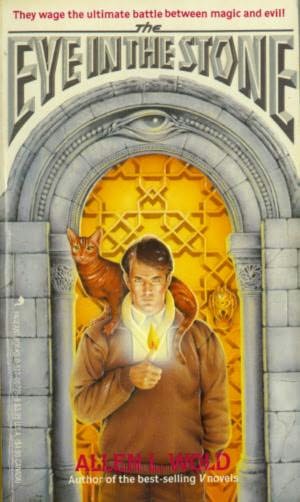 Badly done with Spiderman, unfortunately. So I did. Since McCade was an aspect of me, I knew him intimately. I didn’t direct him on how to get from one plot point to another, I let him do it, that is, I did what I would do if I were he and in his situation, and I just wrote it down as it happened. Fortunately, I’m not Larson McCade, and we should all be thankful.
It’s taken me a long time to perfect that method, and I’m still working on it. I failed many times between now and this century. I didn’t even know what I was doing when I was doing it right. But I do now. All my Elf Quest characters, though I didn’t understand it at the time, were independent people in my head. I just presented them with problems, and let them solve them.
VENTRELLA: How do you prepare? Do you outline heavily?
WOLD: I used to outline, but not any more. My outlines could be five, ten, twenty pages. For my most recent book (rejected twice so far), I had just three plot points: I had to get here, then there, then somewhere else.
At a convention many years ago, I was on a panel with Fred Pohl. The question of outlines came up, and I said, yes, I use an outline, like a road map, or a blueprint. Some people said they hated outlines, because then they were trapped. I couldn’t understand that. Just because it’s in my outline doesn’t mean I have to do it. They said they wanted to be surprised. I felt like I didn’t want to be surprised if, without a blueprint, I discovered that I’d left out a door, or a bathroom. That has actually happened to people I know, with real houses. But Fred Pohl said “I used to outline, but I don’t any more.” I didn’t understand that either. Now I do. I do not predetermine what is going to happen, what people are going to do, what they are going to talk about. I select destinations. He discovers he’s up against a vampire and decides he has to destroy it but doesn’t know how; he is killed by the vampire and in his spirit form discovers how to destroy it but needs a corporeal body to do it; he finds a body he can take over and does what he has to do. Three points, 80,000 words. Rejected twice. But my vampires don’t sparkle. Dracula didn’t sparkle.
On the other hand, for another novel which hasn’t been rejected yet, I had a list of 198 scenes. Each scene was an objective, not a description. I kept to that “outline” as a form of discipline, and it worked. Each scene had a viewpoint character, fifty two in all, and each character was, in my mind, a real person.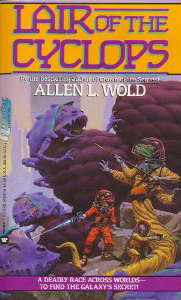 Sometimes the scene description was something like: Riding in the back seat, the little girl sees the blue lights around the house. Now, what happens? Well, I wrote the scene, and all the others, and we’ll see what happens.
How do I prepare? I need my main character, without which nothing happens. I need my setting, my world, however simple or complex that may be, though I don’t need elaborate details, as I’ll discover more about it later. I need the situation in which my character finds himself, or herself, or itself. (Clumsy, isn’t it? How about themself? Check the OED for the use of they/them as equivalent to “he or she.”) I need to know what my character wants. And I have to know what I, as the Creator — um, creator — want my ending to be. Luke Skywalker wants off Tatooine, to go to university, and become a pilot. George Lucas wants to destroy the Death Star, and has to lead, not push, Luke to that ending.
Then it happens.
VENTRELLA: What is the biggest misconception beginning writers have about the craft?
WOLD: That they need talent. Talent is nice. Talent makes things easy. But talent is not necessary. There are plenty of writers who do quite well and have no talent to speak of, but who have acquired the necessary skills, and the reader can’t tell the difference. Skill is far more important. Talent is what you are born with. Skill is learned, and you can learn an awful lot. Any writer who has written more than one book improves from book to book (or they don’t, depending on their talent rather than acquiring skill, and it shows). Dorothy L. Sayers first novel, WHOSE BODY, is nicely done, somewhat frivolous, and LORD PETER is definitely silly. By the time she gets to GAUDY NIGHT, she is a master, telling a story that is neither romance nor mystery, but a deep tale of two people caught up in a distressing situation. Lord Peter and Harriet Vane are real people. The book can stand alone. Dorothy L. Sayers’ talent was revealed in her first book. Her extensive skills are shown in her last book. (BUSSMAN’S HONEYMOON is a novelization of her own play, and something of a disappointment.)
There are other essentials, such as making, not finding, time; developing discipline; acquiring patience; and having the dedication to actually do it.
This last is truly important. You cannot become a writer if you don’t write. You must make the decision that you are, in fact, going to do it. You decide to acquire those other essentials, putting other aspects of your life aside, and you write. You read extensively, especially what you like to read (and you should write what you like to read, not what you “ought” to write), but read outside your field too. And read non-fiction, especially biography, history, mythology, archaeology, and anything to do with human nature and behavior.
You may discover you don’t really want to do this after all, that it takes too much effort and time, that it’s too hard, that the rewards aren’t worth it. In which case, give it up with a clean conscience. Many people who take my workshop discover that they don’t really want to be writers after all, and that’s fine. They’re now free of that obsession, and can go on to something else.
VENTRELLA: What is the biggest mistake you see beginning writers make?
See above. But not giving it enough time, thinking there’s an easy way, not listening to competent comment, not reading enough, taking TV as their model. (Oh, yes, that’s a good one. Thinking that science fiction is what you see on TV or in the movies. Thinking that characters are what you see on TV or in the movies. Huge mistake.) Not paying attention to the real world.
All good fiction is based on, and derived from, the real world in some way or another. The most bizarre fantasy has roots in the real world, at least in the way people react to the bizarreness. Also, trying to write SF without understanding science. You don’t have to have degrees, but you must have a basic understanding of how the world really works. And if you don’t know, either stuff it in a black box, or do some research. The old Tom Baker Dr. Who did this extremely well. They did not make mistakes in their science. They either knew how it worked, or they black-boxed it. I was quite impressed.
Another is not checking a publisher’s submission guidelines. Always check the guidelines, and submit that way, whether you like it or not. Do not try to save paper by printing single spaced on both sides of the page. Always use adequate margins, a header with name and title and page number. And so on. You can learn basic submission formatting, most publishers with tell you. Follow the guidelines, or you’ll be rejected out of hand. Really.
VENTRELLA: Some of your novels are currently out of print. Do you have any desire to have them released as e-books? Is that possible?
WOLD: I would love to have them come out in any format. Currently, THE PLANET MASTERS should be released soon in a print on demand format from Warren Lapine’s Wilder Books, but I don’t know when. Contact Warren and ask for it. He may be doing something more.
VENTRELLA: Do you think writers should begin with the short story market?
WOLD: A story is as long as it takes to tell it. If you try to condense an idea to a short story format, it won’t work. If you puff an idea to novel length, it won’t work. The short story market is tight, not counting on-line publication, but it’s still there. You have to do your research. 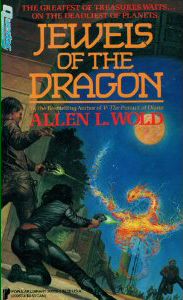 Back in the day, most SF&F writers started with the magazines, back when there were more than five or six national magazines that actually paid money. These days the whole industry is completely different. If you love flash fiction, and write it, that’s what you should try to sell. If you prefer the short story format, there are all kinds of magazines (some pretty bad), and open anthologies to which you can sell. If you prefer novels, say 100,000 words or so, that’s what you should do, though it won’t be easy. Especially if you’re a beginner. I know well established writers who are suddenly being dropped by their publishers, though their books continue to sell. I have no idea why. Maybe because the publishers are more interested in moving product than selling books. I don’t know.
Write what you write, know what the market is, and find the right home. You can not write to a market, it’s too volatile, and your heart won’t be in it.
VENTRELLA: What’s the best resource a writer should use in order to find a market for their short stories?
WOLD: There are two: Ralan and Duotrope .
VENTRELLA: What have you been up to lately? What are you working on now?
WOLD: Lately? Writing, of course. That’s what I do. Every day that I can. I have obligations on Saturdays, and Sundays I try to restore my energy, but otherwise, unless something unavoidable comes up, oh, say, having my gall bladder removed, or like that, I write. Every day. See, I’m writing this today.
And I read, mostly non-fiction. And watch movies, to take me away from my writing rather than for inspiration. And attend to my household management responsibilities (my wife works full time and supports me in every way).
Right now I’m doing a complete rewrite of a book I first wrote in 1990. I learned then the absolute necessity, for me, of having my personal Death Star in mind. I threw away four false starts, totaling about 100,000 words, before I finally asked myself, how do I want this to end? When I had that, everything drove toward that ending, though my hero wanted to do something else.
When we came back from England, in ‘98, I reread it, and it wasn’t very good. I had always wanted to do a character-driven story, instead of a plot-driven story, so I rewrote it, giving my characters free rein. It didn’t sell. Then I reread it again, saw how undisciplined my description and dialog was, and I’m rewriting it from scratch, not revising it, keeping the story as written, but tightening, cleaning up, making my characters internally consistent, cutting out unnecessary description, and tons of bad dialogue. It’s turning out pretty well. But we’ll see. When this draft is done, I’m going to do a new book set in THE EYE IN THE STONE world, then come back to STROAD’S CROSS for a final pass, and try to find a market for it. It’s a haunted village, not a haunted house, forgotten by people who live in the small town a mile away, perfectly preserved for fifty years, abandoned with food on the stove, money in cash registers, toys dropped on the floor. Finding out the truth is what the story is about.
Don’t hold your breath. These things take time.
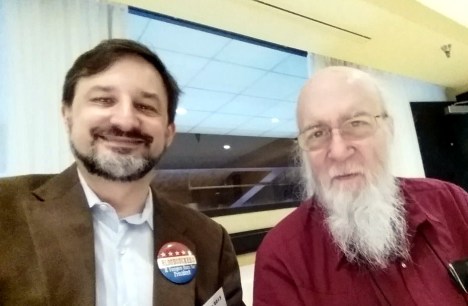
Filed under: writing | Tagged: agents, character development, e-book, new writers, outlines, publishing house, resources for writers, science fiction, short stories, writing advice | Leave a comment »
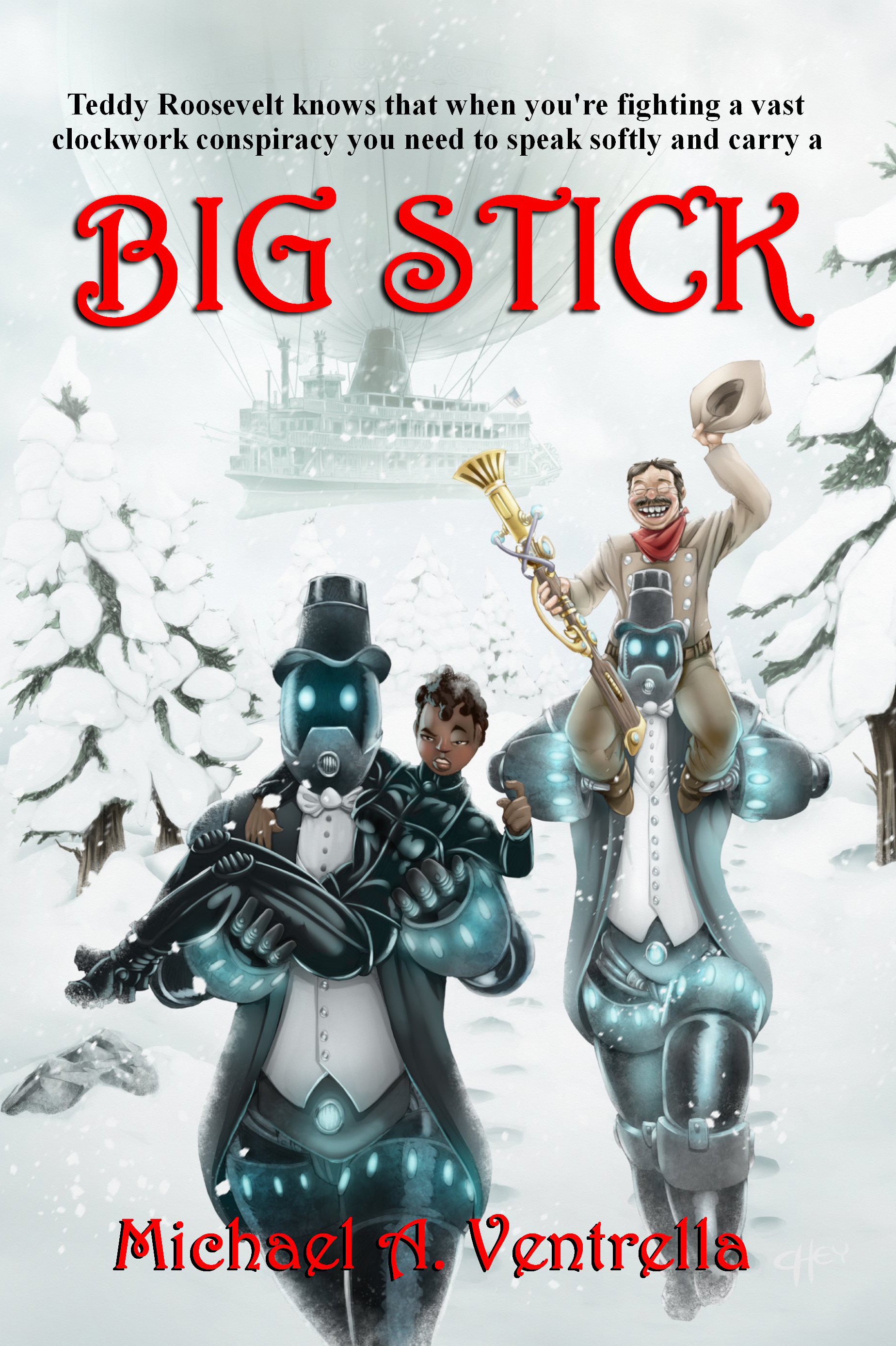
“A wild and thoroughly entertaining steampunk adventure featuring an improbable cast of historical figures, plenty of action, and lots of fun!” – Jonathan Maberry, New York Times bestselling author of Deep Silence and V-Wars


