How not to develop characters

At one of the panels in which I was a guest at Lunacon this past weekend, we had a nice discussion about character development in books.  I used the example given by Dan Brown, writer of THE DAVINCI CODE.

“Dan Brown always lets you know if, for instance, a character is cynical with a good sense of humor,” I said.  “He writes: ‘Dr. Smith was cynical, with a good sense of humor.'”

If you can’t tell from the way my characters act and what they say whether they are cynical and have a good sense of humor, then I have failed as a writer.

To me, the most important aspect of any story is how it affects the characters.  Oh sure, the plot is important and keeps it exciting, but I really don’t like books (and movies) in which the hero is exactly the same before and after the adventure.

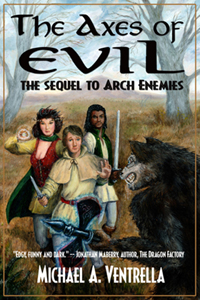
axesofevilARCH ENEMIES and its just completed sequel THE AXES OF EVIL are all about how Terin changes from the cowardly bard to a more confident “hero.” The things he goes through change him, slowly, but not unreasonably.
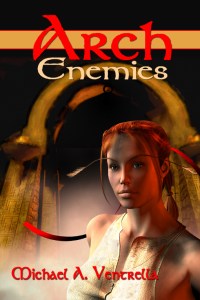
For instance, by the end of AXES he’s still a bit of a coward, but he considers it a reasonable reading of reality.  He doesn’t shy away from speaking his mind and showing bravery in other ways, but when a battle breaks out, he still runs to the back and tries to stay out of the way.

But I guess that goes toward another pet peeve of mine:  Main characters who within a sort span go from being a nobody to the best swordsman in the kingdom or most powerful wizard of what-have-you.  Character development to me means more than just emotional development — it means realistic development in other ways, too.

And the more real the character, the more believable all the other fantasy things I can throw into the mix!

Latest news: Conventions and a new Rule Book

Since this blog is about writing, I wanted to take a quick break and review where I am professionally (?) at this moment…

I have been attending Jonathan Maberry’s monthly wrirter’s coffee and it has been very inspiring and helpful.  Next month I will be attending a writer’s weekend here in the beautiful Poconos which also should help me hone my writing skills as well as make some connections and better learn how to promote myself.

Next weekend (March 20th) I will be at the Lunacon science fiction convention near New York city, where as a featured guest I will be on a few panels as well as participating in an autographing session.  In April, I will be doing the same at Ravencon in Richmond and in May at Balticon in Baltimore.

The “Arch Enemies” sequel (“The Axes of Evil”) is done (first draft anyway) and I have sent out copies to friends and fans for comment.  If anyone reading this wishes to help, I would appreciate it!  Contact me!

My new Rule Book for the Alliance LARP has just been released and is selling well on Amazon and Double Dragon.  Links at my web page:  http://michaelaventrella.com.  I’m quite proud of it!

But other than that I have been tremendously busy and haven’t had much time for writing.  More next time!

Establishing a fantasy world

When writing and creating a fantasy world for a novel, I knew that I needed to explain the world and the way it works in non-sleep-inducing manner. Too many fantasy novels begin like a history text, explaining the background and setting the scene. I hate that. I don’t want to have to study before understanding the story.

In ARCH ENEMIES, Terin is a young lad who has very little knowledge of the world and the ways of magic. He has lived at home until just before the book begins, runs away to find fame and fortune, and learns as he goes along. Rather than having the narrator explain everything at the start, ARCH ENEMIES is told in first person. Things happen in the early chapters that don’t make sense to Terin until much later.ArchEnemies-510

Our reluctant hero is accompanied on his quest by an older squire who teaches him along the way, but her lessons never take so long that the action stops. In fact, much of my second and third drafts consisted of me saying “This gives away too much too soon” and “this slows things down too much” and moving whole chunks to later in the book. I even removed entire sections that explained much about the world but were irrelevant to the story.

Terin also asks many questions about the novel’s basic mysteries along the way. What am I supposed to do to solve the prophecy? Why am I not allowed to read it? What if I am not the person named in the prophecy and they grabbed the wrong guy? Why are the dwarves being attacked and having their memories erased? Who stole the magical homestone needed for the ritual? Why did that barbarian look at me in fear and call me “Bishortu?” He comes up with theories for each of these which almost always are proven wrong, but this allows the reader to consider them as well and come up with their own ideas.

Giving away everything at the start is no fun. Everyone loves a mystery. And the same goes to the “rules” of the fantasy world in which the book exists.

The reluctant hero

Enough with the superheroes.

This may just be a matter of taste, but too many fantasy novels are about extraordinary people. The prince who has special powers because he was the seventh son of the seventh son, the prophecized one who in a matter of weeks becomes the greatest swordsman in the land, the boy who never knew his parents and learns he alone has the power of the force… you get the idea.

These are certainly traditional heroes going back since story-telling began, but you know, when these people complete their quests, it’s kind of inevitable.

When I created Terin Ostler for ARCH ENEMIES (and its soon-to-be-published sequel THE AXES OF EVIL) I didn’t want to do that. Terin is an ordinary kid with big dreams, but he’s not the son of a god or the chosen one. The only problem he has is that everyone thinks he is.ArchEnemies-510

I thought it would be fun to take someone and throw them into one of these epic stories involving a prophecy and see how they would react. For those of you reading this who have not read ARCH ENEMIES, Terin is grabbed and told he must complete a quest because he is named in a prophecy, but the prophecy doesn’t say exactly why he was chosen or even what he is supposed to do. He’s a complete coward with no magical skills or weapon skills. He’s just an aspiring bard who wants to only sing about adventures.

He then must try to live up to the expectations everyone has for him. He goes through a series of adventures largely involving avoiding the bad guys trying to prevent him from completing whatever-it-is he’s supposed to do, and in the end, he accomplishes his goal not through his amazing magical powers or fighting abilities (neither of which he has) but by being brave, honest, and clever.

I think this is why people (including my publisher) have compared the book to Harry Potter, and I can understand this in some ways. Like the Potter stories, Terin has a number of mysteries he has to figure out to reach the final quest, and he has to find that inner bravery in order to do so. (Unlike Potter, however, Terin doesn’t have any secret magical protection or powers above and beyond anyone else.) I like this concept, as it says to all of us that we can accomplish great things with intelligence, honesty, and bravery.

In a future blog post, I’ll discuss why I think honesty is the most important quality a person can have and how I worked that concept into the plotline.