Interview with Author and Editor Cecilia Tan

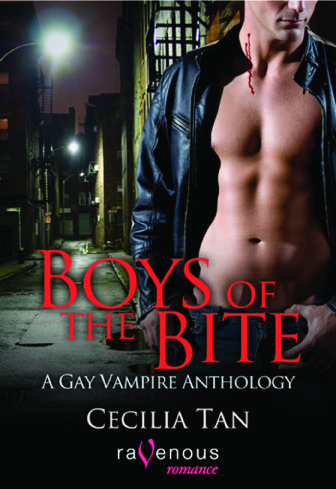
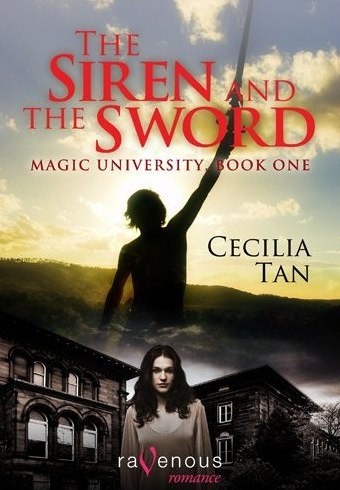
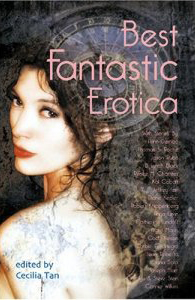
MICHAEL A. VENTRELLA: I’m pleased to be interviewing Cecilia Tan today. Cecilia has been writing and editing professionally for the better part of two decades, both independently and for the small press she founded in 1992, Circlet Press, who specialize in material that mixes the erotic with the fantastic. She has written numerous erotic romances for Ravenous Romance, has edited anthologies for Alyson Books, Thunder’s Mouth Press, Carroll & Graf, Masquerade Books, Blue Moon Books, and others, and collections of her short stories have been published by HarperCollins and Running Press. On top of all that, she also writes and edits publications on baseball.

Cecilia, What brought about the founding of Circlet Press?

CECILIA TAN: I had written a story called “Telepaths Don’t Need Safewords” and just knew at the time I finished it that it was the best story I had written to date. It mixed explicitly kinky erotic action with a science fiction plot. Then I looked around for somewhere to submit it. There was nowhere. Science fiction magazines had explicit rules against sexual content. Porn magazines had explicit rules against both science fiction and any plot beyond “two people meet, then have sex.” The BDSM magazines of the time were either exclusively lesbian or exclusively gay, and my characters were neither. I had been working in book publishing for a few years at that point so I knew the business and I thought “this is nuts. Someone has to do this!” And of course that someone ended up being me.

VENTRELLA: Has it met your expectations?

TAN: Circlet Press has met all my hopes and dreams except for the financial one. We grew by leaps and bounds, garnered fabulous critical acclaim, excellent notice, a great reputation, helped to blow the doors off the old restrictions and show how good mixing the genres could be, jumpstarted the careers of a whole generation of writers … but once the Returns Crisis hit the book publishing industry in the late 1990s, it’s been a financial uphill battle ever since. I’m too stubborn to quit, though, and the ebook has suddenly allowed us to start reaching the readership that mainstream bookstores abandoned. So all of a sudden, there’s some cash flow! Who knows? Maybe someday we’ll turn a profit. What’s most important to me is that we’re still able to connect authors to readers, and then put money back in the pocket of the authors. That part of the business is the same as always … in fact, it’s better.

VENTRELLA: There are many examples of small press these days; do you think this is good for the publishing industry or does it tend to water down the field?

TAN: Oh no. It’s the mainstream presses, not the small presses, who are the most watered down. That’s where you’ll find the most mediocre, recycled pap being packaged and put on the shelf. Granted, it’s not 100% the fault of the big publishers — it’s also the fault of the buyers at Borders and Barnes & Noble, who just want the same thing over and over again, in the hopes that what sold before will sell again. They are all chasing the book equivalent of the Top 40 radio hit and making a lot of boring noise in the process. The small presses are more directly connected with the readership and what they actually want. The small presses occupy the specialty niches.
Another way to look at it is with a comparison to restaurants. The big presses are the chain restaurants. They’re Applebee’s and the Olive Garden and Budweiser. The small presses are that great little gourmet Italian restaurant in your neighborhood, and handcrafted microbrews.

Small presses are also the minor leagues, but for the most part the authors being published in the small press aren’t any less talented than the ones in the mainstream press. They are sometimes less experienced, or less marketable, or just less lucky.

VENTRELLA: As a small press author, I thank you for that!

Has the rise of self-publishing been good for the business?

TAN: Absolutely.

VENTRELLA: When acting as an editor, what is it you look for? What will immediately get a story chucked in the trash?

TAN: The first thing I tell my assistant editors when its time to read the slush pile is DO NOT read the cover letter until after you read the story. Far too many authors think that the job of a short story cover letter is to build you up into a froth of excitement about how great the story is going to be, thus ensuring that a) you’ll be let down, and b) any suspense or joy of discovery in the story has been killed for the reader. I think many amateur writers are confused about the difference between submitting a short story and pitching a novel proposal to an agent or editor, and some just can’t imagine that all they should introduce in the letter is THEMSELVES and let the short story speak for itself.
We get a lot less utter garbage than we used to, though, honestly, and I think the reason why is that thanks to the Internet, writers are actually better informed about how to go about submitting, and they are much more likely to have practiced their grammar and spelling skills on a daily basis. It’s that or the Internet has somehow
swallowed up the attention of most of the crackpots who used to send us wacky submissions in red crayon and the like.

VENTRELLA: What sorts of things do you want in a query letter?

TAN: Since most of what we read is short stories, we don’t read queries. We just want a professional introduction of the author, with whatever credentials they have, but if none, just a firm, no-nonsense hello. It’s professional courtesy to include a cover letter. Sticking a post-it note shaped like a heart on the story is not professional.

Actually, these days, we only accept manuscripts by email, so whenever anything arrives in the mail, I know it’s likely to be from the land of psychoceramics.

VENTRELLA: As a writer of erotic and romantic fiction, what would you advise to someone wanting to enter this field?

TAN: Both romance and erotica have a lot of cliches. The whole trick to writing something that will thrill the pants (sometimes literally) off your readers is to satisfy their expectations while at the same time exceeding them. Be aware of the boundaries of any genre that you write in, and then find out how you can play with and cross those boundaries.

That is, unless thinking about that sort of thing paralyzes you and saps your will to write. In that case, forget everything I said and JUST WRITE. That’s probably the best advice. Step one, start writing. Step two, finish what you started. You’ll get better every time.

VENTRELLA: What trends do you see in the publishing industry that excite you? Which ones worry you?

TAN: I’m very excited at how social networking is allowing authors and readers to connect directly. But the problem is how do you find out about new authors you might like if you’re a reader, when now there isn’t just a publisher-wholesaler-retail chain delivering you a limited selection to choose from? A lot of things are changing now because of that.
It worries me a little that the newer system rewards authors more based on their marketing savvy than on their writing ability … but then I look at a lot of the junk that was published that still hit the New York Times best-seller list over the past 20 years and I realize that’s ALWAYS been true. There have always been populist and popular writers who weren’t particularly great artists.

VENTRELLA: Writing a short story is much different from writing a novel. What are the difficulties you have found? Why do you think some authors specialize in one or the other?

TAN: I’ve written a fair number of both and I really think they are different arts, just like painting and sculpture are different arts. A short story writer has to have guts and brio; a novelist has to have stamina and vision. For me short stories have always come pretty easily. I grab an idea and just pound it until it’s done. A novel takes a bit more planning. The one time I just grabbed hold of a novel with minimal planning, it took six years to finish and came out three times too long to be a commercial novel. (That’s DARON’S GUITAR CHRONCILES, which I’m serializing now on the web.) The next time I plotted out 12 chapters of 5,000 words each and bam, I hit my target right on the nose.

The secret to writing outlines for me is realizing that in the second half I’m going to deviate quite significantly from the outline I wrote, but that some kind of internal logic is at work in my subconscious, so if I forge on, it will all work out. I still have to write the outline, which to me is like sketching out the map of the mountain I’m going to climb. But when I get to the top, exactly halfway through the journey, and am at the turning point, I look down the other side of the mountain… and discover it always looks totally different from the top than it did from where you started at the bottom. Some of the landmarks are the same, but how you get to them changes.

VENTRELLA: Are you sick of vampire stories yet? Is there any plot you have seen too often?

TAN: I love vampires! But even sixteen years ago when I edited my very first anthology of vampire stories, called BLOOD KISS, there were some cliches I didn’t ever need to see. Like setting your vampire story in a goth nightclub … cliche cliche cliche! It really isn’t very imaginative to think “what if those spooky kids who look like vampires actually WERE?” Not exactly an original idea. I actually had to turn down a lot of stories where the “surprise” ending was that one of the two people who met in the bar turns out at the end to be… A VAMPIRE!

I had to write rejections that said things like “It’s a vampire anthology. Every readers KNOWS at least one of them is a vampire.” Then there were the millions who tried the surprise twist: they’re BOTH vampires! Argh. Or surprise twist two: the other one is a vampire hunter! I saw literally hundreds of stories with these plots even after I explicitly banned them in my submission guidelines.

Then there are some ideas that go through fads. I kid you not. One year I received no fewer than four stories all with this exact same plot: an artist falls in love with a model in a painting (usually a Renaissance painting) and gets artistically blocked, can’t paint, is wasting away… until the day the model shows up at the door to have
fantastic sex, looking just like the painting, because s/he is a vampire. Somewhere, once upon a time, that was an original plot. Now, it’s a cliche.

VENTRELLA: How do you think your education has helped your writing?

TAN: Well aside from the actual writing courses I took, it was important to me as someone who writes science fiction to learn some high level science. In college I went right for what was cutting edge at the time, cognitive science (artificial intelligence, neurology, etc) and genetics. Anything you learn that stimulates your brain is going to help your writing. I took a fair amount of psychology in that mix, as well as literature, music, etc. … Long live the liberal arts.
VENTRELLA: Besides “keep writing” what specific advice would you give an aspiring author that you wish someone had given you when you began?

TAN: I think I must have started out with some pretty good advice, because I can’t think of anything. I suppose the advice I would give is this.

You need your reader to trust you to lead them on a rollercoaster ride. For them to trust you, you have to trust yourself. To trust yourself, you have to know your craft and be constantly improving it, constantly learning about yourself and the way your writing affects your readers. So don’t write in a vacuum because you’re afraid people won’t like it. Find the ones who do like it, and write more for them!

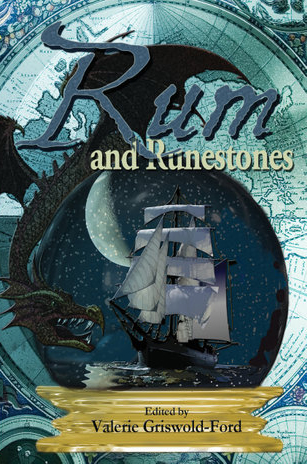
Rum and Runestones

Yarr, ye scurvy landlubbers! There be a new collection of short stories about pirates and magic! It be called “Rum and Runestones” and a picture of the tome appears before ye!

‘Tis edited by Valerie Griswold-Ford and contains short stories from many gifted writers, including Yours Truly, who apparently thinks today is “Talk Like a Pirate Day.”

My story be called “X Spots the Mark”. ‘Tis about Irad the Pirate Captain and a treasure map — but was he fooled into buying a fake one? With almost all of his crew gone, victims of deadly traps, will he complete his quest to obtain the booty of his hated enemy Rummy Jack? Well, since this be a Ventrella story, ye can be sure of some rough sailin’ ahead with many unexpected twists and turns!

Other contributors include:

Danielle Ackerly-McPhail

Danny Beauchamp

Danny Birt

M.J. Blehart

B.A. Collins

Tara Fullbright

Laurel Anne Hill

Stuart Jaffe

Gail Z. Martin

Misty Massey

James R. Stratton

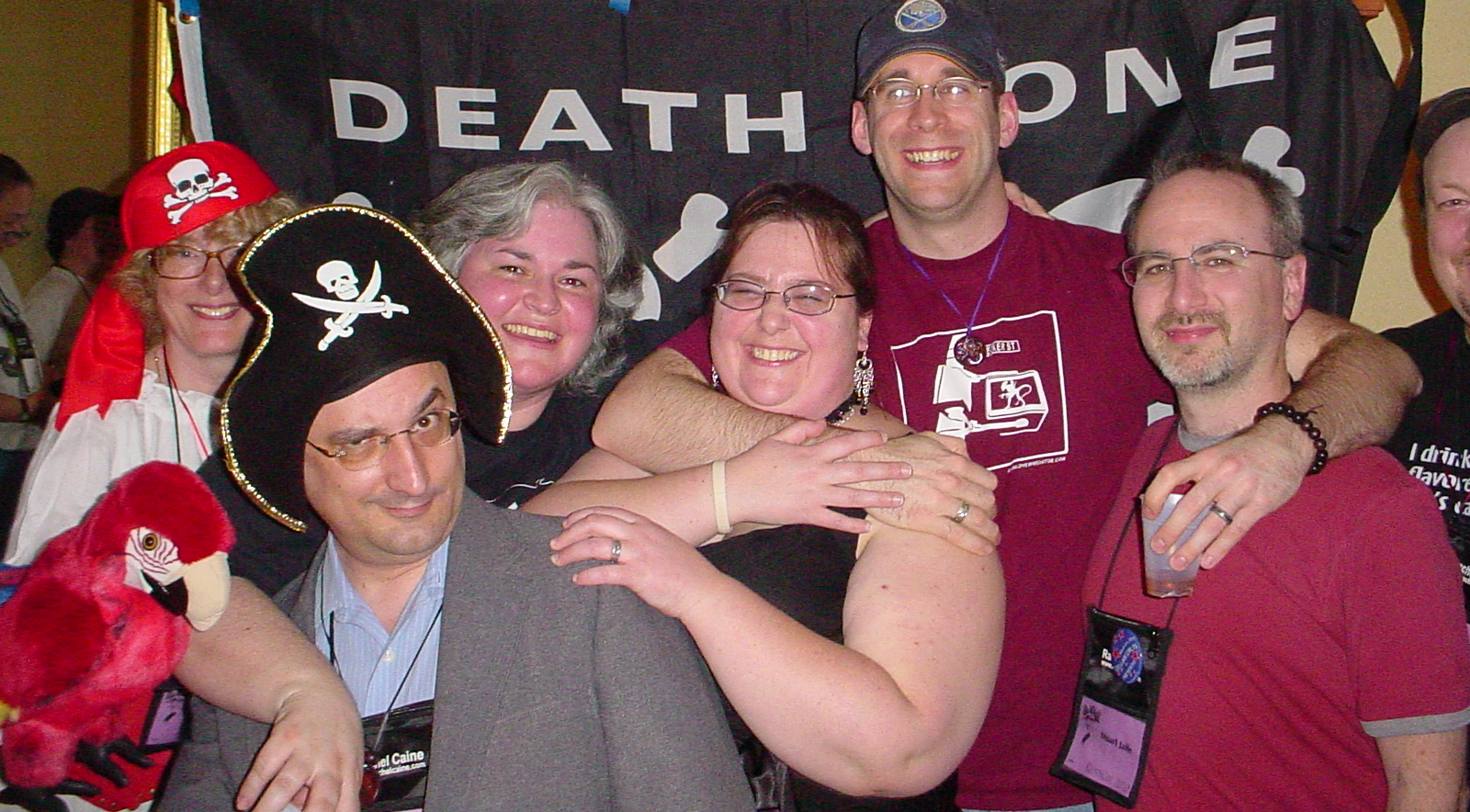
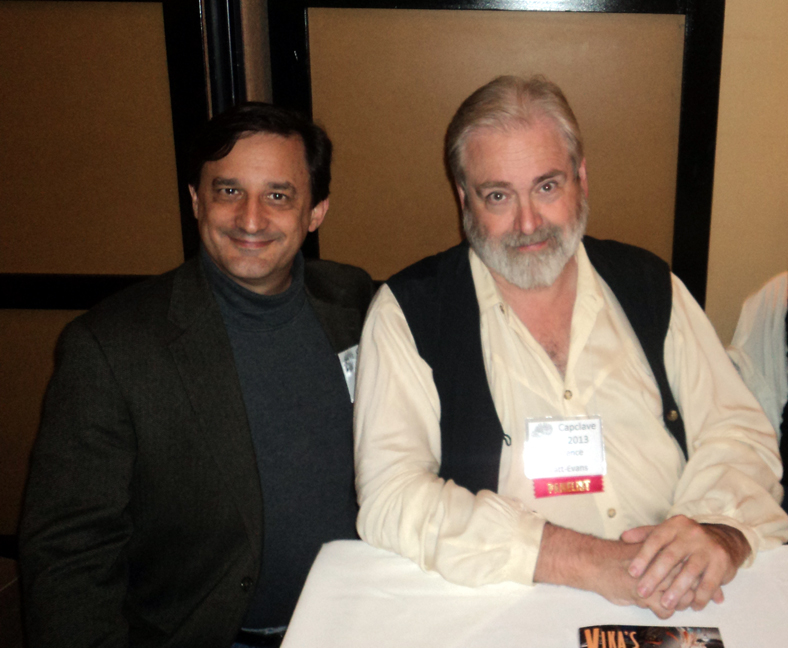
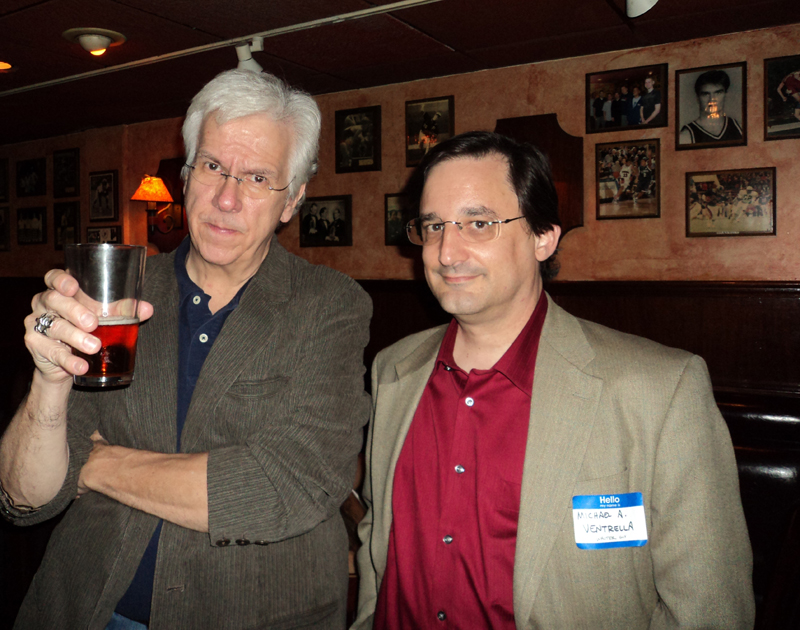
Some of these scoundrels were seen at a convention in Virginia recently for a book release party, standing before a jolly roger and enjoying quite a lot of rum while tryin’ to scratch their autographs on the parchment! And thar be Ventrella himself in his pirate hat. Yarr!

The book can be purchased on Amazon now, so what are ye waitin’ for?

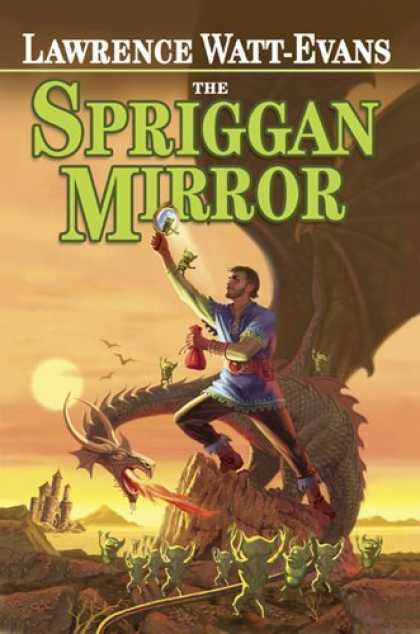
Interview with Hugo Award-winning author Lawrence Watt-Evans

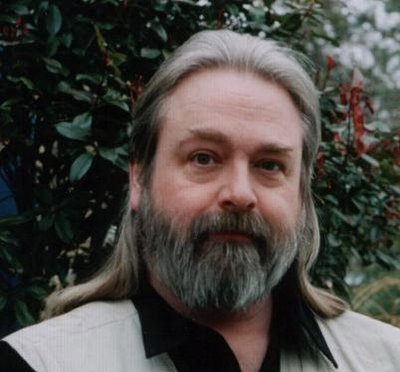
Lawrence Watt Evans grew up with parents who were science fiction readers, so he grew up reading the stuff, and decided at the age of seven or eight that he wanted to write it. He has been a full-time writer for more than thirty years, producing more than forty novels, over one hundred short stories, over one hundred and fifty published articles, and a few comic books. Most of his writing has been in the fields of science fiction, fantasy, and horror, and he has received a few awards, including the Hugo for best short story in 1988, for ”Why I Left Harry’s All-Night Hamburgers.” He served as president of the Horror Writers Association from 1994 to 1996. He lives in Maryland with his wife and the obligatory writers’ cat.

MICHAEL A. VENTRELLA: Lawrence, thank you! Let’s start by letting us know what your latest work is that is available and what we can expect next.

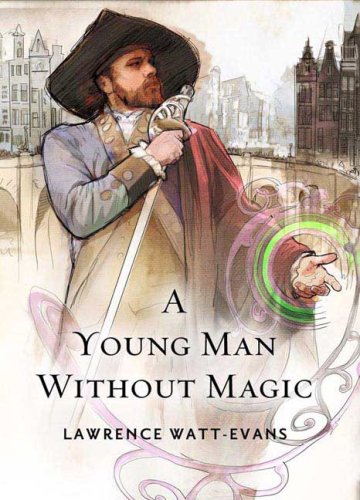
LAWRENCE WATT-EVANS: My latest novel is called A YOUNG MAN WITHOUT MAGIC; Tor released the hardcover in November of 2009. This is the first volume of a fantasy series called the Fall of the Sorcerers; the second volume, ABOVE HIS PROPER STATION, will be out in November 2010. Whether there will be more remains to be seen. If there’s sufficient interest from readers and publishers, this series could go a long time — I have about a dozen novels plotted.

VENTRELLA: You try to break down traditional plot cliches in your stories. What are your plotline pet peeves?

WATT-EVANS: My biggest is simply people doing things, or failing to do things, because it’s necessary to make the plot work, and not because that’s how real people would act. Plots that depend on people not telling each other important things when there’s no reason to keep them secret, for example. Real people generally like to talk, and keeping a secret is hard, so why do so many characters in books go to such lengths to not tell each other things?

Why don’t characters in novels call the cops more often? Why don’t they tell their friends what they’re up to?

VENTRELLA: I’ve commented on this blog before about how I dislike the typical fantasy hero who is a noble-born chosen one with special powers. Why do you think it’s important to avoid those kinds of characters?

WATT-EVANS: I don’t think it’s important to avoid them; I just think they’ve been overdone, and I prefer to focus on more ordinary people.

VENTRELLA: Do you ever worry about genre when your work crosses the line? Do your publishers and editors ever give you a hard time about it?

WATT-EVANS: When I started out I never used to worry about genre. Back in the ’80s, I wrote whatever I wanted and let the publisher worry about labeling it. By the ’90s, that looked like a bad idea — my fantasy was much more successful than my science fiction or horror, so writing SF or horror was dragging down my sales and hurting my career. My agent eventually convinced me of that, and I mostly stopped writing SF and horror novels. (In short fiction, no one cared.) I’d intended to go on writing SF under a different name, but that never really worked out. By the turn of the century I was purely a fantasy writer.

But the thing is, the market kept changing, and now readers and publishers want cross-genre stuff — pure traditional fantasy isn’t selling well anymore. Urban fantasy, crossing fantasy with hard-boiled detective stories — that’s selling. Paranormal romance is selling. Historical fantasy is selling. Since I write for a living, I can’t afford to ignore that, so I’m currently working on an urban fantasy novel called ONE-EYED JACK, and I’m looking at some other genre-bending possibilities.

I’m perfectly happy working in various genres, but I do try to keep up with what publishers are buying.

VENTRELLA: Are humorous stories easier or harder to write?

WATT-EVANS: Easier than what?

For me, each story has its own natural tone, and that has nothing to do with the difficulty of writing it. Some funny stories are easy, some are hard; some serious stories are easy, some are hard.

VENTRELLA: What difficulties and pitfalls face someone trying to write humor?

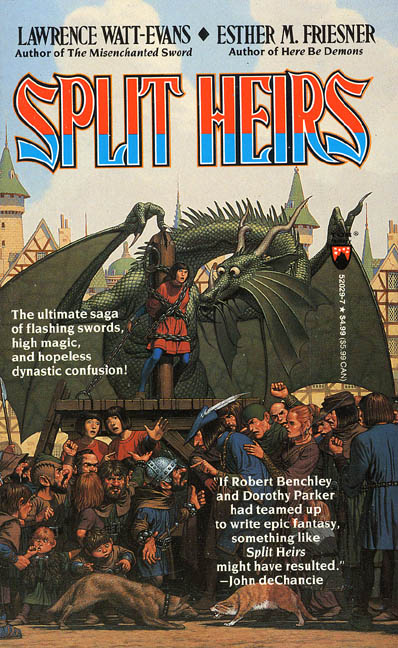
WATT-EVANS: The tricky thing about writing humor is that senses of humor vary. What one person finds funny may leave another cold. When Esther Friesner and I were writing SPLIT HEIRS, while we were mostly in accord, I found out that Esther has a more vicious sense of humor than I do, but isn’t as fond of pratfalls — with one exception, any scene in the book where death or serious injury is played for laughs, Esther wrote it, while I think all the falls are mine. Knowing what readers will find funny — well, I’m not sure there’s anything that every reader will find funny. There are people out there who don’t find Terry Pratchett funny, which I find incomprehensible.

So what you need to do is to incorporate a variety of humor. Don’t stick entirely to one thing — there’s no gag that won’t get old eventually. Maybe you think puns are the epitome of wit, but relying entirely on puns is going to leave most readers cold. SPLIT HEIRS had puns and pratfalls and pain, contrived explanations and elaborate absurdity, double entendres and drunk acts, so if a reader didn’t laugh at one bit, the next might get him. Overusing any one joke can kill it. Change it up.

Also, don’t try too hard. Don’t overdo it. Humor has to have some grounding in reality in order to work. There’s a reason the classic comedy acts always included a straight man. Have some respect for your characters, no matter how absurd their situation may become. It’s much funnier when something ridiculous happens to an ordinary guy than when it happens to a capering buffoon.

VENTRELLA: I know there isn’t a template that is used each time, but when creating a new world, what is your process? Do you first concentrate on the story and characters and then think about the politics and religion of the world?

WATT-EVANS: Oh, it varies. A lot. I mean, a lot.

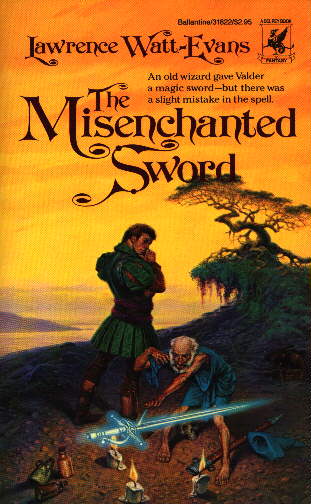
Ethshar started out as a map I drew during a boring geometry class in ninth grade; the locations of Aldagmor and the three Ethshars were where the point of a compass had marked the paper when I used it as backing for an assignment. That was 1969. I added names and worked out some of the linguistics between then and 1972, and figured out some of how warlockry functioned, then put it aside until 1977, when I started designing the other kinds of magic. History and politics and religion came along between 1977 and 1983, but I didn’t have any stories to set there until about 1982. I started writing THE MISENCHANTED SWORD in December 1983. I’m still adding details.

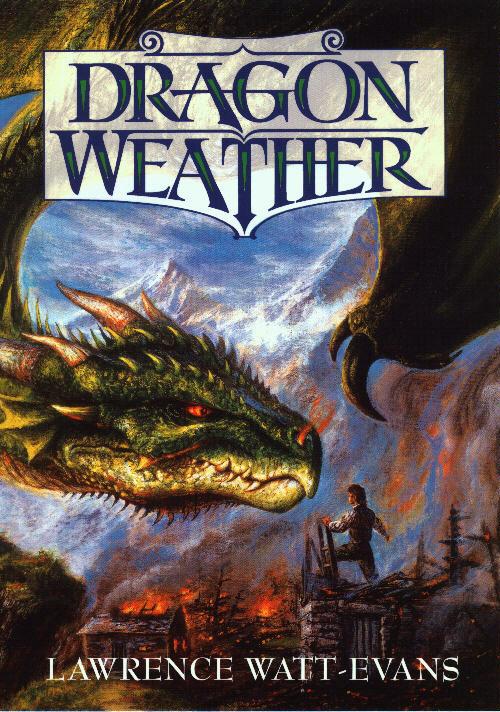
For the Lands of Man, on the other hand, I knew the story first, and wanted a setting. I started with the history, from the wars against the dragons to the opening of DRAGON WEATHER, but I didn’t know the geography or magic, or history before the wars, until after I started writing the novel. I never did get the linguistics straight.

NIGHTSIDE CITY was inspired by the Los Angeles of Ross Macdonald’s Lew Archer novels — “inspired” not meaning copied, at all. Lew Archer’s L.A. is a city of night, where the real world Los Angeles is a very sunny place, and that got me thinking about a city where it’s always been night, but the sun’s about to come up. (A “Little Nemo in Slumberland” strip where the sun dissolves King Morpheus’ palace may also have figured in.) So I started designing out a world where that would be possible, and even hired a planetologist, Dr. Sheridan Simon, to work out the physics for me.

VENTRELLA: Do you prefer writing short stories or novels?

WATT-EVANS: I used to find novels easier, though obviously they take longer, but somewhere in the late ’80s I got the hang of writing short stories, and since then I don’t find one more difficult than the other.

As for which I prefer, do you prefer steak or chocolate cake? They’re different. Sometimes I want one, sometimes I want the other.

VENTRELLA: What do you see as the primary difference between the two?

WATT-EVANS: The primary difference is that a short story is about a single change, while a novel is about something developing, step by step. The first time I was asked this question, many years ago, I said that a short story is a kiss, and a novel is a courtship, and I still think that’s a pretty good analogy.

VENTRELLA: Publisher’s Weekly said of your latest (A YOUNG MAN WITHOUT MAGIC) that the characters were “unlikeable” but that the “the tight plotting and absorbing new world make this tale readable.” Do you agree that the characters are “unlikable”?

WATT-EVANS: I didn’t think they were unlikable — not all of them, anyway. I like Anrel quite a bit. Several of the others are less than charming, I admit, including Anrel’s best friend, but I thought I’d come up with a protagonist readers would find pleasant company. I suspect the reviewer found him too fatalistic, a trait that fades greatly in the sequel, ABOVE HIS PROPER STATION.

VENTRELLA: How do you deal with negative criticism?

WATT-EVANS: Mostly, I ignore it. I know I can’t please everybody. In one case, though, a reader’s comment about TOUCHED BY THE GODS me rethink the whole story, which is a part (though only a small one) of why there’s no sequel and will never be one.

VENTRELLA: What themes do you find yourself revisiting in your work that may pop up without planning?

WATT-EVANS: How broadly are you defining “theme”? A lot of my stories turn out to be about someone finding a place for himself in the world. I also seem to write about a lot of immortal (or at least ancient) characters who have lived in isolation and are reconnecting with the world. And characters who are struggling to control some power that could cause great destruction if unleashed.

I don’t know why.

VENTRELLA: What is your writing style?

WATT-EVANS: It varies, but usually it goes like this:

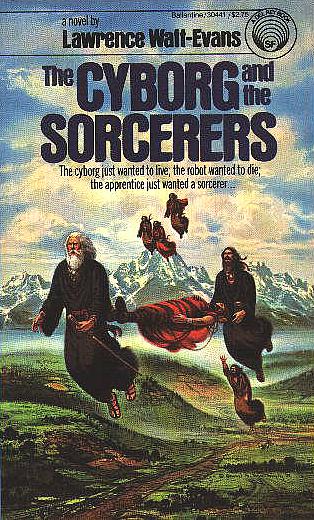
Come up with central concept, which can vary hugely in complexity — it could be a gadget, a spell, a characteristic of the setting, a plot element, a scene, a character. THE MISENCHANTED SWORD started with the spell on the sword, NIGHTSIDE CITY started with the doomed city, THE CYBORG AND THE SORCERORS started with the scene of Slant talking to the wizards of Teyzha. Sometimes this concept is the result of combining two or more old ideas I had kicking around.

Usually, I let this stew for awhile, accreting material. If I didn’t start with a character, figure out who the characters are who would be involved. Work out a background where this could take place — which might be a setting that already exists, or a new one.

Write an opening scene, to get the material fixed in my head. Sometimes this comes before the stewing.

Figure out how the story ends.

Come up with some rough plan for getting from the opening to the ending.

Start writing.

Usually, I’ll stop after awhile — usually the first time I hit a plot problem — and write up a working outline, running from three to thirty pages; when I’m satisfied with that, I’ll go on writing the story.

The first draft is usually skimpy; the second draft is largely filling in details I skipped over while working through the plot. I generally don’t know the characters all that well when I start, but I get to know them writing the first draft, so the second draft lets me flesh them out.

And after that it’s just polishing.

However, not every story follows this model. I do whatever works. Sometimes I never do write an outline. Sometimes I write one, but don’t follow it. Whatever works.

VENTRELLA: Of what work are you most proud?

WATT-EVANS: DRAGON WEATHER. That one came out really good. Some others came close, but I’d rate that one as my best.

VENTRELLA: And finally, who do you like to read?

Terry Pratchett, Fritz Leiber Jr. — right now I’m not sure who else, as I seem to be in a transitional period where I’m losing my taste for old favorites (e.g., Robert Heinlein) and haven’t yet settled on new ones.

51

Interview with Hugo and Nebula Award Winning Author Norman Spinrad

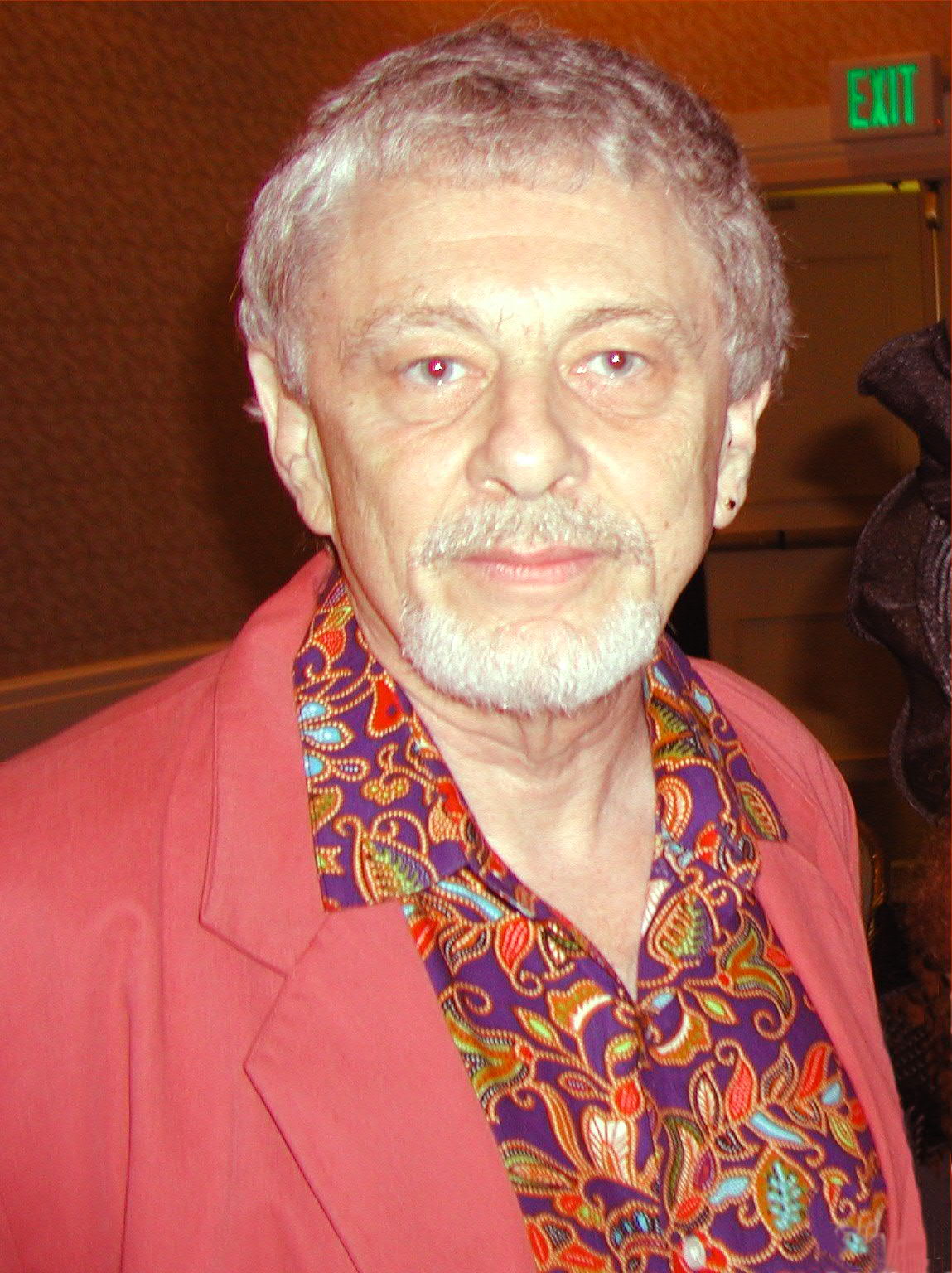
MICHAEL A. VENTRELLA: I’m pleased to be interviewing Norman Spinrad, one of my favorite authors! Norman Spinrad is the author of some 20 or so novels, five or six dozen short stories, a classic “Star Trek” episode, a couple of flop movies, an album’s worth of songs, political columns, film criticism, literary criticicsm, mini-cookbooks, autobiography, and a bunch of assorted other stuff.

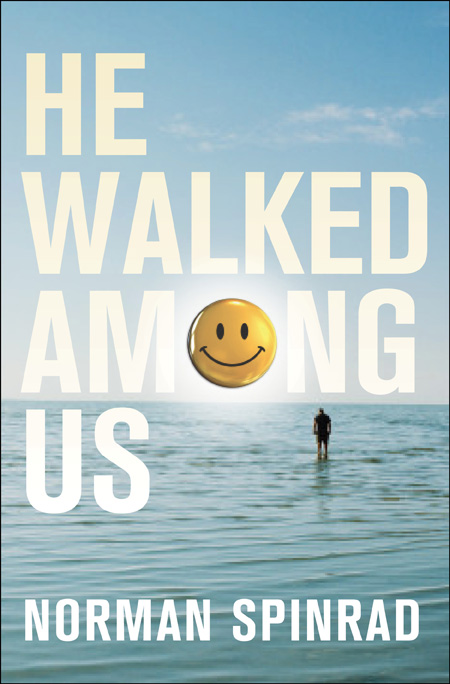
The latest novel to be written is a called WELCOME TO YOUR DREAMTIME, in which the reader is the viewpoint character. The latest novel to be published, in April 2010 by Tor, will be HE WALKED AMONG US.

His web page is here.

I can still recall when a friend and I both read BUG JACK BARRON within a short period of time, and spent months talking about it and saying what a good movie it would make. If you don’t mind, let’s start with that. You have written scripts before (most notably for the original “Star Trek”) and have produced one for BUG JACK BARRON, but somehow, due to Hollywood politics, it has never been made. What has stood in its way and is there the possibility that it might still happen?

NORMAN SPINRAD: This is always the wrong question. The right question is “How does any film get made?” I’ve had the experience of pitching a film project of THE BIG FLASH six times in one day, and what I was doing was walking into someone’s office and saying in effect “gimme $15 million.” Try it some time and see how it feels!

You can look at my YouTubes about this for gory details, but basically, the situation is that Universal had to pay the pick-up money when it looked like Costa Gavras was going to do it, Costa Gavras killed himself in Hollywood with HANNAH K, there were blown scripts, they didn’t like mine, never got made though any number of directors and producers have tried to get it away from Universal (in those days a “pick up” meant they owned the rights forever) because of a tax dodge in which studios keep phantom projects “alive” so they can use them to write-off annual deductions in the form of enhanced overhead for “development.” There are hundreds of such projects in the same situation in Hollywood for the same reason.

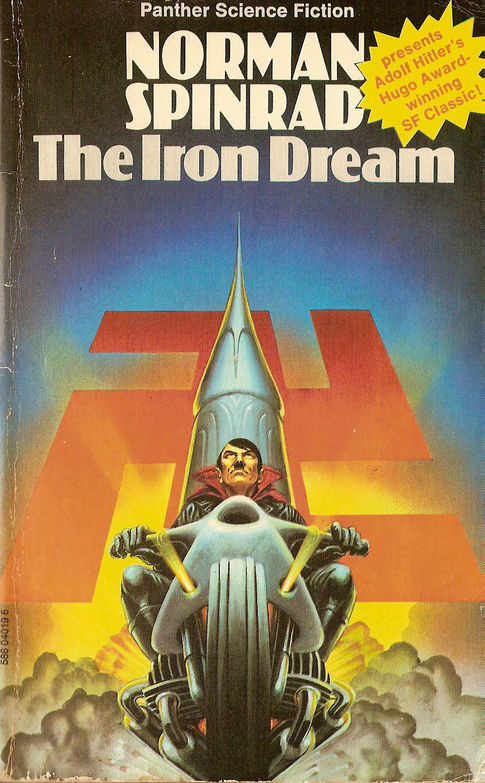
VENTRELLA: After the controversy over BUG JACK BARRON, did you make a conscious decision to push the limits even farther with your book THE IRON DREAM?

SPINRAD: No, I never do that, consciously seek to push limits, I just ignore limits.

VENTRELLA: How did you get the idea?

SPINRAD: I got the idea for THE IRON DREAM by asking Mike Moorcock how he wrote all his commercial fantasies. “Take a myth, or a story from history, run it through a lot of Freudian imagery, and there you have it,” he told me.

“You mean like for instance Nazi Germany…?”

VENTRELLA: Looking back, are you happy with the results?

SPINRAD: In retrospect, after THE IRON DREAM got all those good reviews in over a dozen countries, won an Apollo, was nominated for an American Book Award, I was finally convinced I had written a suigenerous classic. Before that I hated the novel; it took me a long time to figure out that what I hated was the unpleasant work of writing it, not the result.

VENTRELLA: Your novel HE WALKED AMONG US has gone through a most interesting publication history. Can you explain a bit about this? How much of this was by your design and how much of it was because of problems with publishers?

SPINRAD: All of it was problems with publishers, and I’m not going to go into it here. Suffice it to say that HE WALKED AMONG US was finally published by Fayard in French translation last year, a much more presitigous and serious publisher than any of those who rejected it, and will finally be published by Tor in April 2010.

VENTRELLA: You’ve dealt with language in the future in your novels. Where do you think we are heading? Is English taking over the world because of our culture?

SPINRAD: No. Our (pop, Hollywood, etc.) culture is taking over the world because of English, which is the most popular second language in the world as well as the first language of something like half a billion people. The Anglophone market is by far the biggest.

VENTRELLA: As a transplanted New Yorker, what is it about Paris that made you move?

SPINRAD: Nothing, if you mean back to NY, except financial and real estate complicatons. If you mean to Paris, I moved there for what I thought would be a year to write RUSSIAN SPRING, set primarily in Paris. But by the time I had finished, what was going on in Europe was much more interesting to me as a speculative writer, and personally I just enjoyed living in Europe, and particularly in France, much more than in the US. More diversity in the same area.

VENTRELLA: I read an interview you did with Woody Allen where you two discussed how much better artists are received in Europe. What is it about the culture that makes that possible there and not here?

SPINRAD: In part, it may be that it’s an individual thing, my work somehow resonates powerfully with the French as does Woody’s. But as a generality, I think it has a lot to do with American anti-intellectualism. If you’re living off an art, you’re less than macho, and if you are not employed, you’re a bum. How this evolved, I’m not sure, but I think it has to do with the extreme laisez faire capitalism of the US, and the idea that the bottom line is the bottom line. This is not true in France, for example, although the French are very keen on making money, where it is clearly “cultural patrimony” — literature, art, film, music, even comics, that trumps money psychologically and socially.

VENTRELLA: Do you consider yourself an optimist? Does the world today look like you imagined it when you began writing, and do you think it will improve?

SPINRAD: Neither an optimist nor a pessimist, but a realist. And I’ve imaged all sorts of contradictory futures, as have most serious writers of speculative fiction. The point is not prediction, the point is exploring possibilities, even very improbable ones.

VENTRELLA: What is your writing process?

SPINRAD: Story comes first, no story, no writing, and story, at least at novel length implies structure, at least knowing where you’re going before you start, and why you’e going there. So with novels, I don’t so much write “outlines” to begin with but treatments in the film manner, not just the events and the characters, but the voices and the styles.

With short stories, I guess I often do just start writing some stuff to see what happens.

VENTRELLA: Do you have any tricks you use for making sure that your characters are believable and consistent?

SPINRAD: Not really. Except mainly in fiction as in the real world, chez Emerson, “consistency is the hobgoglin of little minds,” meaning that fictional characters don’t have to be and probably shouldn’t be “consistent” if you want them to be “believable.”

VENTRELLA: Have you ever had to make changes you regret due to publisher/editor requests?

SPINRAD: Not really, except for some title changes.

VENTRELLA: Let’s discuss the publishing business a bit. With self-publishing and e-books becoming more prominent, how do you think this will change the demand and market for new writers?

SPINRAD: Not at all. I worked at the Scott Meredith fee reading service, which charged would-be writers for “editorial advice” and promised to try to sell what was marketable.. What was marketable was about 5% of amateur submissions. No technology will ever change this except maybe by increasing the size of editors’ slush piles.

VENTRELLA: The publishing industry still seems to be stuck in a “bricks and mortar” mentality, and is slow to embrace e-books and the like. Do you think that publishers will eventually be forced to reduce their prices on e-books?

SPINRAD: All this is in a creatively chaotic state of flux, and will be for a year or two. Publishers are not now slow to embrace ebooks, far from it, they’re almost desperately trying to figure out business models, pricing, power relationships with Amazon, Barnes and Noble, etc.

In my opinion, the devices to make ebooks take off are already here, more or less, what isn’t is realistic business models stripped of excessive greed. It seems clear to me that an ebook should be treated first like a trade paperback, later as a mass market paperback.

Meaning that when it’s a new title, it should sell for about $10 or $12, say, which is a 20% or so discount from the current standard price of a trade paperback, and this is the difference in numbers that Amazon and Macmillan were fight about, and it’s no big deal. But publishers, for titles that they want to launch in hardcover, should be able to delay ebooks for several months to protect hardcover prices, just as they now delay paperbacks a year to protect them. Once a book as been around over a year or so, the ebook price should be competative with that of a mass market paperback.

This, in general, is the just, workable model that will work, and therefore I believe it will enventually emerge. Think of it as evolution in action.

VENTRELLA: Finally, what is your favorite? For what would you like to be remembered?

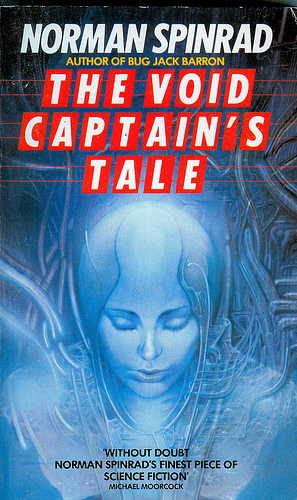
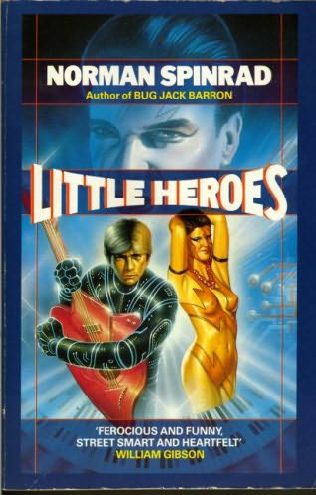
SPINRAD: Like asking someone with 20 kids which is his favorite. I suppose though, I have an A list: HE WALKED AMONG US, CHILD OF FORTUNE, THE VOID CAPTAIN’S TALE, LITTLE HEROES, BUG JACK BARRON…

As for what I would like to otherwise be remembered for:

He opened doors.

Many people walked through them.

Interview with Agent Lori Perkins

MICHAEL A. VENTRELLA: Lori Perkins is the Editorial Director of Ravenous Romance, a new publisher of romance ebooks and audiobooks. She has been a literary agent for 20 years, and is currently President of L. Perkins Agency, which has foreign agents in 11 countries and working relationships with Hollywood agents. She was the agent for HOW TO MAKE LOVE LIKE A PORN STAR: A CAUTIONARY TALE by Jenna Jameson, which made the New York Times best-seller list for 7 weeks. She was also the agent for J.K. ROWLING: THE WIZARD BEHIND HARRY POTTER by Marc Shapiro, which was on the N.Y. Times Children’s best-seller list.

As an author herself, she has produced four books: THE CHEAPSKATE’S GUIDE TO ENTERTAINMENT; THE INSIDER’S GUIDE TO GETTING A LITERARY AGENT and THE EVERYTHING FAMILY GUIDE TO WASHINGTON D.C. and THE EVERYTHING FAMILY GUIDE TO NEW YORK. She has also written numerous articles on publishing for Writer’s Digest and Publisher’s Weekly.

As an editor, she has edited thirteen erotica anthologies. when she is not teaching at N.Y.U.’s Center for Publishing. And somehow she found time to be interviewed by me.

Lori, how did you decide to start Ravenous Romance, and has it been as successful as you hoped?

LORI PERKINS: As an agent, I sell the stuff that other agents won’t handle — SF/Fantasy, pop culture and erotica. So after 9/11 I became the literary agent for the porn industry — I am Jenna Jameson and Vivid’s literary agent. But I also wondered what had happened in the erotica world that I had read as a younger woman, and I was surprised to find that the erotica market was becoming more and more female-centric. I took on Cecelia Tan — who writes SF/Fantasy erotica, as well as baseball books (another passion of mine) — and started selling erotica anthologies. I started reading all these wonderful writers with excellent writing chops who made their living writing short stories, and groomed a few of them into novelists for this burgeoning erotic romance and chick lit market.

At that time, I met Holly Schmidt and Allan Penn, who were nonfiction packagers doing a lot of sex books. They wanted to start a romance publisher, and I suggested that there were enough romance publishers out there, but erotic romance was young and growing. When they examined the market, they came back and said, yes, let’s do all ebooks, and that’s how Ravenousromance.com was born.

VENTRELLA: What is currently selling at Ravenousromance.com, and what are you looking for?

PERKINS: We’ve made a name for ourselves by crossing genres. Our most popular category is M/M romance, which means gay male romance. We’ve taken popular romance classics and rewritten them in contemporary settings — AN OFFICER AND HIS GENTLE MAN, PRETTY MAN, SLEEPLESS IN SAN FRANCISCO. We will be doing the same thing for lesbian F/F fiction now, so we are looking for someone to write THE PRINCESS’S BRIDE and MUST LOVE CATS. You get the idea.

Our paranormal romance is selling really well. We have seven vampire series, and the zombie fiction does well. HUNGRY FOR YOUR LOVE, our zombie romance anthology, is one of our best-sellers, as is our gay zombie romance, FOR LOVE OF THE DEAD by Hal Bodner. And our kinky stuff does well too, such as our THREESOMES anthology. We currently have a call out on the RR blog, ravenousromance.blogspot.com for stories for a paranormal threesomes anthology, THREE’S A CHARM, and an historical threesome anthology, ONCE UPON A THREESOME. We have two more big anthologies coming up soon — FANGBANGERS, which is romance with anything with fangs and claws, and APOCALYPSE TODAY: LOVE AMONG THE RUINS, which is end-of-the-world romance.

VENTRELLA: Do you see e-books being the wave of the future?

PERKINS: Ebooks is the future of the mass market. There will always be collectors and bibliophiles, but when it comes to books as entertainment, you can’t beat an ebook.

VENTRELLA: Do you think there is any stigma attached to books that are primarily sold as ebooks?

PERKINS: Only if they are self-published. We published 150 titles this year and sold reprint rights to a third of them to major houses.

VENTRELLA: Given that it is relatively inexpensive to produce ebooks, is there a worry that some will assume that the standards are lower for publication?

PERKINS: It is not much less expensive to “publish” an ebook. We pay an advance against royalties; we hire an editor, a copy editor, a cover designer; the book has to be converted into eformats from Word, and then it needs to be uploaded to the various Estores that sell it. Plus we need an office and an accounting department. I sell subrights. All Estores (Amazon, B&N, Fictionwise, Audible, etc.) take a huge portion of the sale price of the book (just like a bookstore and a distributor in print). The only part of the ebook system (with a real pubisher) that is less expensive is the cost of printing, shipping and storage, and that is returned to the author in the higher than print royalties — most epublishers pay between 25% and 35% royalties.

VENTRELLA: What will usually get a submission rejected for Ravenous Romance?

PERKINS: All erotic romance must have a happy ending or a happy-for-now ending. We might ask you to change it, and if you won’t, we won’t publish it. And then just plain bad writing will get you turned down — alternating perspectives, passive voice, etc.

VENTRELLA: Have you ever liked an author’s style and voice but rejected a story based on other grounds?

PERKINS: I am an editor who can fix things, so I can usually walk an author through a rewrite.

VENTRELLA: Audiobooks also seem to be growing tremendously. How are the ones with Ravenous Romance produced?

PERKINS: Erotic romance audiobooks do very well, because there aren’t many of them (they are still quite expensive to produce, since they must be done in a studio).

VENTRELLA: Do you think eventually the book publishers will change their pricing to accommodate a new economy model?

PERKINS: I think ebooks should be affordable, and that if they are too high they will encourage pirating. I think the print world needs to get rid of “reserve against returns”, which is an antiquated system that makes the publisher and the author a lender to the book seller. I think books are entertainment, and they must learn to complete with DVDs and games and music, all of which needs to be affordable. So a new blockbuster book should be $20, an ebook $10 and a mass market/backlist $5, IMHO.

VENTRELLA: What is your background? In other words, how did you get to become a literary agent?

PERKINS: I was journalist. I was the publisher of a neighborhood newspaper in Upper Manhattan with a degree in journalism from NYU. I became an agent becuse I wanted to sell both fiction and nonficiton, but I have always been an editorial agent (I fix the books before they go out and I often come up with ideas for my authors). I’ve also written four books and edited 15 anthologies. And I teach writing/editing at NYU.

VENTRELLA: As a literary agent, what do you see as the biggest mistake new authors make?

PERKINS: They are too eager to get published. They don’t work on their craft. They have fantasies about the marketplace that are no longer real.

VENTRELLA: How do you deal with receiving work that you think is well written but to which you don’t think the market wants?

PERKINS: I’ll tell them just that and tell them what’s selling, and if they want to rework something, fine. Otherwise put it in the trunk and get me something commercial.

VENTRELLA: What’s the best way for a new writer to find a literary agent who likes their genre and style of writing?

PERKINS: Get WRITER’S DIGEST’S GUIDE TO LITERARY AGENTS or Jeff Herman’s and go through the book with a marker, making a list of all the agents who sell what you’ve written. Then email the top five, wait a week, and go on to the next five, etc. You can also join Publisher’s Lunch and look up agent sales for the past three months to see who has sold something that sounds like what you are writing. Then send a query letter that starts: “I read on Publisher’s Lunch that you recently sold a….”

VENTRELLA: And finally, who are your favorite authors? Who do you like to read, and why?

PERKINS: My three favorite books are 1984, ALICE IN WONDERLAND and DRACULA, and I would say GONE WITH THE WIND is my fourth. I love Stephen King (am reading UNDER THE DOME now). I especially loved SALEM’S LOT because it was DRACULA set in America and he deftly portrayed the death of a small town. I think MISERY is his finest book — brilliantly crafted. I also love Peter Straub, who has mastered the art of telling a story like the peeling of an onion. He always amazes me.

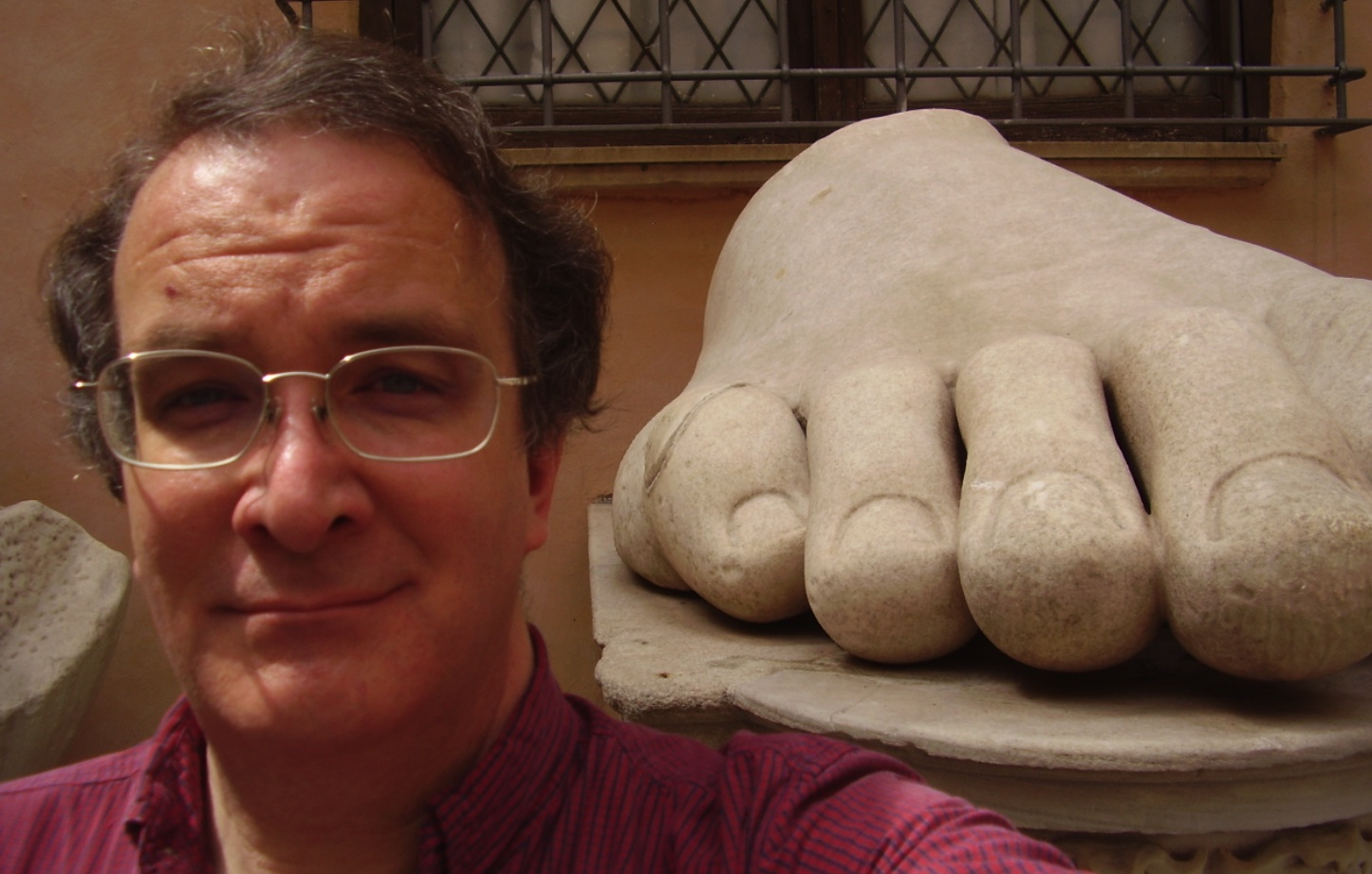
Interview with Christopher Hoare

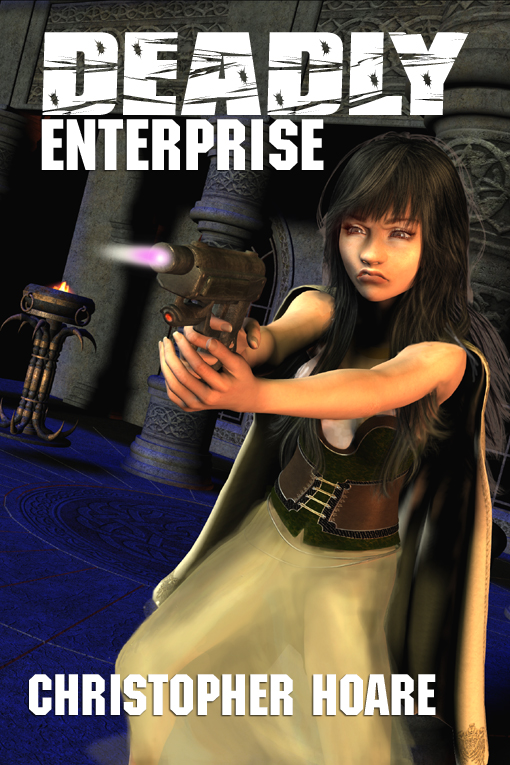
MICHAEL A. VENTRELLA: Today I am interviewing Christopher Hoare, whose books can be found with my publisher Double Dragon. Chris was born in London, England in 1939, immigrated to Canada in 1967, and became a Canadian Citizen in 1974 but we won’t hold that against him. He led an interesting life, studying around the world, serving in the Royal Artillery and then worked in oil exploration in Libya among other things. He now writes full time, living in Alberta at the eastern edge of the Rockies with his wife of almost 40 years, Shirley, and two shelter dogs.

Chris, there are so many new authors out there. What do you say to readers to get them to check out your books?

CHRISTOPHER HOARE: Gisel Matah, the protagonist of my Iskander series, is a woman who excels in a man’s world of action and danger, driving stories that women may find a refreshing change from being treated as sidekicks or helpless targets. She becomes the top security agent for her people when the small group of moderns are stranded in a 17th century world.

VENTRELLA: How did you decide to make the main protagonist a female?

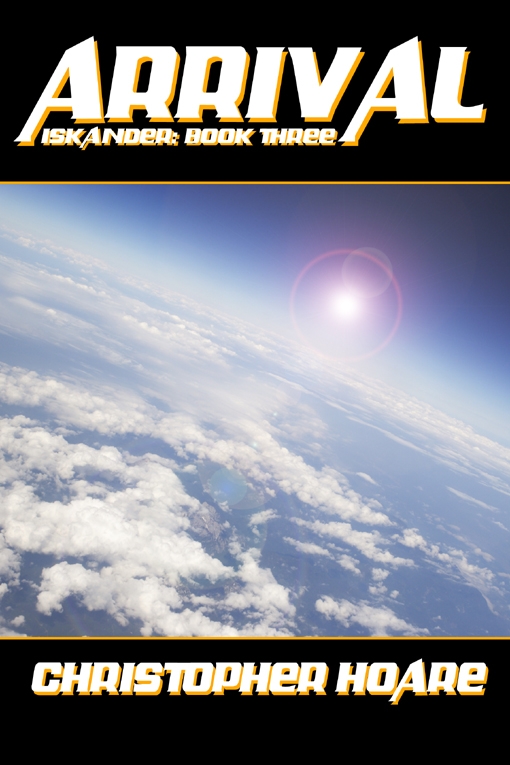
HOARE: I picked my strong and reckless female protagonist to oppose the relegating of women into accidental and amateur roles in action adventure fiction. I felt that women readers would enjoy one of their own who could stand with all the James Bonds and Rambos out there. I have heard skepticism about parts of the early stories where the young Gisel becomes the only person in the situation with the skills to take the lead, but partly because of her age. They query her action because they relate it to our society, that keeps the young in immaturity far longer than earlier societies did. I write such scenes with the age justification for her position carefully buttressed. For example, at 16 in ARRIVAL, she is picked to be Colonel M’Tov’s assistant in training a small group of parachutists because of her gymnastic experience; she then becomes the only person with the technical understanding to lead them on the operational jump when M’Tov breaks an ankle in a training exercise.

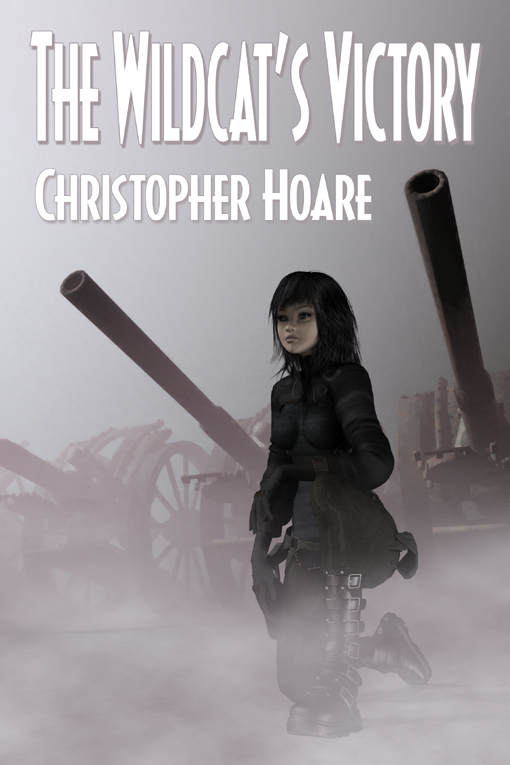
My next release is due to come out very shortly. THE WILDCAT’S BURDEN is a plunge into a dangerous writing minefield – I have Gisel both pregnant and moderately active as the governor of a rebellious city. The mothers in my writing group felt I’d mostly succeeded in depicting her in the conflicting roles, but also added their expert advice into the states of mind she should experience. The final crisis naturally takes place during her confinement and so the novel ends with attacks on her and on the city, while the plans she has prepared for the situation must unfold unattended. Another writer admitted she had a character in a fantasy give birth on a battlefield, but wouldn’t risk it again. We’ll see if readers accept this story.

VENTRELLA: What are you working on next?

HOARE: The novel I should be writing now instead of these answers. I have long wanted to write SF where the power of the mind is more important than the gadgetry. I think Lucas, in “Star Wars”, approaches this with the abilities of the Jedi, and I believe the ’50’s classics did as well in such stories as Alfred Bester’s jaunting in STARS MY DESTINATION (Tiger Tiger) and Asimov’s telepathic “Mule” in SECOND FOUNDATION.

The protagonist I introduce in MINDSTREAM is a retired professor of systems theory who has become abbot of a quasi-Buddhist monastery. He is able to access other beings – on this world, in deep space, and on other worlds – and, mentally, participate in or direct the action there. I blend a lot of the fascinating Tibetan Buddhist esotericism with String Theory in the background scenario. In the novel, Crumthorne and his assistant attend a NASA spaceflight convention to protect it against similar alien intrusion from adepts on other worlds, but it turns out that one of the Earth ‘attendees’ becomes a greater threat to all of them.

VENTRELLA: What’s the hardest part about writing?

HOARE: That’s easy – getting one’s work noticed among the cacophony of other media out there.

VENTRELLA: Have you had any formal writing training? Do you think that is necessary?

HOARE: You should have competence in the language you write in as a prerequisite. I’m appalled at the number of people who write although they have little knowledge of grammar and cannot spell; and even more appalled at those who self publish their writing without rectifying these inadequacies.

As to formal writing programs, I’m always skeptical about over-academicism because it can lead to rigidity and a failure to accept ideas that do not lend themselves to clever analysis. However, I attended a couple of university extensions that contributed greatly to my early development. A writers’ conference at NAU at Flagstaff in the late ’60s had an invited writer whose depth of analysis of fiction really opened my eyes.

VENTRELLA: How did you end up with your current publisher?

HOARE: I’m lucky to have landed with Double Dragon. Deron is supportive of ideas I sometimes spring on him, even when they turn out to be of less value than his own; he allows a writer to amass a growing body of available work without the fear of losing earlier writing to the deadly ‘shelf life’ demon of mainstream publication. Of course, that is also a function of e-publishing, where one is safe from being destroyed by the dreaded ‘returns’ policy.

I have been able to investigate the sales and distribution of POD vs e-books in my own way and learn from my mistakes (the only way I ever learn anything).

VENTRELLA: Do you have other long term goals to grab a more “mainstream” publisher?

HOARE: I would like to have a more mainstream publisher at some point, but I doubt I would find working with them (and they with me) completely successful. Really, the only thing they have that I covet is the greater exposure.”

VENTRELLA: Your short stories have also appeared in various collections, including TWISTED TALES. Do you find short story writing easier?

HOARE: Actually, I don’t like writing short fiction. The two stories accepted in TWISTED TALES II and III are the first short stories I produced since my early writing days. I doubt I will write more as I feel I was not able to get across the intentions I had in writing the stories. Possibly a fault of my lack of experience with the medium, but I really detest the literary genre that most short story writers write in.

VENTRELLA: Do you advise starting writers to concentrate first on short stories?

HOARE: Conventional wisdom when I started writing seriously said that one should always attempt to develop one’s idea first as a poem, then as a short story, and only later consider turning it into a novel. What rot. I do advise a developing writer that the shorter medium is a necessary foil when one is learning the essences of the craft of theme, tone, and plot. In a first novel one can easily lose all control over what one is writing – it certainly happened to my early attempts.

VENTRELLA: What’s your opinion on self-publishing?

HOARE: Would you recommend taking your first transatlantic flight in the captain’s seat rather than the passenger cabin? It requires an inordinate amount of hard work and luck for one’s self pub not to ditch in the ocean.

I do know a few good self published novels (other than Tolstoy’s and Dickens’) but they are exceptions. The writers were not first-time novelists and had some experience and craft knowledge to back their efforts. For a year or two I tried my hand at reviewing fiction and tried to give equal time to self-published works, but after receiving more than one that was actually painful to read I gave up on the exercise.

VENTRELLA: Do you tend to rely on outlines first or do you just plow right in?

HOARE: I much prefer to start with the characters and the opening question and write a first draft as an exploration. By the time the novel reaches the halfway point the ending should have made itself inevitable if one remains true to what has gone before.

There are times, when I’m not sure what should happen in a necessary scene or what comes next, that I will explore ahead with an outline or even an unorganized scattering of issues to determine the logical order which develops the story. I have never sat down and written a detailed outline of a story before starting to write as I feel that would destroy all the life – the illusion of real life happenings – that make the story flow.

VENTRELLA: Tell us about NovelPro.

HOARE: I learned almost all I know about writing during the five or six years I belonged. The partnership with some really brilliant authors and the hard work of extended whole novel critiques was more valuable than a conventional MFA. Not just my opinion, as I saw it expressed by other members who had MFAs.

If you can get in, I’d advise any writer to shelve their own writing ego long enough to submit to the group for awhile. Not everyone can do it. Some quit even before completing their very first novel crit – the be all, end all, of the NPro system – while others get kicked out because they become obstructive. I was cautioned a couple of times, and my posts put on ‘review’. I’m still in contact with some members and past members and have accepted that there will come a time when the writer has to accept that their own needs and the group’s no longer coincide. I still wish them all well, and wait for the time when a work from the group becomes a bigger success than THE DaVINCI CODE – as well as better written.”

In line with others in the NovelPro group I spent an inordinate length of time trying to perfect the query letter and the bit by bit perfection of the opening attention grabber to gain a top NY agent. Then I slowly began to realize that my writer profile ruled me out of their consideration. I’m a grouchy and opinionated senior who lives as far away from New York, and the New York mentality, as it’s possible to get without traveling through space. I tried to bend in the appropriate ways – I became a Toastmaster to hone my public speaking skills for those career building moments on camera, but by the time I became a CTM I realized I hated making speeches. I tried to convince myself that I could turn myself into a saleable ‘brand’ under the tutelage of a wise old literary agent, before I realized that I’m too much of a loner to fit the profile. I’ll go on writing my way and being me – and if that doesn’t fit with the NY concept – to Hell with them.

VENTRELLA: Do you have any specific advice you would give a writer trying to make it in the publishing business that they may not have heard before?

HOARE: I hope a few of the answers I’ve given above have pointed others to useful insights of their own. If there is anything I believe that I’d like to prove true it’s that in order to be a lasting writer – one who produces something that lasts – one has to be a contrarian. Not pretend to be one but to actually feel offended when life tries to squeeze you into a conventional slot.

My old physics prof at engineering college used to say, “If you want to have a brainwave, you have to have a brain, and you have to wave it.” I have absolutely no proof that these qualities will allow you to ‘make it’ in the conventional publishing business, but I assure you they will lead you to a more worthwhile life.

Interview with James Enge

MICHAEL A. VENTRELLA: I’m pleased to be interviewing fantasy author James Enge today. James, how did you get started in the business?

JAMES ENGE: I’ve been writing since forever, but I was first published when I saw a newish magazine called “Black Gate” had started up. They specialized (and still specialize) in adventure fantasy at shorter lengths (i.e. shorter than a novel) and that’s what I was most interested in writing, so I sent them something. When the editor, John O’Neill, finally wrote me back after many months I assumed it would be another in a long string of rejections … but, in fact, he bought the story (“Turn Up This Crooked Way”) and told me he was interested in more. So that’s when it really started for me. That was in 2005, if I’m remembering right.

VENTRELLA: Creating a fantasy world is never easy, because it must be rooted in believability. What have you done to make your world both fantastic and believable? Have you found it difficult?

ENGE: I try to maintain a certain tension between free invention and concrete realism. My favorite bits in my own writing are physical descriptions which are probably invisible to everyone else. In my first story, the hero has occasion to peer through “a dark shoe-shaped patch of nothingness”. It makes perfect sense in the world of the story, but it’s not something that you’re likely to see on the street on your way to work.

VENTRELLA: Along those same lines, what steps have you taken to plant your characters in this world? In other words, many fantasy novels tend to have characters that behave like modern-day people, only in a different setting. How do you avoid that while still making the characters likeable?

ENGE: Someone called this the phenomenon of the “vegetarian Viking” — anachronistic modern attitudes grafted onto people in non-modern societies. It is tricky, because whenever the characters may be living, the audience is a modern audience and they’re not likely to laugh off chattel slavery or infant exposure (to name only two unsavory customs of the past). But, in my fantasies, it’s much more difficult to say what’s anachronistic, since it’s a secondary world. Writers can get themselves some oxygen but writing a different kind of society than lords and ladies and dukes and peasants: not every imaginary world has to be the Middle Ages with real dragons. And the actual Middle Ages were more complicated than some people think: one can plunder history for interesting ideas. Your standard Viking, for instance, would not have been a vegetarian… but he may have lived (if he came from Iceland) in a republic strikingly free from all that kingy junk we associate with medieval states. Likewise a Florentine banker (and so on).

VENTRELLA: Is religion in fantasy novels something to embrace or avoid, given the controversy it may bring?

ENGE: I think you have to tell the story that you want to tell, and if religion comes up, it comes up. Religion is a normative part of human society, so a society without any religious expression would need some justification … but that in itself might make for an interesting story or world. The novel I’m working on now is starting to feature one set of deities (the Strange Gods) very strongly. I didn’t expect it, but it’s been kind of interesting to watch it develop.

VENTRELLA: What’s your biggest gripe about fantasy novels in general?

ENGE: I can’t claim to have read a representative sample — there’s just too much out there. But I think the tendency to view multivolume narratives as the norm is really not good. The longer the narrative, the more difficult it is to bring to a satisfying conclusion. I’m not knocking George R.R. Martin, by the way: I read A GAME OF THRONES years ago and loved it. But I have resisted reading the other volumes in “A Song of Ice and Fire” since then: I’ll wait till he’s done and read the whole thing, and I have every confidence the end will live up to the beginning. But not everybody is GRRM. Also, he’d been writing for a generation, producing work of classic stature long before he tackled this heroic project.

VENTRELLA: What are your favorite fantasy novels? Favorite authors? Why?

ENGE: Tolkien, Leiber, Zelazny, Le Guin, Brackett, Vance. Zelazny has a great line in THE HAND OF OBERON. He actually speaks to his main character, Corwin, and he says that he’s writing “a philosophical romance shot through with elements of horror and morbidity.” I think that’s what all these guys do, to some extent, and that’s what I’m trying to do. I coined the term philorohorrmorbmance for it once, but it didn’t catch on for some reason, so I usually say I write sword-and-sorcery.

VENTRELLA: How important is an agent for a starting writer?

ENGE: Key. I mean, if what you want to do is sell stories to zines, you don’t need an agent. And small presses don’t usually demand that the writer be represented by an agent. But if you want to sell novels to even medium-sized publishing houses, I think writers mostly need an agent nowadays. More and more work that used to be done by publishers is being offloaded to agents — essentially, they’ve become the first readers for the publishing houses. I’m not saying there are no exceptions, but I know that my novel-writing career went nowhere until I got an agent (the great Mike Kabongo who runs the OnyxHawke Agency).

VENTRELLA: What is your writing style?

ENGE: I have to know how a story ends or I can’t make much progress on it. So I begin with the end and a beginning, and the stuff between I usually negotiate as I go.

VENTRELLA: My second novel comes out in a few months, and, like your work, it is a stand-alone story but set in the same world with the same characters as the first novel. One of the difficulties I had is in giving enough background for a new reader while not boring someone who is already familiar with the world from the first novel. How do you handle that sort of thing?

ENGE: It is hard. Mostly I’ve solved that so far by sending my hero, Morlock Ambrosius, to new places. But, in general, I think that writers have to develop a sense for what exposition is genuinely necessary for the story and what isn’t. A writer should always know more about his or her world than will fit into a story, and because the world is our creation we’re often eager to fill the audience’s ear with excessive detail. On the other hand, new and different worlds are one of the reasons people read sf/f, so what’s excessive for one reader will be just an hors d’oeuvre for others.

VENTRELLA: How has your educational background influenced your writing?

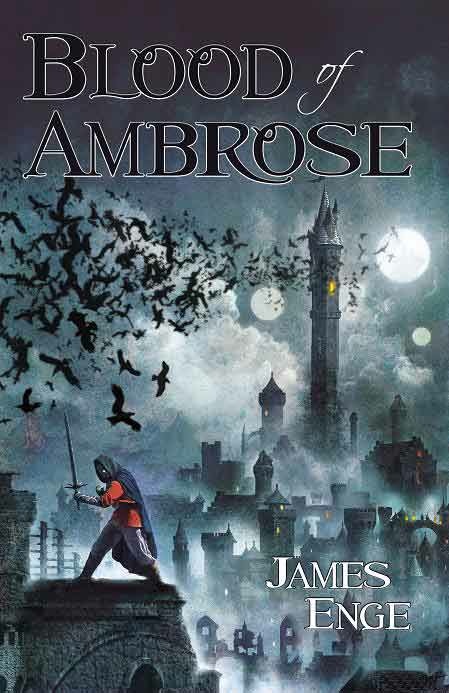
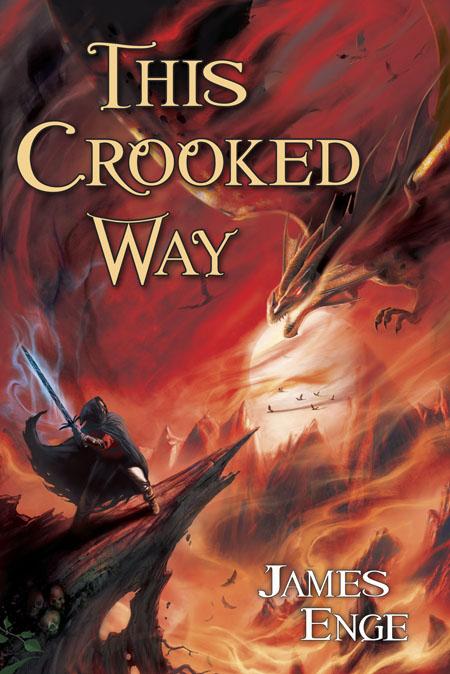
ENGE: I steal stuff from it constantly. My degrees are in Classics, and I studied a few medieval Germanic languages in school, too — all because I was (and remain) nuts about language, mythology and history (three fields that overlap more than one might think). This stuff is a tremendous storehouse for story ideas. For instance, Morlock’s move to defeat the Big Bad in BLOOD OF AMBROSE will seem a little familiar to people who know the myth of Hercules and Antaeus, and when Morlock is confronted by a stone beast in THIS CROOKED WAY he again takes a leaf (or limb) from Hercules’ book to save himself. The trick, when you steal something as blatantly as I do, is to make the borrowed element native to your work. You don’t need to know the Herc myths to read the Morlock stories, but if you do you’ll get an extra smile of recognition sometimes.

VENTRELLA: All authors these days spend a large amount of time on self-promotion, from posting a regular blog to producing podcasts to appearing at conventions. What’s your opinion on the relative value of each?

ENGE: I have no idea. There are so many forms of online community these days, one could spend a working week every week just keeping up. One thing I do feel strongly: online and offline communities may be useful for self-promotion, but they shouldn’t be used solely for that. The communities are meant to be conversational exchanges among people with common interests, and that’s really their primary value.

VENTRELLA: Do you advise aspiring novelists to begin with short stories?

ENGE: I would have said “yes” a few years ago. Now I’m not so sure: the markets are very different in what they want to see, and the forms themselves are diverging radically. When the standard novel was sixty or seventy thousand words and magazines regularly published novelettes and novellas of tens of thousands words, writers with the same skill-set could comfortably operate on book length and short-story length. Now stories seem to be getting shorter and novels are certainly getting longer (at least in sf/f). No doubt a credits-list of stories in reputable publications increases the likelihood that an agent or an editor will take a chance on a new writer. But if novels are what people want to write, maybe they should head straight for that — likewise with stories.

VENTRELLA: Of what work are you most proud?

ENGE: You force me to tell you! Okay, since I have no choice in the matter (not that I want one), I really like my second book, THIS CROOKED WAY. The story begins with Morlock’s horse, Velox, being stolen by an unknown enemy. In tracking down the horse, he has a number of adventures that turn out to be clashes with his veiled enemy. When unmasks his enemy, he finds that he’s already involved in a struggle that hinges on someone else’s life-or-death. The book is an homage to the episodic novels of sword-and-sorcery past (like Fritz Leiber’s Lankhmar books, or Vance’s Cugel books, or Moorcock’s Elric books). I got to sneak in some elements that one doesn’t usually see in a heroic fantasy, like robots (i.e. golems), the internet (a.k.a. Whisper Street) or alien species (e.g. the buglike Khroi or the wormlike dark gnomes). There’s an antiheroic dragon-fight that I’m particularly fond of. And there’s some emotional resonance for me in the over-arching plot, which deals with the death or non-death of Morlock’s mother. THIS CROOKED WAY has not, in fact, made a big splash, but even if it never sells another copy it’s the book I’m likeliest to point to and say, “That’s what I do; that stuff.”

VENTRELLA: What’s your opinion on self-publishing? Do you advise new authors to go this route, or is it better to not publish at all than to be self-published?

ENGE: Self-publishing is risky because there are so many people involved who really don’t have a realistic sense of their work’s merit. Everyone, but everyone, can afford to take a hint every now and then, and the self-publishing route usually involves trimming out all the gatekeepers who might say, “This bit doesn’t work” or “Your hero looks like a jerk here. Is that what you want?” The process of traditional publishing may keep some work from being published, but it unquestionably improves the stuff it does let into the light of day. I’m not saying that everyone involved in self-publishing is engaged in self-deception: it provides an outlet for lots of stuff, like local history, textbooks — niche work that would always have trouble with a commercial publisher but may still find an audience. But so much self-published fiction is so problematic that I think it’s a hard sell for most readers.

VENTRELLA: Any last minute words of wisdom for those wanting to break into the publishing business?

ENGE: Write the kind of stuff you’re interested in reading. This seems like obvious advice, but lots of people get involved in writing work they would never look at twice if it were written by someone else.

I’m not sure if those were words of wisdom, but at least they were words. Thanks for the chance to bend your and your audience’s collective ear!

Interview with Jay Lake

MICHAEL A. VENTRELLA: I’m pleased to be interviewing Jay Lake today. Jay is a winner of the John W. Campbell Award for Best New Writer in Science Fiction, and has been nominated for numerous Hugo awards and World Fantasy awards. His web page is here.

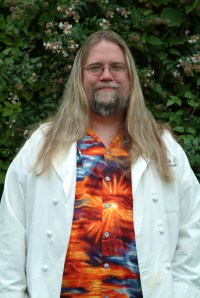
JAY LAKE: Michael, thank you for having me here. I’m very glad to be sharing my experiences with your readers.jay-lake_author-photo_Tor

VENTRELLA: Jay, how did you get started in the business?

LAKE: I began with short stories. Sold my first story in the spring of 2001, and two more that year. Sold about a dozen stories in 2002. Since then it’s been a big part of my writing practice. Did that for a while, all the way through earning the Campbell nod in 2004, before I got traction on novels.

That’s not to say that short fiction is the way everyone should enter the field. In some ways, novels are easier to sell. And if one wants to write novels, one certainly should. Don’t force short fiction because someone like me said it was the path.

VENTRELLA: You’ve placed a few short stories on your web page for free; do you advise this approach for new authors trying to establish themselves?

LAKE: In my case, the stories on my Web page are either Web reprints of older stories that have been in print already, or occasional one-shots of short pieces that for some reason I didn’t feel were what I wanted to market.

For a newer writer, the appeal of a “free sample” approach can be powerful, but I’m not certain of its value. You’re an unproven quantity until you’ve passed through the gateway of an editorial proxy. And most of us don’t have a good sense of the quality of our own writing. Posting something that you and the world would later see as sophomore work migh be iffy. On the other hand, I’m all about being proud of who you are.

VENTRELLA: What are the legal and contractual limitations of doing so?

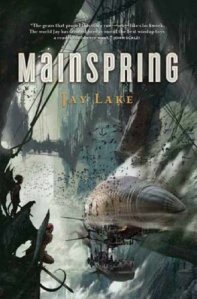
LAKE: Well, the primary issue is first rights. I’m not an attorney, and I don’t play one on the Internet, so this is not legal advice. But it is common sense advice. If you don’t already know how copyrights work, learn.books_mainspring

Basically, a copyright is a piece of property. You rent it out but you rarely if ever sell it. Each of those rentals is done by licensing a right. The rights are not explicitly defined in law. The rights themselves are defined on a case-by-case basis in each contract, and generally include such things as print rights, audio rights, electronic rights, ebook rights, gaming rights, film rights and so forth.

The first time a work is published is considered to be “First Rights”. While electronic publishing (e, appearing on a Web site) does not in fact expire the first print rights, most editors will view any prior publication as a first rights usage. So if you put someting on your Web site, you’re making it unlikely that anyone will be willing to buy it later for professional publication.

Note that aspiring writers are often concerned about protecting their ideas, or having their work stolen. While this can be an issue in Hollywood, it is rarely an issue in print fiction (defining “print” fairly loosely to include online, ebooks, and so forth). The reason that this is rarely an issue is that ideas are the easiest part of the process. Why would anyone need to steal your ideas when they can make their own?

Think about it. You write a fantasy about a quest through a magical kingdom by a mixed band of adventurers. Is that such an original idea that you’d be harmed by someone else writing such a book? There are already thousands of them in the market, an entire subgenre’s worth. Your fantasy includes a dwarf werewolf named Yoni who has a crippled foot from a sliver of moonsilver embedded in the sole when the wizard bar-Simon was assassinated by the Carmine Council. Is that such an original idea that you couldn’t make up another one just as good in the same ten seconds it took me to write that sentence? And probably better?

Short of outright plagiarism, which is quite rare for us, theft isn’t much of an issue. Where it does occur is in the area of unauthorized reprints, and ebook piracy, and those are largely concerns of established writers. To be blunt, if you have such problems it will be because you’re already succeeding.

VENTRELLA: All authors these days spend a large amount of time on self-promotion, from posting a regular blog to producing podcasts to appearing at conventions. What’s your opinion on the relative value of each?

LAKE: Writers write, first and foremost. The rest of it is just marketing, of little value if you have nothing to market, and of not much more value if you do it at the expense of further writing.

That being said, I’m a fan of doing anything to raise your profile and build your brand among readers, editors, reviewers and critics. But only if whatever you’re doing is fun for you, and more importantly, fun for the people who encounter you. In a professional sense, it’s not entertaining to read about your cat’s trip to the vet, or how many smoothies you made for breakfast this week. Likewise sitting around a convention bar griping about how your landlords keep screwing you on security deposits. But, if you can be relevant, or entertainingly tangential, in your blog or podcast or convention persona, you have a hook.

Plenty of people have done this. Mur Lafferty has made a niche for herself with her “I Should Be Writing” podcasts. I have my noisy-fat-guy-in-loud-shirt persona I wear around at cons. (And honestly, in real life, too.) Jim Van Pelt used to run a Campbell Awards Web site. Jeremiah Tolbert edited “Fortean Bureau”, and now “Escape Pod”. All of us did so while building our presence as writers. But we’re all having fun doing what we’re doing, and fun is contagious.

Doing something because you “should” is the kiss of death in this business. There are some exceptions: You “should” use standard manuscript format. You “should” enclose a SASE with postal submissions. You “should” read your contracts carefully before you sign them.

But in self-promotion, there really aren’t “shoulds”, there are only “coulds”.

Take me. I’m a demon blogger. I use my blog, across both LiveJournal and WordPress, with feeds to Twitter and Facebook, to talk about a number of things that interest me. I have regular content on a daily basis, special features several times a week, and continuing series about certain topics, such as my kid, writing processes and my journies through cancer. Some people read me for my strong leftie politics, some can’t stand that but read me for the daily round up of culture and science links. Some people follow me because they’re fans of my kid. Some people follow me for my fiction alone. I offer a range of content, all of which is interesting and engaging to me.

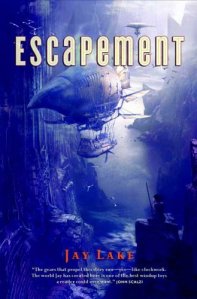
On the other hand, I’ve tried podcasting. It bores me. I don’t do podcasts much at all, because I can’t make them interesting enough, because they don’t interest me. If you like audio production, and expressing yourself through that medium, and have a lot to say, by all means, it’s a growing area. I’m probably missing out by not doing it myself. But it just doesn’t work for me.0765317095.02.LZZZZZZZ

As for conventions, I am of the first belief that one can have an entire highly successful career in this field and never set foot inside a convention. At the same time, writing is by its very nature a solitary act, and conventions are one of the few frameworks where we authors get to interact face-to-face with our peers, our editors and agents, and most importantly, our fans. If your social skills are on the outliers of the bell curve, this may not be the venue for you. Likewise if you are so introverted that groups of strangers are literally painful for you. (Both of those are true of many writers.) But if you can be personable and engaging and enjoy yourself, they’re a hell of an opportunity for networking.

VENTRELLA: How important is the social media (Facebook, Linked in, My Space and so on)?

LAKE: Ask me in five or ten years. Five or ten years ago, I couldn’t have given you a reasonable answer about how blogs would work out. I can tell you that far more people read my Twitter feed every day than read my blog directly, and that I have about as many Facebook friends as blog followers. I can also tell you that my Facebook feed gets more comments than my blog feed, at least most of the time. But the nuances of that? And the long-term value? No clue. Not yet. I do it becaus it’s fun, and because those are places where I can interact with people.

VENTRELLA: What trends in current genre literature do you hate? What vents your proverbial spleen these days?

LAKE: Enough with the vampires already. And I can rant for hours about how most magic systems violate Newton’s laws, as well as the basic rules of economics. But really? Not much hating going on. Taste, yes. I refuse to read TWILIGHT. But millions have read and loved that book and its sequels. I can’t hate on anything that gets people to look at print literature.

VENTRELLA: Who do you love to read? Who has inspired your work?

LAKE: Gene Wolfe. Ursula K. LeGuin. Jeff VanderMeer. Lois McMaster Bujold. Jeffrey Ford. K.J.Bishop. M. John Harrison. Terry Pratchett. Maureen McHugh. And so on and so on and so on. Our field is full of marvelous writers working from every direction, every theme, every plot.

VENTRELLA: Of what work are you most proud?

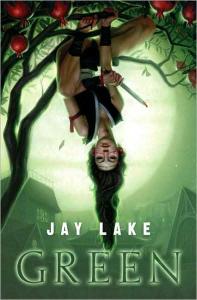
LAKE: That’s like asking me of which child I am the most proud. (Admittedly, I only have one child, so that question is not so hard to answer.) I suppose I’d point your readers to my latest Tor book, GREEN. It’s a coming of age story set in a secondary fantasy world, about a girl sold into slavery at a very young age who is trained to be a courtesan, while secretly being countertrained to assassinate the man she is intended for, a powerful Duke. green-jay-lake-largeShe rebels against both fates, tries to go back to the land of her birth, and makes a mess of a great many things before being forced to save a city, some lives, and even a god or two, in the course of repairing those messes. It’s courtly fantasy, with sex and violence and cityscapes, though not so much with the magic.

I wrote the book for and about my daughter, very much drawing from her character to build Green, the protagonist. Getting inside the head of a young girl of color with Green’s peculiar history was quite a stretch for me as a writer, but so far the readers have loved it. I hope you will, too.

VENTRELLA: What’s your opinion on self-publishing? Do you advise new authors to go this route, or is it better to not publish at all than to be self-published?

LAKE: I share the rather strong tic again self-publishing which can be found among the community of professional writers. Especially for aspiring or early career writers.

Here’s the simple reason. You don’t have any real idea how good your work is, or what its flaws are. Nobody does, especially not early on. That’s what editors are for.

I’ve been publishing professionally for almost a decade, and I’m only beginning to see it in my own work. That story of yours that is brilliant, better than anything you’ve seen in print this year? Maybe it is, maybe it isn’t. But you’re not likely to be able to judge that.

What the self-publishing route does is three things. It allows you to commit work to print that you will quite likely later come to question the wisdom of. If the work is as good as you believe, you’ve lost the ability to sell first rights by self-publishing. And it will reduce your standing in the eyes of professionals in the field, especially editors.

Note that for some purposes, self-publishing is a brilliant tool. Family histories, local interest cookbooks, private editions for a holiday gift, etc. But as a success path for commercial fiction? Not so much. And yes, there’s always a story about this author or that who got a huge contract after a self-published success, but no one ever tells you how many people didn’t.

Remember, editors and agents aren’t out to publish their friends, or suppress new talent, or any of the other things you hear people grumble about it. Quite the opposite. They want nothing more than to find hot new talent, and be the one to bring the work, and the author to market. And they do have an idea of how good work is, and what will succeed in the market.

Publishing is a meritocracy, but it’s not a just meritocracy. Nothing is ever quite fair or sensible. But if you want the credibility and impact of being commercially published, you need to follow the routes that work to enter commercial publication. And yes, it’s a game whose rules change all the time. So far, the rules haven’t changed to include self-publishing as a strongly valid option.

VENTRELLA: You’ve blogged about your fight with cancer. (As my wife is a cancer survivor, I certainly can relate in some small way.) How do you think this will affect your future writing?

LAKE: Cancer will indelibly affect my future writing. It already has. My voice, my themes, my view of myself and the world have been bent in a new direction. Not one I would ever wish on anyone, least of all myself, but there’s a lot of passion, power and pain in cancer. As I write this, I’m two weeks from surgery to remove a metastatic tumor from my lung. Second trip through the cancer mill. Believe me, I have learned new lessons in fear and terror, but I have also learned new lessons in hope, glory and blinding love.

That cannot help but change everything. Once again, I won’t know how til years down the road.

VENTRELLA: What advice do you wish someone had given you when you first began trying to break into the business?

LAKE: Really, I got plenty of good advice. I mostly wish I’d taken more of it.

I think most aspiring writers go through phases. One phase is “I’m an undiscovered genius”, and it’s characterized by a lot of hot pride. Another phase is “publishing is a conspiracy”, characterized by fear and resentment. Another phase is “I suck, and I’ll never make it”. You get the drift.

Each of those phases brings with it a certain wilful deafness. I wish, when I’d been in those phases, that some future me, or someone wise enough to speak in a way that got past my defenses, had simply said, “Shut up and write.”

Because “get back writing, then write more” is the only real advice.

In fact, it’s what I’m going to do right now. Thank you.

Interview with author David Wellington

David Wellington is the author of seven novels. His zombie novels MONSTER ISLAND, MONSTER NATION and MONSTER PLANET form a complete trilogy. He has also written a series of vampire novels including (so far) THIRTEEN BULLETS, NINETY-NINE COFFINS, VAMPIRE ZERO and TWENTY THREE HOURS, and in October of 2009 began his new Werewolf series, starting with FROSTBITE. His web page is www.davidwellington.net.WellingtonAuthorPictureWeb

MICHAEL A. VENTRELLA: Welcome David! You’ve gathered quite an impressive array of degrees from prominent universities having to do with creative writing. How has your education influenced your writing?

DAVID WELLINGTON: Only indirectly, really. The main reason to pursue a graduate degree in Creative Writing is to be surrounded by other writers–you learn a lot more from your fellow students than from the instructors. The focus is on workshops, and I’ve found you can get that from an informal writing group. I suppose there may have been occasions when someone took me more seriously because I had an MFA, but really, the work needs to stand for itself.

VENTRELLA: Do you believe good writers are “born” or is education and training essential?

WELLINGTON: It’s all about hard work, unfortunately. It took me thirty years to get to the point where my work was worth being published. Exceptional talent might cut down on how long it takes–but the only way to improve as a writer is through trial and error. You need to write, a lot, and learn from your mistakes.

VENTRELLA: How did you get your “big break”? Aspiring writers want to know!MonsterIsland_LoRes

WELLINGTON: I tried everything, of course. I tried selling short stories to magazines. I tried submitting manuscripts to publishers, completely unsolicited. Nothing worked. I was actually ready to give up — when a friend of mine suggested that I publish a book on his website. The book happened to be MONSTER ISLAND. He set up a blog for me and I posted a short chapter three times a week. At first it was just for fun — I had no reason to believe it would lead to anything. Then people started reading it. A lot of people. By the time I had a couple of thousand people reading each new post, a publisher came to me with an offer. I used to say I got into publishing through the back door — but I’ve since come to realize there really isn’t a front door. If you want to be published today, you have to get creative. Luckily, if you’re a writer, you’ve already got a well-developed imagination!

VENTRELLA: How did you get involved in the Marvel Zombies series?

WELLINGTON: Marvel actively sought out the authors of zombie novels to come up with some new ideas for the franchise. They approached three of us to each write one issue of Marvel Zombies Return. I absolutely jumped at the chance — I’d been a fan of comics my whole life, and had always dreamed of writing one some day.

VENTRELLA: How does writing for comics differ from writing novels?

WELLINGTON: It’s much more like writing a screenplay. You’re writing something that will never be seen. Your script is going to be interpreted by an artist, so you give up a certain measure of control. You have to trust your artist to interpret your vision. Luckily for me I was matched with Andrea Mutti, whose art really brought my story to life. The guy’s a pro.

VENTRELLA: You have already tackled several classic horror monsters: werewolves, vampires and zombies. All of these takes were fairly unusual in their descrpition of the monsters’ qualites/appearances, yet retaining a lot of the classic elements at the same time. How did you come by that decision?

WELLINGTON: Whenever I start a project, I want to do it my own way. Otherwise where’s the fun? I start with the traditional version, and think about how I can play with it. That way I can add something new, and hopefully something fresh. My zombies don’t just eat brains — they eat anything organic. They peel gum off the street and eat it if there’s nothing else. They’re the ultimate consumers. My vampires were a direct reaction to the romantic vampires you see so often these days. I wanted my vampires to be scary — predators in a world where we would have a very hard time fighting back. And so on.hair ablowin

VENTRELLA: What’s next? Any plans to give us a fresh take on another horror creature?

WELLINGTON: There will be two books in my new werewolf series–FROSTBITE, out now, and OVERWINTER, which will come out next year. I’d like to do a fifth vampire book, to finish the series.

VENTRELLA: The protagonist of your vampire series, Laura Caxton, is lesbian which is quite unusual for mainstream horror. Anything specific that prompted you to that decision?

WELLINGTON: There wasn’t a lot of decision-making involved. When I created Laura, I knew I had a scene where she comes home after a very nasty day at work and gets into bed. I knew there would be someone in the bed waiting for her — when I got to that scene, the other person just happened to be another woman. The character was partly based on my sister, who is gay. Beyond that I gave it very little thought–and nobody ever gave me a hard time about it. My editors never blinked. My readers have accepted it without making a big deal out of it. I was pleasantly surprised by that.

VENTRELLA: What are your favorite books in the horror genre? Favorite horror movies?

WELLINGTON: My favorite books in horror are the classics — Lovecraft, Poe, Arthur Machen. As far as movies go, I like any horror movie that plays with the genre or expands a story in an interesting way. “Near Dark” is a great film, as is “Let the Right One In,” for this reason.

VENTRELLA: Have you ever considered writing in any other genre?

WELLINGTON: When I started publishing, it was with a horror novel. But I’ve never considered myself just a horror writer — I’ve actually written far more science fiction novels than horror novels, they just never got published. I write fantasy, mystery, even literary fiction — whatever idea comes along, I pounce on it.

VENTRELLA: What’s your favorite monster?

WELLINGTON: Frankenstein’s Monster, definitely. There’s something about that character — both in Mary Shelley’s book and in the Universal films — that really speaks to me, an existential loneliness that demands answers. What am I? Why was I created? What am I supposed to do now? The monster asks all these questions, and gets no answers. That’s how I feel every morning when I wake up. Then I eat my cereal and get to work and I feel a lot better.

VENTRELLA: Do you have any specific advice you would give a writer trying to make it in the publishing business that they may not have heard before?

WELLINGTON: Keep writing — it can seem pointless, but it’ll work eventually. Something will catch somebody’s eye. Or you’ll improve as a writer to the point where people can’t ignore you any more. Try to tell stories, rather than creating great art. Keep reading books — every book, good or bad, has something to teach you.frostbite

VENTRELLA: What are you most proud of? For What would you like to be remembered?

WELLINGTON: A book that hasn’t been published yet. One I haven’t written yet. Every book I write is better, in some way, than the last. I don’t want to be one of those writers who publishes one good book and then can never catch that fire again. I want to be the guy who’s best work is always his latest one, like Terry Pratchett.

VENTRELLA: What are you working on now that we can look forward to?

WELLINGTON: FROSTBITE, my werewolf book, is out right now–you can get it at Amazon or in any bookstore. There will be a sequel called OVERWINTER, out next year. I hope you’ll like them!

Interview with Gregory Frost

Gregory Frost is the author of the Shadowbridge duology, SHADOWBRIDGE and LORD TOPHET. His latest short fiction appears in the anthology POE, edited by Ellen Datlow. He’s been a finalist for every award in the sf, fantasy, and horror genres. Other works include LYREC, TAIN, REMSCELA, THE PURE COLD LIGHT, FITCHER’S BRIDES, and the short fiction collection ATTACK IF THE JAZZ GIANTS & OTHER STORIES. His essay on Slipstream fiction appears in Modern Fantasy Literature (Cambridge University Press), co-edited by Farah Mendelsohn. For two years he was the principal researcher for a non-fiction television producer, for shows that appeared on The Learning Channel and The Discovery Channel. Currently he is the acting Fiction Writing Workshop Director at Swarthmore College, in Swarthmore, PA, and teaches in writing programs in and around the Delaware Valley. His web page is Gregoryfrost.com.

MICHAEL A. VENTRELLA: I’m pleased to be interviewing Gregory Frost. I first became aware of Frost with his initial novel LYREC which I remember reading on the Boston subway back in the 80s. Although I have not re-read it since then, I recall it being quite fun with some real issues about religious beliefs…

Gregory, was LYREC the first novel you had written? What made you decide on that theme for your first novel? (PS: My wife says to tell you she loved that book.) Any news on it being re-issued?

GREGORY FROST: LYREC was the first novel that was published. Hardly the first one I’d written. In fact my first attempt at a novel was about 70 pages long. The second attempt was, at least, of an appropriate length, around 250 pages. But it and numerous others live in a box in a closet, which is where they belong. That second one made its way to Lin Carter, who was editing the Ballantine Adult Fantasy Series in those days (that should date me), courtesy of a letter of introduction from one David Gerrold, who’d never even met me. And Carter, bless him, did a line edit on the first 10 pages, showing me how much I did not understand of the craft. It would be a decade after that before I sold LYREC. But both Gerrold’s letter and Carter’s efforts were acts of kindness on their part. I think apiring authors should always stiffen their spines and talk to published writers. Trust me, only some of us bite. The zombie writers…yeah, you should probably not talk to the zombies.

I expect LYREC would have been a YA novel had there been such a category in ’84. Main character is an alien who has little experience with human emotions and finds himself greatly overcome by them as he inhabits a human body; he has to sort out his angry, warring and violent impulses. And his sidekick is unable to manifest as a human and so goes through the book as a large talking cat with attitude. I was trying to do something with fantasy besides interminable trilogies and quests. So there’s way more Fafhrd and the Grey Mouser in there than there is Tolkien or Robert E. Howard. I love Fritz Leiber, and those stories of his were unquestionably influential. Roger Zelazny’s work, too. It’s fresh, funny, different. I was shooting for all that with LYREC. A really good ride.

And at the moment there’s a possibility it’s coming back into print from Wilder Press this winter. Negotiations on that front continue, and I don’t know how that’ll fall out.

VENTRELLA: How did you break into the publishing business at that time?

FROST: I broke in by publishing a short story (in The Twilight Zone Magazine for the old people in the audience), and then in quick succession two more in F&SF, and around then at a convention I met Terri Windling, who at the time was an editor at Ace Books. I was in the middle of a draft of a novel based on the Irish epic The Tain, and the idea excited her. She agreed to look at LYREC, I think, pretty much on the strength of the idea that I was going to do my version of Cú Chulainn.

VENTRELLA: Has the business changed much since then?

Back then a publisher would try to develop a relationship with you—grow your career, so to speak. Now you’d better write a bloody best-seller coming out of the chute or you’re for it, mate. The bean-counters will look at your numbers and instead of thinking, “We can promote her next book and sell even more,” they go “Huh, your numbers weren’t great, so we’re not going to publish you at all!” That is the current reality. I can’t even tell you how many writers I know of who published a portion of a trilogy or series with a full character arc, only to have the publisher say in the middle of it, “Don’t bother to finish. We don’t want the last book(s) because your sales haven’t been great.” It’s ugly—and bovinely stupid—out there.

One of the books I use in teaching writing is THE GREAT GATSBY because so much of the correspondence between Fitzgerald and Maxwell Perkins, his editor, is available to us. And it’s interesting to see how much of that book was pulled together during the editing and revision process. Fitzgerald did not turn in a fine, complete, perfect manuscript. Far from it—the original Jay Gatsby was a complete cypher, even to the author. But nowadays that’s what you’re expected to do, turn in a perfect, finished work. Editors are now responsible for twenty more times the number of books in any given minute, so they can’t take the time to guide, to work in close that way. Someone like David Hartwell may still take such carewith selected authors, but he’s a dying breed. Everything now is Walmartized, the whole process. And it is not giving us better literature.

VENTRELLA: You have not limited yourself to one specific genre. While certainly that is very admirable artistically, do you feel that may harm you professionally? Should authors try to “specialize”?

FROST: I wouldn’t recommend the genre hopping as a career move. But then I wouldn’t recommend you be slow and methodical, either, in the genres.

Okay, I was having lunch with two contemporary authors a few days ago, Rachel Pastan (LADY OF THE SNAKES) and Asali Solomon (GET DOWN). And Rachel expressed to Asali how prolific I am. I mean, I had two books out last year. I’m now working on what I hope are final revisions of a supernatural mystery. I protested that I’d been working on this thing for 18 months and that was after setting it aside to write LORD TOPHET when Random House picked up SHADOWBRIDGE. And in discussing this, I realized that for a contemporary—let’s say (snootily) literary—author, a decade between books isn’t particularly shocking or unusual. Lord-Tophet_web

Asali’s collection came out a few years ago, and she’s under contract to produce a second book. But nobody’s going mad wondering where it is, and she’s still pondering it. Now, I took seven years probably from beginning to end to write SHADOWBRIDGE, and got nothing but shit about it from reviewers and interviewers. You take that much time in the genres and you’re immediately suspect. There’s this kind of “You’re writing entertainments, so if you took that long there must have been a problem” thing going on. We’re expected to knock out a book a year, in the same mold as the last book. You want a career, you should be doing that. You’re not supposed to be spending years crafting sentences.

Anyway, not answering your questions exactly, am I? Short answer: I write what I feel like writing. Always have. Always will. No, it’s not a smart career move when the industry and fan-base wants volume 18 of the seemingly endless saga of Morgock the Swordbelcher, or the eighth alternate history of some damn war that you haven’t added laser weapons to yet. Truth is, if you can stomach doing that and you’re fast, go do it, because you will definitely see more financial reward. Going off into the dark and changing up every time will likely not do this for you. Especially if you’re slow. But I’m stuck with me and that’s how I am. Contrarian by nature.

Having said that, I do write stories for anthologies that I’m invited to contribute to, provided I can think of something that fits within the proposed theme. But I have to get interested. I turned in a werewolf story for an anthology Darrell Schweitzer put together. But I only did it because I got to write a Donald Westlake werewolf story. And for another anthology of Darrell’s, of vampire stories, I wrote one because it allowed me to create a fifteen minute version of Homer’s The Iliad.

There has to be something to interest me and get me beyond the “oh, great, another vampire book” response, which is invariably my first reaction. TWILIGHT? Oh, please kill me now. (Of course, he said, mine wouldn’t be like that.) Also my response to anything to do with King Arthur, bands of small hairy men on terrible quests, or brutish brooding barbarians. The best King Arthur work since T.H. White was a throwaway piece penned originally as a Christmas card by the late John M. Ford. No one else has even come close. The best barbarian was in Ian Banks’ THE BRIDGE.Shadowbridge-web1

VENTRELLA: What is the basic theme of the SHADOWBRIDGE series? What’s the long term plan for the storyline?

FROST: The basic theme is that the books are and will be all about stories and storytelling. The first two are about Leodora aka “Jax”, who travels the world of Shadowbridge collecting stories and performing them. She sort of finds herself obsessed with learning stories and eventually discovers that her own exploits are becoming mythic, stories are being told of her. And finally her very life depends on knowing one particular story, one particular truth.

I built the world to be open-ended, and part of the first book’s challenge was winnowing down the breadth of possibilities into one large canvas on which creation myths, kitsune tales, stories about Death, and ghost stories could all float. With one exception the stories were written where they showed up. And I have a couple that never found their place, so they’re sitting off in a notebook, raring to be used somewhere, sometime.

VENTRELLA: Not every writing technique works for everyone, but what’s your writing process? Do you use extensive outlines?

FROST: No, not every technique works, and no two people have the same process. So I cannot advocate what I do in the sense of saying “you must do this.” In fact, anyone who says “You must do this” is at best telling you what they must do.

I’ve adopted what I call the John Cleese method of outlining, which sounds like a joke but isn’t. I heard him interviewed, describing how he and Connie Booth had written “Fawlty Towers” episodes by stretching a sheet of butcher’s paper across his living room and then writing the things they knew, or thought they knew, in about the place where that seemed it should happen. Started out with just a few things and then added to it, building a timeline of a sort.

So I have boxes of this old useless pinfeed paper, and I now take five or more sheets of it and do the same thing—write what I think I know, approximately where it seems to belong in the book, and then add to it. Build it up. And once it’s done, I’ll pretty much ignore it and go write. Usually by that point I’ve already done a few scenes or chapters anyway, because something got me interested. For the Shadowbridge books, I had a draft of the final dialogue between Leodora and Tophet done before I’d started the second book or had any notion of how I would arrive at that dialogue.

And about a third of the way into the book, I’ll usually find that the outline is invalid, because something better came along while I was writing and I took a left turn at Albuquerque. So I’ll do another outline as verification that I’ve still got a story going. And then I’ll write forward. And on top of that, I’m writing longhand. With a fountain pen (and Noodler’s Inks). Now, how in the world could I recommend that process to any sane human being?

VENTRELLA: Of which book are you most proud? What would you like to be remembered for?

FROST: Currently, I’d like to be remembered for the Shadowbridge duology and for FITCHER’S BRIDES, which I think was a hellishly good novel of horror. I think I did up Bluebeard pretty well for Terri Windling with that book (I seem destined never to stray very far from Terri’s influence). On the other hand, since joining Facebook and other online communities, I’ve been floored by people who have read TAIN and REMSCELA to the point where the pages are falling apart and claim these are their favorite books in the world. So (to quote Bill Murray), I’ve got that going for me…which is nice. Fitcher-Cover

(Oh, and there’s a limited small-press edition of those books in one volume, by a publisher who went out of business, so if anyone’s still searching for them, get in touch, because I have all the remaining copies…)

VENTRELLA: What’s your opinion on e-books? Do you think they’re the wave of the future or a step down from traditional publishing?

FROST: It may be the thing that saves us all. My agent swears by her Kindle. I expect Apple will come up with an iNovels reader in the near future (you heard it here first) that tries to do for literature what the iPod did with music. I think we’ll reach the point where bookstores become places that make the book for you on the spot, eliminating the returns and distribution problems that plague this idiotic industry now. Put in your order, get your book in twenty minutes, like a pizza. I think if America wasn’t so pig ignorant we’d be making books from hemp paper now, which would cut costs ridiculously since, you know, it’s a weed that grows almost anywhere, like kudzu. But that would not make timber and paper industries happy, just as alternative energy sources infuriate Big Oil…so until you kill the chuckleheads, it probably won’t happen and you’ll shortly pay $10 for a mass market paperback.

Essentially, I’m for anything that puts books in the hands—and minds—of people, and makes them kill their TVs. Invite me to your house. I’ll kill your TV for you.

VENTRELLA: Tell me about the Liar’s Club and what you hope to accomplish with it. And be sure to let me know when you are accepting applications for other members.

FROST: The Liars Club of Philadelphia is a small collective of authors from across and outside the genres who felt that we could do more to promote ourselves as a collective. The baker’s dozen includes Bram Stoker Award Winner Jonathan Maberry and bestselling author William Lashner. We’ve been doing a “Liars Club Tells the Truth” tour now for about 6 months in and around the Delaware Valley, strictly at libraries and independent bookstores. We’re trying to promote the indies as well as ourselves. When the dinosaurs die (and Borders, I’m talking to you), then our hope is the independents will move back into the spaces that they were squeezed out of by these small-brained leviathans. We’re doing our part to help by throwing bashes at the bookstores and bringing in as many people as we can get. Here’s a link to our latest outing, at Aaron’s Books in Lititz, PA (http://liarsclubphilly.com/?p=189)

Greg and me