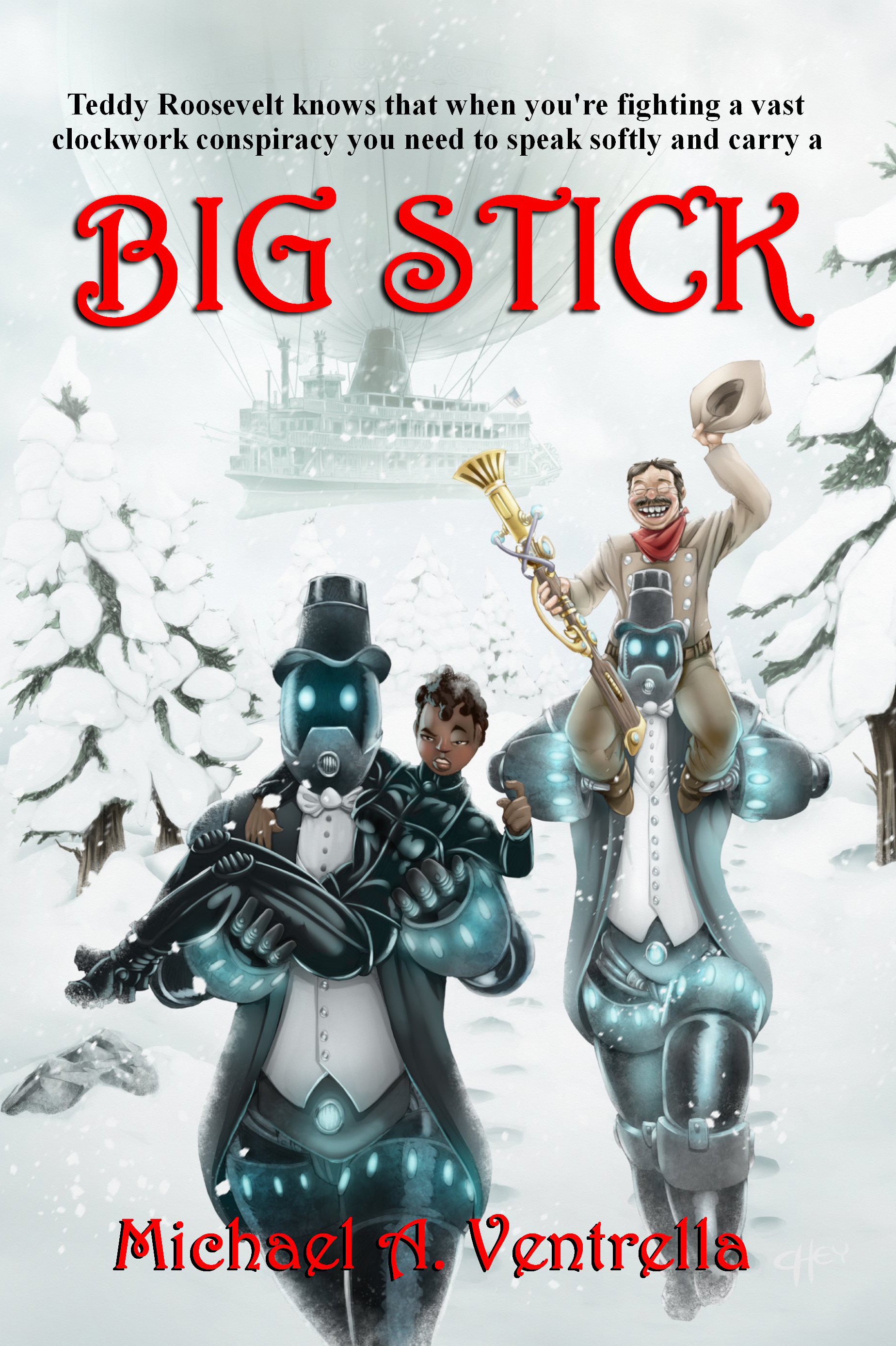
Interview with author Kathryn Craft

MICHAEL A. VENTRELLA: I am thrilled to be interviewing friend and now-successful author Kathryn Craft today! Kathryn is the author of two novels from Sourcebooks: THE ART OF FALLING, and the upcoming WHILE THE LEAVES STOOD STILL. Craft_small_photoHer work as a developmental editor at Writing-Partner.com, specializing in storytelling structure and writing craft, follows a nineteen-year career as a dance critic (Morning Call, Allentown, PA).
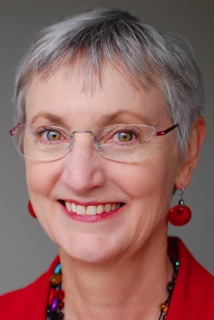
Long a leader in the southeastern Pennsylvania writing scene, she served for a decade on the board of the Greater Lehigh Valley Writers Group, and now serves on the board of the Philadelphia Writers Conference and as book club liaison for the Women’s Fiction Writers Association. She hosts lakeside writing retreats for women in northern New York State, leads Craftwriting workshops, and speaks often about writing. She is a member of the Liars Club, an author’s collective started by NY Times bestselling author Jonathan Maberry and fantasy writer Gregory Frost. She lives with her husband in Bucks County, PA.

Kathryn, let’s start by talking about your first big novel, THE ART OF FALLING, which is already in its second printing! How does that make you feel?

KATHRYN CRAFT: That was a huge surprise! My book was only six days past its publication date when I found out —- I couldn’t believe it when I saw the email from my publisher. I of course realized, from social media and trade shows and the number of reviews, that the book had truly “left home.” But who knew the extent to which it had traveled? I’m thrilled.

VENTRELLA: I recall you saying that you queried 112 agents before you found the right one. Tell us about the story, and what kept you going? (I gave up on my latest novel after about twenty-five…)

CRAFT: I kept going all the way through to publication for one reason: I was powerless to quit. THE ART OF FALLING was more than a path to publication for me. It was the source of my healing.

I turned to writing fiction after my first husband’s suicide, sixteen years ago. I had a lingering need to use my writing to form a more hopeful story from the chaos of those events.

Penelope Sparrow was my path.

I placed her in a harsh environment —- in a dance world with even harsher expectations about a woman’s body than those of our celebrity-driven society -— then watched as inner conflict about her imperfections imploded her dreams and relationships. I dismantled her support system. Gave her talent and passion and exclusive training then whittled away at her faith and resolve with years of rejection. Then I gave her a taste of success, a taste of love, then yanked both away at the same time. Finally, at that point, I thought, maybe she might be at the brink of self-harm.

But I wasn’t sure. So when Penelope wakes up at the start of the novel in a Philadelphia hospital room, and learns that she had landed on a car parked below her fourteenth story penthouse, what happened on that balcony remains a mystery that Penelope must reckon with. And when she bravely started rebuilding her life, I knew I would do whatever it took to see her story told.

VENTRELLA: What advice do you have for people trying to find an agent?

CRAFT: Here are five quick tips:

1. Pass the pitch test. If your project is hard to boil down into a succinct statement about your protagonist’s goal and the chief obstacle faced, rethink your project’s structure. Deepen the motivation and raise the stakes until the story matters — then your pitch will hook the reader.

2. Adjust your inner clock. I’ve heard many estimate that it takes ten years of consistent work to make a novelist, and a couple of years to get an agent. I started submitting early to get a feel for where I was and so learned both the art of writing and the business of pitching simultaneously. Querying is an investment in your career as worthy as writing a good book, so think of it as a process.

3. Submit in small batches. Too many authors use the ease of digital reproduction to blanket the industry with a flawed submission package, blowing opportunities they could have salvaged by tweaking all along. Send no more than 15 at a time.

4. Look for young agents at established agencies. These agents have more time and more room on their lists, yet have all the clout and resources of a reputable agency behind them.

5. Reframe “rejection.” To buoy your spirits for the long haul, mentally thank each agent who steps aside so that your true agent will one day be revealed. If an agent doesn’t know how to sell your book, you don’t want him representing it. You want him to love your work, because that passion will fuel his desire long after the money earned per time spent ratio is surpassed.

VENTRELLA: What was it like dealing with the publisher? Did it meet your expectations?

CRAFT: Sourcebooks exceeded my expectations in almost every way. What I’d heard: You’ll get no advance. (I got a decent advance.) Editorial support will be lacking. (I had two editors who loved my book.) You’ll have to fight for a decent cover. ArtOfFallingSmall(The cover blew me away, as did their retitling.) They’ll put no effort into promotion. (My publicist arranged my blog tour, arranged for giveaways, booked signings, and arranged for radio, TV, and newspaper support.) They no longer put money into marketing. (Good! Paid ads are no longer as effective as the other forms of trade marketing into which they poured their efforts.)
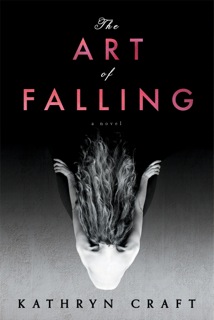
Clearly they’ve done something right, due to the great reviews and the early second printing. I’m a happy camper.

VENTRELLA: How much of the book changed between the time you submitted it to the editor and the time it was released?

CRAFT: Because I’d been working on it so long, and had developmental input from my agent, only one scene was swapped out for something different. All other changes were minor, such as ironing out how to portray one character’s accent.

VENTRELLA: What are you doing to promote the book?

A lot! No one loves this book, or wants it to succeed to its full ability, more than I do. My efforts have included:

• Thirteen years of volunteerism and relationship building in multiple writing communities

• Author website, Facebook Page, author newsletter, social media, and years of regular posts at high-visibility group blogs (The Blood-Red Pencil, Writers in the Storm).

• Facebook meme campaign.

• Two bookstore launch parties in “home” communities (I even had a flash mob!)

• A 9-hour virtual launch party on Facebook with eight other women’s fiction authors with new releases.

• One-month blog tour — both writing the guest posts my publicist arranged and interviews and posts I arranged.

• Signings in PA, MD, DE, NY, MA, and OH in places where I have friends I can stay with.

• Paid marketing through AuthorBuzz (expensive, but it took me thirteen years to get here and I don’t want to squander the chance).

VENTRELLA: What kind of responses are you getting from readers?

CRAFT: The response has been beyond my wildest expectations. I love living in the era of Goodreads and book bloggers, for sure, but direct communication from readers has been so much fun! My absolute favorite so far was from a man (not my target market!) named Douglas in Michigan:

“I stumbled onto THE ART OF FALLING while perusing the ‘New Books’ section of my local library. It was among the stack of books that I got out that day and it sat in my apartment untouched for a week. I didn’t open the cover until I was looking for something to release me from my insomnia last night. It did not have the intended effect. What I found was a beautifully written narrative about a world I know nothing about — modern dance — and something I have personal experience with — expressing those feelings we hold so close to ourselves. In the last day, I haven’t been able to put it down. It’s not often that this happens, that a book is so truthful and engaging that you beg for it never to be over, but when it does happen, you want to shout it from the rooftops.”

VENTRELLA: You also help run writers’ conferences (and once more, thank you for helping me with the Pocono Writer’s Conference we did last October!). How important do you think it is for authors to attend these?

CRAFT: I’d think it would be difficult to get a fully rounded education in publishing without them. And it’s a great way to get a concentrated hit of craft classes, as well, if you don’t have regular access to them. But pitching to agents in person — only available through conferences — has been priceless to me. Gauging their excitement, seeing that they are book lovers just like me, receiving their feedback (you almost always get a request to submit, and almost always receive personalized feedback) really helped usher me along. I also enjoy interpersonal interaction with authors and other writers — I met my critique partner in 2005 at The Write Stuff, and she had traveled there from Ithaca, NY!

VENTRELLA: What is your writing process? Do you outline heavily or just jump right in, for instance?

CRAFT: This novel was a NaNoWriMo mess that took six years to sort out and another two to develop fully. At this point I’m not a believer in directionless fast drafting. I like to write about the story first, exploring how best to bring its structure to life, then write. What I end up with is more like an extended synopsis (my last was a hundred pages) than an outline. Results show that the few months I invested in that step will save me years in the editing phase.

VENTRELLA: What’s your opinion on self-publishing?

CRAFT: I think it’s a viable option for certain well-developed works that have built-in markets and authors who know how to reach them. For my kind of “literary book club fiction” this was never a consideration. I needed broad distribution that would allow my audience to self-select. Since these are the types of books I love, I don’t tend to read self-published work.

VENTRELLA: What’s the worst piece of writing advice you ever got?

CRAFT: “Story is conflict.” That is a partial truth that allows authors to fall into a junk pit where they can get sidetracked climbing over obstacles as diverse as explosive as nuclear rockets and as incongruous as the kitchen sink. “Each story is about a certain kind of conflict” — now that’s much better.

VENTRELLA: What’s the best piece of writing advice you ever got?

It’s from Virginia Woolf: “Each sentence must have, at its heart, a little spark of fire, and this, whatever the risk, the novelist must pluck with his own hands from the blaze.” Two things strike me: that she said “each sentence,” and that the best writing takes risks that might get uncomfortable.

VENTRELLA: What advice would you give to a starting writer?

CRAFT: If you want to get published you need a public, so seek out and pay attention to the feedback that will allow you to evolve as a writer. Surround yourself with wickedly smart people who are farther down the road than you are, never forgetting to turn around and give a hand to those following behind. In doing so you will have mentors, readers, and a good life.

VENTRELLA: What projects are you working on now? What can we expect next from you?

CRAFT: My next novel, WHILE THE LEAVES STOOD STILL, is due out from Sourcebooks in Spring 2015. Based on true events that resulted in my husband’s suicide 16 years ago, it is the story of a tense ten-hour standoff between one desperate man ready to take his life and the police, while the three women who loved him most, and the larger community, grapple with how best to respond.

I’d better get back to work on it — it’s due June 1! Thanks for having me, Michael!
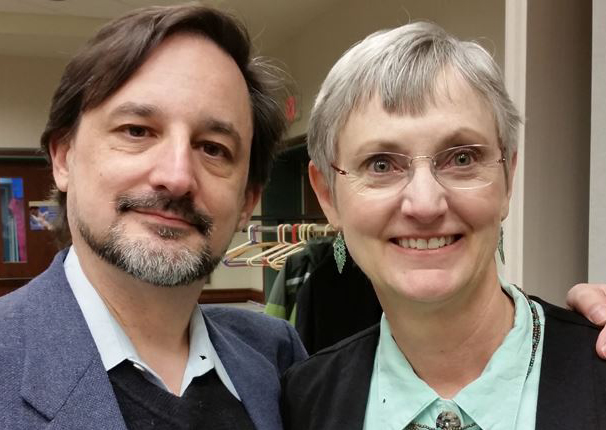
workshop

Interview with author and editor Bernie Mojzes

MICHAEL A. VENTRELLA: Bernie Mojzes is a writer and editor, responsible for a variety of stories ranging from fantasy and science fiction to horror to erotica, and even some non-genre work. He’s a friend who I see regularly at conventions, and has contributed some amazing and captivating stories my own TALES OF FORTANNIS series. bernie-spikeIn his copious spare time, he edits Unlikely Story.

Bernie, How did you first become interested in writing?

BERNIE MOJZES: I read voraciously as a kid, from day one of “Dick and Jane” when I finished the book while the other kids were trying to figure out page 3 (and was then told by the teacher that I was never to read faster than the other kids again. I wish I could have been there when my dad discussed that with the teacher.). But seriously, I loved reading, loved falling into those new and interesting worlds, and for as long as I’ve been reading, I’ve wanted to be one of those people who can create that sense of wonder in others.

VENTRELLA: How much of writing is innate? In other words, do you believe there are just some people who are born storytellers but simply need to learn technique? Or can anyone become a good writer?

MOJZES: Ah, the nature/nurture question. There’s a massive difference between being a writer (being able to use written language to clearly and convincingly convey an idea) and being a storyteller (being able to create an interesting narrative that captivates an audience), and in the intersection of those two things is that creature that most people call “a writer.” Within that intersection, there are three major things that are necessary:

* a willingness to learn the craft (everything from basic grammar to how to incorporate beats and cadance into your prose)
* cultivation of the imagination
* observation and transformation of the world around you
* an openness to hearing critique

Yeah, I know. That’s four things. I can count. I swear.

Different people’s brains work in different ways. How we observe, how we perceive and what interpretations we make of those perceptions, and how we process and integrate and assimilate that information. And that’s not all, but it’s also how we connect the dots between that, what we’ve learned in the past, and what we will learn in the future, and then how we use all that to construct new worlds and new characters and new stories. Some people will weave intricate multilayered tapestries while others write linear, full-throttle with guns a-blazin’ adventures. What’s the right approach? There is none; there’s only the approach that works best for that particular writer.

If you can figure out the way your brain works best, and then train to minimize your weaknesses, and do the hard work of the three (4) things I listed above, I think most people can become good writers. But there are no shortcuts. It’s hard work – harder than most folks realize – and in the end, a lot of aspiring writers falter because they aren’t willing to do the work.

VENTRELLA: Tell us about your latest work!

MOJZES: Last October I had a story in the debut issue of Betwixt Magazine called “The Red Danube,” available here. EvilGazebo_lgThis is the most difficult and unflinching piece I’ve had published, and I’m very proud of it. Technique-wise, it was a challange and a blast to write. I wanted to do two things simultaneously: pull the reader close into the the most intimate thoughts and actions of the characters while simultaneously pushing the reader away, holding the reader at a distance. Since one of my weaknesses is talking about my own work, its probably better to point you at a review of it up at ChiZine, which starts:

No end-of-year round up would be complete without mentioning Bernie Mojzes’s “The Red Danube” (Betwixt Issue 1, Fall 2013). This story is something else.

Charlotte Ashley reads deeply, and writes insightful reviews; she’s worth following closely.

VENTRELLA: How did you decide upon the theme for your magazine? I mean, really, bugs?

MOJZES: Hm. Yes, bugs. The magazine started its life as The Journal of Unlikely Entomology, a biannual online magazine dedicated to stories involving bugs. How we came up with that is a long and sordid tale that involves, well … it’s long and sordid, and since this is a PG13 blog, let’s just leave it at that. Ultimately, we decided that we wanted to see what we could do with a really unusual and specific theme. There was the danger, of course, that everyone would look at it and think, eww, bugs, I’ll send my horror story about spiders. Fortunately, the writing community came through for us, sending us, yes, some horror stories, but also stories about love and loss, death and transformation. About race relations and science and society and historical revisionism. Interestingly, by focusing in on such a seemingly narrow, weird theme, we’ve been able to put together issues of astounding diversity.

VENTRELLA: How has it been received?

MOJZES: Really well, surprisingly. When we first opened up for submissions, we were terrified of the grand experiment being a flop, but from Issue 1 on, we’ve had good to excellent reviews. We’ve had stories by some of the more interesting authors on the scene today. Stories that have appeared in our pages have gone on to make honorable mention lists and appear in Best of Year anthologies.

VENTRELLA: You’re expanding, though. Tell us about your new endeavor.

MOJZES: Expanding? Diversifying is probably a better word. In 2013 we decided that we’d offer new and interesting (for us, and hopefully for others) games to play. With this decision, we realized that The Journal of Unlikely Entomology was no longer properly descriptive, so we’ve gone with “Unlikely Story.” Under the Unlikely Story umbrella, we’ll continue to put out one issue of Unlikely Entomology, and also one issue of The Journal of Unlikely Cryptography (stories involving cryptography, ciphers, hacking, etc.), and one other issue. The first of those was The Journal of Unlikely Architecture (stories about buildings); the second will be The Journal of Unlikely Cartography (stories involving maps). Cryptography will be coming out in February, and we’re currently accepting submissions for the next Entomology issue.

VENTRELLA: You’ve co-written stories (for example, in the TALES OF FORTANNIS: A BARD IN THE HAND anthology, ahem) … how did you go about doing that? bardinhand-510 What was the process?

MOJZES: Co-writing a story is an interesting process. I wrote “Embarassing Relations” with Bob Norwicke, a friend of mine from an old D&D campaign. He’s since moved to a different state, and we’d lost touch, but he had this brilliantly twisted character in the game that I wanted to use as a foil for my protagonist. I found Bob online and asked if he’d mind me stealing his character. That’s how I found out that Bob’s also a writer, and we decided to give co-authoring a try. I sent him a rough one paragraph concept for the story, he liked it, so I wrote an opening scene, written from my protagonist’s POV. Sent it to Bob, who wrote the next scene from his protagonist’s POV. From there we alternated. Some of what we did was writing toward the conclusion, writing to move the plot along. But some of what we did was writing a scene that intentionally put the other’s protagonist into a bind. This was the challenge — write your way out of the bind while still moving the plot along. That created some really interesting and unexpected twists that, I think, led us to bring the story to places we might not have otherwise discovered.

We did establish some ground rules. First was that I had veto power (because it was my story idea), and would eventually do an editing pass to make the story stylistically cohesive. Second, either of us could say “my character wouldn’t do that,” and offer rewrite suggestions. Third, both of us were free to re-write any dialog that the other author put in our character’s mouth.

Other than that, we created a vague outline early on (which included the phrase “hijinx ensue” multiple times) – left intentionally vague in order for us to both have the freedom to play within the plot and let the plot evolve.

VENTRELLA: How do you make your protagonist a believable character? And what’s the best way to make the antagonist a believable character?

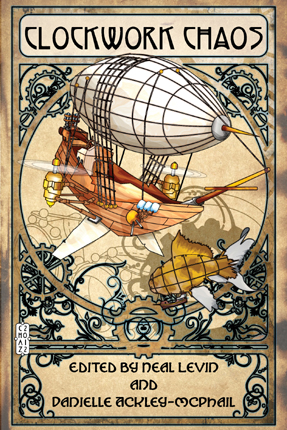
MOJZES: Okay, first thing is, these two are secretly the same question, and I’d expand that out to include the secondary and tertiary characters that appear in your work.ClockworkChaos_lg All of these characters have, to the degree allowable by the point of view from which the story is told and the amount of time they have on the page, be as fully developed and “real” as possible.

First thing to remember is that every character is the protagonist of their own story. So whenever anyone does anything, it has to make sense for that individual to be doing that. Sometimes you find yourself writing a scene where the needy, self-absorbed and completely narcissistic friend of a friend suddenly does something immensely selfless in order to move a plot point along, you’ve got to take a step back and rethink. Maybe you need to rethink the character. Maybe you have to rethink how you get through that plot point.

But most importantly, remember that nobody is perfect. If you have a character that always does the right thing (or that always does the wrong thing, in the case of the villain), you end up with a caricature, not a character. Good people have flaws and failings. Bad people have good in them. That’s what it means to be human. You have to show that humanity in your characters.

VENTRELLA: Do you think readers want to read about “believable” characters or do they really want characters that are “larger than life” in some way?

MOJZES: A character can be larger than life but still be believable. That’s the trick, isn’t it? Finding a character that’s big enough to be interesting but human enough to be believable.

Writers are told to “write what you know.” What does this mean to you?

Not much. I think as advice goes, it’s easily taken to mean that you should know your proper place and not dare step beyond it. All that leads to is solipsism. I think reversing it – know what you write – is more interesting. By which I mean, research deeply and respectfully, and with an open mind. Don’t be superficial, and don’t look to media representations of something for reality. Think three-dimensionally, and consider the wider context.

VENTRELLA: What do you do to avoid “info dumps”?

MOJZES: Whenever possible, I try to break the info dumps into smaller pieces and incorporate that into dialogue or action. fantasic_erotica_cover_comp_400x600Sometimes you’re stuck with an expository lump, though – information that you just need to get across to the reader, and can’t for whatever reason (word count limits, for example) deal with it more elegantly.

So, lets say there’s a 10 sentence paragraph that fills a whole page and sits like a giant indigestable lump in the middle of your story. So first, for each piece of information, decide whether or not the reader really needs it. (You may need someone else to point these out to you). Cut the bits that aren’t needed.

Now you have a 7 sentence info dump. See if there’s any of that that can be incorporated naturally into dialogue or action.

Now you have a 5 sentence info dump paragraph. Break it into 2 paragraphs and separate them with one or more paragraphs of dialogue and/or action.

Lastly, rewrite those two paragraphs so that the info that is dumped is done strongly through your POV character’s perspective. So, not just [fact], but [fact as your character perceives it]. By doing this, you’re taking what is largely an uninteresting declarative statement of fact and making it do double duty as something that reveals character. And like magic, you’ve turned a giant, boring info dump into interesting, compelling prose.

VENTRELLA: As an editor, what is the biggest problem you have when dealing with authors?

MOJZES: We have blessedly not really had any major problems with authors. The biggest problem has been technological, where the author wasn’t seeing all of the edits we had sent them, either due to old software, file format incompatibilities, or whatever. And that ultimately leads to misunderstandings and aggravation on all sides. Probably the most problematic of these issues comes from authors having their software set to use .docx format by default, and we suggest that people change the default settings to use .doc or .rtf instead.

VENTRELLA: In this market, with the publishing industry changing daily, how important is the small press?

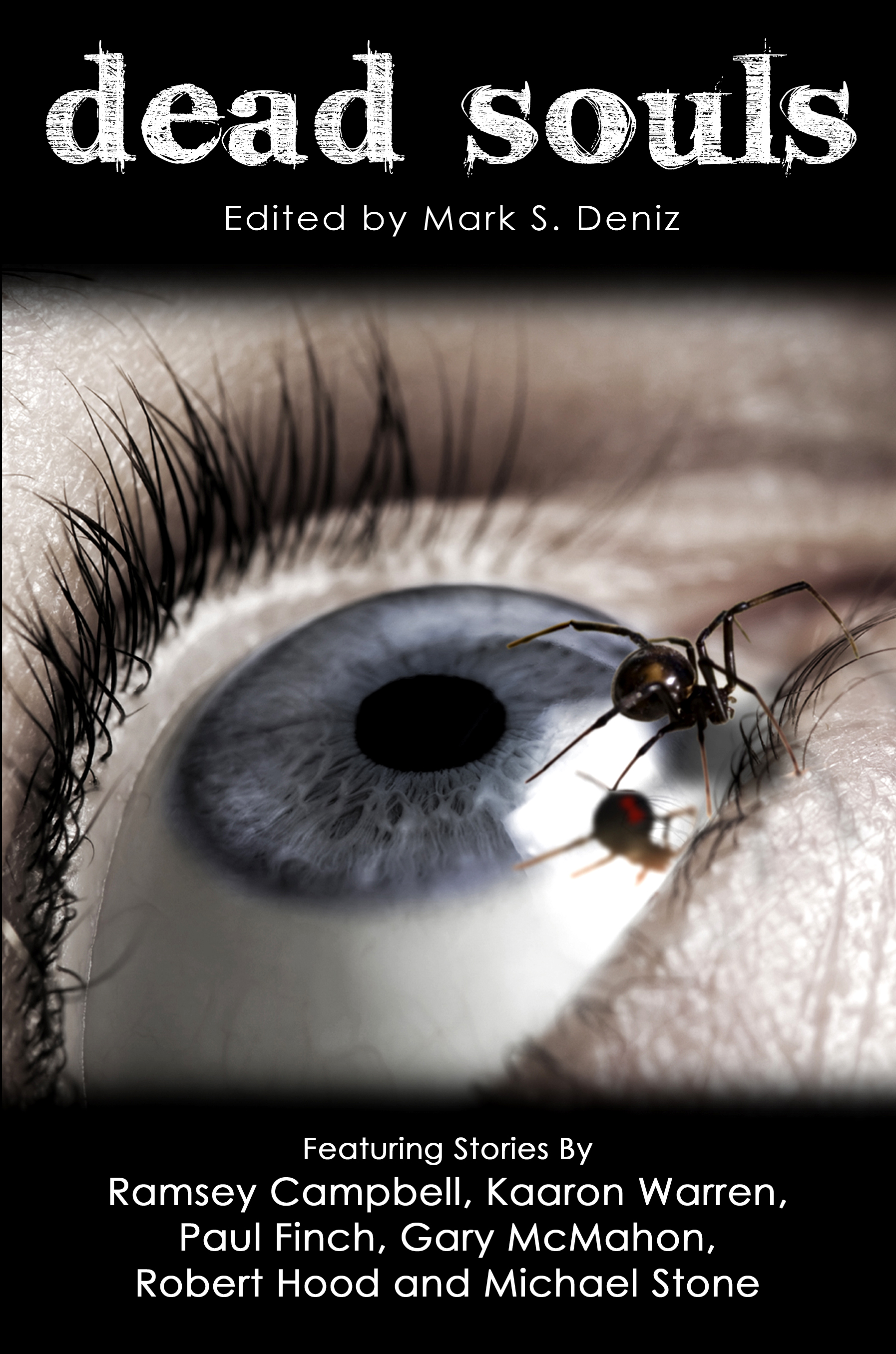
MOJZES: In an environment in with that large presses are contracting and consolidating, small press is critically important. Dead_souls_Cover_Final OnlyWell, first, we should really define some terms. There are small presses like Small Beer and Subterranean that have significant resources and ability to put books into bookstores, and micro-presses which perhaps only put out a few titles a year. I think it’s important to understand that distinction, because they really fulfill a different need in the market.

The are three technological innovations that allow small presses to be successful with books that a large press won’t touch: Print-on-Demand, The Internet, and e-books. POD and e-books allow small press to reduce or eliminate the need to order and warehouse large print runs of books that aren’t guaranteed to sell. The Internet allows people to find obscure and niche books, leading to something called “The Long Tail.” Small and micro-press can cater to niche markets and be successful selling smaller unit counts.

This creates opportunities for a wide variety of authors who simply could not be successful under a large press marketing scheme.

Interview with author Thomas Erb

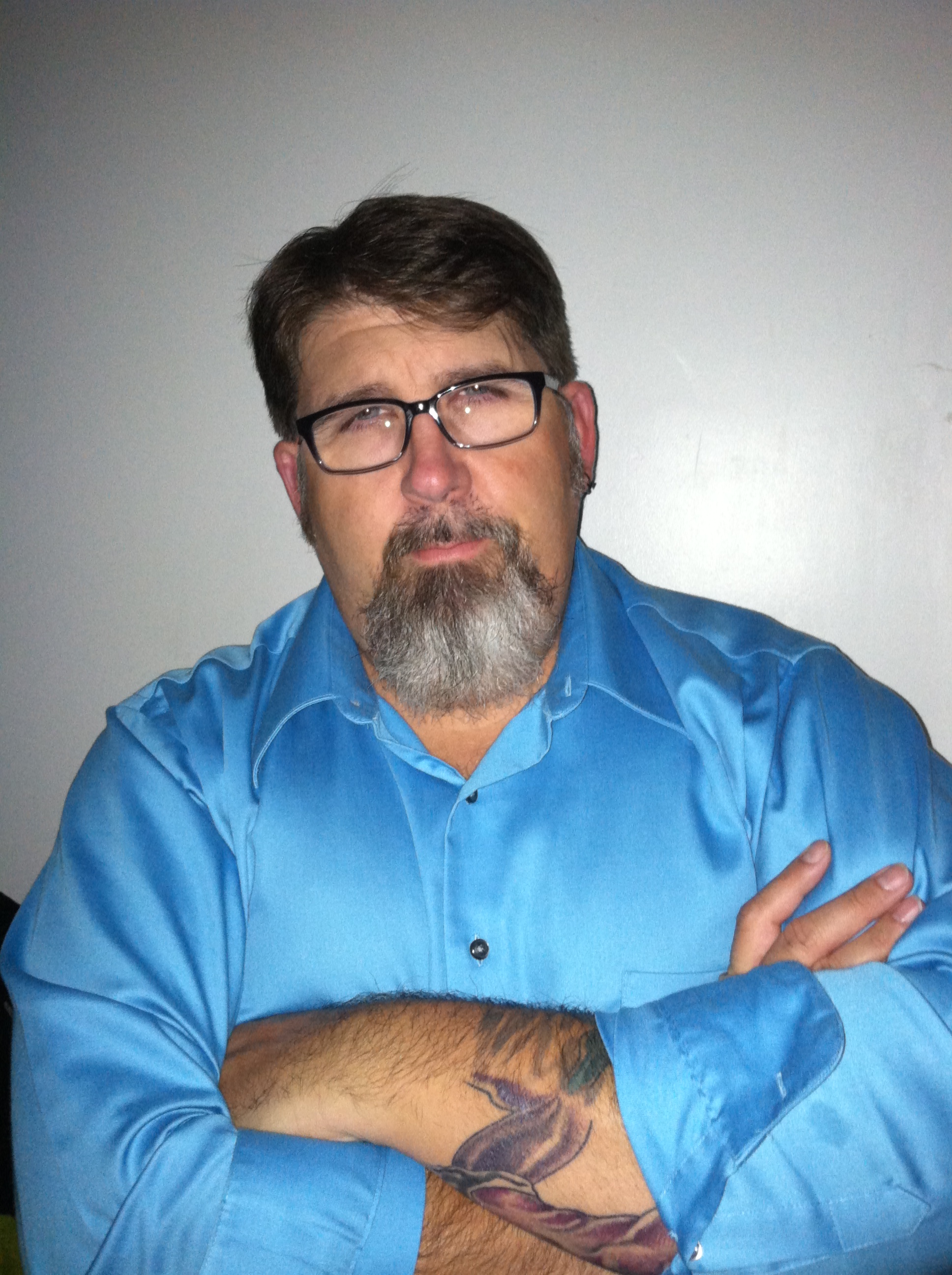
MICHAEL A. VENTRELLA: From the snowy confines of Upstate New York, from a place he calls “Hell’s 1/2 Acre,” author/artist Thomas A. Erb brings stories of the unlikely hero: from extreme brutal violence, to touching, gripping interpersonal relationships sure to catch the reader and never let them free. (He wrote that.) 2012-09-29 22.36.48

Thomas, how did you first become interested in writing?

THOMAS ERB: I’ve always been a storyteller. It started visual when I was two and used to draw elaborate battles with army men fighting the Nazis or another vile foe. It then turned to comic books. For most of my young life, all I wanted to do was work for Marvel comics. I would create my own characters and write whole story arcs to accompany all my great illustrations. (pure sarcasm intended.)

Then I got into role-playing games. Yup, that’s right … Dungeons & Dragons, Traveller, Champions, Twilight 2000, Call of Cthulu, you name it, I’ve played it. And, just like for comics, I’d have to create highly detailed character backstories and potential subplots for my DM(s). Although, I never knew if they liked that I did that or not. Oh, as a word of advice … Never piss off a Game Master. Bad idea.

Now, I’ve fallen in love with writing my very own fiction — a love that keeps on growing with each tale I tell.

VENTRELLA: I must admit, my background is similar — I went from creating worlds and stories in D&D to creating them in LARPs to writing my own stories (the characters in my books are so much easier to control than my players).

How much of writing is innate? In other words, do you believe there are just some people who are born storytellers but simply need to learn technique? Or can anyone become a good writer?

ERB: I believe we all have an innate creative talent. Each one of us has something to say and in that yes, we are all storytellers. However, much like my philosophy with the visual and musical arts, I think that innate ability has a limitation. By that I mean, while we all can create, there is a certain level where some folks top off their talent. Some folks are just “born” to be X. Poe/Hemingway/Toklien/King were surely born to the written word. Michaelangelo, Da Vinci, Picasso, Rembrandt were put on this earth to give us visual masterpieces. Krupa, Rich, Peart were born to make playing the drums into a sonic art form. Same goes for the rest of us.

Quick life anecdote: While I was born to draw, I never tried hard. It’s always come easy to me. I had friends that would bust their humps and draw for hours and hours and no matter what, they couldn’t draw the same level as I did. (Now, I am saying this with no ego at all. Just an observation.) The same holds true for drumming. I’ve been playing drums since I was 16 and really love jamming. Sure, I’ve been in many bands and jammed with some amazingly talented musicians but I’ve plateaued my drumming talent. I know I will never be a Neil Peart. I wasn’t “born” with that level of ability. Even if I took more lessons and practiced for ten hours a day. It’s just a reality.

So … very long answer I know, but yes, writing talent is human nature but the level of craftsmanship,language, once in a generation storytelling ability does have a cut off. Not everyone can be Stephen King, Tolkien or James Joyce.

VENTRELLA: Tell us about TONES OF HOME!

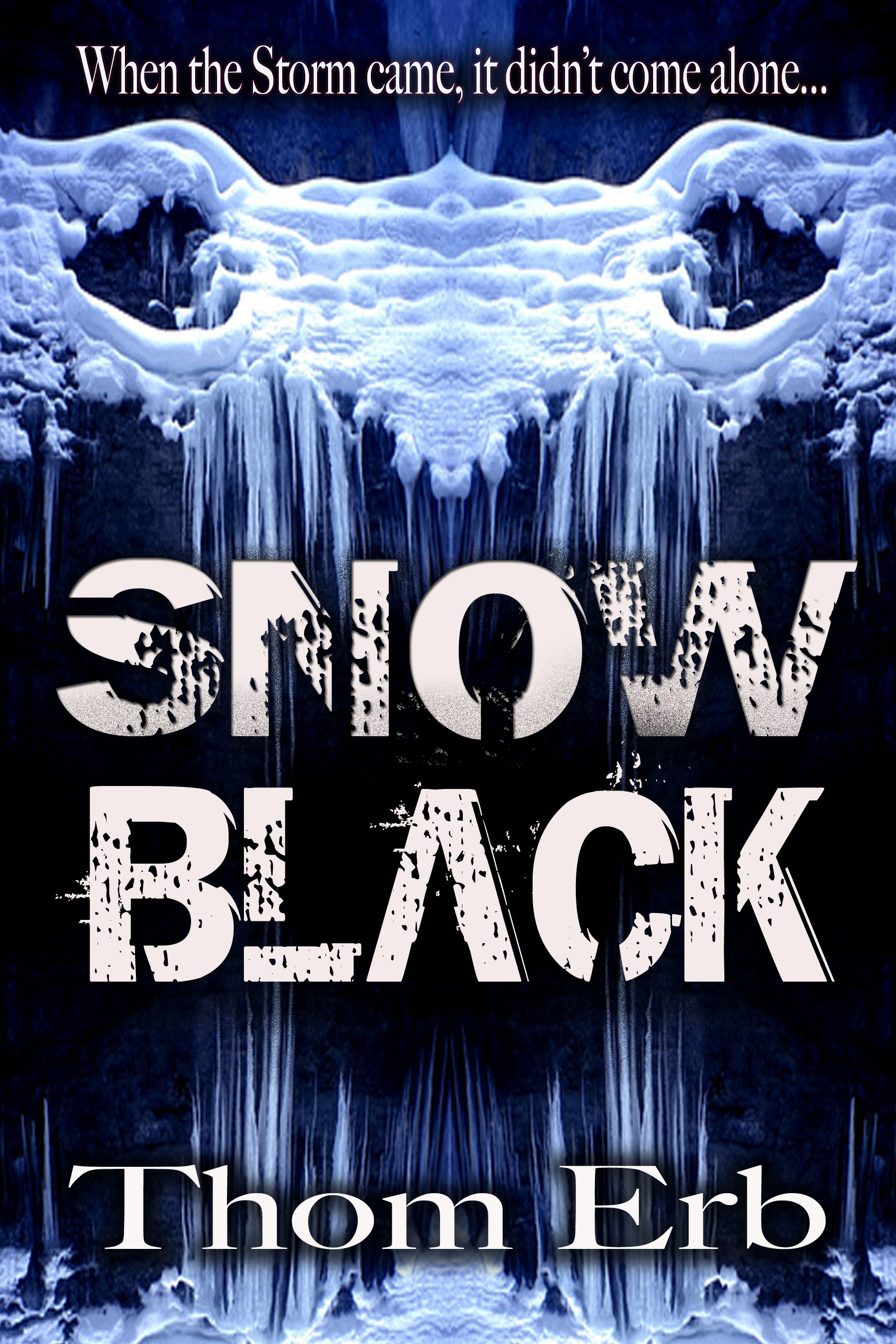
ERB: My very first novella, TONES OF HOME, was released in June of last year and it’s the most brutal, violent story I’ve ever written. If you dig graphic scenes with tons of blood, machetes and shotguns, rednecks and oh yeah, the Beatles … then this story is right up your jukebox.TONES official Cover

I am currently working on my first novel. (well, the one that I actually want folks to read.) It’s a deep story of loss, troubled relationships, a Nor’easter and a black monster coming to a small lakeside town, seeking revenge. I’m really loving this project and hope to have it in the hands of an agent by Thanksgiving.

VENTRELLA: What should someone read first if they want to get to know your work?

ERB: That’s a really tough one. I feel like I am just now, seeing my true “voice” come to fruition. While I loved writing all the great bloodletting in TONES OF HOME, I don’t think I am a Richard Laymon kind of writer. But, it’s the best work I’ve done thus far. So, Yeah, I’d say check out TONES OF HOME or “Spencer Weaver gets Rebooted.” It’s in a new anthology called FRESH FEAR.

VENTRELLA: How do you make your protagonist a believable character?

ERB: All of my stories seem to be based around an extremely flawed character. Or, as I like to refer to them, the unlikely hero. Usually they have something about them, whether it be a physical or mental determent. I have a weakness for the “loser”. The outcast, the outsider. A fat or skinny kid with asthma. I just identify with that and my thinking is, “hey, if I can feel for this guy/gal, then the readers should as well.” It’s not about having the Chisel-chinned, barrel-chested hero, saving the day. No … that’s the easy way out. It’s more of a challenge to break away from that trope and find a way for this less-than-heroic protagonist to overcome all the huge hurdles that makes up a great compelling story.

All characters must have flaws. Both protagonists and antagonists. (even Darth Vader has a soft side.)

VENTRELLA: Certainly agree with that (as you can tell if you read about the reluctant “hero” of my fantasy books.)

ERB: There are so many basic story ideas out there in the ether and to me, it’s more of how you get there as opposed to reworking old ground. Either way, readers want to escape and I hope I offer a wide mix of rich characters and tales they can sink their hungry teeth into.

VENTRELLA: What is your writing process? Do you outline heavily or just jump right in, for instance?

ERB: When I first started writing, I just sat down, opened a cold beer and let the muse of chaos take the wheel. That’s how I wrote my first novel. (a zombie tale that might see the light of day … someday.) But, when I went back to write a second draft, I was overwhelmed. Too many characters. Too many plots and subplots.

So, now, I am working on a happy medium kind of approach. I need to have some kind outline. It’s always loose and organic. Nothing is written in concrete. That would feel too much like a term paper and not an adventure.

I write the basic novel idea is. Usually the characters come to me almost immediately. I then write a very loose outline and then, write the first draft. Get it all down, fast and dirty. Never looking back.

Side note: Dry erase boards and sticky notes are a writer’s best friend.

VENTRELLA: Writers are told to “write what you know.” What does this mean to you?

ERB: This is lame, but I’m going to steal from the master. Stephen King states in his must-read ON WRITING book that we should take that statement as much extensively and inclusively as possible.

While I may not know anything about being a Gunny Sargent in the Royal Space Marines guarding the Princess Allayha, I do know what it’s like to always try to live with the demon of my father being a cruel man whom I could never please. You can use that kind of thing in your fiction.

VENTRELLA: How did you get started? What was your first story or book published?

After on a whim, I spent a year writing a zombie novel, I decided that I really enjoyed this writing thing and I started meeting other writers online. Back then, it was Myspace and through a few message boards. I discovered Brian Keene, (who’s book GHOUL made me want to write seriously) and found out he was attending a con in Ohio. I went and met him and some other folks that changed my life forever.

I began writing short stories and then submitted my short story, “Cutting Class” to the DARK THINGS II anthology edited by Ty Schwamberger (whom I met at the con) and next thing I knew, Bazzinga! I was a published author. mock cover

VENTRELLA: Do you think it is important to start by trying to sell short stories or should a beginning author jump right in with a novel?

ERB: I think each person tackles their writing in their own way. I jumped straight into the novel but I was only doing it for fun. It wasn’t until later that I wanted to do something with this whole writer gig.

With some hindsight, I’d suggest write some short stories first. With shorter works, you really learn how to write tight, lean prose. Plus, it’s far easier (and I use that term loosely) to get published.

VENTRELLA: Do you think short stories are harder to write than novels?

ERB: I think both have their own angels and demons. It also depends on what kind of storyteller you are. If you like deep character development and more than two intricate plots…a novel is best for you. If you really dig fast-paced, gripping tales with a small cast… short stories are for you.
I love writing both. I usually like to write a short story in between other long works. It’s a nice change of pace.

VENTRELLA: How do you promote your work?

ERB: Platform. Publishers are looking to see if you have an effective and active writer’s platform. And to me, that means an engaging, fresh online presence. A blog, Facebook, Twitter, Pintrest, Goodreads account. And many, many more. Too many, in my opinion. It can be a distraction, trying to keep up with updating all your social media sites. (A necessary evil, but still evil.)

I do giveaways, I’ve done podcast interviews, blog talk radio interviews. I go to conventions when the money is right and try to post something funny, new and interesting on the social sites as much as I can manage.

I’m always looking for new ways to get my work out there. It’s an ongoing process.

13. Do you attend conventions or writing conferences? Do you find these to be a useful activity?

I attend as many as time and finances allow. Conventions are one of the biggest reasons I’m here today. I’ve made many, life-long friendships as well as business connections. It’s a must to get you and your words out there. We writers live and create in a room, all alone. You need to get out and meet other like-minded folks who know what you’ve been going through.

Plus, I’ve gotten the blurbs for my books and stories because of the conventions and conferences. Writing and life in general is about relationships.

Get you and your stories out there.

VENTRELLA: What’s your opinion on self-publishing?

ERB: When I first started writing back in 2007, self-publishing was the devil’s work. It was much maligned- rightfully so and very much a joke. But now, in 2014, you are a fool if you don’d consider exploring the self-publishing market. Things are fluid and ever-changing in the publishing world and the once hated and mocked world of self-publishing is now becoming common place.
The secret is to put out work that kicks the crap out of any book that comes out of the big 6, 5, 4, 3, 2, 1 …

VENTRELLA: What’s the best piece of writing advice you ever got?fresh-fear3

ERB: Get the first draft down, fast and dirty. Don’t stop to worry if it’s good. That’s what second and third drafts are for.

VENTRELLA: What advice would you give to a starting writer that you wish someone had given to you?

ERB: Research the publisher before you sign a contract. Know the business side of things. Royalty rates/payments/editing, etc.

VENTRELLA: Who do you like to read? Who are your favorite authors?

ERB: Anything from Jonathan Maberry. They guy is a monster and tackles all the genres I love. YA zombies, military thrillers, comic books, you name it. He is my mentor and I use him as my career guidepost.

VENTRELLA: And I couldn’t help but notice he named a character after you in his latest novel…

ERB: Jon was so kind to have his signature cop-turned Department of Military Sciences bad ass Joe Ledger clean my clock in his last Ledger novel, EXTINCTION MACHINE. I think my jaw still pops when I talk.

VENTRELLA: What can we expect next from you?

ERB: I have a retro-zombie novella that is looking for a new home. And I am currently writing a wintry monster novel that I hope to have completed and in the hands of agent by the end of the year.

I am also working on a comic script, a screenplay and a self-publishing project of my short works I hope to have out early in 2015.

I love having a lot on my plate. Not just saying that as a fat guy. I have many stories and projects inside me and time is of the essence.

Write a story without bad guys

There’s my advice for today.  Write a story without bad guys.

Oh, I don’t mean leave out the antagonist.  01-snidely-whiplashMake that antagonist put all sorts of obstacles in your protagonist’s way.

But don’t make “bad guys” in the way we see much too often (especially in the movies).

Writers can get lazy when it comes to their antagonists.  It’s so easy to just say “He’s the evil bad guy” and never have to explain why he acts that way.  “Well, he’s evil, so that’s why” is false and readers know it. It doesn’t make your story full.

A good exercise is to take a scene and rewrite it from your antagonist’s point of view. Why is he or she acting this way? What is the ultimate goal? Surely the antagonist wants something more than being evil and standing in the hero’s way.

Remember: the antagonist is the hero of his own story.

My favorite bad guys have what they believe to be good motives. It’s why I think Dolores Umbridge is a better “bad guy” than Voldemort. She’s not evil — she is trying to bring order, consistency, and a respect for the law to the wild children at Hogwarts. We believe that she could exist because we know people like her. And we love to hate her for it.

My next novel BLOODSUCKERS (due out in May; film rights available) has a few important antagonists. The main one is Norman Mark, the vampire who is running for President. He lives a very long time, and he has a long term goal which is very good. He believes that his power to control others will enable him to pass laws through Congress that will help all Americans, discover and remove corruption, and move the world into a new renaissance of peace and prosperity. And if a few innocent people have to die along the way, so what? He’s doing this for the good of all humanity.

There are other antagonists who are vampires wanting to keep the secret of vampires from the population. They are not evil either (in their minds) and are afraid that if people realize vampires exist, they will begin hunting them. People will suspect each other of being vampires, wars will break out and economies will fall. These vampires are trying to stop Norman Mark for their own reasons, but they are not the protagonists.

The protagonist is Steven Edwards, a reporter who has been framed for the attempted assassination of Mark and has gone into hiding. In order to prove his innocence, he has to prove that vampires exist. He was a Mark supporter and is conflicted with the problem — he knows Mark will be a better President than his opponent, but dammit, he’s a vampire!

Anyway, you can see what I’ve tried to do here. None of my bad guys think they’re bad guys. They don’t just randomly perform evil acts simply because they can. They only do them when necessary, and even then for a future goal that is good in their minds.

Remember: not counting the insane, no one in the real world thinks of themselves as bad guys.

So take some time and write a little short story from the point of view of your “bad guy”. You may discover parts of his or her personality that were hidden before. And if you’re good, you will make your antagonist a full, complete, and believable character.

Interview with NY Times Bestseller Steven Brust

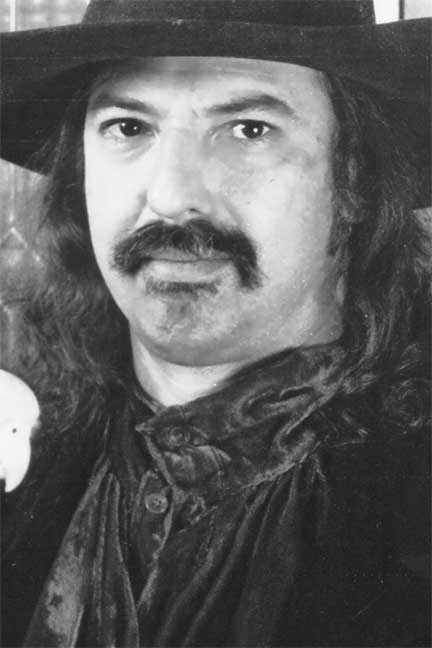
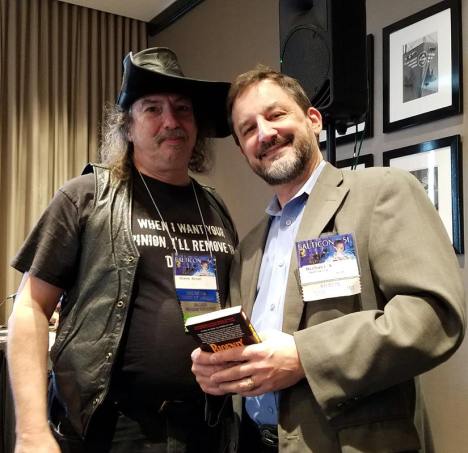
MICHAEL A. VENTRELLA: I am pleased to be interviewing Steven Brust today. BrustSteven is best known for his novels about the assassin Vlad Taltos, and has written many short stories in shared universes (including Emma Bull’s and Will Shetterly’s “Liavek,” Robert Asprin’s “Thieves’ World,” Neil Gaiman’s “Sandman” and Terri Windling’s “Borderland” series.

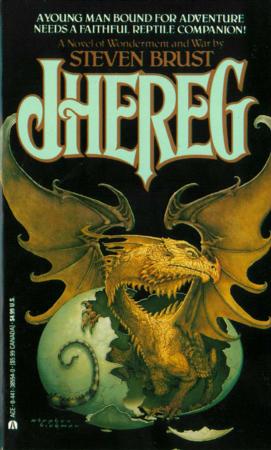
I read JHEREG back when it was released, and enjoyed it tremendously. Did you ever have in mind writing a series, or did that happen on its own?

STEVEN BRUST: Yeah, here’s what happened. I wrote that one as a stand-alone, peppering it with foreshadowing and flashbacks because I like that stuff. Then I wrote TO REIGN IN HELL, which was a very hard book for me to write. When it was finally done, I was thinking that I just wanted to relax and write something fun and easy, and it seemed obvious that I could just go back to Vlad, because I knew so much of his backstory from having played him in a table-top role-playing game. So I did, and just sort of dashed off a book called “Duel.” But when the marketing department at Ace got it, they said, roughly, “But his first book did really well, and it had a funny one-word title. Can’t he find another funny one-world title?” Well, YENDI was pretty obvious, so I renamed it.

Then, after writing BROKEDOWN PALACE, various things hit me about fantasy tropes, and I wanted to examine them. It seemed like Vlad’s world would be the perfect place to do that, and TECKLA was the perfect title for the book. By then I was writing a series, and I knew the major events of Vlad’s life, but I don’t remember if I admitted to myself that it was a series until I did TALTOS. I’m pretty good at lying to myself.

VENTRELLA: You plan on ending the series with a 19th book. jhereg Was this the original plan, or have you decided that the time is right?

BRUST: That was the plan from at least the time I finished TALTOS, and maybe earlier; I don’t remember for sure.

VENTRELLA: Were the books based on a role-playing game? It has that feel with resurrections, especially, which is something you normally don’t see in most fantasy novels.

BRUST: Yes, a game created by Robert Sloan. Such things as the relationship between Kiera and Sethra, and between Aliera and Morrolan, and between Vlad and Kragar (to pick just a few examples) go back to the game.

VENTRELLA: You have specifically tried to vary your writing styles and points of view in the novels, which give them different feels – why did you decide to do this?

BRUST: Discovering the relationship between the story and how the story is told is one of the joys of writing. I just flat out love playing with that stuff; I get excited as hell when I realize that the best way to tell a given story would be something I haven’t tried yet.

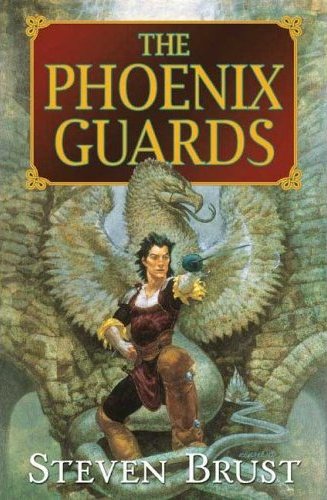
VENTRELLA: THE PHOENIX GUARDS especially reads like a lost Musketeer novel. I assume that was by specific design? Did you go back and change things to make it read more like Dumas?

BRUST: Go back and change things? Oh, no; that was there from the beginning, from the first page of the first draft. That was the whole reason I wrote it. It was so much fun!

VENTRELLA: You certainly have not shied away from politics, both in your books and on Facbook and other social media. Do you believe this has affected your sales (in either direction)?

BRUST: No idea.

VENTRELLA: What’s your opinion on the current state of the political situation in America? 9780765328892 Optimistic or not?

BRUST: Very optimistic–in the world, you can see signs of people fighting back everywhere you look. In this country, it is taking longer, but even here you can see it. The initial success of Occupy Wall Street is as much of an indication of people’s outrage as it’s ultimate failure is of it’s lack of program; and the overwhelming public support of Snowden is a very healthy sign.

VENTRELLA: Do you think there is a place for a third party in America?

BRUST: I don’t know. I’d like to start with a second party and see what happens after that.

VENTRELLA: Back to books: Amazon is reporting that e-books are now outselling traditional publications. What effect will this have on the publishing industry? For beginning authors is this a good thing or a bad thing?

BRUST: No clue. I know nothing about the industry, and I work very hard to keep it that way; it just interferes with my work.

VENTRELLA: Your “Cool stuff” theory of literature explains a lot, actually, and boils down what many “how to write” articles fail to address. Or is the advice basically “Write what you like”?

BRUST: Write what you like to read. Write something you wish someone else had written because you want to read it. The Cool Stuff Theory of Literature was an offshoot of something Gene Wolfe originally said.

VENTRELLA: Is writing a skill that can be learned or are the best writers born, not made?

BRUST: I firmly believe it is a skill that can be learned.pglg

VENTRELLA: Who do you like to read?

BRUST: These days, I’m mostly reading non-fiction, especially history.

VENTRELLA: New authors can make huge mistakes. What big mistake bugs you the most, and how can writers avoid making it?

BRUST: Mostly they over-explain. Write for people as smart as you are. If you’d figure it out, and if you’d enjoy the process of figuring it out, chances are the reader will too.

VENTRELLA: Do you attend science fiction conventions? If so, do you find these useful?

BRUST: Yes, I do. I don’t know if they’re useful, but they sure are fun.

VENTRELLA: What are you working on now?

BRUST: A sequel to THE INCREMENTALISTS with Skyler White.

brust

Breaking the rules

I had a conversation with one of the contributors to the TALES OF FORTANNIS anthologies I edit that went something like this (adjusted for humor):

Me: You need to cut out the first six pages and start the story here.Broken Rules Falls to Chaos Anarchy Pieces

Writer: Why?

Me: Because you need to grab readers earlier. All this other stuff is background that isn’t important to the story.

Writer: But I want it to establish character. Who says I have to start off with action?

Me: That’s what every writer’s seminar will advise you to do.

Writer: Well, you don’t have to listen to the Man! Break the rules once in a while! Who are you to say we should do what they say?

Me: I’m the editor. And if you don’t do it, I won’t buy your story.

Writer: Ah, OK. Why didn’t you say that before? (grumble grumble)

All over this blog and elsewhere, authors will be giving you advice. Don’t use prologues. Introduce information gradually instead of in an “info dump.” Show, don’t tell.

There are “rules” for writing that are very common. Go ahead, google “rules for writing” and see how many pop up. The most famous (and best, in my opinion) come from Elmore Leonard:

1. Never open a book with weather.
2. Avoid prologues.
3. Never use a verb other than “said” to carry dialogue.
4. Never use an adverb to modify the verb “said” . . .he admonished gravely.
5. Keep your exclamation points under control. You are allowed no more than two or three per 100,000 words of prose.
6. Never use the words “suddenly” or “all hell broke loose.”
7. Use regional dialect, patois, sparingly.
8. Avoid detailed descriptions of characters.
9. Don’t go into great detail describing places and things.
10. Try to leave out the part that readers tend to skip.

But writers don’t like to be trapped. We like to be creative. We like to break the rules!

Well, don’t. Unless you can.

There are wonderful examples of writers who break the rules all the time, because they know how. They have the experience (and perhaps talent) the rest of us don’t have.

Follow the rules as much as you can when you’re getting started. People are advising you to follow them for a reason. They’re not just being mean and stifling your creative genius. You do want people to read your work, don’t you?

Jazz musicians break the rules all the time. They play notes that don’t belong in that key, change time signatures to contradict what the other musicians are playing, and just go with the feel. And they’ve spent years learning the rules to know when and how to break them.

Inexperienced newbies doing those things just make noise.

Interview with author Sara M. Harvey

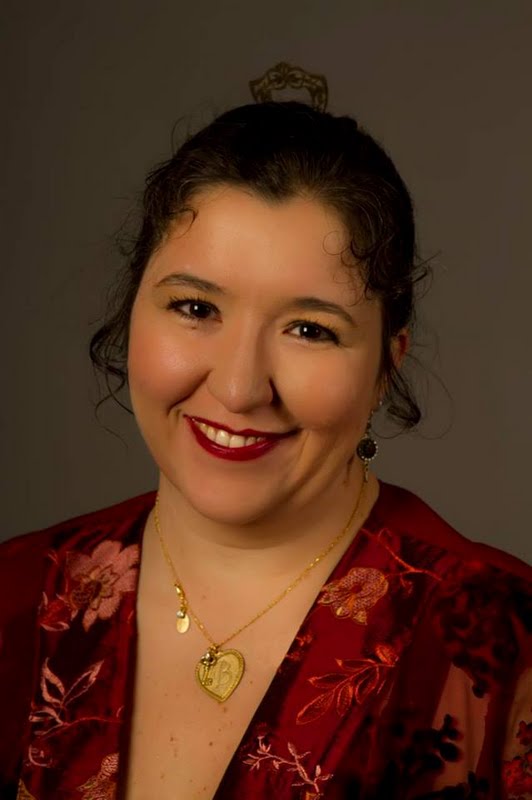
MICHAEL A. VENTRELLA: Please welcome to the blog today Sara M. Harvey. Sara is a genre-crossing author whose work has been described by Jacqueline Carey as “a compelling blend of the numinous and the creepy”. sara harvey Her webpage is here!

Sara, your first work was the romantic urban fantasy A YEAR AND A DAY. Tell us about it!

SARA M. HARVEY: That book was such a work of the heart. I was lonely, living in Orlando, Florida, working for Disney, missing NYC, in the uncertain beginnings of a long-distance relationship, flat broke and spiraling deeper into debt, and I needed a distraction from my life. I came home from work exhausted every night and sat down and wrote about angels living in the East Village and it was magical and got me through a very rough patch.

It got published as a “contemporary romance” but I’d call it more urban fantasy than romance. Sure, there’s a love story, but the main love story is between me and New York City, or so I’m told. This was my NYC, the one that I got to know and love.

The short version is the Angel of Vengeance and the Angel of Joy are roommates in NYC’s East Village, Hijinks ensue!

You can still get it as a used paperback via ebay and the usual online outlets — Powell’s, Amazon Marketplace, etc. Or if you prefer ebooks, Baen Ebooks is your go-to spot DRM-free for any and all devices!

VENTRELLA: How did you get that published?

HARVEY: Funny story, really. I was working as a temp at a temp agency (totally meta, I know!) and one of the managers belonged to a women in business group to whom this local publisher came and gave a pitch. They had a contract with CVS Pharmacies to put out some mass market romances. She remembered that I mentioned I wrote so she brought me their info. What followed was the very worst query letter I ever sent. I literally said “I don’t think you’ll want this but…”

It’s a nice thing to say I sold 35,000 copies through CVS stores nationwide … but the publishing company soon went bankrupt, showed their true colors, and although I finally (after legal action) got my rights back, they still owe me $1700 that I will never see.

VENTRELLA: You then delved into steampunk with your BLOOD OF ANGELS novellas from Apex. How has that been received?

HARVEY: The reception has been overall really great!convent The first of the series THE COVENT OF THE PURE was reviewed by Publisher’s Weekly and it still sells and reviews really well, even years later!

I found Steampunk to be an exceptionally fun genre to work in, there are so many facets and permutations to explore. I really love history and exploring all the dark and twisty “what if?” paths!

VENTRELLA: Do you find novellas easier than full works?

HARVEY: It was a challenge. I really throw the reader into a no-holds-barred roller coaster ride with very few places to stop and breathe. This makes for an exciting but exhausting read. So on the one side, it’s good the size is smaller, but on the other, were I writing a full 100k word range novel I would have done a lot of things differently. So … easier? No, it just didn’t take quite as long.

VENTRELLA: What are the advantages of a novella?

HARVEY: Time commitment, both on the side of the reader and the writer; there’s a certain amount of time sunk into a full novel. Some concepts are just not novel-length so a shorter format allows more freedom to tell those stories without trying to pack in filler to pad the word count. With the ever-expanding self-pub and small-press markets, novellas are really gaining ground as companion pieces to larger works and standalone treasures.

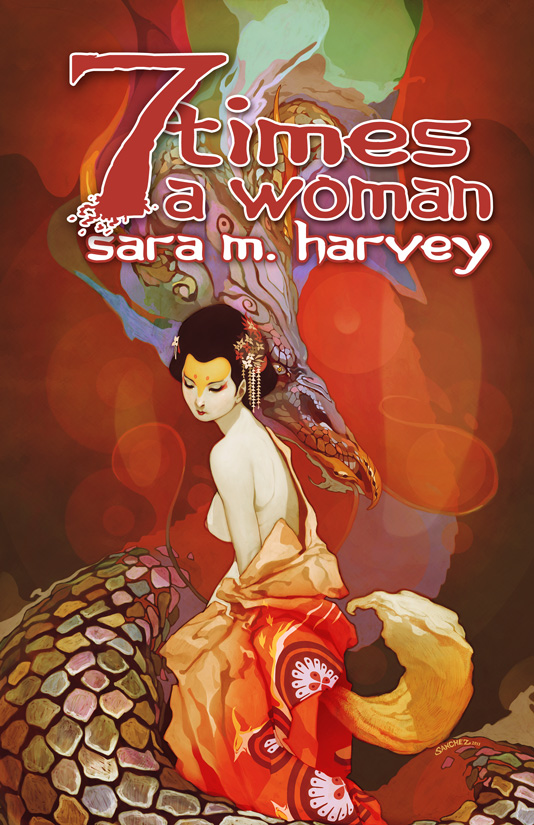
VENTRELLA: Your newest work is SEVEN TIMES A WOMAN set in mythic Japan. What sort of research did you do for this work?

HARVEY: My background is in theatre and history. I have a bachelor’s degree in costume design and a master’s in costume history. I have also had a lifelong love of kimono and all things Japanese. I actually started writing SEVEN TIMES A WOMAN before A YEAR AND A DAY, when I was still living in NYC and had access to the Japanese wing of the Metropolitan Museum of Art, took classes at the Japanese consulate, and had a lot more Japanese people in my life. 7TimesAWoman_FinalSo the research was fairly organic and I had an amazing set of resources at my fingertips. Also, the internet is a wonderful tool! But having the real life experts to fact check stuff made weeding through the bad research online a lot easier!

VENTRELLA: I note that you have been with many different small publishers. What are the advantages of using different publishers?

HARVEY: I am a pretty eclectic author and I write in a variety of sub-genres of fantasy. Each publisher has a little bit of a different flavor to their oeuvre and since I have a lot of facets to my work, I have been able to find different publishers that sync up with each!

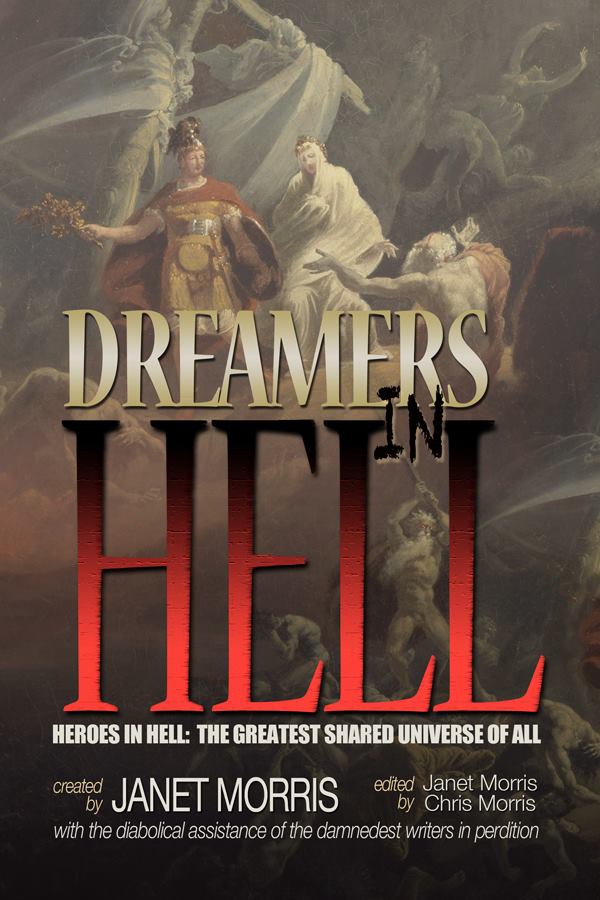
VENTRELLA: You also wrote the opening story in the recent DREAMERS IN HELL, part of the “Heroes in Hell” series (Shameless plug: I’m in the book, too). How did that come to be?

HARVEY: I have some friends among the early recruits for the Heroes in Hell reboot and was invited and accepted to ROGUES IN HELL, but my story got pushed back to DREAMERS IN HELL, where is it much more fitting. I couldn’t be happier to have it there!

VENTRELLA: Is it difficult writing in someone else’s world?

HARVEY: Yes and no. I have written my fair share of fanfic and I find the constraints of fitting original stories and concepts into other people’s worlds and characters to be pleasantly challenging. HEROES IN HELL was a larger challenge because there are so many books and such an enormous cast of characters. Keeping everything organized was really challenging. So I ended up writing what Janet Morris calls an “outlier” story, one that fits generally into the overall story but not directly or linearly.

It was kinda cheating, but also a good way to get my feet wet. With such a robust history, I didn’t want to dive right into the deep end on my first shared-world swim!

VENTRELLA: What can we expect next from you?

HARVEY: Currently shopping out an urban fantasy novel that takes place in Nashville. And my latest piece of short (but also kinda long) fiction is the the MOUNTAIN DEAD chapbook accompanying the Appalachian Undead zombie anthology from Apex Publications.

VENTRELLA: When you’re approaching a story, how do you begin? Pageflex Persona [document: PRS0000039_00075]Characters, plot, themes? What is your writing style? Do you outline heavily, for instance, or just jump right in?

HARVEY: Usually there are characters first, followed very closely by a setting (actors and location) and then I have to work out the specifics of the very vague plot idea I have for them. BUT I just started a YA fantasy where I had a really detailed plot and no characters and no setting. Which is just the opposite of my usual mode of operations. But I’m having a good time with the research and construction. I never shy away from a new way of thinking about writing!

I’m an academic at heart so I always make an outline. I never stick to it, but I make one.

Mostly, I’m a pants-er when it comes to writing. I just jump right in! Even when I wrote longhand, Mead notebooks and Bic pens were cheap, I filled drawers with them. These days I have whole folders of dribbles and drabbles in Word documents. They take up very little hard drive space and fit easily onto a 2GB thumb drive.

VENTRELLA: Who do you like to read?

HARVEY: Jacqueline Carey, Cherie Priest, Neil Gaiman, Catherynne Valente, 1990s era Francesca Lia Block, early Anne Rice, early Stephen King, Lovecraft, Shakespeare, Tolkien, historical fiction, non-fiction history and fashion/costume books.

VENTRELLA: These days, even authors with major publishers need to know how to market themselves. What are some of the smartest things an author can do to promote their own work?

HARVEY: Like Wil Wheaton says, Don’t Be A Dick! Have a platform of actual content or wit or something. You can’t just plug your book over and over. Don’t use birthday greetings on Facebook to market your book, be a cheerleader for others and pay it forward or back or sideways — generally be involved in your community and genre, and most importantly be yourself. Be genuine in your dealings with the people you meet online or in person at conventions or signings or events. You never know who is a fan or a potential fan and you have so many opportunities to make someone’s day by just being you. Be mindful of that, think about how you’d like to be advertised to and apply that to your marketing strategy!

VENTRELLA: Should beginning authors ever consider self-publishing?

HARVEY: I think self-publishing is still the elephant in the room no one wants to talk about. I have a pretty good fanbase but still haven’t moved much of my self-pubbed piece (a novelette called “Allegiance to a Dead Man” about Emperor Norton, available for Kindle and Nook!) but I know a lot of authors who do okay at it. I don’t know anyone quitting their day job, however. The industry is really in flux right now and I think self-pubbing will be with us for a very long time, if not forever. It isn’t the stigma it used to be, but it isn’t the magic wand promised by so many. So I’d say, research all your options and be prepared to go it alone. Alone. Even small presses have marketing teams, blogs, media connections, etc. Have a plan in place, a good and solid plan, before you even think of self-pubbing. Dreamers-in-HellAnd I say, try out your small press options first. Especially your first time out of the gate.

VENTRELLA: What do you see as the future of publishing?

HARVEY: Publishing needs to lose the megalithic “Big Six” or “Big Five” or however few of the major labels there are. They are going to crumble like the big recording labels did ten years ago. Sure, those labels are still around, but they don’t have the same strangle-hold on content like they once did. We’re in a really turbulent time right now and I think there are still a lot more upheavals to come.

That said, we still need gatekeepers. So much self-pubbed and a lot of small-press stuff it a terrible waste of time and an exercise in ego. Wading through that muck is hard on readers. But we have an unprecedented amount of literature available in an unprecedented number of ways — paper books, ebooks, audiobooks, online, etc. and there is nothing bad in that! There just needs to be a higher signal-to-noise ratio, and that’ll come with time. Remember the internet 10 years ago … it was the WWWild West! And things sorted themselves out. Publishing will do the same.

Readers aren’t going anywhere and as things have shown, there are more and more of them and they are engaging with authors in new ways every day and that right there is a thing of beauty and tells me that we’ve got nothing to worry about.

Interview with Catherine Stine

MICHAEL A. VENTRELLA: Today I am pleased to be interviewing Catherine Stine, writer of suspense and speculation. OLYMPUS DIGITAL CAMERA Her newly released crossover sci-fi thriller is RUBY’S FIRE.

Catherine, tell us about this new series. What makes your series different?

CATHERINE STINE: It takes place on a future earth (2099), and the world has suffered from extreme weather and border wars, but it is not an oppressively dystopian atmosphere. There are signs of renewal. I’m more interested in what takes place during a perilously delicate recovery, and what kinds of events and people affect it.

VENTRELLA: My fantasy novels are also considered “young adult” books, primarily because of the age of the protagonist. What else makes a story YA?

STINE: The hallmarks of YA are yes, the age of the protagonist (14 to 18), but the pacing must be fast and the plot high stakes. There is always a romance, yet the romance is not graphic. Themes are geared to teen concerns. RUBY’S FIRE addresses drug use, core identity issues, runaways, love triangles, extreme peer competition and genetic mutation. How’s that for suspense?!

VENTRELLA: When you’re approaching a story, how do you begin — characters, plot or themes? What’s your writing style? Do you outline or just jump in?

STINE: I begin with a compelling situation and characters. Then I construct the plot. I always outline, and I do thematic freewrites. The more I think through the novel and outline beforehand, the stronger and more focused the novel becomes. Rubys-FireI advise my students to outline, even a few lines per chapter. I encourage them to think of it as a fluid entity they can tweak as they go. This seems to help.

VENTRELLA: Who do you like to read?

STINE: I read adult and YA speculative fiction. That includes horror, sci-fi and techno thrillers. Occasionally I’ll read a literary mystery to study how to craft tension.

VENTRELLA: Tell us about how you got RUBY’S FIRE published.

STINE: I published Ruby’s Fire with my own imprint, Konjur Road Press. That said, I’ve also published with Random House, American Girl and Scholastic. I’m a hybrid author, meaning I’ve done it both ways, and would like to continue publishing both ways. Why not? I do have an agent. He’s okay with that.

VENTRELLA: What do you think we will see in the future of publishing?

STINE: I think more and more authors will publish both ways. Even well published authors are choosing to self-publish certain projects. For instance, one trend is to write a “short” or a novella with one of the characters in a novel, between longer projects, and self-publish the shorts. It satisfies readers while they wait for your longer opus.

VENTRELLA: Even authors with major publishers need to know how to market. What are the smartest things one can do to promote a book?

STINE: For RUBY’S FIRE, I’m doing a big blog tour. Last time I organized it all myself. This go-around I hired a book tour host. FireSeed One CoverBut from my first experience, I “met” so many great book reviewers that this time I was able to contact them again, and they were thrilled to read the next book, and also to blurb. People are very generous online and they love getting the word out about books they like. The funny thing is that I have a friend who is published with one of the Big 6, and her publicist is approaching the very same bloggers I have a relationship with. The whole process has become democratized. It’s also good to do giveaways on Goodreads, and to host other authors.

VENTRELLA: You’ve received quite a few good reviews and awards for your work. How did those come about? Do you have to search them out or do they contact you?

STINE: Write the best book you can, and good reviews will follow. I did apply to certain indie award sites; there are good ones, and questionable ones. Do your homework. More and more, these organizations and awards will be helpful to readers to discern the best of the indies.

Thanks for interviewing me on your blog, Michael!

Interview with author Storm Constantine

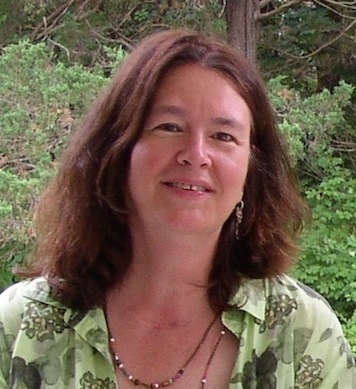
MICHAEL A. VENTRELLA: I’m pleased to be interviewing author Storm Constantine. download Storm’s work has covered many genres from fantasy, dark fantasy and horror to science fiction and slipstream. She has so far written twenty-three novels, and currently has most of her short stories collected in four Immanion Press editions.

Let’s start by discussing the re-release of SEA DRAGON HEIR. There is always an urge to rewrite older materials when it gets re-released; what has changed with this edition?

STORM CONSTANTINE: My urge to tinker with old works is simply that some were written when I was much younger and certain incompetencies in the writing and structure of the stories were just too much to ignore. Also, in some cases, publishers had asked for sections to be removed, simply because they wanted a shorter book. When I came to republish the books myself, I could restore them to my original vision. As I’m an editor as well as a writer, it was impossible for me to keep my hands off revising and refining!

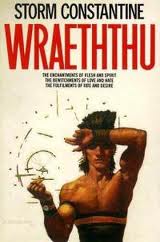
I don’t think the Wraeththu books (the original version of the trilogy) were edited as well as they could have been. I was such a fledgling writer then, and when I returned to the books fifteen years later to republish them I was astonished really at what I’d been allowed to get away with, in terms of inconsistencies, plot holes, wobbly structure, and so on. It was glaringly obvious to me where the stories could be successfully reinforced. Some things happened ‘off stage’ that shouldn’t have. The ending of ‘Enchantments of Flesh and Spirit’ was a prime example of that. I added a couple of extra chapters to the revised edition to ‘show rather than tell’ things that occurred.

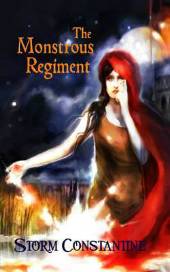
I also re-edited THE MONSTROUS REGIMENT quite heavily, as I’d never been happy with that book. The sequel, ALEPH, had technical errors to be fixed, but I didn’t do that much to it other than that.

As the reissues of my back catalogue progressed, there was less for me to do, because I’d been improving as a writer through those years of creating the original books. book_aleph_new_ed_smallBy the time I got back to ‘The Magravandias Trilogy’, all I was correcting was typos. I was happy with that trilogy as it was first written.

VENTRELLA: What projects can we expect from you next?

CONSTANTINE: I have so many notes written down for both short stories and novels, but my worst obstacle to realizing them now is time. I have sent a couple of stories off to anthologies, but as I’ve not heard back from the editors yet, don’t want to say which they are, in case my stories aren’t suitable for them. I want to finish off the other four or so I’ve got half written, because it’s always handy to have unsold stories available, should I be approached by an editor. Also I simply want to get the ideas down.

Novelwise, there are several books I could write, but it’s knowing which to do first. I’ve started work on the third volume of the ‘unofficial’ third Wraeththu trilogy, which is a series of novellas set in Alba Sulh. English Wraeththu. The first two were quite emotionally grim stories about betrayal and obsession, but the third has a different tone – it just happens to have a couple of the characters in it from the first books. I want this one to be a ghost story, and already have a lot of disturbing images for it that are just pure, enjoyable, supernatural scares. There will be less angsting in this book!

Aside from that, I have notes for at least half a dozen novels that are all unconnected, some of them with chapters already written. My plan is to finish the short stories, finish the Wraeththu ghost story, then take a good long look at what I have in my ‘ideas’ folder on the computer. I just feel like I need to clear the decks before venturing into territories new.

Nonfiction-wise I’m working on some ideas with a friend for a couple of books concerning magical path-workings/visualisations. They will just be fun to do; sit down together and invent the stories for them. The difficult part will be for us to get together, since my friend is very busy and quite often off on research trips around the world. I hope to get at least one of these books out this year, though.

VENTRELLA: How did Immanion Press come to be?

CONSTANTINE: When I sold The Wraeththu Histories (the second trilogy) to TOR in America, I wished that the original trilogy had still been available in the UK. WRAThis coincided with the advent of Print of Demand publishing, which meant that it was possible for small presses to bring out books at a fraction of the price of traditional publishing. So initially, Immanion Press was set up to coincide with the Grissecon convention I ran in 2003, where I relaunched ‘The Wraeththu Chronicles’ As I was let down in the UK by a publisher who initially wanted to publish the Histories, I decided I might as well bring out my new Wraeththu trilogy in the UK too. From there came the idea to reissue all of my long unavailable back catalogue titles. Then it just grew from there. Other writers asked me about reissuing some of their out of print titles too, and I had a rather altruistic urge to help new writers get published as well. Unfortunately, the latter idea didn’t really survive contact with reality. I found that it’s incredibly difficult to sell the work of new fiction authors, so I’ve had to cut back on that dramatically.

However, the non fiction side of things does well. People buy books on certain subjects irrespective of who the author is, or what they might have written before. Generally speaking, they just want a book on a particular topic, rather than to seek a name they already know. Megalithica Books, the nonfiction imprint, came about because a friend of mine, Taylor Ellwood, was interested in getting work out through Immanion. He saw a way to expand that side of things and eventually became the manager of the non fiction line.

VENTRELLA: Many established authors are now self-publishing their back catalogues themselves, avoiding the big publishers completely. What are the disadvantages of doing so?

None really, since the big publishers are largely not interested in doing this job for us. OK, we’re not going to have big publicity budgets at our disposal, and most presses (like mine) run on a shoe string. We can’t afford to hire staff, so have to do everything ourselves, or work with volunteers. In my case I simply don’t have enough time to be a full time publicity manager as well as everything else.

For established authors, it’s great to see their often long unavailable works back in print. SEA DRAGONYou just have to make sure you have a fairly active online presence to help publicize your work, and let people know where they can buy it.

Is Immanion’s goal mostly to allow for established authors to reprint old works or are you actively looking for exciting new talent as well?
As I said above, the new author experiment didn’t go too well. Sadly, it just lost me a lot of money. We’re moving into ebooks more now, though, which have far fewer overheads, so perhaps in that medium I can still endorse new writers.

VENTRELLA: Has it been successful?

CONSTANTINE: Well, we’ve been around for 10 years this year, so we’re not doing too badly. The downside of it is that it eats into my working day like a pack of starving wolves. That’s another reason I’ve had to downsize the fiction line. I was in the position over the past five years or so where my workload had grown so much editing other people I had no time at all, and no energy, for my own writing. That had to stop. So I started to delegate more, to a fabulous woman, Sharon Sant, who volunteered to do editing for me. We’re publishing her first novel RUNNERS in June. I might not be able to pay a salary to people, but I can help out in other ways.

VENTRELLA: Starting authors often mistakenly think they can do this as well; they self-publish and then go nowhere. What advice do you have for beginning writers concerning getting published?

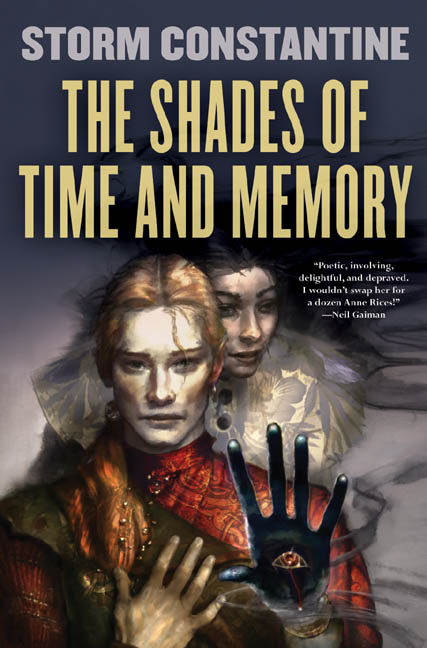
CONSTANTINE: One of the biggest downsides of everyone being able to self-publish easily, either through ebook or printed copies, is that they can do so without their work ever being looked at by a critical pair of eyes, whether that’s a professional editor or a friend who’s prepared to be honest. Editing is a very different job to writing. Even though I edit my own work to a degree, I still get someone else to do so as well. Writers are too close to their own work. We know everything that’s going on, but the readers don’t, and sometimes we don’t put enough in, or we over-write and things have to be trimmed back. The more people who can read a book before publication, the better. SHADESYou have more chance of errors being found.

Even though there are now millions more people producing books of some format or another, sadly a lot of it is let down and diminished by the fact the writing itself isn’t up to scratch, and the writers don’t know their craft.

When I ran a creative writing class, I generally had to spend the first term every year teaching the students how to write. They knew nothing of grammar, syntax, spelling, punctuation or narrative structure, (the writer’s essential tool box), not to mention how to create credible characters, a compelling plot and realistic dialogue. They just had an idea they wanted to write stories or a novel, and didn’t even think it involved any particular skills other than the storytelling urge. From what I’ve seen there is a hell of lot of new writers actually publishing works with all of those aforementioned aspects being of poor quality.

So, first advice – hone your writing skills, learn your craft, share your work with other writers to get constructive criticism. Your Mom saying, ‘yes, that’s very nice, dear’, is no use to a writer. You want and need people to tear your work apart really. You don’t have to agree with every criticism, and might choose to ignore some of it, but without this flow and exchange you’re at a disadvantage. You owe your work your best shot, and that means using the tools at your disposal to make that work as good as it can be.

Also, it’s now absolutely essential for new writers to self-promote and use the Internet and social media to their full advantage to get word about and create a buzz.

VENTRELLA: Some writers tend to avoid controversy, but that doesn’t seem to stand in your way. Have you ever avoided an idea because you thought your readers (or editors) wouldn’t accept it?

CONSTANTINE: Not so far, that I can think of!

VENTRELLA: To the other extreme, have you ever specifically written in order to make a point about religion, politics, sexual orientation and so on, or do these things just flow from the plots?

CONSTANTINE: I think a writer’s political and religious beliefs tend to permeate their work naturally. book_monstrous_regiment_smallI haven’t gone out of my way to pontificate about these things, but I don’t think any reader of my work would be in doubt about where my political and spiritual beliefs lie.

VENTRELLA: Do you think fantasy/science fiction settings allow you to tackle these issues in a way you could not otherwise?

CONSTANTINE: These genres give writers marvelous freedom to tackle issues it might be more difficult, or even risky, to tackle in a mainstream novel. Science fiction has long been used to criticize political regimes under the guise of fiction. I can’t help thinking that writers who have run into trouble over what they’ve written wouldn’t have done so if they’d set their stories in a fantasy world. It’s liberating; you can say what you like really.

VENTRELLA: How much of your own personal religious beliefs are reflected in your work?

CONSTANTINE: I am a spiritual person but not a religious person, but I do possess Pagan leanings. And yes this is reflected in my work.

VENTRELLA: What book do you advise for the starting Constantine reader and why?

CONSTANTINE: When I discover a new writer to read, I like to start at the beginning of their works if possible, but other people might feel differently. I don’t think it matters, other than it’s perhaps not the best idea to start with the second or third volume of a trilogy! I do have a number of short story collections published through Immanion Press, which can also give people a taster of my style.

VENTRELLA: The Wareththu series is probably your most famous. Do you plan on continuing to expand it?

CONSTANTINE: I think I’ll always return to it, but as I’ve concentrated on it exclusively for quite a time now, I want to explore something different for a while. I’ll continue to produce the Wraeththu story anthologies to keep my hand in. These are published roughly annually (or I hope them to be) and include stories by other writers as well as a couple by me. The first was ‘Paragenesis’, and the recently published ‘Para Imminence’. Both are available through Immanion Press, and I’m just mulling over ideas for the theme for the next one. Paragenesis explored the start of Wraeththu, and Para Imminence its far future. Anyone interested in contributing, please do get in touch via editorial@immanion-press.com

On top of the anthologies, I’ll continue to publish novels set in the Wraeththu world but written by others. A thriving online community of fan fiction writers helped keep Wraeththu alive during the years (fifteen of them) when I couldn’t sell any more Wraeththu novels to publishers. 6880909I began to publish the best of these writers, and again am always on the lookout for new ones. If anyone is interested, get in touch at the aforementioned address.

VENTRELLA: Do you think that there are things women can write about that just can’t be done by men writers?

CONSTANTINE: Not really, but perhaps it’s fair to say they might be able to write about certain aspects of life more convincingly than a man.

VENTRELLA: Are you someone who outlines heavily or are you a “pantser”?

CONSTANTINE: Not quite sure what a pantser is, but I don’t outline that heavily. I feel that stories are organic entities that tend to create themselves as they emerge. Publishers always used to demand huge outlines from me, which I found a pain to do, and quite frankly the finished books rarely had much resemblance to their synopses. Once a story is written down, then it’s time to go back and work on fine-tuning the plots, locations and characters. I can’t put all that in a synopsis. The story has to come out first.

VENTRELLA: Do you start with an idea, a setting, or a character?

CONSTANTINE: It can be any of those, just a spark of an idea, a smell, an impression, an emotion.

VENTRELLA: All writers are told to “write what you know.” What sort of research do you do before writing?

CONSTANTINE: I think it’s important to get your facts right. I often see movies about the 70s and see so many anachronisms in them. That’s why I write fantasy instead of historical novels. You have far more freedom in a fantasy novel about, say, what people might have on their breakfast tables. You don’t want to find Pop Tarts on a Victorian table in a novel, do you? But you do see that kind of thing. I really admire historical novelists; the amount of research and checking they must have to do is phenomenal.

For myself, I research aspects that apply across universes and realities. For example, I have an idea to write a fantasy novel that heavily involves the weather – so I bought some books for research on that.

VENTRELLA: What techniques do you use to make your protagonist someone with whom the reader can relate?

CONSTANTINE: I think it’s important to observe in reality how people speak, how they use their bodies and faces to communicate, how much a silence says. No one really speaks in formal dialogue like an updated Shakespeare play. hermetechOf course, it would be really irritating to have characters in a story talking completely realistically, so you have to impose some boundaries and restrictions, but it’s important to have an ‘ear’ for realistic speech.

Giving your characters credible behavior makes them believable, and people will relate to them more effectively. One thing I always tried to stop my students doing was using fiction clichés, such as people screaming or dropping a teacup/glass/plate in shock. When people are really frightened, I think most are more likely to swear beneath their breath, or not make a sound, than scream like someone in an old horror film. And have you ever seen someone drop something they were holding in shock? I haven’t. Also, things like collapsing/fainting. I don’t see that happen much either. Screaming might have its place, but the dropped tea cup and maidenly collapse really have to go!

VENTRELLA: What do you do to establish a believable fantasy world? In other words, how can you introduce the fantasy elements into the story and make them real without relying on info dumps?

CONSTANTINE: It’s just a case of being aware of it, and not dumping too much at once. A great amount of detail can be introduced with subtlety, such as in the ‘stage directions’ you might use for characters during lengthy dialogue. What are they doing as they’re talking? What are they picking up, leaning on, looking at, avoiding, etc etc.

VENTRELLA: When going through second and third drafts, what do you look for? What is your main goal?

CONSTANTINE: Pretty much all of the things I’ve talked about throughout the interview. Plot holes, realistic characters and situations, grammatical/syntactical errors, spelling, compelling dialogue and so on.

VENTRELLA: What criticism of your work do you disagree with the most?

CONSTANTINE: I had this one reviewer, who used to go out of his way to review my books, who absolutely hated my work. CROWNHe obviously got his jollies by being able to slag me off once a year. I disagreed with his observations because they were subjective and just plain offensive. Clearly, he wasn’t comfortable with many of the subjects I include in my work.

I don’t expect everyone to like what I write – that would be an unrealistic expectation. And everyone is entitled to their opinion. A lot of people love writers I absolutely despise, but I don’t believe I am right and the others are wrong. It’s just down to taste.

VENTRELLA: All writers basically write what they would like to read. So what do you like to read? Who are your favorite authors?

CONSTANTINE: My favourite authors are Tanith Lee, Alice Hoffman, Jack Vance, P G Wodehouse, Jonathan Carroll, to name but a few. I have just about everything the first three on that list have ever written.

VENTRELLA: What advice would you give an aspiring author that you wish someone had given you?

CONSTANTINE: Don’t expect to be rich. Let go of any attachment to outcome, and simply write because you love to do so. Write what you love, because your heart will show, and other people will be more likely to love it too.

Thanks for giving me the opportunity to talk with you about my work.

Interview with Hugo and Nebula Award Winning Author David Gerrold

MICHAEL A. VENTRELLA: Today, I am honored to be interviewing Nebula and Hugo award winning author David Gerrold. David-GerroldDavid Gerrold is the author of over 50 books, several hundred articles and columns, and over a dozen television episodes. TV credits include episodes of Star Trek, Babylon 5, Twilight Zone, Land Of The Lost, Logan’s Run, and many others. Novels include WHEN HARLIE WAS ONE, THE MAN WHO FOLDED HIMSELF, the “War Against the Chtorr” septology, The “Star Wolf” trilogy, The “Dingilliad” young adult trilogy, and more. The autobiographical tale of his son’s adoption, THE MARTIAN CHILD won the Hugo and Nebula awards for Best Novelette of the Year and was the basis for the 2007 movie starring John Cusack, Amanda Peet, and Joan Cusack. His web page is here.

David, you’re probably best known for your first sale, the Star Trek “The Trouble with Tribbles” classic episode (which you’re probably tired of talking about). It’s kind of a Cinderella story for writers, in that your sale would never happen these days. Or would it?

DAVID GERROLD: I think it would be a lot harder for a new writer to break into a prime-time show the way I did. Back then, most shows were written by freelancers. Today, most shows are written by staff writers, and there are less episodes in a season, so there just aren’t as many opportunities. And it’s a lot harder for an unknown writer to get his outline in front of a producer, let alone have it pass the “Is this good enough to take a chance?” test.

Back then, it was a lot easier for a writer to establish a reputation. Guys like Richard Matheson and Robert Bloch and Charles Beaumont and George Clayton Johnson were well-known as go-to guys for a good script. Today, because shows are mostly staff-written, it’s a lot harder for a TV writer to establish a reputation outside of his specific show, until he becomes a producer.

VENTRELLA: You’ve also written for one my favorite shows (Babylon 5), as well as scripts for Logan’s Run, Twilight Zone, and other TV series. star trekHow much control do you have over these scripts? In other words, do they get edited greatly by Hollywood types or are the end results usually what you wanted?

GERROLD: It depends on the producer. Joe Straczynski (Babylon 5) is one of the very best. He knows what a good script looks like and he respects writers who bring their passion to the story. He trusts writers. He doesn’t rewrite scripts unnecessarily.

Other producers (unnamed) can’t drink their coffee without first peeing in it to improve the flavor. Every writer has horror stories.

VENTRELLA: Your novel THE MARTIAN CHILD has to be one of your biggest successes, and that must be very satisfying to you given the biographical aspects of the story. Do you think the personal nature of the story hindered you in any way?

GERROLD: Actually, I think the personal nature of the story was enormously liberating. I didn’t have to make stuff up. It was already there. And because the focus of the story was about the relationship between myself and my son, I had an enormous wealth of material to draw upon. The story was about how much I love my son. Whether he’s a Martian or anything else, he’s my Martian. That’s the point.

I think the success of the story has to be that every parent who read the story or saw the movie recognized the experience of falling in love with their own child. I think it’s the best love story I’ve ever lived.

VENTRELLA: Were you happy with the resulting film–both as a film and given the changes that were made to the main character?

GERROLD: Where the movie stayed true to the love story, I enjoyed it enormously. I felt that there were things added to the movie that were unnecessary—-like all that business with sun block and weight belts.martian child I wanted one sequence from the book included, which I felt would have illustrated the core of the entire relationship-—that’s the “pickled mongoose” sequence, where Dennis learns how to tell jokes. I think it would have been a better movie with that included.

VENTRELLA: Money considerations aside, do you prefer books to scripts?

GERROLD: Scripts make more money, but disappear faster. Books are harder work. They’re a much more personal creation. I view books as a special kind of love affair with one reader at a time.

VENTRELLA: Through Land of The Lost and the Star Trek animated series, you worked with a number of great science fiction writers. Do you see that sort of thing in television today?

GERROLD: There was a moment when a producer (unnamed) who should have known better, said, “Don’t hire science fiction writers. They think they know more about my show than I do.” And based on the evidence, most SF writers do know more about science fiction than most TV producers.

On the other hand, there are brilliantly written shows like Dr. Who that demonstrate that an intelligent writer-producer can push the envelope over and over again.

VENTRELLA: You were originally involved in the first season of Next Generation but left as the lawyers took over … Has TV (and the movies) turned away from the people who know science fiction best to instead rely upon standard television scriptwriters too much? If so, are there exceptions?

GERROLD: See above. The exception is Dr. Who.

VENTRELLA: What’s your opinion on all the various Star Trek incarnations? Which is your favorite? (Not counting the episode where you had a cameo…)

GERROLD: A lot of good people have worked on a lot of different incarnations of Star Trek. But my favorite is still the original series, the episodes produced by Gene Roddenberry and Gene L. Coon—when Star Trek was about exploring a very big, very unknown universe. Book1-AMatterForMen-DavidGerroldIt was about challenging our heroes with the question, “How does this universe work? What is our place in it? What does it mean to be a human being?” Those stories were humane, subversive, disturbing, thoughtful, and ultimately caused a whole generation to think outside the boundaries of what we had previously believed to be possible. To me, that’s what Star Trek should be—a humanistic challenge, not just a franchise for selling toys and tickets.

VENTRELLA: Did you ever have a project you really wanted to do that fell through? Do you have any new ones you’re trying to get done?

GERROLD: The Star Wolf TV series. I think that would have been a wonderful show to work on.

And yes, I have some new projects I’m working on.

VENTRELLA: Most authors agree that they write for themselves, not others. Do you agree with that assessment? Is that a good idea for a starting writer?

GERROLD: I write for myself. I let others pay for the privilege of reading over my shoulder.

VENTRELLA: I remember reading your novel THE MAN WHO FOLDED HIMSELF when it first came out, and I still recall much of its plot–probably because I love a good time travel story. More importantly, the fun of the book was not the adventure, but the possibilities and consequences of time travel and world changing. Why did you decide to go in that direction instead of a straight-ahead adventure?

GERROLD: Because that’s where the story wanted to go.

VENTRELLA: Did you ever consider doing a sequel? Someone else gets the belt?

GERROLD: A sequel would be anti-climactic. There’s nothing else to say. (Well…that’s not quite true, but I’m not going to give it away here.)

VENTRELLA: Some established authors these days have begun placing their out-of-print catalogue in e-book format and selling it on the web, avoiding a publisher completely.the-man-who-folded-himself-7 Have you considered such a thing? Why or why not?

GERROLD: It costs money to print a book and distribute it. It doesn’t cost anything to make it available as an ebook, and the income goes directly to the writer. Having your back-list available to the audience is good business. I’ve got several stories available on Amazon.

VENTRELLA: I’ve been given advice, as a small time writer, to avoid politics on Facebook and my blog. I’ve ignored that advice. I note that you also post your political views from time to time, as well as visiting a political bulletin board. Do you think this has hurt your sales in any fashion, or do you not care?

GERROLD: Larry Kramer said it, “Silence equals death.” Martin Neimoller said it, “First they came for the communists,and I didn’t speak out because I wasn’t a communist. Then they came for the socialists, and I didn’t speak out because I wasn’t a socialist. Then they came for the trade unionists, and I didn’t speak out because I wasn’t a trade unionist. Then they came for me, and there was no one left to speak for me.”

I think that it’s important to speak up. Not speaking up is surrender. And the status quo is always the enemy. But if you’re going to speak up, do your research first. I believe that the evidence is the strongest argument.

But there’s an even larger context that I would advise. Be pro-, not anti-.  If you’re going to speak up, then speak up for people, speak out against injustice, speak up for making a difference, speak out against hate-mongering. If you identify a class of people and vilify them, you’re making enemies. But if you identify a category of people who have a just cause and speak out for them, you’re showing your compassion for others.

I think that if we remain silent, our silence is interpreted as agreement. Nope. I’d rather be unpopular for speaking out than accepted for the lie of silence.

VENTRELLA: Speaking of politics, one of the biggest issues for me is the anti-science position many take these days–arguing against climate change and evolution for political or religious reasons instead of scientific ones.13806 As someone who relies on science for your fiction, what’s your opinion on this? What should we do?

GERROLD: The answer to hate speech is more speech, honest speech, accurate speech, thoughtful speech, humane speech, rational speech, compassionate speech, forgiving speech, loving speech.

The answer to stupid speech is evidence, rationality, accuracy. And occasionally, a healthy bit of ridicule.

VENTRELLA: Who do you like to read for pleasure?

GERROLD: Terry Pratchett, John Varley, Spider Robinson, George R.R. Martin, Victor Hugo, Charles Dickens, Alexandre Dumas, Laura Joh Rowland, Frederik Pohl, and about a thousand others who are stored on my Kindle and who I have not yet gotten to.

VENTRELLA: Fantasy has grown tremendously in popularity over the past twenty or thirty years and now outsells science fiction. Why do you think this is? What is it about fantasy that appeals to readers that they can’t get from science fiction?

GERROLD: Science fiction is harder to write. There’s so much new science happening every day that it’s impossible to keep up.

Fantasy doesn’t have the same restrictions, but writing a great fantasy might be even harder than writing good science fiction. I think George R.R. Martin proves that.

VENTRELLA: What advice would you give to a starting author that you wish someone had given you?

GERROLD: Quit.

If you’re going to be discouraged, be discouraged now and save yourself all that time and frustration.

But if being told to quit just pisses you off, then maybe you have the determination to keep going no matter how frustrated you get.9780812576085

VENTRELLA: Given your career, you’ve met a number of other talented and/or famous people. Who did you most enjoy meeting?

GERROLD: Robert A. Heinlein, of course. Theodore Sturgeon. Arthur C. Clarke. Spider Robinson. Anne McCaffrey, Frederik Pohl, Randall Garrett, Robert Silverberg, Harry Harrison, but especially Harlan Ellison who has been a lifelong friend.

Outside of the writing community, the entire cast of the original Star Trek series, especially William Shatner, Leonard Nimoy, De Kelley, and Nichelle Nichols.

Beyond that, Robin Williams, Virginia Madsen, Candice Bergen, Pat Tallman, Brent Spiner, Jonathan Frakes, Levar Burton, Chase Masterson…I could go on for hours.

Oh yes, and one particular former Mouseketeer I had a kind of crush on once.

VENTRELLA: With a time machine and a universal translator, who would you invite to your ultimate dinner party?

GERROLD: Suetonius, Voltaire, Charles Dickens, Mark Twain, Oscar Wilde, Kurt Vonnegut, and Gore Vidal.


12719316_10156523882800416_3978827886227917712_o