The P.O.V. Waltz

“I wonder why I have to have another point of view…” — Harry Nilsson, “P.O.V. Waltz”

As I am working on editing the second TALES OF FORTANNIS anthology, I once again am finding that the biggest problem starting authors have is with Point of View.

I don’t mean the difference between 1st person, 2nd person, and 3rd person — I assume everyone reading this blog knows what that means — but instead the difference between omniscient POV and limited third person POV.

Some authors can successfully write an omniscient POV, but it’s a rare talent — one most writers don’t have.

Most starting writers don’t even think about the POV, and there’s the problem.

Here, look at this paragraph:

John marched into the room. His anger raged within, like a volcano about to erupt. He stared at Mary, who stepped backwards, scared. She couldn’t help but admire the shirtless Adonis before her, but feared his power. Mary wondered if she could reach the knife in the drawer before John came closer. Fido barked, wanting only to be fed and have someone scratch his ears.

With whom does the reader identify? Is the main character John? Is it Mary? It could even be Fido!

Jumping around from head to head tells the tale, but at a distance, with the reader removed from any one character. It’s clumsy, and often makes the reader have to go back and re-read a section to make sure it is understood. And that is something you definitely don’t want.

“And suddenly the strangest things are happening…” — Nilsson again, “P.O.V. Waltz”

By making each scene take place with a limited third person view — where everything is told from one character’s point of view — you can add drama, suspense, and most importantly get your reader to identify with that character and feel a part of the story.

John marched into the room. His anger raged within, like a volcano about to erupt. He stared at Mary, who backed away. Her eyes scanned his body as she softly licked her lips, and then her view darted to the kitchen. The dog barked once, its tail wagging happily.

This version allows the reader to identify with John. We still get the idea of what Mary is thinking, but through John’s POV. We also know the dog’s bark is friendly without having to analyze the dog’s thoughts.

Whenever there is a scene with your main character, the story should be in that person’s POV. Imagine residing in that character’s head. Descriptions of other characters will be from your protagonist’s POV and may not even be accurate.

Sometimes there will be scenes with minor characters, and then you need to decide whose POV will best tell the story. In my next novel BLOODSUCKERS, the first chapter was originally told from the POV of a senator who is surprised at the arrival of an intruder into his room (who turns out to be a vampire assassin). Later, I rewrote it from the vampire’s POV and the suspense level rose exponentially. It grabs the reader better, lets them know something terrible is about to happen, and also provides the reader with a proper set-up for the way the vampires think and what their plans are.

Later, there is another scene where this same vampire is trying to find the protagonist and is questioning someone. Despite the fact that a previous chapter had been told from her point of view, this chapter is told from the POV of the victim. Why? Because it helps build the suspense once again.

It might be a good exercise to take some of your scenes and rewrite them, telling them from the POV of one of the secondary characters. Even if you don’t end up using it, the practice should tell you something about that secondary character you might not have known before, and can only help make your characters more real to the reader.

Not having a consistent POV is a sure sign that you’re a starting author. If you’re piling up the rejection letters, look to that first — it sure seems common among the stories I have been receiving for my anthology, so I’m sure it’s true elsewhere. Don’t make this mistake!

“I hope it’s not the last time…” — Nilsson again, “P.O.V. Waltz”

My Balticon 2012 Schedule

I’ll be a guest at the science fiction convention Balticon next weekend (May 25-28, 2012) in Baltimore. I’ll be talking about writing and editing and, of course, making a fool of myself at the “Eye of Argon” panel. The Guest of Honor is Jodi Lynn Nye, who (as you might know) wrote a great blurb for my TALES OF FORTANNIS book!

The nice people at Balticon scheduled me for a plethora of panels!

Friday 9:00 pm: Meet the Pros: Mix and mingle with the Guests of Honor and Balticon 46 Program Participants.

Friday 10:00 pm: The Role of Anthologies: As both a source of fiction and a means of promotion, what do anthologies have to offer? Fan and author panelists discuss. With Danielle Ackley-McPhail, Joshua Bilmes, C. J. Henderson, Bernie Mojzes, Pete Prellwitz, Jean Marie Ward, and Trisha J. Wooldridge

Friday 11:00 p.m.: Readings: Authors read from their works. With James Maxey and Jeff Young

Saturday 10:00 am: Editor’s Roundtable: Editors discuss the way they work with authors and how that differs when working on a single author project, a collaborative project, or an anthology project. With Carl Cipra, Joshua Bilmes, Barbara Friend Ish, Bill Fawcett, Joshua Palmatier, Ian Randal Strock, and Steven H. Wilson

Saturday Noon: Magical Systems in Fantasy Literature — A Round Table Discussion: Panelists look at what are some of the things we expect to see in magical systems and give examples of works that are missing those factors, but work just fine for the reader anyway. With Gail Z. Martin, Hildy Silverman, Trisha J. Wooldridge, Myke Cole, Jody Lynn Nye (Guest of Honor), David Wood, Barbara Friend Ish, Elektra Hammond, Bill Fawcett, and Jean Marie Ward

Sunday 10:00 am: Editors Looking For Submissions: Meet editors who are actively looking for writing and/or artwork for their publications. Get tips on what they like and dislike. Find out what kind of work they need right now. With Vonnie Winslow Crist, Bernie Mojzes, Brian Koscienski, Kate Kaynak, and Michael D. Pederson

Sunday 11:00 am: Liberty and Other Inalienable Rights: Will Basic Rights Change in the Future? In what ways? With Danny Birt, D. H. Aire, and Steven H. Wilson

Sunday 8:00 pm: Young Adult Fiction: Is YA Science Fiction Failing to Educate While It Entertains? Should it be aspiring to do so? With Peter Prellwitz, Jagi Lamplighter, Maria V. Snyder, and Janine K. Spendlove

Sunday Midnight: Eye of Argon — The Play “One of the genre’s most beloved pieces of appalling prose” read by some of the best narrators, presented in all its theatrical glory and critiqued by those who can’t keep a straight face. The history of this tome is discussed, and experts weigh in on why this book is so horrible. Sadly, due to hotel fire laws, we cannot burn anything. Not for people who have weak stomachs or suicidal tendencies. With Susan de Guardiola, Walter H. Hunt, Grig Larson, and Hildy Silverman

Monday Noon: The Role of Alcoholic Beverages in Fantasy: How are intoxicants treated in fantasy? Beers, hard liquor, absinthe, etc – where do the culture of obliteration and that of escapism intersect? What about that cliche about writers and drinking? Does it apply to writers of speculative fiction in the same way, and how does it effect the works they produce? With Jagi Lamplighter, Ruth Lampi, Maria V. Snyder, and Janine K. Spendlove

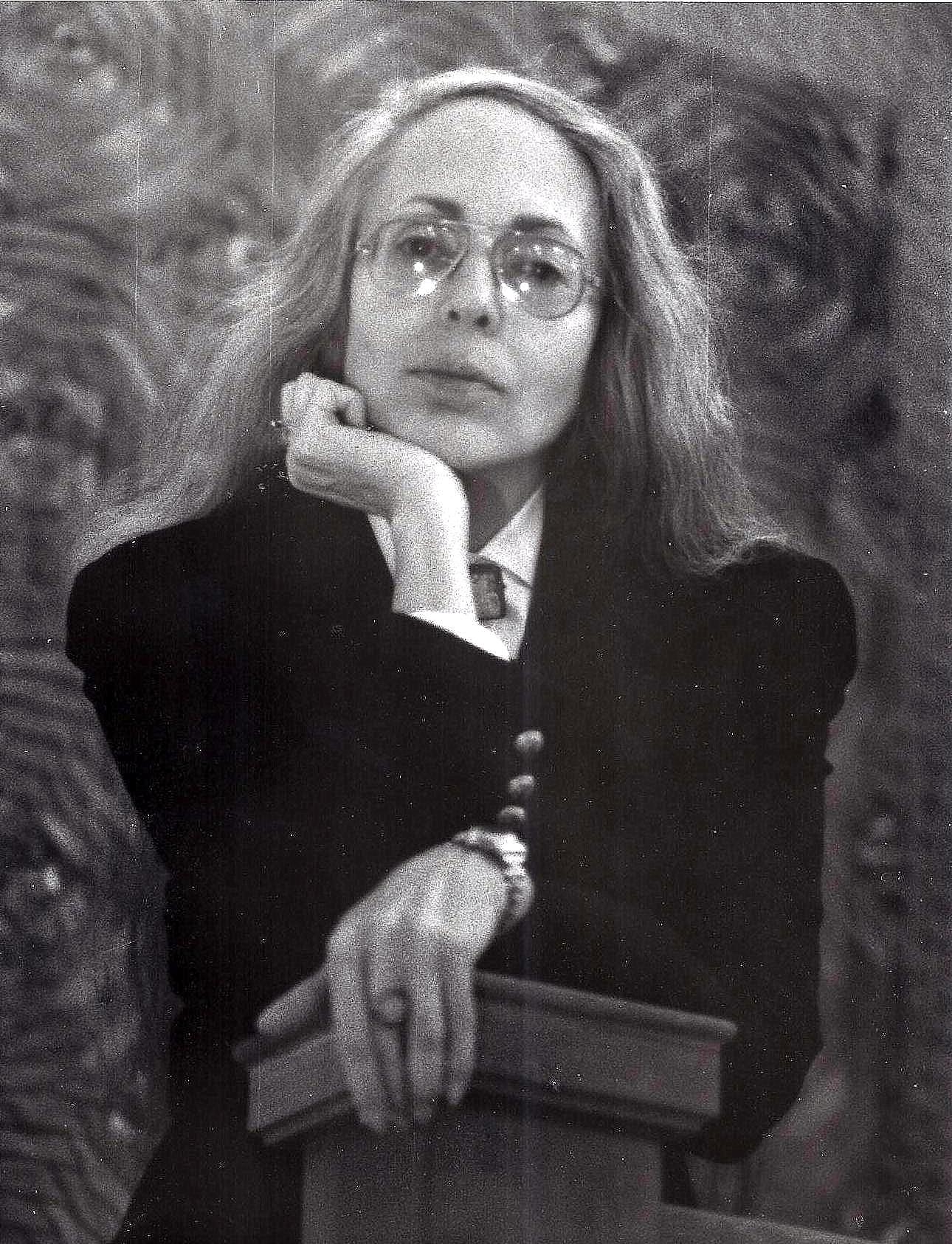
Interview with Hugo-Nominated Author Janet Morris

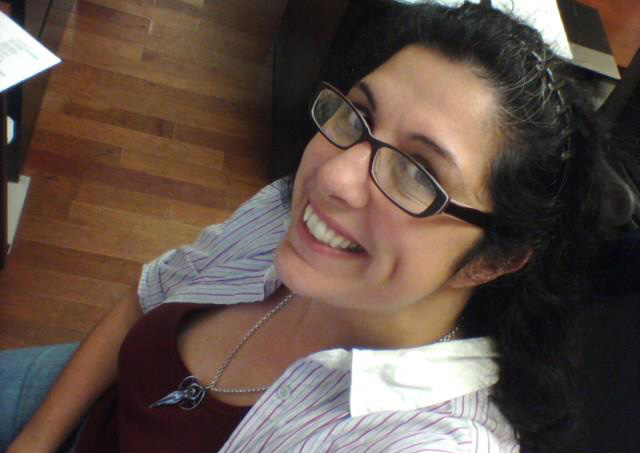
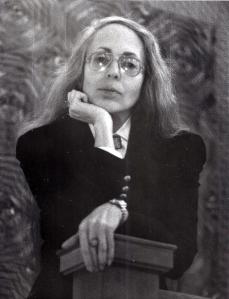
MICHAEL A. VENTRELLA: Today, I am pleased to be interviewing Hugo-nominated author Janet Morris. Janet is probably best known for her Silistra series. She has contributed short fiction to the shared universe fantasy series “Thieves World” and then created, orchestrated, and edited the fantasy series “Heroes in Hell,” writing stories for the series. Most of her fiction work has been in the fantasy and science fiction genres, although she has also written historical and other novels. Her 1983 book I, THE SUN, a detailed biographical novel about the Hittite King Suppiluliuma I, was praised for its historical accuracy.
Janet, let’s start by talking about the Kindle promotion going on right now.

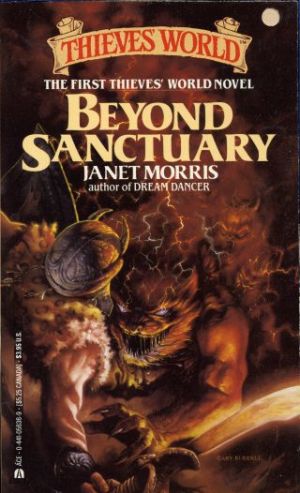
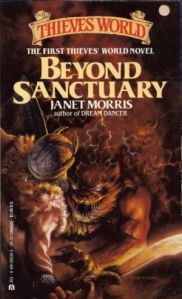
JANET MORRIS: There is an Amazon giveaway (May 15-17) of the author’s cut reissue of BEYOND SANCTUARY as a Kindle book. This is the only time this book will be offered as a free Kindle download.

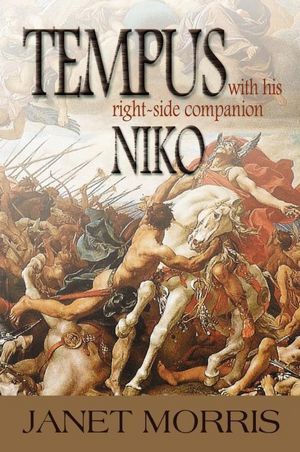
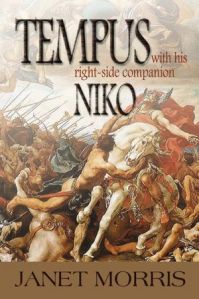
It the first novel in the “Author’s Cut” group of reissues: each “Author’s Cut” volume is compeltely revised and expanded by the author(s) and contain new material never before available. The other “Author’s Cut” volumes that have been released as ebooks and as trade paperbacks are TEMPUS WITH HIS RIGHT-SIDE COMPANION NIKO (2011) and THE FISH THE FIGHTERS AND THE SONG-GIRL (2012). The next “Author’s Cut” edition will be BEYOND THE VEIL (2013), second of the three “Beyond novels” in the Sacred Band of Stepsons series. We will eventually reissue all the Sacred Band of Stepsons books, and then more of our backlist, in this ‘author’s cut’ program. It’s very satisfying to get all the errors and deficiencies corrected, and have a chance to enhance these perennial sellers.

Most Sacred Band novels will not have giveaways; we chose BEYOND SANCTUARY as a good starting place for those new to the series and, in its enhanced and expanded form, as an attraction for those who loved these books and stories in the 20th century. We are planning to do a few Sacred Band stories as Kindle shorts as time goes by, but nothing specific has been decided.

VENTRELLA: You started your publication history with the Silistra series. How did you make that first sale?

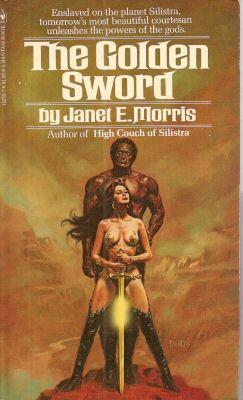
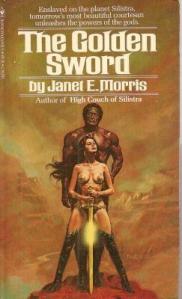
MORRIS: I wrote HIGH COUCH in 1975 and its two follow-ons, THE GOLDEN SWORD and WIND FROM THE ABYSS thereafter for fun: following the story for my husband and our friends. I knew no one in publishing and had no aspirations to break into the business.

One friend said her husband knew an agent and the book (HIGH COUCH) should be published but I would need to provide the manuscript in a clean, double-spaced copy, not single-space with handwritten corrections. I had my dad’s ancient typewriter (non-electric, non-correcting; the “p” key stuck) and was a terrible typist. I found out it would cost $1.00 per page to have the manuscript typed by a professional, which meant a $250.00 investment. So I didn’t do that for over a year; by then my second book was finished. In 1976 my friend sent the typed HIGH COUCH manuscript to an agent, Perry Knowlton, president of Curtis Brown, Ltd.. Perry called me and said I was a natural storyteller and he wanted to represent me and the book, and did I have any other books? I said I did but they weren’t typed up. He said, “Get them typed.”

Perry remained my only agent until his death. By the time I had the other books typed, he had sold HIGH COUCH for five figures to Frederik Pohl and Sydney Weinberg at Bantam and I was able to quit my day job. Then Perry sold THE GOLDEN SWORD and WIND FROM THE ABYSS to them in a package. By then I was writing THE CARNELIAN THRONE. By the time THRONE came out, Bantam had over 4M copies of the first three in print.

They bought THE CARNELIAN THRONE also, and my next series went to auction in two countries simultaneously based on sample chapters: I still don’t like to write outlines.

Silistra got many foreign rights deals, but only the French one is a divergent manuscript: for a sizable additional sum, I provided extra ‘erotic passages.’ ‘Erotic’ in those days was much less explicit than now, but even so, SILISTRA shook a lot of people from complacency: it wasn’t feminist, nor was it conservative; it featured pansexual characters and dealt with philosophical and sociobiological questions about sexuality and abuse of power; the main female character was powerful and had a sword: all these elements were challenging to the fantasy and SF community. And the book didn’t fit a neat category. In what was then a very hidebound and immature market, it blazed tough trails and still today doesn’t fit any simplistic or political model.
VENTRELLA: How has the publishing world changed since then?

MORRIS: E-publishing is a big change. Deconstructionism is rampant: the continual division of the novel into smaller and smaller subsets of its constituent elements (such as mystery, thriller, erotic, adventure, romance, horror, etc.) either mirrors or leads the deconstruction of politics and of society. Writing outside established marketing categories is increasingly difficult; the mid-list book, which was an incubator of talent, is all but gone in print publishing.

As an ox-gorer and a windmill-tilter who writes mythic novels with political subtexts and who never has been easy to categorize, I think e-publishing is a good thing. I no longer have to cut a big idea into three volume-sized chunks: I can write the book at the length it needs; I don’t have to fix or endure additional errors from semi-educated production people; I can control my covers and the book’s sell copy. The downside is there is much more free reading material (some worth the price, some not), and a lower educational level among some groups – but there have always been books and writers for every echelon of society.

VENTRELLA: Do you see a future where self-publishing will be accepted?

MORRIS: Sure, eventually. When we decided to return to fiction (after taking 20 years off to create the nonlethal weapons mandate, the nonlethality concept, and other initiatives in the defense policy and planning realms), we wanted to keep our fiction e-rights and at that time my agent (Perry Knowlton’s son, Tim, at Curtis Brown) said it was impossible to make a deal like that with a major house. So we decided to put together a small publishing house that did e-books and trades and make strategic alliances with other small publishing houses who produced quality hardcovers. We did this because the self-publishing road is still stigmatized, and because the production learning curve is steep. Kerlak did our first two hardcovers and gave me what I wanted: sewn binding, linen boards, generous print size, etc.

The stigmatization of self-publishing is primarily from the big chains, who look down on POD but POD was what attracted me to small publishing: no remaindered books; no books going to dumpsites; no torn-off covers returned and no tax liability for unsold stock. When we do reissues, we do “Author’s Cut” editions in which we can correct and expand and enhance each book that we’re releasing with better covers and production values than the twentieth century originals: an approach possible now but not practical even ten years ago.

Machiavelli commented in THE PRINCE as follows: “There is nothing more difficult to carry out nor more uncertain of success nor more dangerous to handle than to initiate a new order of things: for the reformer has enemies in all those who profit by the old order, and only lukewarm defenders in those who would profit by the new; this weak support arising partly from the incredulity of mankind who does not truly believe in anything new until they actually experience it.” We found this when initiating the nonlethal weapons programmatics: twenty years later, we are where we should have been in five years in nonlethals, and at absurd cost because nothing is adopted until big things take that viewpoint onboard commercially. Similarly, with publishing, as vested interests deal themselves in and competitive entities are created, things will stabilize – hopefully with new players, but with many of the old entities in new guises.
VENTRELLA: Will the rise of smaller publishing houses and e-books mean that these may someday be better accepted? For instance, will SFWA someday accept more of these publishers? Would that be a good thing?

MORRIS: Eventually the writers organizations must accept reality. E-books and small publishing are part of the new reality. SFWA, like all bureaucracies, protests that it protects its membership while it actually protects primarily itself. When SFWA sees that it must change to survive, it will change. Adaptation is always necessary for survival.

VENTRELLA: Now let’s talk about something more fun: Writing! What led you to write fantasy?

MORRIS: My work doesn’t fit many contemporary definitions of fantasy. I really write mythic novels and stories, sometimes in an SF and sometimes in a fantasy context, but there’s nothing ‘sweet’ or ‘pastel’ about my work: my characters face challenges and so do my readers.

When I write something that publishers call ‘fantasy’ I am writing in what I think is the most important tradition of fiction: starting with Homer and up through Shakespeare and Milton, the most important themes to tackle are those of the mythopoeic domain, tales of the body and mind seen through a temperament and a cosmos divorced from current reality so what is said can be more clear. For me, myth is the ‘common’ language of us all – or has been until these days of stories reduced to their lowest mechanical nature. My stories have a historical cognizance, a literary cognizance, and a philosophical/ scientific cognizance.

Bantam once wanted to separate a book of mine into two books: a short ‘wisdom literature’ book and a longer ‘mainstream’ book. I didn’t do that, but in retrospect it was a well-thought impulse on the publisher’s part.

I’ve also written nonfiction; a rigorous historical about Suppiluliumas, a Hittite king; a pseudonymous ‘novel’; other pseudonymous ‘high-tech thrillers’ (or what you will) with strong technology drivers. I make more money when I write under one male name than when I write under one female name or, as reality dictates, as “Janet Morris and Chris Morris.” But I write the book, each time, that forces me to write it, whether fiction or nonfiction. If the book is fiction, I write only when the story and characters demand that I give up my real life because what they will say is more important.

VENTRELLA: How do you create a realistic, believable fantasy world without just looking like every other realistic, believable fantasy world out there?

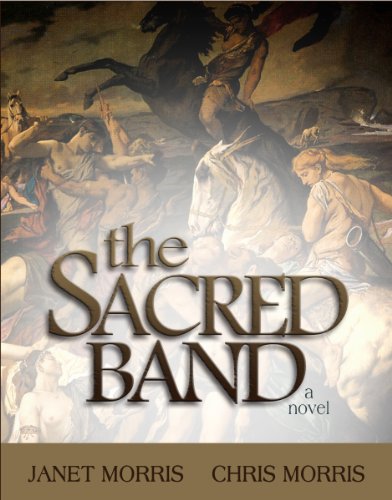
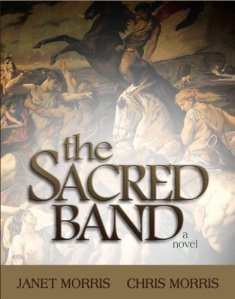
MORRIS: We say about THE SACRED BAND, our newest mythic novel, that it is “an adventure like no other.” This book had waited since the late 1970s to be written.

My books are remarkably unlike most of what else is available in contemporary fiction, so making the story or milieu ‘unique’ is not an effort for me. We started ‘The Sacred Band of Stepsons’ series and characters in the ‘shared world’ universe of Thieves’ World®, and so wrote in a milieu populated with other writers: making my work ‘fit’ their construct was a challenge. I have a deep love for the third, second and first millennia BCE, and my ancient characters always are touchstones to historical reality: I don’t “try” to make my fantasy world different from reality: I try to take you into the mythos of humanity. Silistra had a complete language, a glossary, a unique context, a rigorous rationale actually based on sociobiology and genetics, but had sword-wielding women and horses and ancient skirmishers as well as high-tech outsiders trying to understand it. The “Dream Dancer” series, also ‘science-fantasy,’ was set in space habitats primarily. It’s very easy for me to establish a credible world construct and posit behaviors there: I have predicted several major events in the real world over a number of years based on that ability to identify the most likely course of action that a country or individual will take in a given context. Now this skill is beginning to become a field of study called “intuitive decision making” and also “implied learning.” We once called it “speed understanding.” Writers often have this ability, and it allows creators to make their characters and societies credible. The writers who don’t have it can’t make their characters, or worlds, credible enough to please me.
If you want to write something completely unique, you will probably fail or at best write something without redeeming value. The mind works in certain patterns: the mind organizes facts in story form; it is your commonality with that body of human thought that makes a good book, not its estrangement from the common values that humans share.

VENTRELLA: As one of the original THIEVES’ WORLD gang, you’ve had a huge influence on modern fantasy fiction. It’s one of the first (or maybe the first?) shared world anthology. (I copied it completely and stole this idea for my TALES OF FORTANNIS series, by the way.) Where did the idea for this originate?

MORRIS: TW had one volume published when I was asked to come aboard: “Thieves’ World,” which had Joe Haldeman and Andy Offutt and Bob Asprin and others. Bob had the original idea for the “worst town in fantasy, the grittiest, meanest, seediest place possible.” He asked me to write for it at a convention and I said, “How serious are you about gritty?” I had written a very short piece about a woman who killed sorcerers for a living, and I proposed to bring those characters into Thieves’ World, plus an immortalized and very unhappy mercenary who regenerated. Bob said okay, I could bring the characters and take them out again afterward.

I started the story “Vashanka’s Minion,” that introduced Tempus (a/k/a the Riddler, Favorite of the Storm God, the Obscure, the Black). He has a metaphysical link to Herakleitos of Ephesus, and lives as a warrior in a Herakleitan/Hittite cosmos that I overlayed on what Bob and Andy already had done. But when Tempus got down to the dock and Askelon of Meridian got off the boat, Tempus said, “You, get out of my story. There’s not room enough here for both of us.” So Askelon didn’t arrive in Thieves’ World until “Wizard Weather,” although Cime, Tempus’ sister-in-arms, did show up. Tempus forms the Sacred Band of Stepsons in Thieves’ World #2, meets the patron shade of the Sacred Band in #3, and puts the Band together.

Then the TW books start to succeed and people get cranky. I called Bob and asked for a letter because I wanted to take my characters out of the shared town and do a group of novels with them, since Bob was complaining my characters were “too big.” So we agreed on that plan. These tensions made the stories more fun: people came and went; I took my characters into my own constructs such as Wizardwall and into the real ancient-world settlements of Nisibis and Mygdonia. Everyone contributed something useful to TW, and its fabric is still very rich.

I got Lynn Abbey’s permission, after Bob died, to bring the Sacred Band back to Sanctuary for a big novel to tie up loose ends that was set ten years after the Stepsons left town in TW #11 and well before Lynn’s own novel, since that milieu wouldn’t work for me. This project became THE SACRED BAND. As agreed with Lynn, THE SACRED BAND was followed by a novella, “the Fish the Fighters and the Song-girl” (the title story from the second “Sacred Band Tales” anthology), which takes the Stepsons back out of Sanctuary again and sweeps up all my TW stories not previously collected. So now, between “Tempus with his right-side companion Niko” and “the Fish the Fighters and the Song-girl” all our ten TW Sacred Band stories are assembled in two volumes, along with other Stepsons tales not available elsewhere.
As for fun quotient, I get more joy from the Sacred Band of Stepsons than from any other characters. And the SBS character list is expanding….

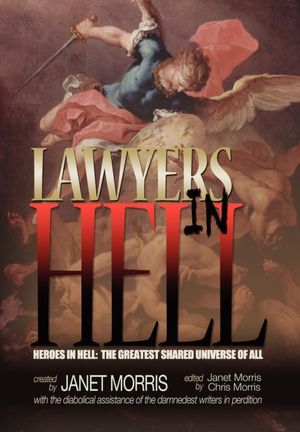
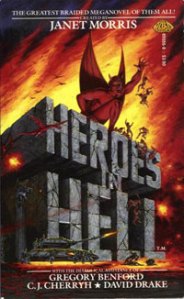
VENTRELLA: Another great series you’ve run is the HEROES IN HELL series (which now apparently includes LAWYERS IN HELL, which could be the name of my autobiography). What future themes can we expect to see?

MORRIS: If I’d known you, I’d have invited you to contribute to LAWYERS. In the 21st century Heroes in Hell books, next up is “Rogues,” to be followed by “Dreamers” (or “Visionaries,” I haven’t finalized the title), then “Poets,” then “Pirates” (or “Swashbucklers”). “Doctors” is a distinct possibility. There are many stories left to tell in hell, especially now that we have met hell’s landlords and heaven has sent down auditors to make sure hell is sufficiently hellish.

VENTRELLA: How do you work with the authors to make sure there is consistency in the world setting for these collections?

MORRIS: Each hell book takes a year to write and assemble, and the writers must coordinate more completely than was possible before the internet: we have a “secret” working group on Facebook where the writers interact and arcs and meta-arcs are chosen and polished. They choose characters. Our “Muse of Hell,” Sarah Hulcy, has put up 130 orientation docs, so there’s plenty of available information. When they choose the characters, we check to see if those characters have been used previously, and if the characters are available and meet our criteria, they can “claim” those characters for the time they write for the series. If they leave, they can’t take the characters: characters come back to me and stay in hell to be recycled.

Then they work on a short “two or three sentence” synopsis. I must accept the synopsis and the characters before they start to write. They can use legendary, historical, or mythical characters. They can’t use characters from modern fiction (post 1900) and they can’t use recently dead or living people. Then writers are allowed to post in-progress snippets which the group can read, and comment upon – or not. Chris and I write “guide stories” (two or three), setting up the current long arcs and the general tone of the volume at its beginning and end. Between these “bookends,” the other writers must set their stories.

When the stories are generally selected, I edit for continuity and tone, and Sarah Hulcy follows me with a copy-edit. Chris Morris is the final editorial reader, and with the three of us working on the stories for continuity and cohesion, we get a strong result and a better book than we could have produced before the internet.

VENTRELLA: I assume your anthologies are primarily invitation-only (correct me if I am wrong). How do you deal with stories that don’t meet your standard or are rejected for other reasons?
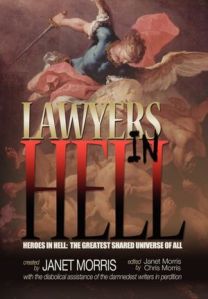
MORRIS: We are invitation-only. The milieu of our hell belongs to Chris and me. The authors know that from the outset. We usually won’t let them write a story we don’t think will work: by the time we’ve approved characters and synopsis, we know what the story will be and how we’ll use it. If someone simply fails to write a useful story, they probably haven’t met our guidelines. Our hell universe is easily recognizable. Each writer has left a clear trail of participation. If they want to rewrite a story we won’t accept and take out the arguably HIH context and characters, of course they can try.

VENTRELLA: Let’s discuss your novels. Which is your favorite?

MORRIS: In fantasy: THE SACRED BAND (Janet Morris and Chris Morris; Paradise, 2010; Kerlak, 2011), the mythic novel of the Sacred Band of Stepsons uniting with the Sacred Band of Thebes and returning to Sanctuary. In historical: I, THE SUN (Janet Morris, Dell, 1987).

VENTRELLA: Who is your favorite character?

MORRIS: Tempus and then Niko and the Sacred Band of Stepsons fighters.

VENTRELLA: What would you ask that character if you could meet him or her?

MORRIS: Tempus lives in my skull. I meet him on a regular basis and I’m happy to have a character so available. He’s been there since 1979. I went to the White House and he said, “Kinda small, isn’t it?” I would ask him, in all seriousness, whether he truly believes that “character is destiny,” a line he shares with Herakleitos.

VENTRELLA: And what do you think he or she would answer?

MORRIS: “The sun is new every day.” We call him the Riddler, remember.

VENTRELLA: Do you prefer writing fantasy or science fiction?

MORRIS: Fantasy, because very little in SF can transcend the gimmickry of a technical conceit, yet without that conceit at its heart a book isn’t truly science fiction. Furthermore, so little emerging thought and technology is employed by sf writers today that the genre is lagging far behind reality both in the cosmology area and the technology area: sf is no longer a place to experiment, but is now very derivative.

VENTRELLA: Do you find novels easier to write than short stories?

MORRIS: A novel is a major commitment, and must move smoothly along its trajectory. A “short story,” if it’s more than three thousand words, actually lets you focus more deeply on a circumscribed area or event. I think short stories and novels are different; each form is unique and equally demanding. I prefer novels but short stories are good exercises in discipline.
VENTRELLA: Do you tend to outline heavily or just jump right in? What is your writing style?

MORRIS: I don’t “outline” in the way that you mean. I get characters, and their background; I immerse my intelligence in a milieu that’s fully realized: a place with weather and politics and problems and a special nature. I use square post-it notes to write down certain things that must happen during a sitting: a line of dialogue, a particular event, where I need to be when the section is done; a section or chapter or story title. I know where I want the story or chapter or novel to end; I know where I want to start each section: how I get there is the fun for me.

Often times the question for me is which viewpoint character will have the best take on a particular set of events. When I have (twice) sold a project based on outline, it took all the fun out of it.

VENTRELLA: When creating believable characters, what techniques do you use?

MORRIS: I wait. I lie on the bed or go for a drive with paper in my pocket and wait for the characters to start to interact with me, or to tell their story to me. I need to “see something moving” and other writers who write this way all agree – if there’s something moving in your mind’s eye, there’s a character there.

Abarsis was a good example: I knew I wanted to do “A Man and His God” in which at the end the Slaughter Priest would die in Tempus’ arms. I got a character called Abarsis. I thought he and the Slaughter Priest would be two different people but the character wanted to be “Abarsis, the Slaughter Priest.” This was a very big, very strong character and I argued that if Abarsis was the Slaughter Priest then he would die. He said that was fine. Susan Allison of Ace called me up after she read it and confessed that the story made her cry. And Abarsis came back as patron shade of the Sacred Band: the character knew more than I what to do and how, in order to be memorable. Sometimes with good characters you must let go and let them forge ahead. This requires belief in your Muse.

VENTRELLA: You’ve collaborated with other prominent authors, at least one of whom lives with you, which makes it easier. How have these worked? (For instance, do you share writing equally? Does one author do the basic work and the other expand from that outline?)

MORRIS: With whatever writer, we talk about the story line, points of interest, what needs to be accomplished. If it’s Chris, he may come up with a title or a concept. I usually do draft or if I write with others, I’ll often write first: I like beginnings. With some writers, I send sections and they pick up the action; with others, I’ll do a draft and then they will add to it after I’ve done all I want to do, from beginning to end.
Everyone has a special genius, and working with each person is different. If the other writer starts, that’s a different process for me: I work on the story they’ve sent in Track Changes, do what I want to the entire manuscript. Then they accept or reject or we go back and forth. I worked a number of projects with a writer who was outline-driven and I could never figure out what those notations were supposed to evoke, so I’d call to discuss it. The outline made the other writer feel better. I can do a series of chapter titles and use those as an outline, but beyond that, outlines don’t help me. I often work with other writers who don’t like to outline either, or outline in the most cursory way.

VENTRELLA: Writers who are trying to make a name get hammered with lots of advice: The importance of a strong opening, admonitions about “writing what you know,” warnings to have “tension on every page” – what advice do you think is commonly given that really should be ignored?

MORRIS: All advice should be ignored. Every real writer is different. Every story has a nature, an organic way it wants to unfold. Tell a story that sweeps you up, that you want to hear, that keeps YOU on the edge of your seat. Some stories start best with dialogue, others with narrative: writing is catching the wave of creativity. The wave must be there for you to catch.

Writers learn from reading other writers whom they can admire, and writers whom they detest. Before Silistra, I bought a paperback by a famous writer and when I was done I threw it in the wastebasket, said “I can do better than that,” and did. When I read, I try to read writers who can teach me something, who are better at some things than I am. But print-through is always an issue: often when I am writing fiction I read only nonfiction, and vice versa.

The only person who should ask you to make changes in your book is some editor who has paid a lot of money for it. Even then, changes are risky: the story unfolds on the first pass the way the universe unfolded in the first moments of creation: in the way that it must.

VENTRELLA: What is the biggest mistake you see starting writers make?

MORRIS: Writers who have no characters and force a story bore me. Writers who are good at one thing – such as dialogue – may do that one thing too much: talking heads don’t work except very occasionally, when they can work very well. Knowing when to do something is part of the art of writing. Sometimes I act as an acquisitions editor. If you want to sell to me, you’ll tell me who, where, what, and why, and then finally how – all on the first page, hopefully in the first couple paragraphs: where I am, what it’s like, who cares about what’s happening. I want to fall through the words into a different place. But most of all, you must make me care almost immediately.

VENTRELLA: With a time machine and a universal translator, who would you invite to your ultimate dinner party?

MORRIS: Homer, Hesiod, Tiye, Virgil, Marcus Aurelius, Herakleitos, Einstein, DaVinci, Xenophon, Kikkuli, Thales, Plato, Odysseus (assuming he was Homer’s grandfather), Epaminondas, T.E. Lawrence, Marlowe, Shakespeare, Byron, Mary Shelley, Evelyn Waugh, Emil Zola, Dwight Eisenhower, Sun Tzu, Aspasia, Aristotle, Marguerite Yourcenar, Henry James, Suppiluliumas, Anksepaaten, Herodotus, Sappho, Emily Dickinson, Richmond Lattimore, Solomon, the Biblical “J.” And I’d really like to have Roger Penrose as toastmaster, but he’s still alive.

Interview with Author KT Pinto

MICHAEL A. VENTRELLA: Today, I am pleased to be interviewing KT Pinto. KT has been writing since she was twelve, finally getting her first book published in 2007. She writes alternate history (The Books of Insanity series) with vampyres and alternate reality (The Sto’s House Presents series) with mutants. She is a modern mythologist and a self-proclaimed ‘fluffy goth’ who would sooner wear pink with sparkles than black velvet. She will be a guest at Balticon in a few weeks (where I also will be a guest). KT will be promoting her latest novel and participating in a book release party.

KT, let’s talk first about your latest big news. You received a grant! Tell us about the End of the Rainbow project.

KT PINTO: I received a DCA Premier Grant from the Council on the Arts & Humanities for Staten Island (COAHSI), with public funding from the NYC Department of Cultural Affairs to re-write the myths from an alternate lifestyle perspective. I am going to be rewriting myths from Greek, Roman, Norse, Egyptian, and Gaelic cultures. You could read an excerpt of the book here.

I will also be doing a reading of this book at Bent Pages, NYC’s only remaining LGBT bookstore (391 Van Duzer Street, Staten Island, New York) on Thursday, October 11, 2012 at 7:00 PM.

VENTRELLA: And there’s a raffle, too?

PINTO: Yes! The proceeds from this raffle will go towards completing my End of the Rainbow grant project and the winner will be announced at the end of the Staten Island LGBT Festival on June 2nd! There will be 10 different prize “baskets” (the prizes will not actually be presented in baskets), each with a different theme. All of the basket items were donated (it’s great that people are so generous!), and the baskets range in value from $70 – $220. Details on the baskets can be found here!

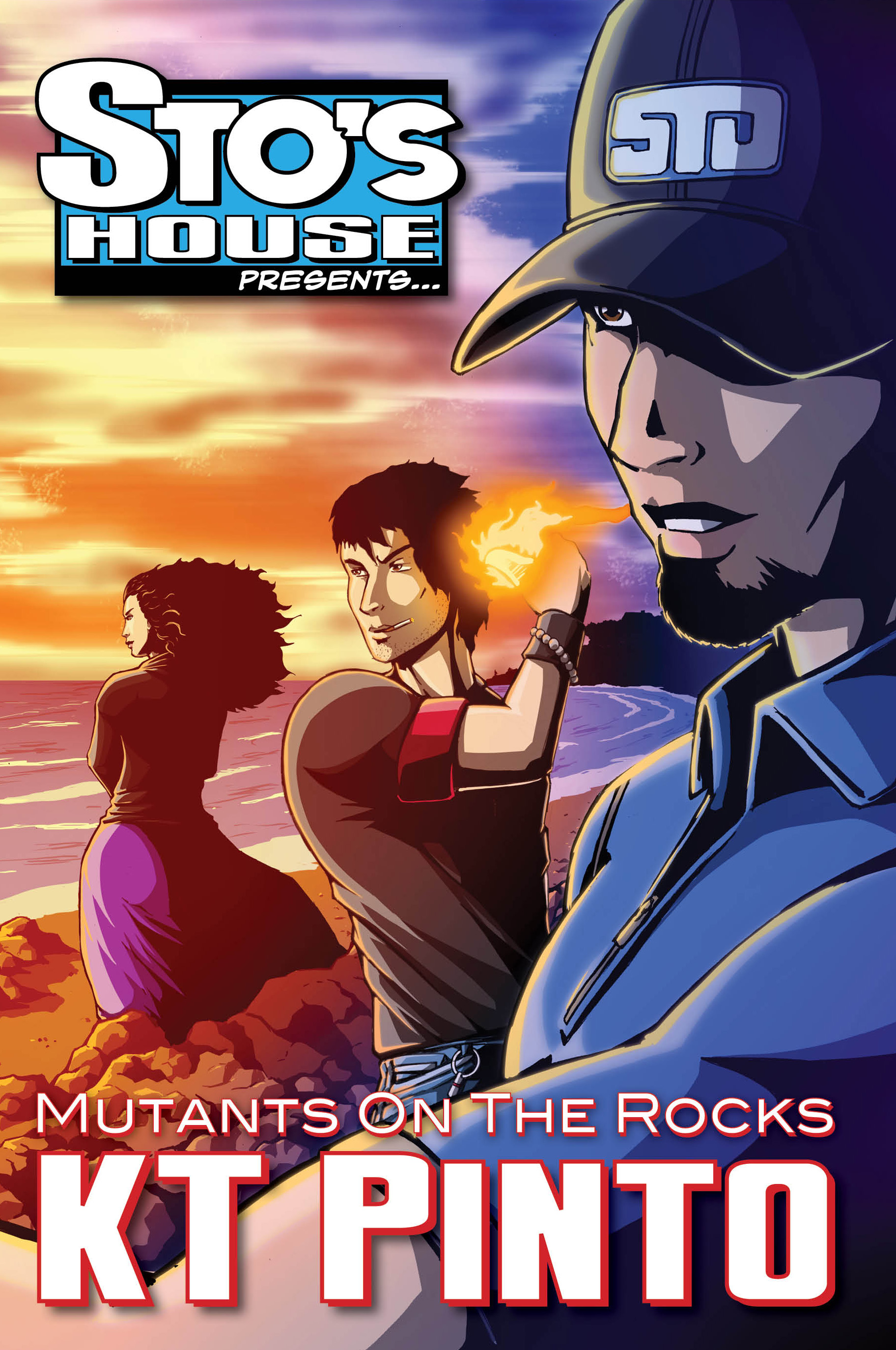
VENTRELLA: MUTANTS ON THE ROCKS is about to be released and is the latest in your “Sto’s House” series. Where did you come up with the idea?

PINTO: I had been having a really hard time with my vampyre series, and I realized that being in that dark place all the time wasn’t good for my creativity, so I decided to start writing some more light-hearted stories. I took the idea from an RPG I created called Sto’s House, which is about a bunch of 20-somethings who are mutated by the toxic waste in the Staten Island Dump. They don’t want to save the world, just find the world’s best microbrew.

The characters are based on my friend Christopher Mancuso (aka Sto) and the people we used to hang out with at his house when we were in our 20s. I hadn’t planned on it becoming novel-length, but one day I noticed that I had written 10 short stories, and had enough material for a really good (if I do say so myself) novel.

VENTRELLA: How has the series been received so far?

PINTO: People seem to be having a good time with it. I wasn’t sure how it would be received on Staten Island especially, but people seem to really enjoy the humor and there are enough different characters that readers can relate to one or more of them.

VENTRELLA: You’re having a release party at Balticon. Tell us about that!

PINTO: I personally am not having the party. Dark Quest Books, who publishes my Sto’s House Presents… series, is having a party highlighting their new releases for the spring. I think four authors are being highlighted there including myself and MUTANTS ON THE ROCKS, which is the second book in the Sto’s House Presents… series.

VENTRELLA: Like me, you’re a regular on the east coast convention circuit. What are the advantages of attending these?

PINTO: Conventions give you a chance to interact with fans as well as getting together with fellow authors and networking with publishers and agents. For me, it’s also good to be on the circuit because I get a chance to see what’s going on in other genres and other disciplines (like costuming and gaming). I actually am starting to cut back on some local conventions and travel to further locations, like Pittsburgh, Pa. and Roanoke Va. because I want to connect with more fans and professionals.

VENTRELLA: These days, it takes much more to be a successful author than merely writing a good book. What other efforts have you made to publicize yourself and do you think they have been worth your time?

PINTO: I have gotten very involved with my local arts organization, COAHSI, which is a good resource not only for grants, but to meet other local artists, find out about community events, help promote you and your work and even to learn about more mundane information like jobs, insurance and other resources.

I’ve been on Live Journal for a really long time, and don’t plan on leaving it any time soon. Not only am I able to write full journal entries, but I can also link it to my facebook and twitter accounts. Facebook used to be a good resource, but it’s gotten so big (I’m up to 1000 friends) and has made so many changes, networking has become difficult.

Inanna from By Light Unseen Media – who published MARCO, the third book in my vampyre series – suggested that Goodreads may be a better site for promotions, so I’m feeling my way through that site as well.

I also have an account with Constant Contact, which helps me send out a newsletter to a mailing list that I developed by going to conventions.

VENTRELLA: What was your first professionally published work?

PINTO: My first work was “E-mails 10”, which was a short story published in Nth Degree Magazine (which is now Nthzine on-line).

VENTRELLA: You have a LARP background (as do I). How has that led to you writing fiction?

PINTO: Although I have been writing since I was 12, LARPing was what helped me create my world and characters of The Books of Insanity series. I used to own a gaming company that ran LARPs around the Hudson Valley, NY and at conventions.

During that time I created some original LARPS (ex: Sto’s House) and some murder mystery nights, the main game that we ran was vampyre LARP. So I was not only able to create evil, blood-sucking fiends, but I was able to become them as NPCs

I had created a character that was supposed to only be a one-shot ‘big bad’ that the players were supposed to kill in a one-night (possibly two-night) story line. More than a year later, she still existed, because instead of people trying to kill her, they wanted to join forces and build storylines around her.

That character’s name was Celeste, and she became the main character in my Books of Insanity series.

VENTRELLA: What are the differences between writing for a LARP and writing fiction?

PINTO: When writing a storyline for a LARP, you have to be prepared that all of your plans are going to be destroyed within the first five minutes of the game. You have to plan for different levels of gamers and prepare to lead them through a storyline if necessary. Other times your PCs make their story their own and all you have to do is keep track of the rules (in my case, the staff kept track of the rules; I was more a storyline/character person).

With fiction, it’s all on you to keep the audience’s attention and creating all the drama and action. On the upside, you don’t have to worry about almost 500 characters trying to do their own thing…

VENTRELLA: Boy, do I know that feeling. Do you prefer short stories or longer works?

PINTO: I used to dislike writing short stories, but the more I do (and the more I get published!) the more I like them. I think I have developed a rhythm to creating a short in a concise manner, unlike when I write a novel.

When it comes to my reading, my preference has always been novels. I tend to feel gypped when I read a really good short story and it ends. It always feels like it ended too soon and leaves me wanting more.

VENTRELLA: You’ve mostly dealt with mid-sized press (like me!). What are the advantages of dealing with a smaller press?

PINTO: Mid-sized presses are good because they’re more open to different ideas and you are able to communicate with the senior staff on a regular basis. You also don’t need an agent in most cases to work with a mid-sized press.

Working with mid-sized presses also gives you a chance to work with and recommend other professionals in different disciples, like editors, artists, typesetters… for example, the cover for MUTANTS ON THE ROCKS was created by Victor Toro, an artist that I recommended to Neal, the publisher of Dark Quest Books.

The downside to a smaller press is they don’t get the respect that they deserve from bookstores, reviewers, some conventions…

VENTRELLA: Do you advise new authors to consider self-publishing?

PINTO: I think self-publishing is good if you have the same knowledge as a publisher would, in order to protect yourself legally and financially.

I think self-publishing is good for someone doing a photography or art book, because it’s a way of highlighting your art form. But for me, I think mid-sized presses are a good way to interact with other writers and learn about more writing opportunities that are both with other publishers and with your own company.

VENTRELLA: Let’s talk about your writing style. Do you tend to outline heavily or just jump right in?

PINTO: It depends on my project. My Books of Insanity series happens over 2000 years, so not only do I have to plan out each book story as I write them, but also had to plan out the arch of the series (I have 13 books planned, but once you hit the world wars, that number can become bigger).

The Sto’s House Presents… series, on the other hand, is completely off the cuff.

VENTRELLA: What predictions can you make about the future of publishing, given current trends towards e-books and self-publishing?

PINTO: I think publishing is always going to stay around; it’s just going to change form. For example, we no longer write on stone or papyrus. I also think with the popularity of ‘nerds’ with all their crazy book reading, along with the eventual (hopefully) return of a good economy, the publishing world will flourish. Just not as much in the brick and mortar form.

I also think that with the healing of the economy will also come a rise in vampires again. Lately zombies and steampunk (and sometimes both) have taken over readers’ interests, but eventually it will shift back again. And then my vampyres will rise and take over the world… and my mutants will crack open a beer and enjoy the show.

Damn you, Real Life!

As I type this now, I am sitting in a hotel room in Harrisburg, Pennsylvania. I’m here for a legal seminar. As an attorney, I am required to take a certain number of courses per year to make sure I am up to date on the latest laws and cases. I guess that’s why it’s called a “practice.”

I just finished a trial that lasted three weeks, and I have two more scheduled for next week. I also run a nationwide live action role-playing game, act as parliamentarian for the local Democratic party, and take care of my wife (a cancer survivor who is a bit handicapped because of it). Sometimes I get to go to conventions where I can talk about the writing that I am not doing.

I’d bet each one of you have similar time problems.writing

I know that professional writers say “Be sure to write something every day” and that’s a great piece of advice. I’d gladly do it if Real Life didn’t get in the way. And sometimes Real Life is so stressful that I don’t want to do the thinking that writing involves. I’d rather load up a computer game and kill some zombies, watch a movie, or read a book. Or watch a movie based on a book about killing zombies.

I know that the more I write, the better I get. I can see it in my work. I know I should try to spend some time every day writing.

But damn, that’s hard to do!

I guess some of it is a matter of priorities. I have already cut back on the amount I do for the game; I do not volunteer as much for political campaigns as in the past.

But as far as work goes? Hey, I have to pay the bills.

Then I think to myself “If my new book gets picked up by an agent and then is published by a major house and produces some income, maybe I can cut back on the legal work.” It’s nice to dream.

But until that day, I will write whenever I can while shaking my fist at Real Life.

My Ravencon 2012 Schedule

I’m looking forward to attending Ravencon on the weekend of April 13th. As a son of Richmond, I love going back and visiting friends and seeing the city — or at least as much as I can, since I’m mostly in a hotel all weekend.

Here’s what they have planned for me:

Building Suspense (Friday 4:00 pm) Panelists discuss how to structure a mystery and keep the reader’s interest without frustrating them or giving too much away. With Austin S. Camacho, A.J. Hartley, Gail Z. Martin, and Kate Paulk

Ghost Hunters verses Mythbusters (Friday 6:00 pm): Are we still as gullible as our ancestors? Do we really still believe in ghosts and goblins, or is it all just camp fire stories? With Diana Bastine, Ben Davis, Pamela K. Kinney, and Christopher Weuve

Opening Ceremonies (Friday 7:00 pm): The guests are introduced and there is much merrymaking.

Science Fiction Motifs in Fantasy (Friday 9:00 pm): What happens when fantasy uses science fiction motifs? Is it now science fiction, or at least not “real” fantasy? Panelists discuss F/SF mash-ups and their potential to destroy civilization as we know it. With Diana Bastine, Barbara Friend Ish, Monica Marier, Ahlen Moin, and Janine K. Spendlove

Pervy Elf Fanciers (Friday 10:00 pm): Panelists discuss the romantic appeal of humanoid but non-human creatures such as elves, vampires, fairies, and so on, as well as the ramifications of human-nonhuman interbreeding. With Anita Allen, Rachael Hixon, Monica Marier, KT Pinto, and Erin “Zenobia” Woods

What Harry Potter Did Right (Saturday 9:00 am): What did J.K. Rowling do right, and what can an aspiring author learn from that? With Paula S. Jordan, Gail Z. Martin, and Warren Rochelle.

Self Promotion and Social Anxiety Disorder (Saturday 1:00 pm): … At Least Your Mom Still Loves You (Maybe). Talking about your work isn’t as hard as you think. How to promote your work without driving yourself crazy. With Austin S. Camacho, S. Reesa Herberth, Ahlen Moin, Michelle Moore, and Leona Wisoker

Disturbing Ramifications of Harry Potter (Saturday 10:00 pm): What does trust mean in a world with polyjuice potions, love potions, and the Imperius curse? And what really happened to Dolores Umbridge? With Mike Kabongo, Gail Z. Martin, Tedd Roberts, Patrick A. Vanner, and Robert E Waters.

Interview with author and editor Danielle Ackley-McPhail

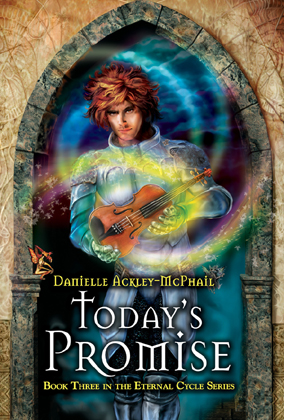
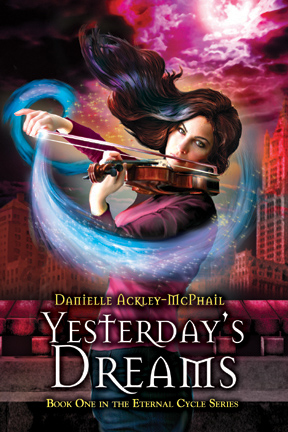
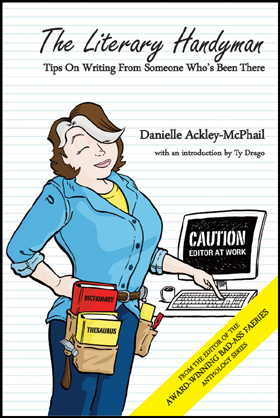
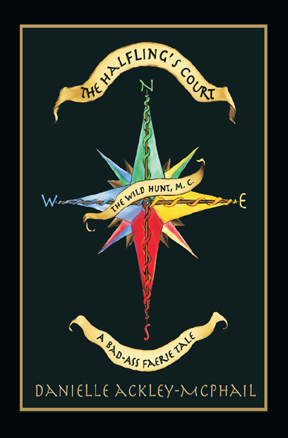
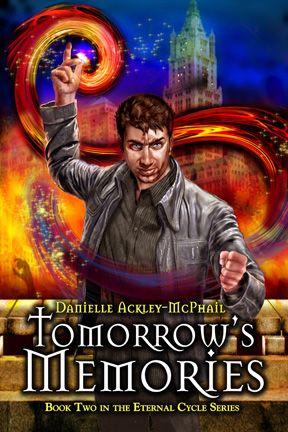
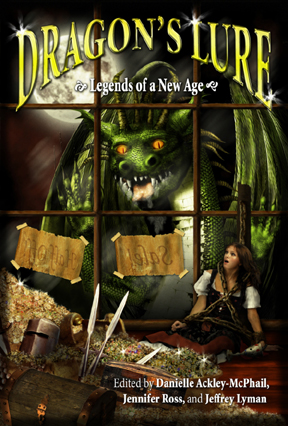
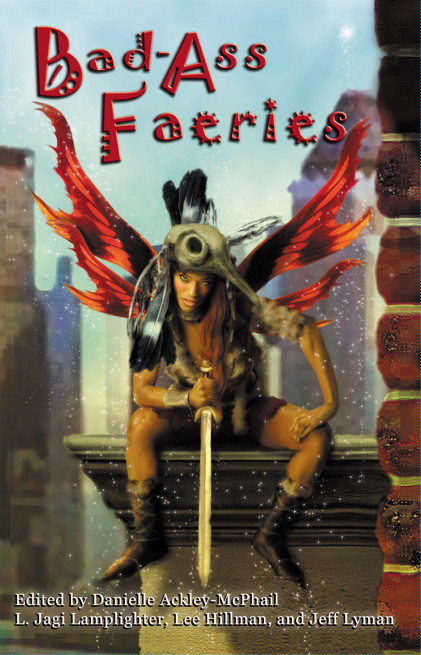
MICHAEL A. VENTRELLA: Please welcome Award-winning author Danielle Ackley-McPhail! Danielle has worked both sides of the publishing industry for over seventeen years. Her works include the urban fantasies YESTERDAY’S DREAMS and TOMORROW’S MEMORIES, the upcoming TODAY’S PROMISE, and THE HALFLING’S COURT, and the writers guide THE LITERARY HANDYMAN. She edits the Bad-Ass Faeries anthologies and DRAGON’S LURE, and has contributed to numerous other anthologies.

To read excerpts from the Eternal Cycle series, and other works by Danielle Ackley-McPhail, visit the excerpts page on her website.

Danielle, tell me about your new “Eternal Cycle” series.

DANIELLE ACKLEY-McPHAIL: Well, I can’t really call the Eternal Cycle series new … or not all of it, anyway. YESTERDAY’S DREAMS was originally published by Vivisphere Publishing back in 2001, then again by Mundania Press in 2006, and TOMORROW’S MEMORIES was also published by Mundania in 2009. TODAY’S PROMISE completes the series and has never before been in print. All three books will be released by Dark Quest Books between now and Summer 2012. In fact, the DQ edition of YESTERDAY’S DREAMS is already available.

When I started this series I had no idea I was writing a novel, let alone a trilogy. I had an idea and then that idea spiraled out of control. I’ve always been interested in Irish mythology but most of the Irish-themed fiction I had picked up over the years never really did anything with the mythology. When I finally realized Yesterday’s Dreams was going to be a novel I saw a chance to indulge my interest in the Irish and mythology in general.

Set in New York, the books follow Kara O’Keefe, a young first-generation Irish American. What Kara doesn’t know is that she is also descended from the Sidhe, the elves of Ireland. When her father begins his second battle with cancer Kara must make a choice. She pawns her heirloom violin to save the family house. She ends up at Yesterday’s Dreams, a pawnshop in the Village run by Maggie McCormick, a full-blooded Sidhe. Kara’s selfless act brings her to the attention of forces both good and evil. One wanting to teach her and keep her save, the other wants to claim her power for his own, by any means necessary.

Olcas is an ancient demigod long ago defeated by the Sidhe when he and his and his brothers, along with their mother Carman terrorized Ireland. Though their bodies were destroyed their spirits lingered. Throughout each book one of them returns by possessing another until they join forces first to take revenge on the Sidhe, then ultimately dominate the world.

This is a classic tale of good versus evil, along with a healthy dose of self-discovery, written in a lyrical style. I like to think I capture the magic and wonder of the old myths, while introducing some truly unique concepts.

VENTRELLA: What makes your series different?

ACKLEY-McPHAIL: You know, I’m not egotistical enough to thing I really bring anything different in content. If you look hard enough you can find similar things somewhere else. What I — and all other authors — bring to the table is perspective. No matter how many times a story has been told the perspective is unique. I also bring passion and vision. I take the same elements that everyone is familiar with and see what unexpected angle I can put on those elements. From time to time I hit on a concept that my readers really seem to appreciate, such as the Great Wall that appears in both TOMORROW’S MEMORIES and TODAY’S PROMISE, where the life forces of the Sidhe take visible representation in the form of a spiraling knotwork pattern that changes and grows with each thing they experience, or in THE HALFLING’S COURT where my biker faeries have wings, but they are only partially physical. They function in the same way as a magic sink, starting as a fin that unfurls from the fae’s body then expands as they draw in more magic. The more magic they gather, the more tendrils come off those fins until they look like angel-style wings made of mage energy. For the most part, though, I just look at things differently. As different as I can manage and then I let my imagination out to play.

VENTRELLA: When you’re approaching a story, how do you begin? Characters, plot, themes?

ACKLEY-McPHAIL: I have a saying: The plot is what happens when you’re getting to know the characters. It is very important to me to have well-developed characters people connect with and care about, or love to loath, depending on their role. Not saying the story isn’t important, but it is filtered through the characters’ perception. Without the characters there is no story. It is my job to ensure the characters are not interchangeable, but distinct and recognizable personalities in and of themselves.

VENTRELLA: What is your writing style? Do you outline heavily, for instance, or just jump right in?

ACKLEY-McPHAIL: You know, I’m told I’m a pantser. Until I was I had never heard the phrase, but basically it means I jump in and discover the story as I go along. I’ve tried writing outlines, but most of my writing starts with an idea. Sometimes one line. Often I don’t know where it’s going until I get there. Most of the time I write a scene until that sparks another idea and I jump to that scene until I have a framework that give me an idea of the shape the project is going to take. Think of it as the supports for a deck. You pour the footing, you build the framework, and then you close everything in.

With YESTERDAY’S DREAMS it started with two things: an idea for a short story about a pawnshop that only accepts goods that are connected to the owner’s soul and a bad guy named Olcas, which is Irish for evil. I named the character that without realizing that there was an actual figure in Irish myth named that. Once I made the discovery that determined that my novel became a trilogy because Olcas had two brothers. So you see, I never approach a project trying to figure out what all the pieces are because my imagination works better when I give it free rein. I’m not saying there aren’t time I know where I want to end up, but I enjoy the discovery of figuring out the in between as I go. I used to think this meant it took longer for me to finish a project, but recently I finished TODAY’S PROMISE, the last book in the Eternal Cycle Series, and it only took three months, without an outline. The process was all-consuming, not to mention exhausting, but the satisfaction in the end is something I’ll never forget. I don’t regret not working from an outline, it’s just the way my brain works. I don’t recommend it for everyone, but it does work and I love the organic feel of the end result. I find that I do need to keep a close eye on details so that if something changes I make the proper adjustments in the bits I’ve already written. By writing the key points as I figure out what they are and then linking everything I end up with a tightly woven story.

VENTRELLA: Do you have a favorite of your babies?

ACKLEY-McPHAIL: I have favorite aspects more than anything. Every book or project has something that stands out. In THE HALFLING’S COURT, my biker faerie novel, it was the weaving of social identity with the fantasy elements and drawing parallels. I was able to draw heavily on mythology, which I really like, but also on dialect and recognizable subcultural elements. Finding the way to meld the recognizable with the fantastic really gets me going. I love turning things on their ear.

In the Eternal Cycle series I again weave mythology with the everyday, but there I actually took an existing myth and expanded on it which was challenging and also really cool. See, Irish mythology is a bit fragmented because it was an oral tradition and the ethnic identity of the Irish people was for so long repressed that a lot of detail has been lost. Taking the bits and pieces and weaving them into something rich and powerful is a real thrill. So much of the myths and legends dovetail nicely, but there was also the challenge of addressing popular belief, particularly with something as popular as elves. We draw on them so heavily in our literature that the lines between legends and creative license have blurred. Take for example the belief that elves or faeries can’t touch cold iron. I’m not saying that doesn’t exist anywhere in world mythology, but I found nothing to support it in Irish mythology. In fact, Goibhniu, one of their major gods, is a blacksmith. Sorry, but blacksmiths work with iron and steel. Also, redcaps … they carry and iron pike. So, I had to find a way to recognize the popular belief while at the same time explaining why I’ve discounted it. One thing I did find, though, is that in the folklore, which is often separate from the actual mythology, it was common to hang iron implements to ward off evil … scissors over cradles and horseshoes over doors, that kind of thing, so I suspect that is the basis for the belief about elves and iron, but that only presumes that elves are evil, which to me isn’t necessarily so. I love playing with details like this.

And … on another front, I actually have a nonfiction book that will always be special to me. It is THE LITERARY HANDYMAN, an informal writer’s guide. This isn’t meant for someone on our level, with either learning or experience already under their belt, but for the beginner who could really use some solid advice about the craft and business of being a writer. That one is special to me because it is so much different from the fiction I write. The core of the book started out as various articles I posted at different sites on the internet, so there is some overlap, but each article is meant to be taken individually so I didn’t worry about that too much. Besides, some points bear reinforcing.

VENTRELLA: Who do you like to read?

ACKLEY-McPHAIL: I do have a few core authors that I follow … Anne McCaffrey, Patricia Briggs, Sherrilyn Kenyon, Mercedes Lackey, Jim Butcher … you know, the ones most people know about. But I also have some personal treasures that have yet to be discovered by the world at large, and I’ve had the pleasure to work with them. They are L. Jagi Lamplighter, Bernie Mojzes, Elaine Corvidae, and James Daniel Ross. There are others, but this would be a really long answer if I tried to include everyone.

Of course, romance is my guilty, junk-food reading.

VENTRELLA: Let’s discuss publishing. You’re with Dark Quest Books. How did that come to be?

ACKLEY-McPHAIL: I was courted. There’s no other way to put it. The publisher, Neal Levin, saw what I was doing on my own and actively sought out a relationship, first on the technical end, and then as an author. He wanted to build his list quickly and effectively and knew I had the promotional experience, as well as contacts in the industry. When I had issues with several titles going out of print Neal was in a position to offer me a home for them, a situation that has benefited us and the authors involved quite nicely.

VENTRELLA: What are the advantages of going with a small press?

ACKLEY-McPHAIL: I have worked for virtually every level of publisher in the industry, from Random House to reprint publishers, specialized markets such as medical or music publishing, even magazines. I have seen pretty much everything there is in publishing. That insight has taught me that no publisher is perfect and many of them have the same flaws when dealing with their authors, no matter the size of the House: response time, royalty payments, and scheduling issues. The majority of authors struggle with all of those things. The larger publishers are both harder to get into and less forgiving of the learning curve. I find by starting out in small press I have had an opportunity to learn the business more fully, make contacts and establish myself. Print distribution is harder for a small press, but with the market drifting more toward ebooks anyway that is less of drawback.

The other concern is marketing. Whether you are with a small house or a big one, in most cases the promotional responsibility falls to the author anyway because the marketing budget is disproportionately divided with the large houses and generally nonexistent with the small ones.

So, when you look at it that way large houses have only two things going for them, visibility and distribution. The drawback: higher expectations and very little flexibility when it comes to identifying a “successful” book.

I know one author who signed a three book deal with a major publisher. The first book came out and performed respectably, but not to the publisher’s expectations. The elected not to release the other two books in the series, but likewise would not release the rights either as they were keeping the first book in print. Unless you do really well at the offset there are only a small proportion of authors out there (relative to the number that are actually published) that have staying power with a large publisher, whereas small press by using print-on-demand technology, can afford to maintain a large backlist and allow titles to grow in visibility over a prolonged period of time. Unless a publisher goes out of business or the relationship is dissolved by one or the other party, books stay in print indefinitely.

Personally, I also find small press affords me a lot of creative control, more personal interaction with my publishers, and deeper understanding of the process because I am involved at virtually every stage. In many cases I have taken books from concept to completion before even approaching a publisher to sign it. This experience has allowed me to work on projects a major publisher probably never would have considered, some of them which have been quite profitable, as well as award-winning. With a larger publisher you are luck if they even ask what you would like to see on the cover. Once you give them the manuscript you take what you get, a lot of the time, and it isn’t always representative of your book’s content.

This doesn’t mean I would never consider or pursue a contract with a large publisher, it just means that I will always maintain a relationship with small press as well.

VENTRELLA: You’re Marketing Director for Dark Quest. Were you involved in its inception?

ACKLEY-McPHAIL: Well, not really. See, Dark Quest started out as a game company over ten years ago. That arm of the company still exists, but separate from the fiction division of Dark Quest Books. Neal Levin had tested the waters with SKEIN OF SHADOWS, a novella collection based on a gaming universe. That book had already been produced and Dark Quest was looking to take things further into full-fledged book publishing. They were familiar with my work both writing and promoting through the Garden State Horror Writers, a writers group we both were members of. He first approached me to come on staff as Promotions Director. At the same time he approached my husband, Mike McPhail, to pick up the role playing game he’s had under development. That game is the Alliance Archive Martial Role Playing Game, which is scheduled to release later this year.

While we were negotiating our participation another publisher of ours made the decision to opt out of the business. Unfortunately, that company published our best-selling anthologies: The Bad-Ass Faeries series and the Defending the Future series. Dark Quest Books stepped in to contract the Defending the Future books, collections of military science fiction short stories by some of the biggest names in the industry. In fact, SO IT BEGINS was the first book Dark Quest released, after SKEIN OF SHADOWS, which was a venture of the gaming arm of the business.

Between Mike and I, we’ve been taking an active role ever since, not just as authors, but editors, promoters, designers, and artists. Just recently the Defending the Future series has become the core of a new imprint, DTF Publications, which offers military science fiction novels and anthologies by well-known and beginning authors. Mike McPhail is the administrator of that imprint.

VENTRELLA: Let’s discuss marketing. These days, even authors with major publishers need to know how to market themselves. What are some of the smartest things an author can do to promote their own work?

ACKLEY-McPHAIL: Create an internet presence. You can do this via a professional looking website, social media, blogs, being featured on book sites, making sure your work is in the database sites with accurate information and covers wherever the book is listed. You should also solicit author interviews, guest blogs, and book reviews, as well as join productive professional organizations or groups, such as Broad Universe or SFWA (Science Fiction and Fantasy Writers of America). Not only do such groups offer support and networking opportunities, but they are a great way to learn of events. Other than possible membership fees, all of these are free promotions.

With your website include more than just who you are and what you’ve published. Have excerpts, a schedule of author events, free stories, a link to a blog you update regularly, that kind of thing. Some authors even have contests. Make the site something that warrants repeat visits. On mine I include my costuming and crafting efforts as well as a point of interest. Mike, my husband and fellow author and editor, includes the development phases for his creative works.

The other thing I recommend is conventions. Both attending them and distributing flyers or bookmarks at them. If you can attend you meet your target audience first hand and benefit from the celebrity phenomenon, an one would presume the potential readers can actually see your book and perhaps even buy it. If you can’t attend most conventions will accept promotional goods for free, or a slight fee if you want the materials put in the registration packs. If you write speculative fiction or one of the other established genres like romance or horror, this is a surefire way to reach those you want to reach, whereas a general book fair might not be as effective.

VENTRELLA: What are some of your marketing pet peeves?

ACKLEY-McPHAIL: My biggest issue I have with promoting (beyond the fact that it is a massive time-sink) is that once you make the contact requesting a review or interview you have no control over 1) if anything comes of it, and 2) if the person responsible for posting the review or interview presents it either professionally or accurately. I have not encountered this, but a friend solicited a review from a site and sent a physical copy of the book. When the review posted it was clear the reviewer only read the back cover copy, which had certain incorrect information on it that made it obvious the reviewer hadn’t actually read the book.

One thing I did encounter myself was one person I gave a book to for review who rather than writing a review of their own lifted two of the Amazon reviews for the book and posted it on their site, as if they had wrote them.

VENTRELLA: You’re also an anthology editor. Do you find that to be a difficult job to take on?

ACKLEY-McPHAIL: Again, like promotions, this is a time-consuming job. There are many elements in being a project editor that are not the fun bits. Paperwork, organizing details, acting as a go-between with the publisher and the authors. Working with difficult personalities. I love taking a book from concept to completion, but some of the stages in between are pure torture.

VENTRELLA: I also edit my own anthologies and it’s not easy, especially when you have to say no to friends who submit stories. Has this been a problem for you?

ACKLEY-McPHAIL: I’ve had to deal with a lot of things across the ten anthology projects that have actually published, and a number that are still in the works. There have been problems with unpleasantness when it came to rejections, but my biggest problems have been with temperamental authors having issue with the editing process or the publisher’s terms, and not dealing with either in a constructive manner.

Sadly, this has lead me to be more circumspect in who I invite to a project because editing an anthology has enough inherent headaches involved without voluntarily inviting gratuitous headaches on board.

VENTRELLA: Anthologies just do not sell like they once did, given Smashwords and other places on the internet to get stories. What have you done to get attention and increase sales?

ACKLEY-McPHAIL: We’ve built something of a reputation, for one. Of the projects I am directly involved in five have been finalists for various awards, three have won. There are plenty of excellent reviews, and, of course, we have made a point to be very visible at conventions through launch parties, panel discussions, adds, and a presence in the dealer’s room. For our two major series, Bad-Ass Faeries and Defending the Future we have dedicated websites with extra content and lots of information about the series. Another thing we do is try and solicit submissions from big name authors who happen to be friends, people likely to do it for the love, not those who want big money. I also tend to give more consideration to authors who write well and I know put effort into promoting every project they are a part of. The two series I mentioned are by far our best sellers, with sales in the thousands, but all of them do respectably, particularly in ebook.

VENTRELLA: Do you accept unsolicited stories? If so, what are you looking for now?

ACKLEY-McPHAIL: My projects are a bit different from the usual collection. I require every author to present me with a proposal for approval because my biggest gripe is having to reject a perfectly good story just because it is too close to something I already have, so yes, I will consider proposals from authors that have not been approached for the collection, but the stories will have been discussed beforehand in those instances. I do not generally consider stories that were not specifically written for the collections because we do theme anthologies, so unless the author has talked to us in advance and made a case for their story, it is best to wait until there is a call for submissions and then pitch your idea.

I have two projects in the works currently, but the deadline has passed for both of them and any future projects will be invitation only as I have learned that there is much less hassle that way. But you know, I have had to make the decision recently to step back from anthologies for a while. Between the stress and the time involved I haven’t been accomplishing anything toward advancing my personal writing career. I don’t see departing anthology work altogether—there are a large group of people who likely wouldn’t let me—it’s definitely taking a back burner for a while. Mostly I discovered I have six partially completed novels on my computer…and having learned if I focus on them I can complete them relatively quickly, there is something very wrong with them being stuck in limbo.

VENTRELLA: The “Bad Ass Faeries” series is probably your most popular. How did that come to be?

ACKLEY-McPHAIL: This series was borne out of the artwork of Ruth Lampi. Really and truly. At Albacon one year I met this then-aspiring young artist and she showed me some sketches on notebook paper. Her skill was such that when I had a project I wanted illustrated I contacted her. Years later we were holding a shared promotional event that was, unfortunately, barren of attendees. While sitting there with the store’s staff chatting to entertain ourselves we were talking about how we met and suddenly an anthology was conceived. Because most people have come to think of faeries as the pastel princesses portrayed in children’s shows and related media, we decided it was time to be true to the spirit of the faerie legend of old where they were mischievous, malevolent or warriors. They were tough and wicked and sometimes downright ugly. Thus, Bad-Ass Faeries. The series has taken on a life of its own.

VENTRELLA: You’re a regular at east coast conventions (where we have shared a few panels from time to time). What are the reasons you attend?

ACKLEY-McPHAIL: Being a writer is for the most part a solitary endeavor. We pour ourselves out on to the page and we desperately want to know that the readership enjoys what we have written. Reviews are usually few and far between, not to mention at times mixed. By going to conventions I have the unique opportunity to interact with my fans, learn what they liked and what they didn’t, and conversely, share with them the development and thought that went into the books I’ve written or been a part of. Conventions more than any other promotional event allow the author to make a personal connection with the fans in a comfortable, relaxed, and informal setting. The other reasons I put so much time and effort into conventions are networking, as a means to distribute my books (which is a challenge for small-press authors), and being social with fellow authors and fans, which is a great way to generate ideas and keep touch with what is going on in the industry.

Interview with Author Donna Galanti

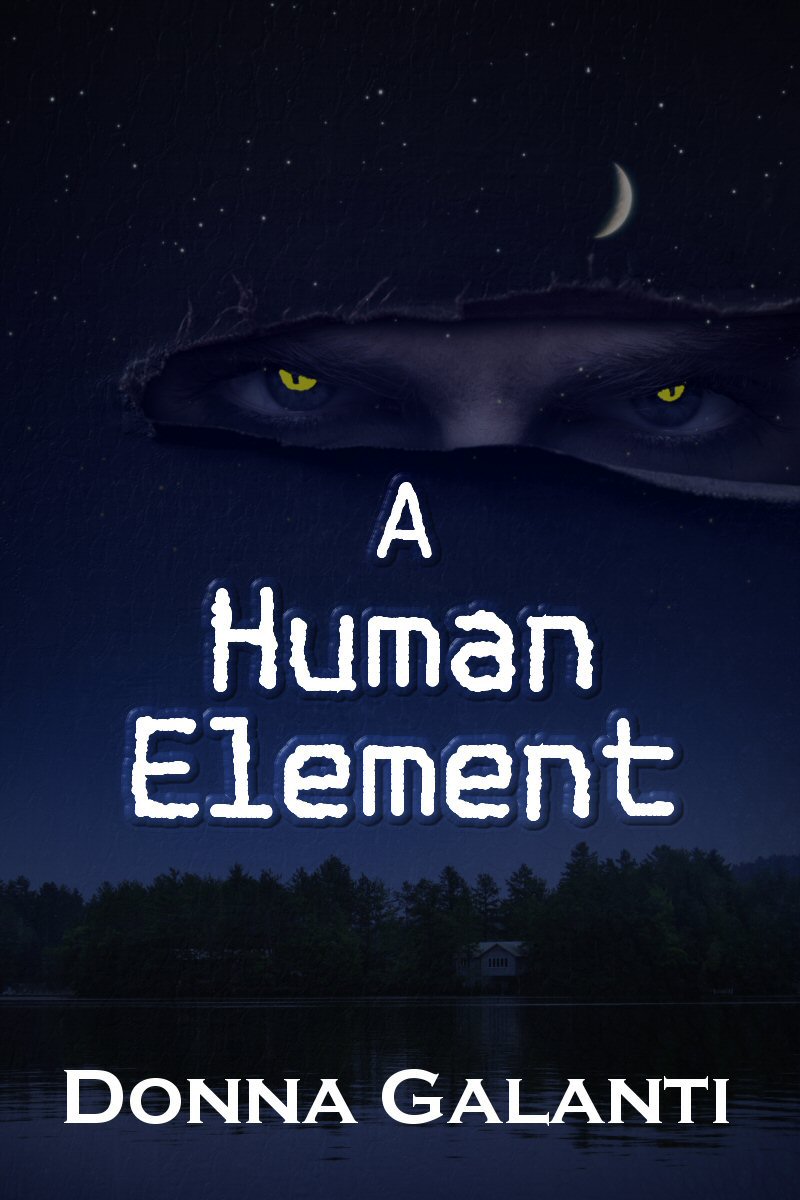
MICHAEL A. VENTRELLA: Today, I am pleased to be interviewing Donna Galanti. Donna is the author of the paranormal suspense novel A HUMAN ELEMENT (Echelon Press). She has a B.A. in English and a background in marketing. She is a member of International Thriller Writers, The Greater Lehigh Valley Writers Group, and Pennwriters. Her blog is here. You can connect with Donna here on Twitter and Facebook and purchase her book here!

Donna, your first novel has just been released. Tell us about it!

DONNA GALANTI: Absolutely!

In my paranormal suspense novel A HUMAN ELEMENT, Laura Armstrong’s friends and adoptive family members are being murdered, and despite her unique healing powers, she can do nothing to stop it. The savage killer haunts her dreams, tormenting her with the promise that she is next. Determined to find the killer, she follows her visions to the site of a crashed meteorite –- her hometown. There, she meets Ben Fieldstone. In a race to stop a mad man, they unravel a frightening secret that binds them together. But the killer’s desire to destroy Laura face-to-face leads to a showdown that puts Laura and Ben’s emotional relationship and Laura’s pure spirit to the test. With the killer closing in, Laura discovers her destiny is linked to his and she has two choices –- redeem him or kill him.

Readers who devour paranormal books with a smidge of horror and steam will enjoy A HUMAN ELEMENT, the new novel about loss, redemption, and love.

Here’s what reviewers are saying:

“A HUMAN ELEMENT is an elegant and haunting first novel. Unrelenting, devious but full of heart. Highly recommended.” – Jonathan Maberry, New York Times best-selling author of ASSASSIN’S CODE and DEAD OF NIGHT

“A HUMAN ELEMENT is a haunting look at what it means to be human. It’s a suspenseful ride through life and love…and death, with a killer so evil you can’t help but be afraid. An excellent read.” –Janice Gable Bashman, author of WANTED UNDEAD OR ALIVE, nominated for a Bram Stoker Award.

VENTRELLA: How did the idea originate?

GALANTI: It came to me in a flash from nowhere 15 years ago driving to work. I wrote the entire outline on my lap as I drove (dangerously) and shelved it until 2 years ago.

VENTRELLA: Do you tend to outline heavily or just jump right in? What is your writing style?

GALANTI: I do outline but when I over-outline I can’t get started. I tend to write an 8-10 page preliminary synopsis, bulleted chapter outline, and a 1-page worksheet detailing each character. I like to write “from the dark places” in the third person. A HUMAN ELEMENT has a ton of dark in it from murder and mystery with an evil paranormal thread. However, I did challenge myself to write a middle grade adventure fantasy recently in the first person and had a lot of fun.

VENTRELLA: Aspiring authors often seem to think that writing a book is easy and your first one is sure to be a huge hit. What writing experience did you have prior to publication?

GALANTI: I definitely don’t think it’s easy or a sure thing to be a huge hit. Being a writer is constant learning and improving your craft. You may write a good book but you still need other elements like having professional editing skills, a good cover, and be marketing savvy. Before this novel came out I was writing in one way or another since I was seven. I majored in English and Journalism in college and did some news reporting for Gannett News Service. I eventually ended up in marketing communications and after several layoffs launched my own resume writing service and also became a freelance advertising copywriter. I closed up my resume business to write novels.

VENTRELLA: What was the biggest mistake you made when first starting out as a writer?

GALANTI: Writing a book before I learned the craft. I became involved with other writers and took writing workshops after I finished my first book. This required going back and fixing a ton of things! I don’t regret the learning that took place afterwards as I can now write a better book from the beginning. And hopefully keep learning and writing even better books. The sequel (in progress), A HIDDEN ELEMENT, starts out fast and dark and propels you into an evil underworld where chaos, despair, redemption, and murder reign.

VENTRELLA: OK, let’s be honest here — You (like me) are with a smaller, independent publisher. Of course, we’d both like to be with Random House or some other huge publisher, where we could be easily found in book stores. Did you make an effort to obtain an agent first and go the traditional route or did you instead look to the smaller publishing houses for your first venture?

GALANTI: I did submit to agents first, yes. I spent several months doing this and waiting on feedback from manuscript requests. However, I knew my premise was a harder sell for a debut author as it crosses genres in a blend of paranormal, romance with a smidge of horror and sci-fi. I believed in the story and so did Echelon Press, a small press with a solid 10 years in the industry. Karen Syed, the president, worked with me on developmental edits before I even signed so she was invested. I’m also not focused on “getting in every brick and mortar bookstore” in America. I am focused on being seen at the online bookstores.

VENTRELLA: What do you think are the advantages of a smaller publisher?

GALANTI: Definitely personal attention. I like that. I also like that Echelon Press honored my title and delivered on the cover I was pursuing. They listened to me as an author, and I was not treated as a product. I also have much leeway with my own marketing, and as a former marketer I like having that control.

These days, it takes much more to be a successful author than merely writing a good book. What efforts have you made to publicize yourself and do you think they have been worth your time?
With a book coming out, one in editing, and one being written – I’m finding out that this is only half my author time spent. The other half is “being seen.” And it’s absolutely worth the effort. I have an active blog where I post and host guest authors. I’m also active on Twitter, Facebook with a personal and author page, and GoodReads. It takes time to build relationships in all these places and manage them while promoting others too, yet I have met many supportive peers through these avenues and built a network of readers and professionals. I am currently running a blog tour (as seen here!) which involves multiple articles written, a grand giveaway, and a GoodReads giveaway. I also coordinated a book launch (4/21 at The Doylestown Bookshop) and wrote several press releases around the locales in A HUMAN ELEMENT.

VENTRELLA: I’ve met so many people who think self-publishing is the way to go, and I have tried to dissuade them of this idea. What is your opinion?

GALANTI: I honestly think a writer should start at the top and work their way down. It takes patience and waiting. Lots of waiting. I understand some people don’t want to wait. I gave myself a timeframe to look for agents and decided, after that time, it was best to go with a small press. I don’t regret it, as it allows me the ability to sell my books at conferences and be on conference panels. These are some things self published authors may not have access to. Yes, there is still a stigma. I also could not have become an accepted active member in International Thriller Writers if I self published. That being said, I see many authors with much success being self published. If you are marketing savvy I believe you can have success with it if you deliver a good product, great cover, and know how to be seen. Being a debut author, I think there are benefits to having a respected publisher standing behind you.

Interview with Hugo, Nebula, and Campbell Winning Author David Brin

MICHAEL A. VENTRELLA: I am tremendously happy to be interviewing one of my favorite authors this week, David Brin! The number of award-winning books he has authored is amazing, among them EARTH, STARTIDE RISING, GLORY SEASON, THE POSTMAN, SUNDIVER, and the UPLIFT series. His KILN PEOPLE is a fast-moving noir detective novel, set in a vivid future when people can literally be in two places at once.

His hard science fiction comes from someone who knows his stuff — he has a doctorate in space sciences among his degrees and honors and is a fellow of the Institute for Ethics and Emerging Technologies.

He also does graphic novels: TINKERERS shows a future when the nation’s manufacturing has declined and searches for answers, and THE LIFE EATERS explores how mystically-obsessed Nazis might have hoped to use a bizarre kind of magic.

And then there’s his popular nonfiction romp that stirred lots of controversy, STAR WARS ON TRIAL: SCIENCE FICTION AND FANTASY WRITERS DEBATE THE MOST POPULAR SCIENCE FICTION FILMS OF ALL TIME.

His web page is here. And, if you are interested in writing advice from a real professional, David has a section on his web page for you.

David, a theme in many of your work is about enlightenment and human progress. Humanity only started progressing recently in human history, primarily because of science. Do you think enlightened literature (specifically science fiction) has helped to bring this about?

DAVID BRIN: Of course it has. Science fiction arose to prominence in the United States and Britain exactly in pace with the climb to scientific pre-eminence in both nations. It flowered then in Japan and is now burgeoning in China, even as it has fallen into harder times in the U.S. See the correlation?

But it goes beyond simply inspiring a new generation of vividly motivated technical types. Science fiction also reflects the concerns of the times. Self-preventing prophecies like 1984, “Soylent Green” and “Dr. Strangelove” made us ponder, soberly, the possible ways that liberty, or the planet, or life itself might be lost, girding millions to dedicate themselves, striving to prevent the portrayed worlds from coming true. That’s power.

And SF offered the opposite – portrayals of us coping, learning, growing, improving. Stories of hope, like “Alien Nation” and – of course – “Star Trek.” Alas, these have grown unfashionable, much to our loss.

VENTRELLA: There’s a noted backlash against science in America these days. Certain political personalities rebel against things they know nothing about, denying climate change and evolution. How does one fight against this kind of stupidity?

BRIN: First, we must expose who benefits from this callous, cynically destruction thing called “culture war”… which has spoiled the generally pragmatic American genius for negotiation and practical compromise. We tend to not be dogmatic types… unless we are at war. Indeed, I look at the furious rage that now infests us, manifesting in outright war-level campaigns against scientists, teachers, doctors, journalists, economists, professors, skilled labor, civil servants… against all the “smartypants” clades… and I am compelled to realize – we are in Phase Three of the American Civil War.

VENTRELLA: Do you worry that lately we as a society may be moving backwards?

BRIN: Back in the 1950s, Robert Heinlein foresaw this kind of an era. He forecast the year 2012 as when a briefly maniacal United States would “elect” a non-plurality president – a fundamentalist preacher named Nehemia Scudder – who would them proceed to clamp a theocracy upon our land. Scary stuff and dismally prescient.

VENTRELLA: One of my favorite novels of yours is EARTH, which made some staggering predictions about the near future, many of which have already come true. How much of that novel was the result of research and how much was pure guesswork? Have any of your predictions surprised you?

BRIN: Actually, my fans have noticed the unusual number of “hits” or predictive successes that seem to have been scored in EARTH. These accurate foretellings … and some that were embarrassingly off-target(!) are now being tracked here.

VENTRELLA: Do you see a future for religion?

BRIN: While I am scientifically trained, with my union card as an astrophysicist, and I am proud to be a member of a rational civilization that does not need threats of hell to behave far better than any other. I refuse to go to the opposite extreme as so many have, and deride our neighbors who believe. (Indeed, I have some levels of spirituality, myself.) Yes, some versions of God are excluded now by our clear-eyed view of reality and the cosmos, but some have not been and I see no harm in acknowledging some tasty… possibly theologically redolent… ambiguity.

In fact, see me get all biblical! Science-friendly theology? At the recent Singularity Summit 2011 I gave a talk to all those folks who think that technology will soon empower us to construct super-intelligent artificial intelligences, or perfect intelligence enhancing implants, or even cheat death. The title: “So you want to make gods. Now why would that bother anybody?”.

VENTRELLA: What themes do you find yourself revisiting in your work that may pop up without planning?

BRIN: I am behooved to revisit the Uplift Universe and answer many riddles. I hope also to keep channeling ideas as bizarre and enticing as I had in KILN PEOPLE. Some will say this happened in EXISTENCE (coming in June from Tor Books.)

VENTRELLA: What is your writing style? (Do you outline heavily or just jump right in? Do you tend to start with a scientific idea, a character concept, or something else?)

BRIN: All of the above. I like to surprise myself!

VENTRELLA: How has your educational background influenced your writing?

BRIN: Let me admit and avow that writing was not my own first choice of a career. True, I came from a family of writers. It was in my blood. But I wanted something else — to be a scientist. And by the fates, I became one.

I also had this hobby though — writing stories — and it provided a lot of satisfaction. I always figured that I’d scribble a few stories a year… maybe a novel now and then… while striving to become the best researcher and teacher I could be.

Don’t mistake this for modesty! It’s just that I perceive science — the disciplined pursuit of truth — to be a higher calling than spinning imaginative tales, no matter how vivid, innovative, or even deeply moving those tales may turn out to be.

I know this seems an unconventional view.

Even now that civilization has made it clear that it wants me to write and not do research (by paying me better) I still try to bring the thinking tools of science into all that I write, even light fantasy.

VENTRELLA: What’s on your plate these days? What can we look forward to?

BRIN: Keep your eyes peeled next June for a sprawling near future novel called EXISTENCE. My first big-Brin-book in some years, it’s filled with epic scope, adventure, and more huge ideas than you’ve ever seen packed in one place! It also has some “uplift portions”… and a first contact scenario that I guarantee you’ve never seen before. Stay tuned!

And yes, folks want more Uplift. I do hope to get back to Tom, Creideiki and the others soon. (I assume you’ve read the second Uplift trilogy, starting with BRIGHTNESS REEF? ) Till then, see the story “Temptation” downloadable here. Some will argue that EXISTENCE is Uplift!

VENTRELLA: Any news on SKY HORIZON?

BRIN: SKY HORIZON is a short but exciting novel in the Heinlein tradition won the Hal Clement Award for best SF novel for young adult readers. The limited run, from Subterranean, is sold out. I’ll announce when a mass market edition is available… as well as the sequel, written with the great young author Jeff Carlson!

VENTRELLA: Any other news you’d like to share?

BRIN: I was a cast member on the History Channel show “The ArchiTechs” as well as History’s most popular show ever: “Life After People.” I’m now appearing frequently on the science shows “The Universe” and “Alien Worlds.”

My Lunacon 2012 Schedule

I will be participating as a guest at the 2012 Lunacon science fiction convention on the weekend of March 16th. There are some great guests this year, including many who have been interviewed on this blog: Danielle Ackley-McPhail, Neil Clarke, Myke Cole, Keith DeCandido, Genevieve Iseult Eldredge, Esther Friesner, C. J. Henderson, Marvin Kaye, Michele Lang, Gail Martin, Mike McPhail, Joshua Palmatier, Tamora Pierce, KT Pinto, John Ringo, Lawrence M. Schoen, Ian Randal Strock, and Howard Tayler (among many others)…
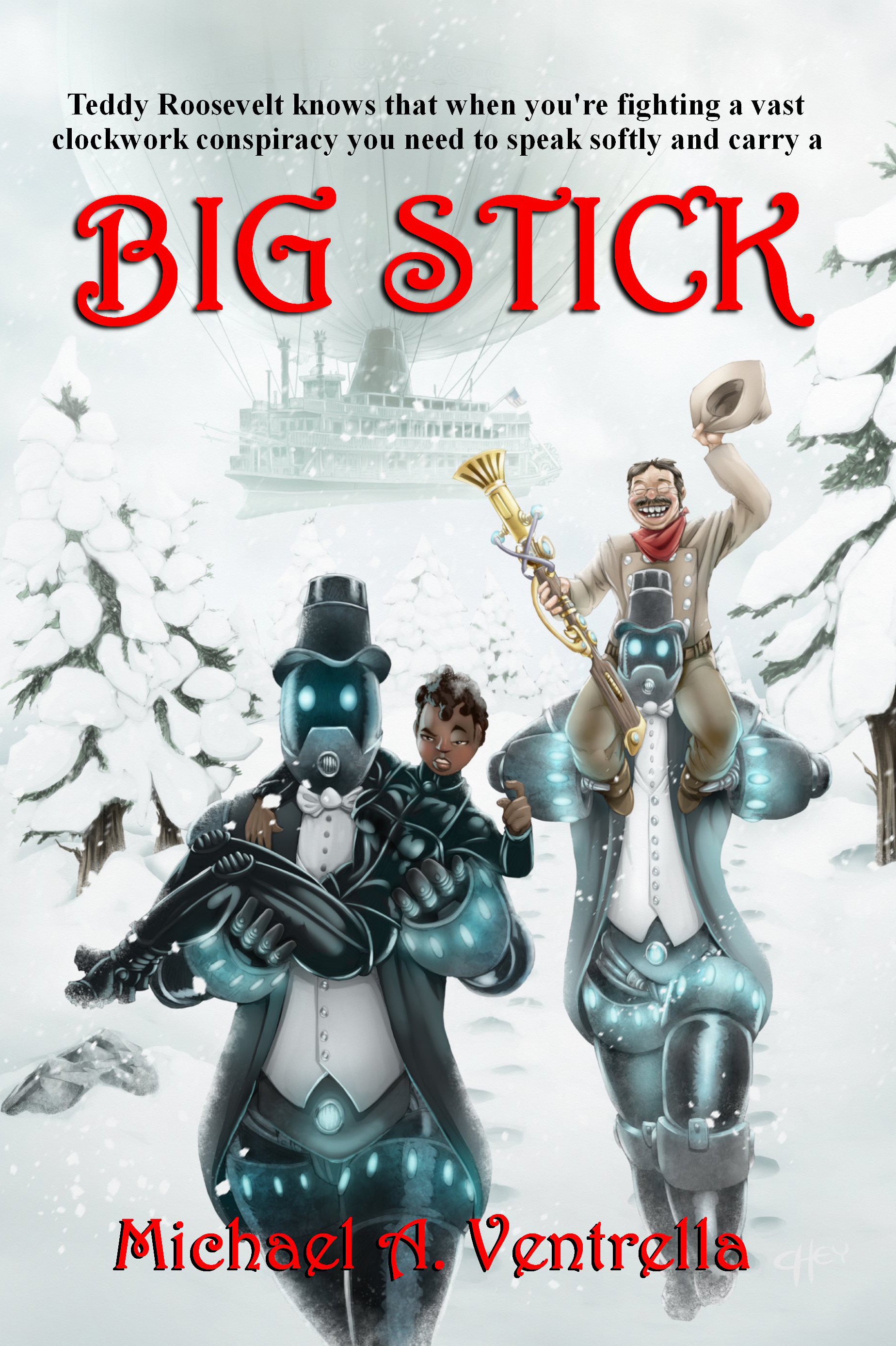
Below is my schedule. It’s not as crowded as last years’, but I should still have a great time. I’ll even be doing a reading from my upcoming novel BLOODSUCKERS. And then there’s “Blindfolded Sculpting” where a group of guest artists (including my wife!) will compete to make clay sculptures in a few minutes from ideas from the audience — while blindfolded. (I’m the MC for that one!)

And of course, the old favorite “The Eye of Argon” which has this description: “The worst science fiction story ever written gets a reading by our brave panel as they compete to go the longest without tripping over a misspelled word of laughing uncontrollably. Audience members are also encouraged to rake a chance. Can you keep a straight face, especially when the panel begins acting out the story?”

Fantasy Without Gods (Friday 7:00 pm)

LARPing 101 (Saturday noon)

Michael A. Ventrella Reading (Saturday 1:30 pm)

Blindfolded Sculpting (Saturday 3:00 pm)

Marketing and Promotion for Authors and Artists (Saturday 7:00 pm)

The Eye of Argon (Sunday 10:00 am)